1. Song Overview
| FieldDetails | |
|---|---|
| Song | Moonlight Becomes You |
| Composer | Jimmy Van Heusen |
| Lyricist | Johnny Burke |
| Year | 1942 |
| Original context | Paramount film Road to Morocco; sung by Bing Crosby. The song was published by Paramount Music Corporation in 1942. (Smithsonian Institution) |
| Lead-sheet key | F major |
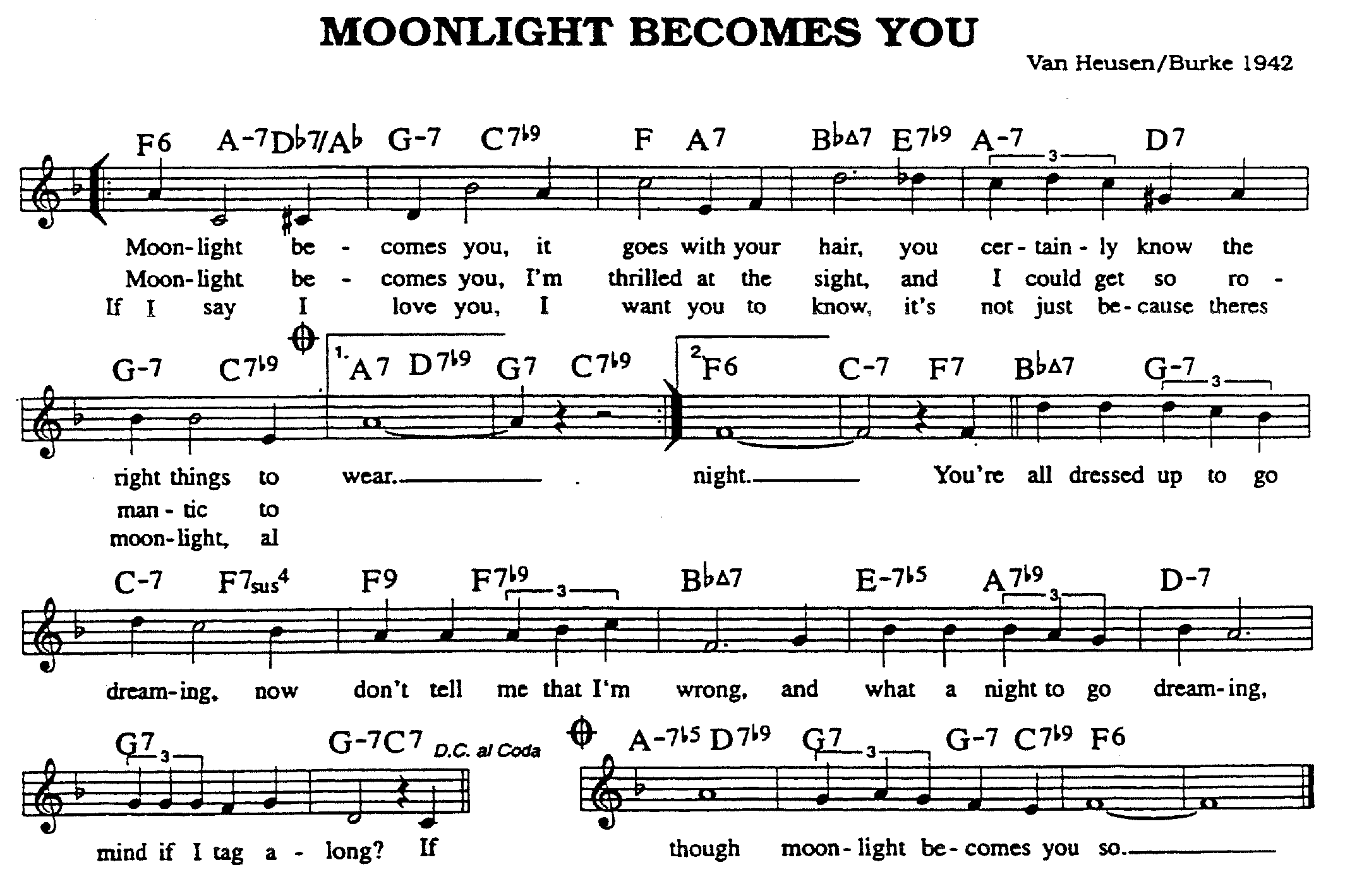
| Form | 34-bar AA′BA″ chorus: 8 + 8 + 8 + 10, realised in the notation through a repeated A strain, alternate endings, D.C. al Coda, and a four-bar coda |
| Principal tonal centres | F major; B-flat major in the bridge; brief D minor tonicisation; return to F |
| Common jazz classification | Great American Songbook film ballad; jazz standard |
Moonlight Becomes You begins with a compliment that appears almost decorative. Moonlight suits the addressee: it complements her appearance as though it were another item of clothing. Johnny Burke develops that conceit with unusual consistency. Light “goes with” the beloved’s hair; she knows what to wear; later she is “dressed up” to go dreaming. The language initially places the speaker safely outside his own emotions. He can discuss her appearance before admitting anything about himself. The lyric’s dramatic movement is therefore not from sadness to happiness, or separation to reunion, but from aesthetic observation to increasingly explicit personal disclosure.
Van Heusen’s harmony complicates this apparent ease. The tonic F6 is immediately followed by Am7 and the chromatic D-flat7/A-flat before a conventional Gm7-C7 return. Applied dominants, altered dominants and dominant chains repeatedly disturb an otherwise compact, singable melody. The effect is not one of harmonic crisis. Rather, the accompaniment keeps suggesting more emotional activity than the speaker initially acknowledges. His language is elegant and controlled while the harmony continually slips away from uncomplicated tonic stability.
What distinguishes the song from many moonlit romantic standards is Burke’s awareness of the cliché he is using. By the final A section, the speaker explicitly insists that his declaration is not merely an effect of the setting. Yet the final qualification effectively admits that the setting matters after all. Moonlight is both supposedly irrelevant to the truth of his love and indispensable to the circumstances in which he can say it. That contradiction gives a potentially sentimental lyric a degree of self-knowledge and wit.
The attached lead sheet begins directly with the familiar chorus. Some published piano-vocal editions preserve a separate introductory verse, but it is absent from this source and therefore does not enter the formal or harmonic analysis below. (Musicnotes.com)
2. Form and Dramatic Architecture
For analytical purposes, the written repeats and D.C. are unfolded into consecutive bar numbers. The resulting chorus is 34 bars rather than the more usual 32. The first two A sections share six bars and take different two-bar endings; after the eight-bar bridge, the D.C. returns to those six common A bars before the coda supplies a four-bar conclusion.
| Section | Bars | Tonal centre | Lyrical or dramatic function | Musical function |
|---|---|---|---|---|
| A1 | 1-8 | F major | Compliment and visual observation | Establishes the principal melody and tonic, but destabilises it with D-flat7/A-flat, applied dominants and a four-chord dominant chain |
| A2 | 9-16 | F major, turning towards B-flat | The speaker admits his own response and contemplates becoming romantic | Repeats the six-bar A premise; the second ending closes briefly on F6, then Cm7-F7 redirects the harmony towards IV |
| B | 17-24 | B-flat major, then D minor, then dominant preparation for F | Fantasy becomes a proposed shared activity; the speaker asks to accompany the addressee | Tonicises IV as a genuine local centre, moves through iiø-V to D minor, then uses G7-Gm7-C7 to recover F |
| A″ and coda | 25-34 | F major | The speaker finally raises the word “love”, denies that moonlight is its cause, then qualifies the denial | Six bars of the A material return; a new four-bar coda intensifies the dominant preparation before a two-bar F6 close |
The architecture is dramatically efficient because musical repetition does not mean psychological repetition. A1 allows the speaker to hide behind description. A2 places him in the sentence: his pleasure becomes the subject, but the modal “could” still postpones commitment. The bridge changes both tonal centre and rhetorical mode. Instead of describing or imagining his own feeling, he makes a social proposal. Only when the A melody returns for the third time does the language become a declaration.
The 34-bar design is particularly important. The final A is not simply another eight-bar restatement. Its ordinary six-bar beginning is redirected into a coda, so the very moment at which the speaker tries to distinguish love from atmosphere receives new music. The song thus abandons exact formal repetition precisely when its emotional argument changes most decisively.
There is also a useful structural irony in the D.C. instruction. The final confession literally requires a return to the beginning. The music goes back to the same melodic and harmonic circumstances that first accompanied a superficial compliment, but those circumstances are now heard retrospectively as preparation for something the speaker had not yet been prepared to say.
3. Close Reading of the Lyrics
| Lyric or cue | Literal meaning | Literary and poetic reading | Emotional subtext | Musical and harmonic interaction |
|---|---|---|---|---|
| “Moonlight becomes you” | Moonlight suits or flatters the addressee. | “Becomes” uses the elegant older sense of is becoming to. It treats illumination almost as clothing. The phrase also permits a faint secondary suggestion of transformation: moonlight does not merely illuminate the beloved but changes how she is perceived. | The speaker begins with admiration while withholding explicit desire. Appearance provides a socially safe subject. | Bar 1 starts on F6 but almost immediately passes through Am7 to D-flat7/A-flat. The words sound settled while the harmony refuses to remain simply tonic. The chromatic chord is primarily a voice-leading approach rather than demonstrable text-painting, but its perceptual effect suits the idea of altered appearance. |
| “goes with your hair” | The light complements her hair. | Cosmic light is reduced, humorously and affectionately, to an accessory. “Goes with” belongs to the vocabulary of clothes and colour coordination rather than metaphysics. | The speaker idealises the addressee but avoids grandiose language. The intimacy comes through understatement. | Bars 3-4 move F-A7 to B-flatmaj7-E7flat9. The arrival on IV gives the phrase a slight opening-out beyond tonic; the ensuing E7flat9 immediately prevents that colour from becoming a resting point. |
| “right things to wear” | She has good taste in dress. | The conceit is completed by making moonlight part of an outfit. “Right” suggests assurance and social polish. | The admiration remains displaced onto taste and appearance. The speaker still says nothing that requires an emotional response from her. | Bars 5-8 become progressively more active: Am7-D7, Gm7-C7flat9, then A7-D7flat9-G7-C7flat9. The held conclusion is supported by a dominant chain, so a verbally confident judgement is harmonically anything but static. |
| “thrilled at the sight” | Seeing her produces excitement. | A2 repeats the opening premise but introduces the speaker explicitly. The shift from “you” to “I” is the first major rhetorical change. | His feeling is now admitted, though still framed as a reaction to appearance rather than a declaration of attachment. | The same A harmony returns. Repetition makes the shift in pronoun especially audible because the psychological change occurs without requiring new music. |
| “could get so romantic” | The speaker might become romantically expressive tonight. | “Could” is crucial. It is not “I am” or “I will”. The conditional preserves deniability and attributes possible behaviour partly to circumstance. | Desire has become explicit, but commitment remains deferred. He tests the emotional temperature rather than making a claim. | The latter half of A2 again traverses applied dominants before the second ending reaches F6. The harmony repeatedly behaves more decisively than the grammar. |
| “tonight” | The possibility is attached to the present evening. | Time becomes an enabling condition. Romance is imagined as something the night may permit rather than something the speaker must independently initiate. | The environment gives him an excuse to move closer. | The word is sustained over the second ending's tonic area. F6 seems to close the thought, but Cm7-F7 immediately redirects towards B-flat, so the apparently complete “tonight” opens directly into the bridge. |
| “dressed up to go dreaming” | The addressee appears prepared for a dreamlike outing. | The clothing conceit becomes surreal. One can dress to go somewhere, but “dreaming” is not normally a destination. Burke turns fantasy into an imagined social place. | The speaker begins constructing a shared world rather than merely observing the addressee. | The bridge arrives in B-flat major, the song's subdominant region. The new tonal centre makes the dream metaphor perceptibly feel like entering another space. |
| “don't tell me ... wrong” | He asks her not to contradict his interpretation. | The phrase is playful but revealing. A person who is entirely certain does not normally pre-empt disagreement. | Confidence and insecurity coexist. He is trying to turn his imagined scenario into a shared understanding. | Cm7-F7sus4-F9-F7flat9 prolongs dominant function in B-flat before B-flatmaj7 resolves the phrase. The eventual tonic arrival gives comic confirmation to his insistence, but only after unusually prolonged dominant tension. |
| “what a night ... dreaming” | The evening seems ideal for fantasy. | The repetition of “dreaming” links atmosphere with desire, but its second appearance is less decorative. By now dreaming means the possibility of intimacy. | The speaker's fantasy is becoming increasingly personal. | Em7flat5-A7flat9-Dm7 creates the darkest local colour of the bridge. The move into D minor gives the second invocation of dreaming a more inward quality without turning the song tragic. |
| “mind if I tag along?” | He asks permission to accompany her. | After elaborate moonlight and dream imagery, “tag along” is almost deliberately ordinary. The colloquialism deflates grandeur and makes the request human. | The speaker is vulnerable enough to ask rather than assume. The modest wording protects him against rejection. | G7 does not proceed in the most obvious way. It yields to Gm7-C7, converting G major's B natural to B-flat before the home dominant. The question therefore coincides with harmonic deferral rather than arrival. |
| “If I say I love you” | The speaker introduces a possible declaration of love. | Even at the point of confession, Burke uses a conditional clause. “If I say” places a small grammatical screen between the speaker and the declaration itself. | This is the lyric's most exposed moment, but it is still carefully managed. | The original A melody and F-centred progression return. The familiar music makes the new words more striking: nothing outwardly dramatic changes, yet the semantic stakes are transformed. |
| “I want you to know” | He asks that the declaration be understood correctly. | The emphasis shifts from saying to interpretation. The speaker is now concerned not merely with expression but with credibility. | He anticipates that his sincerity might be attributed to the atmosphere. | F-A7 moves into B-flatmaj7-E7flat9 across this portion of the returning A. The harmony again moves away from tonic as he tries to stabilise the meaning of his words. |
| “not just because” | His love is not merely an effect of the setting. | “Just” performs important rhetorical work. He does not deny moonlight's influence outright; he denies its sufficiency as an explanation. | The speaker wants the addressee to believe that the feeling persists beyond tonight. | Am7-D7 and Gm7-C7flat9 form a strong chain towards resolution, but the coda intervenes. His verbal attempt to establish certainty therefore does not receive an immediate tonic confirmation. |
| “although” | He concedes that moonlight nevertheless contributes something. | A single conjunction destabilises the defence that preceded it. The lyric turns upon qualification rather than contradiction: the love may be real, but the atmosphere undeniably helps him articulate it. | The speaker's final honesty is more convincing because he admits the weakness in his own argument. | The coda begins with Am7flat5-D7flat9, a iiø-V that strongly predicts G minor. Instead of settling there, the progression converts the expected G root into G7, then Gm7-C7flat9 before F6. The concession receives the song's most compressed sequence of harmonic redirections. |
| Final “so” | Moonlight suits the addressee to an exceptional degree. | The ending returns to the original compliment after the confession. Rather than transcend the opening image, the lyric reinterprets it. | Emotional exposure is folded back into tact and admiration. | Two bars of F6 finally prolong the home tonic. The extended close feels earned because the preceding coda has repeatedly postponed F. |
Burke’s diction is notable for its mixture of polish and colloquial speech. “Becomes” belongs to a slightly formal social vocabulary, whereas “tag along” is deliberately casual. That contrast prevents the speaker from becoming a courtly abstraction. He can aestheticise the beloved, but when he actually asks for proximity he speaks plainly.
The rhyme and sound design are correspondingly unobtrusive. The recurring long o sounds in words surrounding “know”, “so” and the moonlight refrain soften the final A, while the recurrent -ing of the bridge’s dream language produces continuity without an ostentatious rhyme scheme. More important than rhyme is parallel syntax. Each A begins with a compact proposition and then extends it, allowing the same melodic architecture to move from compliment to reaction to confession.
4. Lyrical and Emotional Arc
Opening Position
The speaker begins as an observer. He can describe how the addressee looks without disclosing why her appearance matters to him. The vocabulary of clothes and appearance gives him a sophisticated form of emotional camouflage. Even the title phrase is a judgement about her, not an admission about him.
The music quietly resists that detachment. F major is present from the first chord, but the tonic is not allowed to dominate the opening bar. D-flat7/A-flat introduces chromatic tension almost immediately, and the first A section eventually accelerates into a dominant chain. The discrepancy is important: the speaker’s rhetoric is controlled while the harmonic environment is restless.
Development
The second A section changes the grammatical subject. “I’m thrilled” acknowledges an internal response, and the possibility of becoming romantic moves desire into explicit language. Yet “could” still makes the feeling contingent. The speaker can blame the night if necessary.
The bridge advances from feeling to proposed action. The addressee is imagined as going “dreaming”, and the speaker asks to participate. Tonally, the song leaves F for B-flat, then briefly turns towards D minor. The bridge therefore does what its lyric describes: it temporarily inhabits another world. Significantly, the most vulnerable social request is phrased in the least elevated language.
Point of Greatest Tension
The decisive point is the final A’s conditional declaration of love and the qualification that follows it. The dramatic tension is not whether the speaker loves the addressee; by this stage that is reasonably clear. The issue is whether his feeling is independent of the highly romantic circumstances in which he voices it.
Musically, the final six bars of familiar A material do not provide new certainty. Instead, the coda substitutes a new harmonic path. Am7flat5-D7flat9 appears to promise G minor, but G arrives as G7, then turns to Gm7 before C7flat9 finally produces the home tonic. The argument is therefore at its most explicit precisely when the harmony becomes most circuitous.
Resolution or Lack of Resolution
There is genuine resolution in one sense: the speaker has progressed from a compliment to a declaration. He no longer hides entirely behind the addressee’s appearance. The final F6 is also unambiguous, prolonged and calmer than many earlier tonic appearances.
There is no resolution of the song’s causal ambiguity, however. The speaker insists that his feeling is not merely produced by moonlight, then immediately grants moonlight renewed rhetorical importance. The ending therefore resolves the harmony more completely than it resolves the psychology.
Central Paradox
The song’s central paradox is that the speaker attempts to prove that his love exceeds the romantic atmosphere while relying on that atmosphere to make the confession possible. Moonlight is simultaneously an inadequate explanation of his feeling and the indispensable medium through which the feeling becomes speakable.
5. Detailed Harmonic Analysis
The global tonic is F major. The one-flat key signature, recurrent F/F6 cadences and final prolonged F6 establish this clearly. The song nevertheless spends substantial time weakening the psychological security of that tonic through chromatic approach harmony and applied dominants.
The bridge establishes B-flat major, IV of F, strongly enough to function as a temporary tonal centre rather than merely a momentary tonicisation. Its subsequent Em7flat5-A7flat9-Dm7 is better heard as a local iiø-V-i tonicisation of D minor than as a full modulation. The bridge’s final G7-Gm7-C7 restores the gravitational field of F.
The bar numbering below unfolds the written repeat and D.C. structure.
| Bars | Lyric cue | Chords | Roman numerals | Tonal centre | Harmonic function and interpretation |
|---|---|---|---|---|---|
| 1 | Opening title phrase | F6 - Am7 - D-flat7/A-flat | I6 - iii7 - flatVI7, fifth in bass | F | Tonic immediately expands to iii. D-flat7/A-flat is best understood here as chromatic approach harmony to Gm7 rather than as a functional tritone substitution. Its voices can resolve economically: D-flat to D, C-flat/B to B-flat, A-flat to G, with F retained as a common tone. |
| 2 | “becomes you” | Gm7 - C7flat9 | ii7 - V7flat9 | F | Conventional predominant-dominant motion restores recognisable F-major syntax after the chromatic first bar. |
| 3 | “goes with your” | F - A7 | I - III7, or diverted V7/vi | F | F resolves the preceding C7. A7 has the pitch content of V/vi but does not proceed to Dm; it is redirected chromatically to B-flatmaj7. |
| 4 | “hair” | B-flatmaj7 - E7flat9 | IVmaj7 - V7flat9/iii | F | The unexpected A7-B-flatmaj7 motion produces smooth semitone voice leading. E7flat9 then functions conventionally as an applied dominant of Am. |
| 5 | “certainly know” | Am7 - D7 | iii7 - V7/ii | F | Am7 can be heard both as iii and as the ii of an applied ii-V into Gm. D7 confirms the latter retrospectively. |
| 6 | “right things to” | Gm7 - C7flat9 | ii7 - V7flat9 | F | A direct ii-V back towards tonic, although A1 delays the actual F arrival by extending the dominant cycle. |
| 7 | Sustained “wear” | A7 - D7flat9 | III7 - VI7 | F | The first half of a descending-fifths dominant chain. A7 resolves by root to D7, so the chord is more usefully heard as part of backcycling than as an isolated V/vi. |
| 8 | End of A1 | G7 - C7flat9 | II7 - V7 | F | Dominant chain completes A7-D7-G7-C7. C7 sends the repeat directly to F6 at the beginning of A2. |
| 9-14 | Second A, through “romantic to...” | F6-Am7-D-flat7/A-flat; Gm7-C7flat9; F-A7; B-flatmaj7-E7flat9; Am7-D7; Gm7-C7flat9 | Same as bars 1-6 | F | Harmonic repetition places new psychological content inside the same tonal argument. The listener hears greater lyrical disclosure without corresponding formal expansion. |
| 15 | “night” | F6 | I6 | F | Unlike A1, the second ending gives a direct tonic arrival. Its stability is brief. |
| 16 | Bridge preparation | Cm7 - F7 | ii7-V7 in B-flat; equivalently ii7/IV-V7/IV | F moving to B-flat | A textbook applied ii-V turns decisively towards IV and prepares the bridge's B-flatmaj7. |
| 17 | “dressed up to go” | B-flatmaj7 - Gm7 | Imaj7 - vi7 in B-flat | B-flat | The bridge begins with an unmistakable local tonic and its relative-minor substitute. |
| 18 | “dreaming, now” | Cm7 - F7sus4 | ii7 - V7sus | B-flat | Predominant-dominant motion continues, but the suspension delays the dominant's third and softens the cadence. |
| 19 | “don't tell me...” | F9 - F7flat9 | V9 - V7flat9 | B-flat | Dominant prolongation intensifies by moving from a more open ninth sonority to the altered flat-nine colour. |
| 20 | “wrong” | B-flatmaj7 | Imaj7 | B-flat | The extended dominant resolves cleanly. This is the bridge's strongest confirmation of B-flat as a local centre. |
| 21 | “what a night to go” | Em7flat5 - A7flat9 | iiø7 - V7flat9 in D minor | D minor | A compact minor ii-V temporarily reorients the bridge. In the global F framework these chords tonicise vi, but the minor cadence is strong enough to be heard locally. |
| 22 | “dreaming” | Dm7 | i7 in D minor; vi7 in F | D minor | The expected tonic arrives, though as a seventh chord rather than a more final minor triad. The local centre therefore remains permeable. |
| 23 | “mind if I tag a-” | G7 | V7/V in F | Returning towards F | G7 appears to prepare C, but the expected dominant is withheld. |
| 24 | “-long?” | Gm7 - C7 | ii7 - V7 | F | G7 is converted to Gm7 through B natural to B-flat, then C7 restores the conventional home-key ii-V. The move is both functional and strongly voice-led. |
| 25-30 | Final A through “moonlight, al...” | Same harmonic sequence as bars 1-6 | I6-iii7-flatVI7; ii7-V7; I-III7; IVmaj7-V7/iii; iii7-V7/ii; ii7-V7 | F | The confession reuses the initial A harmony. What was first accompaniment to compliment now supports a claim about love and sincerity. |
| 31 | “though” | Am7flat5 - D7flat9 | iiø7-V7flat9 of ii | F, strongly implying G minor | This progression predicts G minor with particular force. The use of a half-diminished predominant makes the coda darker than the ordinary A ending. |
| 32 | Return to title idea | G7 - Gm7 - C7flat9 | V7/V - ii7 - V7flat9 | F | The expected Gm target first arrives as G7 instead. Its B natural then falls to B-flat to form Gm7, allowing an immediate ii-V. The coda compresses dominant redirection into a single bar of unusually active harmony. |
| 33-34 | Final “so” | F6 - F6 | I6 - I6 | F | Prolonged tonic. The added sixth avoids the harder closure of a plain triad or major seventh and preserves the song's urbane ballad colour. |
Several voice-leading details are central to the progression. The first bar’s D-flat7/A-flat works because nearly every voice has an economical path into Gm7. A7 to B-flatmaj7 in bar 3-4 is similarly smooth despite its nonstandard functional resolution: A can rise to B-flat, C-sharp to D, E to F, and G to A or F. These motions make the chromatic harmony feel inevitable rather than disruptive.
The bridge’s G7-Gm7 transformation is another characteristic device. The root remains G while the third B drops by semitone to B-flat. Function therefore changes without changing bass root: the applied dominant of C becomes the diatonic ii of F. The coda repeats and intensifies this device by first suggesting G minor through Aø7-D7flat9, then presenting G7 before finally yielding to Gm7-C7flat9.
6. Tonal Journey
| Passage | Starting centre | Destination | Mechanism | Dramatic effect |
|---|---|---|---|---|
| Opening A | F major | F major, repeatedly destabilised | Tonic expansion, D-flat7/A-flat chromatic approach, applied dominants | Establishes home while making it more mobile than the lyric's polished surface suggests |
| A1 ending | F | Dominant of F | A7-D7-G7-C7 descending-fifths chain | Turns a sustained verbal conclusion into harmonic momentum; closure is postponed until the repeat |
| A2 ending | F | B-flat major | F6 followed by Cm7-F7 | The speaker's increasing romantic involvement coincides with departure from home |
| First bridge half | B-flat | B-flat | ii-V prolongation and V9-V7flat9-I | Gives the dream imagery a temporary alternative tonal world |
| Second bridge half | B-flat | D minor | Em7flat5-A7flat9-Dm7 | Darkens the centre briefly and makes “dreaming” more inward |
| Bridge close | D minor/F region | Dominant preparation for F | G7 becomes Gm7-C7 | Converts an applied dominant into a home-key predominant by semitone alteration |
| Final A | F | F, with recurrent excursions | Repetition of A-section applied dominants | The return is formal rather than psychologically innocent; familiar harmony now carries a confession |
| Coda | F orbit | F | iiø-V towards G minor, majorised G7, then Gm7-C7flat9-F6 | Delays the final tonic while the lyric qualifies its own declaration; only after the concession does stable F persist |
The movement to B-flat in the bridge matters because IV in a major-key standard often feels related to the tonic while still providing a perceptible widening of space. Here that perceptual relationship serves the lyric particularly well. “Dreaming” does not require a radically remote modulation. A neighbouring tonal region is enough to suggest that ordinary reality has been temporarily reframed.
D minor provides a different colour. It is not prolonged sufficiently to become a competing global key, but the minor ii-V-i introduces a short-lived inwardness after the bridge’s polished B-flat harmony. The speaker’s fantasy acquires weight just before his most colloquial request.
The return to F is deliberately prepared rather than abrupt. G7’s expected resolution is diverted through Gm7, from which C7 can function conventionally. Consequently the song seems to recover its home key by changing the quality of a single chord from major to minor. The final coda magnifies the same principle.
The home tonic is therefore never absent for very long, but it is repeatedly qualified. The song’s tonal drama is not exile and return. It is the continual testing of how much chromatic and applied-dominant tension F major can absorb while remaining perceptually present.
7. Melody and Prosody
The melody is compact. Published lead-sheet data for the song in F gives a vocal range of C4-D5, a major ninth, consistent with the attached notation. (Musicnotes.com) That range is significant to the song’s character. Van Heusen does not depend upon extreme register for intensity. The tune remains close to the speaking range, making subtle shifts in rhythm, duration and harmony more important than spectacular leaps.
The A melody is built from short, largely conjunct gestures with repeated tones and modest rises towards phrase peaks. Its restraint enables the same melodic material to support three very different textual functions: compliment, romantic anticipation and confession. If the tune had an inherently climactic profile, the third A would risk sounding emotionally predetermined. Instead, the words can progressively redefine the same melodic gestures.
The melody also interacts productively with the applied harmony. Chromatic scale degrees required by A7 and D7 introduce C-sharp and F-sharp colours into an otherwise F-major melodic environment. These tones do not make the melodic line sound chromatically labyrinthine; they register as momentary attractions within an essentially diatonic contour. That division of labour is central to the song. The melody remains singable while much of the sophistication is carried by the chords beneath it.
Prosodically, the written triplets are particularly important. The setting of words such as the multisyllabic “certainly”, and the triplet figures in the bridge, resist square syllabic declamation. They imitate conversational compression: several syllables can pass naturally through a beat without each being given equal metric weight. This feature aligns unusually well with Bing Crosby’s documented approach to the number. Michael Feinstein has used Moonlight Becomes You specifically to demonstrate how Crosby altered written rhythm and melody to make a song sound more conversational; Tony Bennett characterised Crosby’s general vocal manner as intimate and understated. (PBS)
Long notes perform the opposite function. The second A’s “night” is prolonged at the point where tonic F6 appears to offer closure. Because the following Cm7-F7 turns immediately towards the bridge, the sustained note functions less as a full stop than as a hinge. Similarly, “wrong” is given space after prolonged F-dominant tension in the B-flat section, while “dreaming” receives length over Dm7. Duration marks these words without requiring a wider melodic range.
The bridge’s repeated-note and triplet writing also makes its lyric more speech-like than the A sections. This is appropriate because the speaker is no longer merely admiring. He is arguing, anticipating contradiction and asking a question. The syntax becomes conversational at the same time that the rhythm loosens.
The final “so” is the opposite kind of prosodic event: speech has essentially finished, and the melody is allowed to remain suspended over the two-bar F6 prolongation. The word itself contributes little new information. Its expressive significance comes from being extended after the lyric has already conceded the power of moonlight.
Melodic climax should therefore not be equated automatically with emotional climax. The highest register appears earlier as part of the song’s normal lyrical profile. The decisive final declaration acquires force largely from context: familiar melodic material suddenly carries a more dangerous sentence. This is one reason a singer need not manufacture a new dynamic climax at the word “love”. The form has already made it important.
8. Word, Melody, and Harmony: Key Moments
| Moment | Lyric cue | Musical event | Interpretive significance |
|---|---|---|---|
| 1 | Opening title phrase | F6-Am7-D-flat7/A-flat | The song's most apparently effortless compliment is immediately given a chromatic shadow. The harmony suggests movement beneath verbal composure. |
| 2 | Reference to “hair” | F-A7 moves into B-flatmaj7-E7flat9 | The visual compliment opens into IV colour, then is immediately destabilised by an applied dominant. Admiration does not produce rest. |
| 3 | “right things to wear” | A1 closes with A7-D7-G7-C7 rather than a simple tonic cadence | A statement of social certainty rides over a chain of unresolved dominants. The contrast is structurally generated rather than literal word-painting, but dramatically apt. |
| 4 | “tonight” | F6 arrival followed by Cm7-F7 towards B-flat | The word appears to complete the thought, yet the harmony uses that apparent closure as the departure point for the bridge. The night opens rather than closes the dramatic space. |
| 5 | “go dreaming” | Bridge establishes B-flat major | Fantasy is accompanied by a genuine local shift of tonal centre. The lyric's imagined destination acquires its own harmonic territory. |
| 6 | “wrong” | F9-F7flat9 finally resolves to B-flatmaj7 | The speaker's request not to be contradicted receives a delayed harmonic confirmation, lending the passage a lightly comic confidence. |
| 7 | Second “dreaming” | Em7flat5-A7flat9-Dm7 | Dream imagery becomes darker and more inward through a minor tonicisation. The change is brief enough to colour rather than overturn the song's romantic ease. |
| 8 | “tag along?” | G7 changes to Gm7-C7 | The most modest and socially vulnerable question is denied an immediate resolution. A single semitone, B to B-flat, changes dominant function into predominant function. |
| 9 | “If I say I love you” | Original A melody returns | The melody remains familiar while the lyric's stakes change radically. Emotional climax is produced by semantic transformation rather than new melodic spectacle. |
| 10 | “although” | Am7flat5-D7flat9 suggests G minor, then G7-Gm7-C7flat9 delays F | The qualification of the speaker's argument receives the song's most concentrated harmonic detour. His honesty increases just as tonal certainty is withheld. |
| 11 | Final “so” | Two-bar F6 prolongation | Once the speaker has admitted moonlight's continuing importance, the music finally stops qualifying the tonic. Harmonic resolution follows rhetorical concession. |
9. Historical and Cultural Context
Jimmy Van Heusen composed Moonlight Becomes You to words by Johnny Burke in 1942. The Smithsonian’s surviving sheet music identifies Burke as lyricist, Van Heusen as composer, Paramount Music Corporation as publisher and Road to Morocco as the associated Paramount film. AFI credits the same Burke-Van Heusen songs in the film and records a New York opening on 10 November 1942. (Smithsonian Institution)
Road to Morocco, directed by David Butler and starring Bing Crosby, Bob Hope and Dorothy Lamour, belonged to the successful series of self-aware “Road” comedies. That context matters because Moonlight Becomes You is permitted to function both sincerely and comically. TCM describes a later mirage sequence in which the three leads lip-sync to one another’s voices during a reprise of the song. The film can therefore frame the number as a genuine romantic ballad and subsequently make it part of the picture’s comic destabilisation of performance itself. (Turner Classic Movies)
The song circulated with striking speed even before the film’s November opening. Discographical material collected by the Shedd Institute lists Bobby Sherwood recording it on 5 May 1942, Bing Crosby with John Scott Trotter on 12 June, Glenn Miller on 15 July, Johnny Long on 16 July and Harry James on 18 July. That sequence demonstrates that the song entered the commercial dance-band and popular-recording system essentially immediately. (theshedd.org)
Crosby’s relationship to the song was particularly consequential because its construction fits the microphone-era crooning aesthetic. The lyric does not require projection in the theatrical sense; it works as one person’s lightly teasing conversation with another. Tony Bennett later described Crosby’s broader innovation as an “art of intimacy”, while Michael Feinstein has singled out Moonlight Becomes You to demonstrate Crosby’s willingness to reshape written phrasing and melody until it sounded like speech. (PBS) The evidence is especially relevant here because conversational rhythm is already latent in Burke’s diction and Van Heusen’s triplet writing.
The song’s 1942 setting also places it within wartime American popular culture, but its lyric contains no topical wartime reference. Its world is deliberately private. Clothes, moonlight, romantic possibility and tactful confession could be detached easily from the film narrative, an important condition for subsequent standardisation.
Its movement into jazz repertoire followed naturally from several musical properties. The tune is compact enough to retain identity under instrumental treatment; its harmony contains enough applied-dominant activity to interest improvisers without requiring them to abandon conventional functional hearing; and the bridge produces a clear secondary tonal area. By December 1953 Chet Baker had recorded an instrumental version with an arranged West Coast ensemble, evidence that the piece had already migrated from film-pop repertory into modern jazz practice. (Jazz Discography)
As jazz musicians adopted it, the song could progressively shed its cinematic scenery. Instrumental versions have no literal moonlight, hair or clothing, yet the melodic restraint and delayed harmonic resolution still convey something of the lyric’s tact. This is an important marker of a durable standard: the lyric enriches the composition, but the composition does not depend upon the listener hearing every word.
10. Significant Interpretations
| Performer | Recording or period | Interpretive character | What it reveals about the song |
|---|---|---|---|
| Bing Crosby with John Scott Trotter | Decca, recorded 12 June 1942 | Intimate, conversational crooning rather than theatrical declaration | Crosby demonstrates how naturally the lyric can be addressed to one person. His tendency to alter phrasing in the interests of speech-like delivery became a documented example of his broader vocal practice. ([theshedd.org][6]) |
| Chet Baker Ensemble | 22 December 1953; later associated with The Trumpet Artistry of Chet Baker | Cool-jazz instrumental treatment, with Baker's restrained trumpet placed in an arranged small-ensemble texture | Removing the lyric exposes how much of the song's character is contained in its compact contour and harmonic pacing. The performance also demonstrates that the tune could support modern-jazz language without requiring wholesale recomposition. The session included Herb Geller, Jack Montrose, Bob Gordon, Russ Freeman, Joe Mondragon and Shelly Manne; Jack Montrose is credited as arranger in discographical data. ([Jazz Discography][7]) |
| Ella Fitzgerald with Frank DeVol | Los Angeles, 11 July 1959 session | Vocal clarity and controlled orchestral setting place the verbal structure in the foreground | Fitzgerald's precision makes Burke's progression from compliment through fantasy to conditional confession unusually legible. Discographical evidence identifies Frank DeVol as arranger and conductor for the session. ([Jazz Discography][8]) |
| Frank Sinatra with Nelson Riddle | Recorded 30 November 1965; issued in the Moonlight Sinatra period | A later, more mature crooner perspective within Riddle's orchestral language | The song can move from youthful flirtation towards reflective sophistication without changing its text. Session documentation credits Nelson Riddle as arranger and conductor; Moonlight Sinatra was released in 1966. ([Jazz Discography][9]) |
| Paul Motian with Joe Lovano, Bill Frisell and Charlie Haden | On Broadway, Vol. 2, recorded September 1989 | Spacious modern instrumental reading in which metre, texture and conversational ensemble interaction matter as much as songbook polish | The performance demonstrates how little literal period styling the composition requires. Once the melody and harmonic landmarks remain recognisable, the tune tolerates a markedly more open post-bop treatment. ([Wikipedia][10]) |
The Crosby and Baker versions make a particularly instructive pair. Crosby foregrounds linguistic intimacy; Baker removes language yet preserves a comparable economy of gesture. The affinity suggests that restraint is not merely a property of Burke’s text or Crosby’s persona. It is embedded in the melodic construction.
Fitzgerald and Sinatra show two different vocal possibilities available once the song had become detached from its original film moment. Fitzgerald’s command of diction can clarify the lyric’s rhetorical architecture, while Sinatra’s later recording places the same words inside a more reflective orchestral frame. Neither approach requires the singer to turn the number into a torch song.
Motian’s treatment demonstrates the opposite historical movement: by the late twentieth century, Moonlight Becomes You could function simply as standard repertoire for musicians whose rhythmic and textural language belonged to a much later jazz world. Its identity survives because the melodic profile and harmonic route are strong enough to withstand that change.
11. Place in the Jazz Canon
Moonlight Becomes You occupies a durable place in the ballad wing of the jazz-standard repertoire, although it is not dependent on the kind of ubiquitous jam-session familiarity associated with a small group of canonical 32-bar vehicles. Its value to improvisers lies partly in the tension between familiarity and small formal irregularities.
The first important fact is the 34-bar form. A musician who merely hears “AABA standard” and runs on automatic pilot is liable to mishandle the coda. The final A is ten bars, not eight, and the first two A sections do not share the same ending. Form knowledge must therefore include the actual architecture of this particular song, not merely its family resemblance to other songbook forms.
Second, the harmonic language rewards functional hearing. The changes are not a sequence of unrelated jazz chords. Bar 1’s D-flat7/A-flat is a chromatic voice-leading event; E7flat9 is an applied dominant of iii; D7 functions towards ii; the first ending develops into a complete dominant chain; the bridge establishes B-flat before tonicising D minor; and G7 becomes Gm7 to prepare the home dominant. Improvisation becomes much more coherent when those motions are heard as directed processes.
Third, the melody gives an improviser a useful model of economy. Its limited range, repeated-note writing and conversational rhythm prove that melodic interest need not depend on wide intervals or high density. A solo that ignores this quality entirely may still be harmonically correct but will sacrifice one of the composition’s strongest characteristics.
The tune also invites reharmonisation because many points can support substitutions. The danger is that its existing chromaticism already has strong voice-leading logic. Replacing every dominant with an altered substitute can flatten the distinction between structural events. The peculiar colour of D-flat7/A-flat, the B-flat bridge, the G7-Gm7 conversion and the final minor ii-V implication are more valuable when they remain audible as differentiated events.
For an improviser, the central practical task is therefore to retain the large-scale tonal narrative while moving freely inside it: F as home, B-flat as the bridge’s temporary world, D minor as a brief inward turn, and the carefully delayed recovery of F. The chord symbols are a map, but the standard becomes substantially easier to improvise on once those larger gravitational relationships are internalised.
12. Interpretive Considerations for Performers
The song benefits from an emotional stance that recognises flirtation, tact and genuine vulnerability simultaneously. Beginning at full emotional intensity weakens the dramatic design because the lyric has nowhere to develop. The first A can remain observational; the second can permit more personal warmth; the bridge can become socially bolder; the final A can then make the declaration consequential.
Over-sentimentalising the opening is particularly risky. The language is witty. Moonlight is effectively being described as something that matches the addressee’s outfit. If every phrase is weighted as a solemn declaration of eternal devotion, Burke’s social intelligence disappears.
Conversational words deserve conversational treatment. “Could” should retain its conditional quality. The bridge’s challenge about being “wrong” can carry a hint of play rather than anguish. The request to “tag along” is powerful precisely because it is unpretentious. Stretching that phrase into grand romantic rhetoric tends to reverse Burke’s intended scale.
The word “love” in the final A does not necessarily require the loudest note or strongest dynamic. Its importance already follows from two completed A statements and a bridge. A quieter delivery can make the conditional syntax more exposed, particularly if the surrounding phrase remains close to speech.
Rhythmic freedom is most useful where the notation already implies conversation: the triplet figures, the sustained “night”, the bridge’s question and the final coda. Crosby’s historically documented practice of modifying the line towards speech is relevant here, but imitation of Crosby’s exact phrasing is unnecessary. The underlying principle is to preserve syntactic meaning. (PBS)
For accompaniment and reharmonisation, several landmarks deserve protection:
- The D-flat7/A-flat in bar 1 should not be treated casually as just another altered dominant. Its semitone resolutions into Gm7 are part of this lead sheet’s harmonic identity.
- The A7-B-flatmaj7 move should retain its chromatic voice leading. Substitutions that erase the half-step attraction can make the phrase less distinctive.
- The A1 dominant chain needs directional momentum. If every chord is prolonged equally, the backcycling loses its accelerating quality.
- Cm7-F7 at the end of A2 should make the B-flat bridge perceptible as an arrival rather than simply two more chords in F.
- Em7flat5-A7flat9-Dm7 should sound as a coherent minor ii-V-i unit.
- G7-Gm7-C7 should preserve the B-natural to B-flat change. That single pitch is one of the bridge’s most informative guide-tone movements.
- The coda’s Aø7-D7flat9 implication of G minor should be allowed to register before G7 redirects it.
- The final F6 benefits from actual repose. Filling both tonic bars with further turnaround harmony changes the meaning of the ending.
Tempo changes the lyric’s apparent psychology considerably. At a very slow ballad tempo, pauses and conditional phrases become highly exposed; the confession can sound more serious, but sentimentality becomes a greater danger. A moderate ballad or relaxed medium-slow swing highlights the lyric’s wit and conversational syntax. A faster instrumental treatment can emphasise the progression’s elegance, though the melody’s long notes and understated contour need rhythmic imagination if they are not to become merely schematic.
Instrumentalists can profit from mentally retaining the lyric. The bridge should not become generic blowing merely because there are useful ii-V relationships. Its phrases correspond to argument, fantasy and a question. Likewise, the final A is not simply another chorus repeat. The same melodic cells now carry the composition’s central disclosure.
13. Final Reading
Moonlight Becomes You is fundamentally about the difficulty of distinguishing genuine feeling from the circumstances that make feeling easier to express. The speaker begins with a compliment because a compliment is safe. He can say that moonlight suits the beloved without admitting why he has been looking at her closely enough to notice. Burke then lets the language approach intimacy by degrees: first the speaker reports his own excitement, then imagines becoming romantic, then proposes companionship, and only afterwards places the word “love” into the conversation.
The crucial sophistication is that the final declaration does not invalidate the opening frivolity. The lyric never discovers that moonlight was irrelevant. Instead, it discovers that atmosphere and sincerity can coexist. A romantic setting may encourage speech without rendering the speech false. The speaker’s last qualification is therefore not a retreat from his declaration but an improvement in its honesty. He cannot convincingly claim to be untouched by the scene because the entire song has shown how thoroughly the scene has shaped his language.
Van Heusen’s harmony supplies the same argument without literal illustration. F major is indisputably home, yet uncomplicated tonic repose is remarkably scarce until the end. D-flat7/A-flat disturbs the opening immediately. Applied dominants redirect apparently settled phrases. A1 concludes not with F but with a descending-fifths chain. A2 reaches F only to convert it into preparation for B-flat. The bridge travels through B-flat and D minor before G7 itself must change character to Gm7 in order to find the route home. Harmonic certainty is continually deferred even while the lyric maintains elegant composure.
The melody provides the counterweight. Its moderate range and speech-compatible rhythms prevent the harmonic activity from making the song sound overwrought. Van Heusen rarely asks the tune to announce importance through sheer altitude. Instead, repeated melodic material acquires altered meaning as the lyric changes beneath it. The final confession matters because the listener has heard this melody before under safer words. Repetition becomes dramatic memory.
The coda concentrates the whole composition. As the speaker admits that moonlight does matter, Am7flat5-D7flat9 briefly points towards G minor; G then appears unexpectedly as G7, changes to Gm7, and only through C7flat9 finally reaches F6. The harmony behaves like the sentence: assertion, qualification, redirection, resolution. Yet the final tonic is unusually generous, extending across two bars. Once the speaker has ceased trying to separate love perfectly from circumstance, the music no longer needs to evade home.
The result is neither a song about intoxication by moonlight nor a simple declaration that love transcends atmosphere. It is about a subtler human behaviour: using style, setting and humour to make vulnerability bearable. Its sentiment survives because Burke builds self-awareness into the sentiment, while Van Heusen continually places tonal qualification beneath verbal assurance.
The central artistic insight is contained in the final concession. The speaker’s love may not exist because of the moonlight, but without the moonlight he might never have found this particular way to say it.