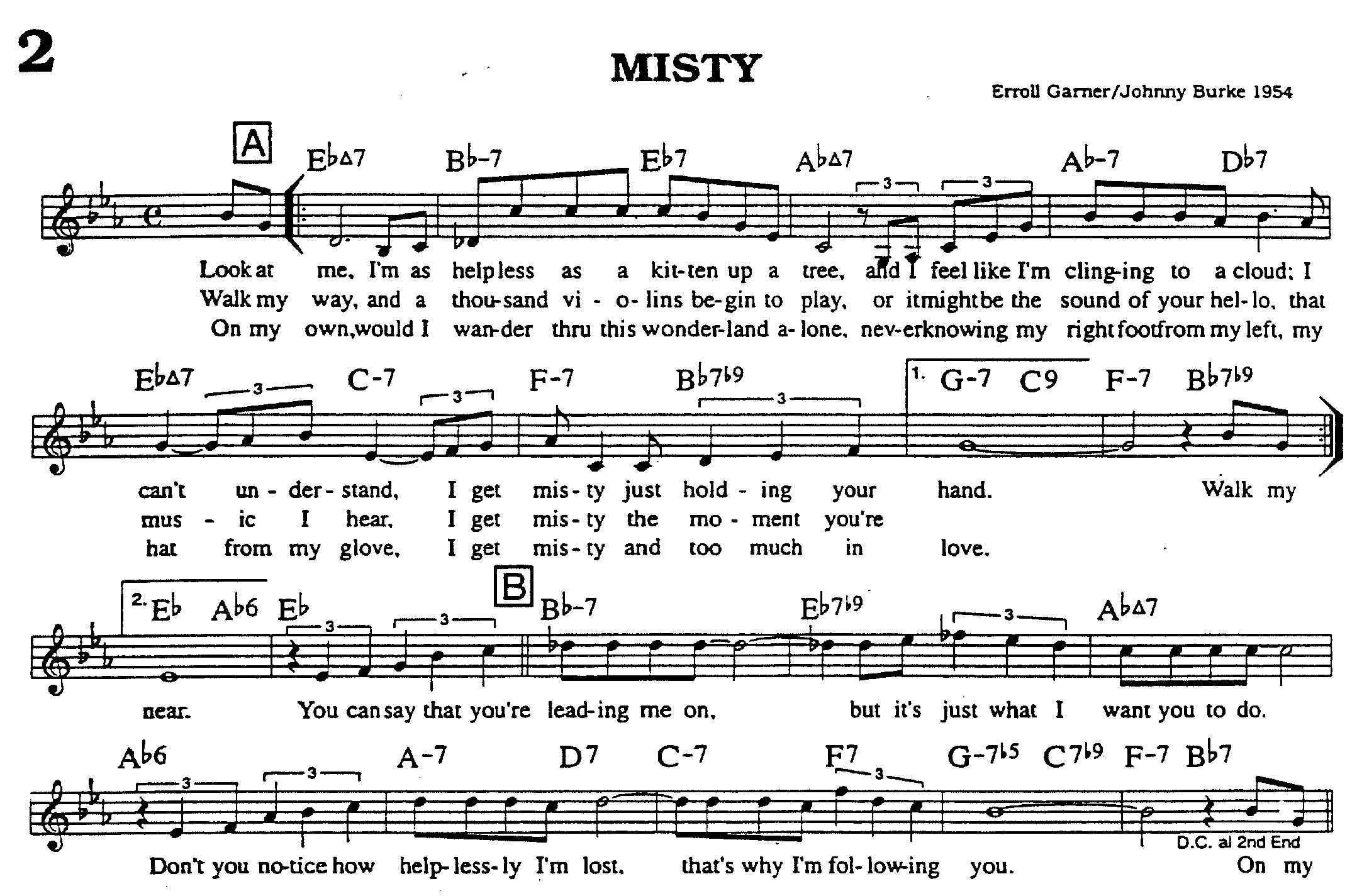
1. Song Overview
| Field | Details |
|---|---|
| Song | Misty |
| Composer | Erroll Garner |
| Lyricist | Johnny Burke |
| Year | 1954 instrumental composition; published lyric version by 1955 |
| Original context | Standalone jazz instrumental, subsequently fitted with lyrics rather than written for a stage or film production |
| Lead-sheet key | E-flat major |
| Form | 32-bar AABA, 8 + 8 + 8 + 8, notated through repeats, first and second endings, then D.C. al 2nd End |
| Principal tonal centres | E-flat major; strong tonicisation of A-flat major; brief implied centres around G, B-flat and F minor during the bridge |
| Common jazz classification | Jazz ballad; 32-bar AABA standard |
The attached lead sheet presents one of the unusual cases in the standard repertoire in which the music came first. Garner’s composition existed as an instrumental before Johnny Burke supplied the lyric. Garner recorded it in 1954, and surviving published sheet music with Burke’s words is dated 1955. (Erroll Garner) This fact matters analytically. Apparent correspondences between words and harmony are not, strictly speaking, conventional text-painting by the composer. Burke was instead fitting language to an already expressive melodic and harmonic architecture. The remarkable achievement is how naturally his images inhabit that architecture.
The lyric’s central condition is not simply romantic longing but voluntarily surrendered orientation. The speaker repeatedly describes being unable to think, distinguish, navigate or remain physically composed in the beloved’s presence. “Misty” therefore operates on several levels at once: atmospheric haze, blurred perception, incipient tears, romantic intoxication and loss of cognitive focus. Burke supports that central metaphor with a deliberately unstable vocabulary of height and disorientation: kitten, tree, cloud, lostness, following, wonderland, right and left. The images are partly sincere and partly comic. The lyric avoids becoming pure lament because the speaker knows what is happening and, at the bridge, explicitly consents to it.
Musically, the composition sustains that contradiction. The home key of E-flat major is never difficult to identify, yet the A section repeatedly leaves it for the subdominant, darkens A-flat major into A-flat minor, slips through D-flat7, and only then recovers tonic. The opening melody itself does not simply plant itself on E-flat: the characteristic pickup outlines B-flat-G-D, scale degrees 5-3-7, placing the word “me” on the major seventh of E-flat major. The home chord is present, but the melody retains a degree of unresolved yearning above it. That combination of harmonic security and melodic suspension is the essence of the song’s emotional grammar.
Two textual details of this lead sheet deserve explicit attention. It prints “helplessly I’m lost”, creating an exact verbal recall of the opening “helpless”, whereas many familiar vocal versions use “hopelessly”. It also prints “I get misty and too much in love” at the close, rather than the frequently sung “I’m too misty and too much in love”. These differences do not change the song’s broad argument, but they alter its psychology. In this chart, helplessness is a recurrent condition, and the final “I get misty” turns the title phrase back into an event that keeps happening rather than a fixed self-description.
2. Form and Dramatic Architecture
| Section | Bars | Tonal centre | Lyrical or dramatic function | Musical function |
|---|---|---|---|---|
| A1 | 1-8 | E-flat major, with A-flat tonicisation | The speaker first presents romantic helplessness and bodily disorientation | Establishes the principal melody; moves I to IV, through borrowed minor-subdominant colour, then into a turnaround rather than full repose |
| A2 | 9-16 | E-flat major, again touching A-flat | Romantic disorientation becomes sensory exaltation: imagined violins and the beloved's voice | Repeats the main strain, but replaces the first ending with an E-flat-A-flat6-E-flat tonic prolongation |
| B | 17-24 | A-flat major, then a chain of applied ii-V regions leading back towards E-flat | The speaker admits that being "led on" is desired and openly acknowledges being lost | Creates the greatest tonal excursion, moving through chromatic applied dominants and a minor ii-V before preparing the home dominant |
| A3 | 25-32 | E-flat major | The speaker imagines being alone, finds that state impossible, and ends by admitting excessive love | Returns to the opening strain with new words and uses the second ending to close on tonic |
The physical notation is economical. Rehearsal mark A contains the music for all three A statements, with three lyric lines placed beneath it. A1 takes the first ending, Gm7 C9 | Fm7 Bb7b9, which functions as a turnaround. A2 takes the second ending, whose printed chord symbols are E-flat, A-flat6 and E-flat, giving a substantially more settled close before rehearsal B. After the bridge, D.C. al 2nd End sends the performer back to A for the third lyric, again taking the second ending. The realised form is therefore conventional 32-bar AABA even though the page does not write out all 32 bars consecutively.
The dramatic value of repetition is unusually strong because the three A texts reinterpret the same melody. The opening anacrusis first carries “Look at me”, an appeal for scrutiny. On the second A it carries “Walk my way”, an invitation. On the final A it becomes “On my own”, a hypothetical withdrawal from the relationship. The same melodic gesture therefore moves from self-display, through approach, to imagined isolation. The music remains recognisably itself while the speaker’s understanding of that music changes.
A1 does not close psychologically. Its first ending turns through iii-VI-ii-V and sends the song forward. A2, by contrast, receives the second ending and is permitted to rest on E-flat before the bridge. That difference makes the beloved’s actual nearness more stabilising than the earlier act of merely holding a hand. The bridge then destabilises the song from another direction, not through dream imagery but through explicit self-knowledge. By the final A, the opening helplessness is no longer merely a symptom. It has become a choice the speaker knows they are making.
3. Close Reading of the Lyrics
The wording below follows the attached lead sheet, including its “helplessly” and final “I get misty” variants.
| Lyric or cue | Literal meaning | Literary and poetic reading | Emotional subtext | Musical and harmonic interaction |
|---|---|---|---|---|
| "Look at me" | The speaker asks the beloved to observe them | The imperative immediately makes the singer an object of inspection. It is both invitation and confession | Vulnerability is performed rather than concealed | The B-flat-G-D pickup descends towards the opening E-flatmaj7, with D functioning as the tonic major seventh. Even arrival at I retains expressive tension |
| "helpless as a kitten" | The speaker compares themself to a stranded animal | The simile is deliberately domestic and slightly comic. It makes helplessness small, exposed and almost childlike rather than tragic | The speaker wishes to be cared for, but exaggeration prevents complete solemnity | The line moves through B-flatm7-E-flat7 towards A-flatmaj7, temporarily relocating the tonal focus to IV. The lyric's lack of footing coincides with departure from home |
| "up a tree" | The imagined kitten is physically stranded above ground | Height imagery begins a vertical sequence continued by the cloud image | Attraction is experienced as loss of ordinary stability | The local ii-V resolves into A-flat major. Harmonically there is a genuine arrival, even while the image describes being stuck |
| "clinging to a cloud" | The speaker imagines holding onto something that cannot be grasped | This is more impossible than the kitten image. A tree can support a body; a cloud cannot. The metaphor moves from comic helplessness into dream logic | Desire has weakened the speaker's distinction between reality and fantasy | A-flatm7-D-flat7 supplies the A section's most characteristic chromatic colour. As ivm7-bVII7 it creates a backdoor approach to tonic; alternatively it resembles a ii-V aimed at G-flat that deliberately does not arrive there |
| "can't understand" | The speaker cannot explain their condition | The syntax briefly abandons metaphor for direct admission | Self-awareness exists, but explanation does not | E-flatmaj7 returns beneath the admission. The harmony knows where home is before the speaker claims to understand anything |
| "get misty" | The speaker becomes emotionally and perceptually blurred | The title word condenses tears, haze, intoxication and cognitive uncertainty | The response to love is involuntary at the bodily level | Fm7-B-flat7b9 begins a cadential process, but A1 does not simply conclude. Cadential pressure increases under the refrain |
| "holding your hand" | Physical contact triggers the reaction | The gesture is conventional and modest compared with the lyric's extravagant effects | The disproportion between cause and response reveals the intensity of attraction | The first ending carries Gm7-C9-Fm7-B-flat7b9 beneath the sustained close. Rather than resting, harmony circulates through iii-VI-ii-V |
| "Walk my way" | The beloved is asked to approach | The line is more active than "Look at me". The speaker now solicits the very stimulus that causes disorientation | Helplessness is already becoming voluntary | The opening melodic material returns, giving an identical musical frame a more invitational meaning |
| "a thousand violins" | The speaker imagines an enormous orchestral sound | Hyperbole externalises private sensation as cinematic accompaniment | Desire turns perception into fantasy | The same secondary ii-V towards A-flat that previously accompanied helplessness now sounds expansive and theatrical |
| "your hello" | Perhaps the entire imagined orchestra is only the beloved's greeting | The grand image is immediately undercut by an ordinary word. The lyric oscillates between fantasy and mundane reality | The beloved has acquired disproportionate emotional power | The phrase again encounters the darker A-flatm7-D-flat7 region. An everyday greeting acquires harmonically strange illumination |
| "music I hear" | The speaker hears music associated with the beloved | The line deliberately leaves uncertain whether the music is external or imagined | Perception is no longer reliable, but the speaker enjoys that unreliability | E-flatmaj7-Cm7 restores familiar ground while the lyric remains perceptually ambiguous |
| "moment you're near" | Proximity alone is enough to produce the effect | This intensifies the previous claim: touch is no longer required | Attraction has become anticipatory and environmental | The second ending replaces the turnaround with E-flat, A-flat6 and E-flat. Unlike A1, nearness produces a comparatively settled tonic close |
| "leading me on" | The beloved may be encouraging an attachment they do not intend to fulfil | The phrase introduces the possibility of manipulation | For the first time, the speaker recognises a potentially unequal relationship | The bridge moves firmly into the A-flat region. The lyric becomes psychologically sharper while the music adopts a fresh tonal perspective |
| "what I want you to do" | The speaker consents to being led | This is the lyric's decisive reversal. The apparent victim of romantic confusion claims agency inside that confusion | Self-deception and self-knowledge become inseparable | The A-flat-major bridge opening is comparatively stable. The frankest admission initially receives some of the song's clearest harmonic grounding |
| "helplessly I'm lost" | The speaker admits having no sense of direction | In this lead sheet, "helplessly" recalls the first A's "helpless", creating deliberate lexical circularity | The original symptom has become a recognised state | A minor-D7 followed by Cm7-F7 begins a chain of applied dominant relationships without giving the listener the straightforward resolution each ii-V seems to promise |
| "following you" | Because they are lost, the speaker follows the beloved | The reasoning is intentionally circular. The beloved causes disorientation and simultaneously becomes the solution to it | Dependence is rationalised as navigation | Gm7b5-C7b9 leads into Fm7-B-flat7. The harmony acquires unusually directed fifth-motion precisely as the speaker says they are following |
| "On my own" | The speaker considers being without the beloved | Grammatically it opens a hypothetical question rather than a declaration of independence | Solitude is imagined, not chosen | The opening melody returns for the third time. Material first attached to "Look at me" now frames the possibility of separation |
| "wonderland alone" | Life without the beloved would be an enchanted but solitary landscape | "Wonderland" is positive in isolation, but "alone" deprives it of value. Fantasy itself has become dependent on companionship | The speaker cannot conceive autonomy as emotionally viable | The A section again moves towards A-flat. The harmonic excursion makes the supposed "own" space immediately depart from tonic |
| "right foot from my left" | The speaker cannot distinguish elementary opposites | The image turns romantic confusion into physical incompetence. Its ridiculousness protects the song from unqualified pathos | The speaker is amused by their own loss of control | The borrowed A-flat minor and D-flat7 colour recur beneath the language of confusion. The correspondence is striking, though the music predates Burke's text |
| "hat from my glove" | Even obviously different objects become indistinguishable | The sequence escalates comic confusion through parallel construction | Self-mockery becomes a way of admitting emotional extremity without melodrama | The return towards E-flat and Cm7 begins to restore harmonic order while the words insist the speaker has none |
| "I get misty" / "too much in love" | The speaker identifies love as the cause of the recurring condition | The lead-sheet wording repeats the refrain as a process, then appends a judgement of excess. "Too much" is acknowledgement without renunciation | The speaker knows the attachment exceeds ordinary proportion but offers no intention of resisting it | The final ii-V resolves into the E-flat/A-flat6/E-flat close. Musical closure is decisive; psychological closure is not |
Burke’s imagery is carefully graduated. The kitten is helpless but physically plausible. The cloud is impossible to hold. The violins may be imaginary. “Wonderland” openly abandons ordinary reality. By the final A, the speaker’s perceptual confusion is no longer merely figurative: right and left, hat and glove, have become rhetorically indistinguishable. The lyric therefore expands “misty” from an emotional adjective into an entire epistemology.
The bridge prevents that imagery from remaining innocent. The speaker recognises the possibility of being “led on” and explicitly approves it. That admission changes the preceding verses retrospectively. What initially sounded like involuntary romantic bewilderment now appears partly cultivated. The beloved may be the agent of confusion, but the speaker is no passive victim.
The attached “helplessly” reading strengthens this structure. It makes the bridge quote the psychological vocabulary of the opening. A singer using the more familiar “hopelessly” introduces a darker shade: the state becomes not merely one of incapacity but of apparent irretrievability. The present lead sheet is more circular and less tragic. Its speaker remains helpless from beginning to bridge, but not without choice.
4. Lyrical and Emotional Arc
Opening Position
The speaker begins by asking to be looked at, not by declaring love. That distinction establishes a relationship in which the self is already being presented for judgement. Romantic attraction appears as visible incapacity: the speaker is stranded, suspended and unable to explain what is happening. Yet the comic scale of the kitten image keeps the confession from sounding catastrophic. From the beginning, there is an awareness that the speaker’s symptoms are excessive.
The opening musical gesture reinforces this delicately. E-flat major is established, but the melody’s D over the tonic prevents the first arrival from sounding completely settled. The singer is at home harmonically but emotionally leaning away from the tonic.
Development
The second A transforms incapacity into sensory fantasy. The beloved’s approach creates an imagined orchestra; a simple greeting becomes music. This is an escalation from bodily instability to altered perception. Crucially, the speaker does not seek relief. “Walk my way” actively invites the cause.
The bridge then makes that complicity explicit. The possibility of being deceived is acknowledged but not rejected. The speaker prefers the unstable relationship to autonomy. The final A tests the alternative through a hypothetical question about being alone, but the answer is already implicit: without the beloved, even “wonderland” becomes directionless.
Point of Greatest Tension
The emotional argument is most exposed at the bridge’s admission of being lost and willingly led. Here the lyric abandons much of the earlier decorative imagery. The confession is direct, while the harmony becomes more chromatically sequential: A minor-D7, Cm7-F7, then Gm7b5-C7b9. Each pair suggests a destination, yet the music repeatedly redirects before the expected arrival.
That is an unusually apt relationship between music and words. The speaker says they are lost while the harmony offers successive possible destinations without immediately settling into any of them. Because Garner’s music predates Burke’s lyric, this should not be called compositional text-painting. It is instead evidence of how perceptively Burke heard the dramatic potential already present in Garner’s bridge.
Resolution or Lack of Resolution
The final cadence provides genuine tonal resolution and no genuine psychological resolution. E-flat major returns and the second ending closes the A section decisively. The speaker, however, has not overcome the condition described at the beginning. The last admission merely names its cause more explicitly.
The structure is therefore circular rather than therapeutic. Love has not been secured, rejected or clarified. The speaker has simply become more articulate about preferring disorientation to independence.
Central Paradox
The central paradox is self-aware helplessness.
The speaker repeatedly claims to lack control, yet actively invites the beloved closer, accepts the possibility of being led on, chooses to follow, and rejects the imagined alternative of being alone. “Misty” is compelling because loss of agency and exercise of agency occupy the same emotional space. The speaker chooses the condition that makes choice difficult.
5. Detailed Harmonic Analysis
The global tonic is E-flat major. The A sections remain fundamentally within that key even when they strongly tonicise A-flat major. The bridge establishes A-flat more firmly before travelling through a chain of applied ii-V relationships. None of the later G, B-flat or F-minor implications lasts long enough to supersede E-flat as the governing tonic.
The A-flatm7-D-flat7 progression is especially important. Its principal interpretation in E-flat is borrowed minor-subdominant harmony followed by a backdoor dominant, ivm7-bVII7-I. Because A-flatm7-D-flat7 is also a literal ii-V in G-flat major, a performer may hear a momentary G-flat implication, but the expected G-flat tonic is withheld. Calling D-flat7 merely a tritone substitute for some other dominant would obscure the more audible voice-leading and backdoor function.
| Bars | Lyric cue | Chords | Roman numerals | Tonal centre | Harmonic function and interpretation |
|---|---|---|---|---|---|
| 1 | "me" | E-flatmaj7 | Imaj7 | E-flat | Tonic statement. The melody's major seventh prevents the tonic from sounding inert |
| 2 | "helpless..." | B-flatm7, E-flat7 | ii7/IV, V7/IV | Moving towards A-flat | Applied ii-V to the subdominant |
| 3 | "tree..." | A-flatmaj7 | IVmaj7, or Imaj7 in IV | A-flat | Resolution of the preceding applied ii-V; strong tonicisation of IV |
| 4 | "clinging..." | A-flatm7, D-flat7 | ivm7, bVII7 | E-flat with G-flat implication | Borrowed minor subdominant plus backdoor dominant. Alternatively, an unfulfilled ii-V towards G-flat |
| 5 | "can't understand" | E-flatmaj7, Cm7 | Imaj7, vi7 | E-flat | Tonic recovery followed by diatonic tonic prolongation |
| 6 | "get misty" | Fm7, B-flat7b9 | ii7, V7b9 | E-flat | Conventional cadential ii-V, intensified by the altered dominant |
| 7 | "hand" | Gm7, C9 | iii7, V7/ii | E-flat | Circle-of-fifths extension. C9 is the applied dominant of Fm7 |
| 8 | sustained close / pickup | Fm7, B-flat7b9 | ii7, V7b9 | E-flat | Turnaround returning to the top rather than final tonic closure |
| 9 | "way" | E-flatmaj7 | Imaj7 | E-flat | Second A restates tonic |
| 10 | "thousand violins" | B-flatm7, E-flat7 | ii7/IV, V7/IV | Towards A-flat | Repeats the subdominant tonicisation |
| 11 | "play..." | A-flatmaj7 | IVmaj7 | A-flat | Local resolution |
| 12 | "hello" | A-flatm7, D-flat7 | ivm7, bVII7 | E-flat with G-flat implication | Repeats the borrowed/backdoor colour |
| 13 | "music I hear" | E-flatmaj7, Cm7 | Imaj7, vi7 | E-flat | Tonic recovery and continuation |
| 14 | "moment..." | Fm7, B-flat7b9 | ii7, V7b9 | E-flat | Cadential preparation |
| 15-16 | "near" | E-flat, A-flat6, E-flat | I, IV6, I | E-flat | Tonic prolongation with a plagal inflection. IV6 here denotes the added-sixth A-flat6 sonority, not first-inversion notation |
| 17 | "leading..." | B-flatm7 | ii7 in IV | A-flat | Establishes the bridge's subdominant region as a functional local tonic area |
| 18 | "on" | E-flat7b9 | V7b9 in IV | A-flat | Strong altered dominant to A-flat |
| 19 | "what I want..." | A-flatmaj7 | Imaj7 in IV | A-flat | Clear resolution |
| 20 | "Don't you notice..." | A-flat6 | I6 in IV | A-flat | Prolongs the bridge's temporary tonic while softening the major-seventh sonority |
| 21 | "helplessly..." | Am7, D7 | chromatic ii7-V7/iii | G implied | Applied ii-V suggesting G, but the expected G chord is evaded |
| 22 | "I'm lost..." / "that's why..." | Cm7, F7 | ii7/V, V7/V | B-flat implied | Another applied ii-V, now pointing towards the home dominant rather than establishing B-flat as a tonic |
| 23 | "following..." | Gm7b5, C7b9 | iiø7/ii, V7b9/ii | F minor | Minor ii-V tonicising Fm, the diatonic ii chord of E-flat |
| 24 | "you" | Fm7, B-flat7 | ii7, V7 | E-flat | Home-key predominant and dominant. The bridge finally points unambiguously back to tonic |
| 25 | "On my own" | E-flatmaj7 | Imaj7 | E-flat | Final return of tonic and opening melody |
| 26 | "wander..." | B-flatm7, E-flat7 | ii7/IV, V7/IV | Towards A-flat | Repeats the A-section subdominant tonicisation |
| 27 | "wonderland..." | A-flatmaj7 | IVmaj7 | A-flat | Local resolution |
| 28 | "right foot..." | A-flatm7, D-flat7 | ivm7, bVII7 | E-flat with G-flat implication | Borrowed backdoor region, again darkening IV into iv |
| 29 | "hat..." | E-flatmaj7, Cm7 | Imaj7, vi7 | E-flat | Tonic recovered |
| 30 | "get misty..." | Fm7, B-flat7b9 | ii7, V7b9 | E-flat | Final cadential preparation |
| 31-32 | "too much in love" | E-flat, A-flat6, E-flat | I, IV6, I | E-flat | Plagal tonic prolongation and final closure |
Several voice-leading features explain why the progression feels more continuous than its chord-symbol count suggests. In bars 2-4 the music first raises A-flat to the status of a temporary tonic, then changes its quality from major to minor. That single modal alteration, C to C-flat within the A-flat harmony, is one of the progression’s defining colours. The subsequent D-flat7 contains C-flat as its seventh, allowing the darkened subdominant sound to continue smoothly into the backdoor dominant before E-flat is recovered.
The first ending extends rather than concludes the cadence. Gm7-C9-Fm7-B-flat7 forms a descending-fifths chain whose roots move G-C-F-B-flat. That makes A1 inherently forward-looking. The second ending does the opposite. E-flat-A-flat6-E-flat is not harmonically adventurous; its purpose is to stabilise the form before the bridge or final close.
The bridge is a study in implied destinations. Am7-D7 strongly points towards G, yet G is withheld. Cm7-F7 then points towards B-flat, but again the anticipated major resolution is displaced. Gm7b5-C7b9 finally identifies F minor with much greater specificity, and Fm7 becomes not only the resolution of that minor ii-V but also the home key’s ii chord. A single chord therefore converts a temporary tonicisation into the predominant of the global key. This pivot is one reason the return from the bridge feels economical rather than abrupt.
6. Tonal Journey
| Passage | Starting centre | Destination | Mechanism | Dramatic effect |
|---|---|---|---|---|
| A1, bars 1-3 | E-flat | A-flat | B-flatm7-E-flat7-A-flatmaj7, ii-V-I in IV | The song leaves home almost immediately, giving the opening confession a sense of emotional displacement |
| A1, bars 3-5 | A-flat | E-flat | A-flat major darkens to A-flat minor; D-flat7 functions as backdoor dominant | Bright subdominant warmth turns suddenly ambiguous before tonic recovery |
| A1, bars 5-8 | E-flat | E-flat dominant preparation | I-vi-ii-V followed by iii-VI-ii-V | Cadence is prolonged, keeping the first statement open |
| A2 ending | E-flat | E-flat | I-IV6-I | The beloved's nearness receives the first comparatively uncomplicated tonal rest |
| Bridge opening | E-flat | A-flat | B-flatm7-E-flat7b9-A-flatmaj7 | The bridge begins by treating IV as a local tonic rather than merely visiting it |
| Bridge middle | A-flat | Implied G and B-flat regions | Am7-D7, then Cm7-F7 | Tonal direction becomes unstable as the lyric acknowledges being lost |
| Bridge close | Chromatic applied regions | F minor, then E-flat | Gm7b5-C7b9 resolves to Fm7; Fm7-B-flat7 redirects that chord as ii of E-flat | The apparently wandering progression discovers a functional route home |
| Final A | E-flat | E-flat | Restatement of the A progression followed by I-IV6-I | Harmonic homecoming is decisive even though the speaker remains emotionally dependent |
The song’s principal large-scale contrast is not E-flat versus a remote key. It is E-flat versus its own subdominant world. A-flat is close enough to feel related yet different enough to soften the tonic’s gravitational pull. Much of the song’s characteristic atmosphere arises from repeatedly making IV seem like home and then darkening it into iv.
The bridge intensifies this process by making A-flat a genuine temporary centre before loosening tonal orientation through successive applied ii-Vs. Importantly, those ii-Vs often fail to provide the expected major tonic. The ear recognises directed harmonic syntax but is repeatedly denied the exact destination that syntax predicts. This is more psychologically suggestive than a simple distant modulation would be.
The final tonic is therefore real but limited. There is no question about where the music ends. The ambiguity belongs to the speaker, not to the key signature.
7. Melody and Prosody
The melody begins with one of the song’s most identifying gestures: B-flat-G-D, scale degrees 5-3-7 in E-flat major. Rather than descending cleanly through the tonic triad to E-flat, it bypasses the tonic and lands on D, the major seventh of E-flatmaj7. That is a precise melodic analogue for the composition’s larger character. The listener is given the tonic harmony immediately but not the most final melodic note available within it.
The three A statements exploit identical musical syntax with sharply different language. “Look at me”, “Walk my way” and “On my own” are all anacrustic openings. The important grammatical completion comes at or immediately after the barline. This gives the melody conversational momentum: it seems to begin speaking before the harmonic sentence formally starts. A performer who over-regularises these pickups can remove much of the tune’s natural speech rhythm.
Triplet figures recur throughout the lead sheet. At a slow ballad tempo they prevent the line from becoming a succession of static long notes. More importantly, they allow Burke’s multi-syllabic phrases to fit Garner’s instrumental melody without sounding like mechanically subdivided prose. Words such as “helpless”, “violins”, “notice” and the longer syntactic phrases of the bridge gain a supple mixture of duple and triplet motion.
The relationship between long melody notes and moving harmony is equally important. At the end of A1, the verbal thought concerning the beloved’s hand is prolonged while Gm7-C9-Fm7-B-flat7b9 passes underneath. The singer can sustain a single emotional object while the accompaniment continues to reinterpret its harmonic meaning. This is one of the tune’s essential ballad techniques: the melody often appears simpler than the harmony supporting it.
The bridge is comparatively declamatory. Repeated or closely neighbouring pitches allow more text to be delivered with something closer to spoken insistence. The effect is appropriate because this is where the lyric stops constructing elaborate similes and states its emotional logic directly. The contrast between the A melody’s languor and the bridge’s verbal density gives the confession additional force.
The melody also makes frequent use of chord extensions rather than merely roots and thirds. The opening major seventh is the clearest example. Similar colour tones allow the line to remain almost unchanged while the harmony beneath it is reharmonically active. This helps explain why the tune supports both lush accompaniment and very sparse treatment: much of its colour is already encoded in the relation between the tune and the chord symbols.
Prosodically, Burke’s success is particularly striking because he was fitting words to pre-existing music. The language rarely sounds like an arbitrary syllabic overlay. Instead, he places short imperative or prepositional pickups before the bar, reserves longer values for emotionally loaded words, and allows the A-section refrain to arrive at points of harmonic pressure. The few slightly constructed phrases are part of the price, and charm, of lyricising an instrumental melody.
The final A gains meaning through melodic memory. “On my own” does not introduce a new theme for a new psychological state. It uses the original appeal melody. The speaker’s idea of independence is therefore musically inseparable from the melody previously associated with the beloved.
8. Word, Melody, and Harmony: Key Moments
| Moment | Lyric cue | Musical event | Interpretive significance |
|---|---|---|---|
| 1 | "Look at me" | B-flat-G-D pickup, with D becoming the major seventh of E-flatmaj7 | The song establishes tonic and incompleteness simultaneously. The speaker asks to be seen while the melody itself avoids complete repose |
| 2 | "kitten up a tree" | B-flatm7-E-flat7 resolves to A-flatmaj7 | Romantic helplessness coincides with departure from the global tonic into the subdominant region |
| 3 | "clinging to a cloud" | A-flat major becomes A-flat minor, followed by D-flat7 | The impossible image receives the A section's most chromatically altered colour |
| 4 | "holding your hand" | Gm7-C9-Fm7-B-flat7b9 continues beneath the phrase ending | A simple physical gesture produces harmonic continuation rather than rest |
| 5 | "thousand violins" | The first A's subdominant tonicisation returns unchanged | Music associated first with helplessness now supports ecstatic fantasy, showing how repetition can change meaning without changing harmony |
| 6 | "moment you're near" | Second ending closes through E-flat-A-flat6-E-flat | Actual nearness receives greater harmonic repose than the earlier hand-holding passage |
| 7 | "leading me on" | Bridge establishes A-flat through B-flatm7-E-flat7b9 | The lyric introduces relational doubt at the moment the music adopts a new local home |
| 8 | "helplessly I'm lost" | Am7-D7 and Cm7-F7 imply successive destinations without settling into them | The harmony has direction but no immediate destination, mirroring the speaker's admitted loss of orientation |
| 9 | "following you" | Gm7b5-C7b9-Fm7-B-flat7 creates a strongly directed route back towards E-flat | The act of following coincides with the bridge finally acquiring an unmistakable path home |
| 10 | "too much in love" | Final A takes the tonic-prolonging second ending rather than the turnaround | Music resolves more completely than the speaker does. Love remains excessive even after the cadence becomes stable |
The ninth moment is particularly revealing, but it should not be overstated as literal word-painting. Garner wrote the harmonic trajectory before Burke wrote “following you”. The expressive achievement belongs to Burke’s recognition that a line about directed dependence could fit a passage already constructed as a chain of increasingly purposeful dominant motion.
9. Historical and Cultural Context
Erroll Garner created “Misty” as an instrumental, not as a theatre song awaiting words. The Erroll Garner archive describes the piece as a 32-bar instrumental recorded in 1954, while Garner’s official site places its creation in a July 1954 Mercury session in Chicago. (Digital Library Pitt) This origin immediately distinguishes it from a large part of the standard repertoire, which entered jazz through Broadway, Hollywood or Tin Pan Alley popular song.
Garner and his manager Martha Glaser subsequently sought a lyric for the piece. The University of Pittsburgh’s Garner materials state that they approached Tin Pan Alley lyricists and that Johnny Burke responded. (American Music Online) Burke was especially well equipped for the task. He had worked extensively in Hollywood, particularly at Paramount, and his long collaboration with Jimmy Van Heusen produced songs including “Polka Dots and Moonbeams”, “It Could Happen to You” and “But Beautiful”. The Songwriters Hall of Fame lists “Misty” among his major works. (Songwriters Hall of Fame)
A surviving Vernon Music sheet in the Mississippi State University collection is dated 1955 and identifies Burke as lyricist. (scholarsjunction.msstate.edu) It is therefore useful to distinguish the dates: 1954 belongs securely to Garner’s instrumental composition and first recording; 1955 is the documented publication date of the lyric sheet. The attached lead sheet’s simple “1954” attribution follows the conventional dating of the composition rather than recording the chronology of the words separately.
This sequence of events affects interpretation. Burke did not ask Garner to alter the melody so that a particular image could rise, fall or cadence. He had to discover verbal images latent in the existing tune. The resulting lyric is therefore closer to a poetic interpretation of instrumental music than to the normal composer-lyricist process. The title supplied the governing metaphor, while the tune’s wide melodic gestures, long suspensions and repeated departures from tonal home offered Burke a vocabulary of instability that he converted into clouds, lostness and blurred perception.
The first vocal history developed quickly. Dakota Staton’s 1957 recording is one of the earliest documented lyric versions. Sarah Vaughan recorded the song in Paris on 7 July 1958 with an orchestra arranged by Quincy Jones; the session later appeared on Vaughan and Violins. (MusicBrainz) Johnny Mathis’s 1959 recording on Heavenly then moved the song decisively into mainstream popular consciousness, reaching number 12 on the US pop chart according to the University of Pittsburgh’s Garner archive. (American Music Online)
The process was therefore the reverse of the usual Broadway-to-jazz pathway. “Misty” began inside jazz, acquired a Tin Pan Alley-style lyric, became a major popular vocal song, and then continued circulating simultaneously as a jazz instrumental and vocal standard. That double identity remains important. Instrumentalists can approach it as a Garner composition with an unusually singable melodic line; singers inherit Burke’s narrative but also a harmonic design whose expressive logic does not depend on the words.
Its cultural afterlife expanded further in 1971 when Clint Eastwood used the song as the central motif of his directorial debut, Play Misty for Me. The Garner archive records a US$25,000 licensing payment and notes the song’s role in the film, where a listener’s repeated request for “Misty” becomes part of an obsessive relationship. (Digital Library Pitt) The film imposed a darker cultural association on music originally grounded in romantic surrender. It did not alter the composition, but it demonstrated how easily the lyric’s willing loss of control could be reframed as something psychologically threatening.
10. Significant Interpretations
| Performer | Recording or period | Interpretive character | What it reveals about the song |
|---|---|---|---|
| Erroll Garner Trio | 1954 original recording | Instrumental, highly personal piano phrasing, with melody floating behind or across the pulse | Establishes that the tune's expressive ambiguity belongs to the music itself, not only Burke's later words |
| Sarah Vaughan | 1958 Paris session, Vaughan and Violins | Lush orchestral setting with highly flexible vocal time and timbral control | Shows how a singer can inhabit the tune's harmonic luxury without surrendering rhythmic independence |
| Johnny Mathis | 1959, Heavenly | Polished, legato popular-ballad treatment | Fixes the song strongly in the romantic popular imagination and demonstrates the melodic line's effectiveness outside a small-group jazz setting |
| Ella Fitzgerald | 1960, intimate piano settings | Relatively spare, text-centred and rhythmically poised | Reveals how little orchestral decoration the composition actually requires when diction and harmonic implication are strong |
| Frank Sinatra | 1961 recording for Sinatra and Strings | Controlled, speech-conscious ballad phrasing against Don Costa's strings | Recasts the lyric less as swooning innocence and more as adult acknowledgement of emotional dependence |
| Wes Montgomery with Wynton Kelly Trio | Half Note, 1965 | Instrumental small-group treatment, melodic paraphrase and improvisational expansion | Demonstrates that the progression supports extended jazz improvisation without Burke's lyric or a heavily romantic arrangement |
| Ray Stevens | 1975 | Country-inflected transformation using a radically different instrumental vocabulary | Shows the structural portability of the melody and changes; the arrangement later won a Grammy for arrangement with instruments and vocals |
Garner’s own recording remains the indispensable starting point because it precedes the lyric. Contemporary commentary on his version has noted his characteristic placement of the melody behind the pulse and the independence between his right-hand theme and left-hand rhythm. (Jazz.com) Hearing this version makes clear that “mistiness” is not solely a Burke metaphor imposed on neutral material. Garner’s temporal looseness already gives the melody an atmosphere of suspension.
Vaughan’s recording is historically well documented: Quincy Jones arranged the 1958 Paris session, with Ronnell Bright, Richard Davis, Kenny Clarke and other players participating. (MusicBrainz) Her treatment demonstrates an important option for singers. The composed melody may be highly recognisable, but its long values and triplet subdivisions leave considerable room for delayed placement, timbral shading and anticipatory phrasing.
Mathis’s version is important for a different reason. Its popular success helped detach “Misty” from any requirement that the listener understand jazz harmony. The tune works immediately as a romantic song, even for listeners who do not consciously hear the applied ii-Vs and backdoor cadence. Its harmonic sophistication operates beneath an unusually direct melodic surface. (American Music Online)
Ella Fitzgerald’s 1960 recordings move in the opposite direction from lush orchestration. Smithsonian archival material documents a 1960 session associated with The Intimate Ella, with Paul Smith probably at the piano. (Smithsonian Institution) Stripped of large ensemble colour, the lyric’s internal wit becomes more apparent. The song can sound less like an orchestral swoon and more like a speaker thinking aloud.
Sinatra recorded “Misty” on 21 November 1961 with Don Costa arranging and conducting; it appeared on Sinatra and Strings. (MusicBrainz) His approach is useful because it demonstrates how the same words can sustain more conversational weight. A singer need not imitate the vulnerability suggested by the kitten image. The bridge in particular can be delivered as an adult admission rather than a collapse.
The 1965 Half Note performance by Wes Montgomery with Wynton Kelly, Paul Chambers and Jimmy Cobb shows the composition’s instrumental durability. Discographical records place “Misty” in their 17 September 1965 Half Note material. (Jazz Disco) Once the tune becomes an improvisational vehicle, its real structural assets become obvious: strong tonal destinations, a melody whose contour survives paraphrase, and enough harmonic movement to generate long lines without requiring constant substitution.
Ray Stevens’s country treatment is outside the central jazz tradition but historically illuminating. Its stylistic relocation did not require destroying the song’s identity, and Stevens’s arrangement won the Grammy category for arrangement with instruments and vocals. (Grammy) That portability is evidence of unusually robust melodic and harmonic construction.
11. Place in the Jazz Canon
“Misty” occupies an unusual place in the canon because it did not need to be converted into jazz. It began there. Garner’s original supplied a 32-bar form, a harmonically sophisticated but intelligible progression, and a melody strong enough to function both as an instrumental theme and, after Burke, as a vocal song. Garner’s official archive describes it as a global standard, and its subsequent recording history spans vocal jazz, instrumental jazz, traditional pop and country. (Erroll Garner)
For improvisers, the main mistake is to treat the chart as a succession of unrelated chord symbols. The A section can be heard in a few large gestures: E-flat tonic, ii-V into A-flat, minorisation of A-flat into the backdoor cadence, recovery of E-flat, then a conventional cadential chain. Once that architecture is audible, the changes become considerably less cumbersome.
The bridge presents a different problem. The player must distinguish tonicisations from actual key changes. A-flat is genuinely established at the bridge opening. G and B-flat are mostly prospective destinations implied by Am7-D7 and Cm7-F7. F minor is more strongly confirmed because Gm7b5-C7b9 actually reaches Fm7, but Fm immediately becomes ii in E-flat. An improviser who mentally “changes key” at every dominant is likely to produce segmented lines. The better strategy is to hear the bridge as a directed sequence whose temporary targets ultimately feed the home ii-V.
The melody also places constraints on accompaniment. “Misty” invites reharmonisation, but its identity is not located only in the roots. The major seventh at the opening, the modal change from A-flat major to A-flat minor, the sustained tones over the first-ending turnaround and the clear minor ii-V near the end of the bridge all create specific vertical relationships. Substitutions that obliterate those relationships may sound sophisticated while weakening the composition.
At ballad tempo, voice leading becomes unusually exposed. A semitone alteration that might pass almost unnoticed in an uptempo standard can become the central expressive event of an entire bar. The C to C-flat transformation implicit in A-flatmaj7 to A-flatm7 is therefore more important than the raw number of chords printed on the page.
Pedagogically, the tune is useful precisely because it contains several essential jazz-harmony devices within an easily remembered form: secondary ii-Vs, tonicisation of IV, modal interchange, backdoor dominant motion, applied dominant chains, minor ii-V harmony and a conventional home ii-V. Yet those devices are not presented as an exercise. They support a melody that remains immediately singable.
12. Interpretive Considerations for Performers
The central performance problem is sentimentality. The lyric certainly permits tenderness, but Burke continually inserts comic self-awareness: the kitten, the impossible cloud, the confusion of foot with foot and hat with glove. Treating every line as solemn romantic anguish erases the lyricist’s protection against bathos. A singer can allow the bridge to reveal that the speaker knows exactly how irrational the situation is.
The opening deserves restraint. The B-flat-G-D gesture already contains considerable expression because D is the major seventh of E-flatmaj7. It does not need a large dynamic swell to announce importance. The tension is harmonic. Preserving the D against a clear E-flat-major sonority usually says more than adding excessive melisma.
Accompanists should also be attentive to the pickup melody when colouring the preceding dominant on repeated A sections. Highly altered B-flat7 voicings can interfere with the melody’s natural notes. The chart’s B-flat7b9 is already sufficiently tense; indiscriminate addition of every available alteration may obscure the line rather than support it.
The A-flatm7-D-flat7 passage is one of the tune’s defining landmarks. It can certainly be reharmonised, but removing the major-to-minor transformation of the subdominant sacrifices a major part of the song’s harmonic personality. A more productive approach is often to vary voicings, bass motion or extensions while preserving the underlying ivm7-bVII7 relationship.
The first ending and second ending should not feel identical. The first is a turnaround. Gm7-C9-Fm7-B-flat7b9 should retain enough forward movement to make repetition inevitable. The second ending is a release. E-flat-A-flat6-E-flat can be broadened or simplified because its function is to allow the phrase to rest.
The bridge benefits from a clear hierarchy of destinations. Am7-D7 should suggest G without making G sound like a new permanent tonic. Cm7-F7 then redirects the ear; Gm7b5-C7b9 should make F minor unmistakable; Fm7-B-flat7 should finally reveal that Fm was also the route home. Bass players and pianists can clarify this with guide-tone motion rather than by increasing harmonic density.
For a vocalist, “leading me on” need not be accusatory. The following admission immediately reveals consent, so an angry reading creates a contradiction the text does not sustain. A more interesting possibility is to let the first phrase momentarily suggest suspicion, then make the answer almost matter-of-fact. That creates dramatic discovery within the bridge.
The lead sheet’s “helplessly I’m lost” should be treated differently from the commonly sung “hopelessly” if the chart is being followed strictly. “Helplessly” links directly back to the opening and can be delivered as recognition. “Hopelessly” carries a stronger suggestion of despair. The difference is only one syllabic consonant cluster, but it changes the speaker’s psychological temperature.
Tempo alters the lyric’s meaning substantially. At a very slow tempo, every extension and borrowed chord becomes sensuous, and the lyric can sound intensely private. The danger is inflation: the kitten metaphor can become absurd if burdened with excessive pathos. A moderately moving ballad or light swing exposes the lyric’s wit and makes the bridge more conversational. At still faster tempos, the harmony remains effective for improvisation, but the sense of suspended romantic perception diminishes.
Instrumentalists should internalise the lyric even when not performing it. The three A statements are not emotionally interchangeable once Burke’s words are known. An instrumental first A can sound tentative, the second more expansive, and the final one more reflective without changing the written melody. Conversely, a singer benefits from remembering that the music was originally instrumental. Not every note needs to be justified as verbal rhetoric; sometimes the line should simply be allowed to behave like Garner’s melody.
13. Final Reading
“Misty” is fundamentally about the pleasure of losing orientation. Its speaker does not merely suffer romantic confusion. They cultivate it, invite it and finally defend it. The opening presents helplessness as an involuntary physical condition, but the bridge reveals the deeper truth: the speaker recognises the possibility of being misled and wants the experience anyway. The song’s emotional sophistication lies in that movement from symptom to consent.
Burke’s lyric succeeds because its imagery is both extravagant and self-correcting. A stranded kitten risks cuteness; a cloud is knowingly impossible; a thousand violins are grandiose; confusion between a hat and a glove is comic. The speaker repeatedly inflates the effects of love and then allows the exaggeration to expose itself. This self-mockery prevents the lyric from demanding that every romantic claim be taken literally. The feeling is sincere, but the speaker retains enough intelligence to see their own absurdity.
Garner’s harmony complicates that intelligence. E-flat major is never truly lost, yet the route through the song repeatedly makes neighbouring regions feel temporarily persuasive. A-flat becomes a local home, then darkens into A-flat minor. D-flat7 suggests a route elsewhere but returns by the back door. The bridge repeatedly proposes tonal destinations and redirects them. The result is not harmonic chaos but controlled disorientation, which is precisely the distinction the lyric makes about love.
The melody adds another layer. Its first important arrival is not the tonic note but the major seventh above the tonic harmony. That D over E-flatmaj7 is a small but decisive refusal of complete repose. The three A-section pickups then place different psychological statements into the same melodic mould: first “Look at me”, then “Walk my way”, finally “On my own”. The last phrase cannot convincingly declare independence because the listener already knows that melody as the sound of appeal and attraction.
The bridge is where knowledge enters the song. Earlier, the speaker says they cannot understand. Later, they understand enough to identify the dynamics of being led, lost and following. What they fail to do is translate knowledge into withdrawal. This is why the return of the A section is not a regression. The final speaker is more self-aware than the opening speaker, but no less committed to the condition being described.
The final cadence therefore resolves the composition more thoroughly than it resolves the person. E-flat returns, the plagal A-flat6 folds back into tonic, and the song stops wandering. The speaker does not. In the wording of this particular lead sheet, mistiness remains something that continues to happen whenever love exerts its force.
That is the central artistic insight of “Misty”: tonal home can be recovered while emotional orientation remains willingly surrendered.