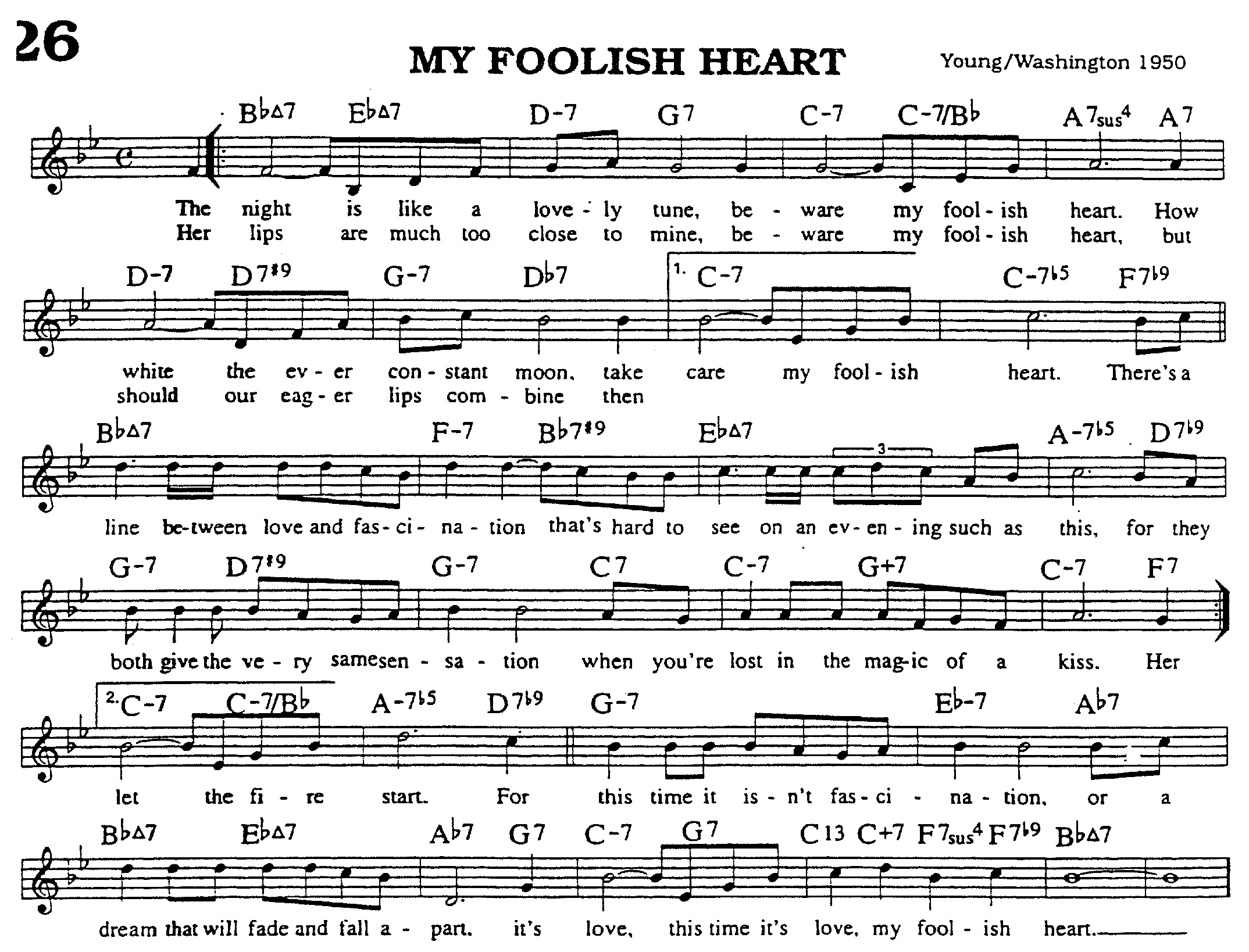
1. Song Overview
| Field | Details |
|---|---|
| Song | My Foolish Heart |
| Composer | Victor Young |
| Lyricist | Ned Washington |
| Year | 1949 publication; the attached lead sheet labels the song 1950 |
| Original context | Title song for the Samuel Goldwyn film My Foolish Heart, performed in the film by Martha Mears |
| Lead-sheet key | B-flat major |
| Form | 32-bar ABAC, 8 + 8 + 8 + 8, sometimes described as a "16 and 16" form |
| Principal tonal centres | B-flat major, with tonicisations of C minor, E-flat major and G minor, plus borrowed B-flat minor and backdoor-dominant colour |
| Common jazz classification | Slow ballad; Hollywood popular song and Great American Songbook jazz standard |
The governing idea of “My Foolish Heart” is not simply romantic surrender. It is an argument conducted by the speaker with an internal adversary. The heart is personified as an impulsive second self whose conclusions cannot be trusted. The speaker initially assumes the role of guardian, repeatedly warning it against mistaking atmosphere, physical proximity and erotic attraction for love. The central dramatic question is therefore epistemological as much as romantic: how can one know that desire is love rather than fascination when, as the lyric itself concedes, the two produce nearly indistinguishable sensations?
That uncertainty gives the lyric more tension than its moonlight-and-kisses vocabulary initially suggests. The first half repeatedly treats the senses as unreliable. The beautiful night, the moon, physical closeness and the kiss all conspire to obscure judgement. Yet the final section does not discover a new source of evidence. Instead, the speaker suddenly declares that the feeling really is love. The conclusion is emotionally persuasive precisely because it is not logically secure. The adjective “foolish” survives the revelation. The speaker has not proved the heart wise; the speaker has decided to trust it.
Victor Young’s melody and the harmony in this lead sheet reinforce that instability. The 32-bar ABAC form sends the opening warning through an extended melodic ascent, allows the B section to become more verbally analytical, then repeats the opening music with more immediate physical danger before the C section offers verbal certainty. A scholarly analysis of the composition identifies the same 32-bar ABAC organisation and hears the large-scale melody as an ascent in A, a descent through B, a renewed ascent in the second A, and finally a descent to tonic in C. (DukeSpace) The attached harmony sharpens the process further through applied dominants, tritone substitution, minor-mode borrowing and delayed cadences. The song therefore distinguishes itself from more straightforward declarations of romantic certainty: its final affirmation is earned through the very uncertainty it claims to overcome.
2. Form and Dramatic Architecture
The lead sheet uses repeat notation economically. Bars 1-6 serve both A sections. The first ending continues through bars 7-16, completing A1 and B; on the repeat, bars 1-6 become bars 17-22 and the second ending supplies bars 23-32, completing A2 and C. Heard linearly, however, the form is the conventional 32-bar ABAC design documented in analytical literature. (DukeSpace)
| Section | Bars | Tonal centre | Lyrical or dramatic function | Musical function |
|---|---|---|---|---|
| A1 | 1-8 | B-flat major, with C minor, D minor and G minor tonicisations | Establishes the speaker's caution and the self-address to the "foolish heart" | Long-range melodic ascent; tonic is repeatedly left for applied dominant motion before a borrowed minor ii-V returns towards B-flat |
| B | 9-16 | B-flat major moving through E-flat major and G minor regions | Attempts to rationalise the distinction between love and fascination | Melody becomes more stepwise and speech-like; harmonic excursions broaden the tonal field before ii-V returns towards home |
| A2 | 17-24 | B-flat major moving towards G minor | Repeats the warning, but physical proximity is now immediate rather than atmospheric | Opening melody and harmony return, but the ending is altered so that the section points into G minor rather than cadencing back to B-flat |
| C | 25-32 | G minor to B-flat major | Rejects "fascination" and "dream" in favour of an explicit declaration of love | G minor gives way to a borrowed ivm7-bVII7 return, followed by dominant intensification and a final authentic resolution to B-flat |
This is not an AABA song in which a contrasting bridge interrupts three statements of essentially the same thought. The 16 + 16 organisation is more directional. A1 and B form the first half of the argument: instinct is dangerous, and perception cannot reliably distinguish love from fascination. A2 and C replay the conditions but reach a different verdict. The form therefore resembles a proposition followed by reconsideration.
A2 is especially important. Its first six bars duplicate A1 closely enough to suggest that the speaker is back in the same predicament. The altered ending changes the psychology. In A1 the warning eventually reaches a cadence directed back towards B-flat; in A2, the line about allowing the “fire” to begin is followed by an Aø7-D7b9 progression that points directly into G minor. Instead of securing the tonic, the speaker deliberately enters a darker subsidiary region. The harmonic structure thus changes at precisely the moment the speaker stops resisting.
The C section supplies the missing answer, but not by becoming harmonically simple. It begins after the iiø-V of G minor, moves through a borrowed backdoor progression, and then spends several bars traversing secondary and altered dominants before B-flat major finally settles the form. Verbal certainty consequently arrives before tonal certainty. That separation is central to the song’s drama.
3. Close Reading of the Lyrics
| Lyric or cue | Literal meaning | Literary and poetic reading | Emotional subtext | Musical and harmonic interaction |
|---|---|---|---|---|
| "night ... lovely tune" | The evening is aesthetically pleasing and musical. | The opening simile aestheticises the environment before the lover is even mentioned. The night itself appears composed, ordered and seductive. Calling it a "tune" makes the speaker's surroundings resemble the very song being sung, a mild form of self-reflexivity. | The speaker already recognises that atmosphere is exerting pressure on judgement. Beauty is treated as potentially incriminating evidence rather than uncomplicated pleasure. | Bars 1-2 begin on B-flat major but immediately introduce E-flat major, Dm7 and G7. Home is present but not stationary. The opening melody participates in the A section's large ascending trajectory, so caution begins while the music is already being pulled upwards. |
| "beware my foolish heart" | The speaker warns the heart not to make a mistake. | The apostrophe divides the self into intellect and emotion. "Foolish" is affectionate but distrustful, and "beware" belongs to the vocabulary of danger rather than courtship. | Desire is already strong enough to require active supervision. The warning is therefore evidence of attraction rather than evidence of detachment. | G7 moves into Cm7, then the descending bass of Cm7/B-flat destabilises the apparent arrival. The heart is warned over harmony that has not found a durable tonic resting point. |
| "constant moon" | The moon is bright and apparently unchanging. | "Constant" is knowingly ambiguous in a love song. It can mean physically persistent, but also faithful. The natural object therefore carries precisely the emotional quality the speaker wants to determine in the relationship. | The speaker mistrusts romantic symbolism while simultaneously invoking it. The lyric cannot escape the conventions it warns against. | A7sus4-A7 and Dm7-D7#9 progressively sharpen the harmony. Suspension resolving to a dominant third gives the passage a sense of clarification, but that clarity immediately becomes another applied dominant rather than repose. |
| "take care" | A second warning is issued. | The change from "beware" to the gentler "take care" slightly reduces the severity of the admonition. The speaker is already softening towards the experience. | Resistance is weakening without being openly abandoned. | Gm7-D-flat7 leads chromatically towards Cm7. D-flat7 functions as a substitute dominant of C minor, so even a simple caution is surrounded by sophisticated chromatic attraction. |
| "line between love and fascination" | Love and temporary enchantment are separated by a distinction that may be difficult to perceive. | "Line" suggests an objective boundary, but the following clauses undermine its visibility. "Fascination" is the lyric's crucial counter-term to love: intense attraction without guaranteed permanence or moral seriousness. | The speaker's caution becomes philosophical. The problem is no longer merely resisting a kiss, but determining what inner experience means. | Bar 9 returns to B-flat major, but bar 10 immediately forms Fm7-B-flat7#9, an applied ii-V into E-flat. The harmony enacts boundary-crossing while the lyric discusses boundaries. |
| "hard to see" | The distinction cannot easily be recognised under present conditions. | The visual verb develops the moonlight imagery. Ironically, the brightly illuminated evening does not make the relevant truth more visible. External brightness and internal obscurity coexist. | The speaker admits that rational judgement may not be sufficient. | The E-flat-major arrival is immediately followed by Aø7-D7b9, redirecting the ear towards G minor. A momentary harmonic clarification therefore proves temporary. |
| "evening such as this" | The particular circumstances make judgement difficult. | The phrase shifts blame from the lovers to the setting. The syntax externalises temptation: the evening itself is the problem. | This is a form of emotional indirection. The speaker can acknowledge desire while pretending it is situational. | The lead sheet includes triplet compression in this region. The otherwise measured ballad line briefly becomes more verbally crowded, as though analysis itself is accelerating under pressure. |
| "same sensation" | Love and fascination feel alike in the moment. | This is the lyric's most sceptical proposition. Feeling alone cannot establish the category of feeling. The rhyme and parallel reasoning give the claim a nearly aphoristic quality. | The speaker has reached a disturbing conclusion: the heart's evidence is intrinsically ambiguous. | Gm7 and C7 create an applied ii-V directed towards F, but the expected F-major arrival is avoided. Cm7 appears instead. The harmonic redirection is an apt analogue for an argument whose expected conclusion cannot yet be trusted. |
| "magic of a kiss" | Kissing can overwhelm discrimination. | "Magic" is deliberately double-edged. It describes enchantment while implying a suspension of ordinary causality and judgement. A kiss changes consciousness rather than proving truth. | The speaker knows that the very experience desired is the one most capable of invalidating caution. | Cm7-G7#5-Cm7-F7 cycles through applied dominant tension and a turnaround. The harmony literally keeps moving in circles beneath the description of being "lost". The B section ends without melodic closure on the expected tonic, preparing the return of A. |
| "Her lips ... too close" | Physical intimacy has become immediate. | The second A replaces cosmic scenery with bodily proximity. The distance between moon and observer collapses into the distance between two mouths. "Too close" is technically a complaint, but its exaggeration reveals attraction. | The danger is no longer hypothetical. The speaker's warnings are being issued from within the event. | Bars 17-22 repeat the music of bars 1-6. The same ascent now carries a more concrete erotic charge. Formal repetition demonstrates that the psychological mechanism is unchanged even though the stimulus has intensified. |
| Repeated "beware" | The speaker renews the warning. | Repetition could imply discipline, but here it increasingly resembles ritual. A warning that must continually be repeated has not succeeded. | The speaker is maintaining the language of resistance after resistance has ceased to be convincing. | The same G7-Cm7 and Cm7/B-flat motion returns. The harmony confirms circularity rather than progress. |
| "eager lips combine" | The lovers may kiss. | "Eager" is the first diction that openly attributes desire rather than merely describing circumstances. The conditional "should" retains grammatical restraint, but the adjective gives the restraint away. | Intellectual caution and physical willingness have separated almost completely. | Dm7-D7#9-Gm7-D-flat7 again builds successive attractions. Instead of the first A's borrowed cadence back towards B-flat, the second ending diverts into Cm7/B-flat and Aø7-D7b9. |
| "let the fire start" | If they kiss, the speaker will allow passion to develop. | The fire metaphor changes the speaker from passive victim of atmosphere to active participant. "Let" is the decisive verb: permission replaces warning. | This is the first genuine surrender, although the lyric has not yet declared love. | The altered ending of A2 directs Aø7-D7b9 towards Gm7. Structurally, the song leaves the repeated A material precisely as the speaker elects to proceed. |
| "this time ... isn't fascination" | The speaker denies that the present feeling is merely infatuation. | The phrase depends on negation. Certainty is first expressed by excluding an unwanted category rather than naming the desired one. "This time" also implies experience with previous misjudgements, giving "foolish" a possible history. | The speaker is trying to distinguish this encounter from earlier emotional errors. | The C section begins on Gm7 after a strong Aø7-D7b9 preparation. The verbal assertion therefore occurs not on the global tonic but in the relative-minor region. Certainty begins under a darker harmonic light. |
| "dream ... fade and fall apart" | The relationship is not a temporary illusion that will disintegrate. | "Dream" extends the song's vocabulary of unreliable perception. "Fade" and "fall apart" introduce time for the first time explicitly: the distinction between fascination and love may only be verifiable through endurance. | The speaker wants permanence, not merely intensity. Yet permanence is asserted prospectively rather than demonstrated. | Ebm7-A-flat7 supplies borrowed minor colour before resolving by the backdoor to B-flat major. The darkening under the rejected "dream" makes the return of B-flat feel significant, but the tonic is immediately destabilised again by E-flat major and A-flat7-G7. |
| "it's love" | The speaker finally names the feeling as love. | The short syntax contrasts with the earlier explanatory language. Argument gives way to declaration. Repetition makes the sentence perform conviction rather than prove it. | This is the moment of maximum confidence and maximum vulnerability. The speaker risks being wrong after having explained exactly why feelings can deceive. | The declaration occurs while the harmony is still moving through Cm7-G7 and C13-C7#5 rather than resting on tonic. Verbal certainty precedes harmonic resolution. |
| Final "foolish heart" | The speaker addresses the heart one last time. | The adjective is not revoked. The heart may be correct now, but it remains constitutionally "foolish". The conclusion therefore preserves rather than erases the song's irony. | Acceptance replaces control. The speaker does not reform the heart; the speaker joins it. | F7sus4-F7b9 postpones the final cadence before B-flatmaj7 arrives. The sustained ending gives the declaration tonal confirmation, but only after the dominant has been made unusually tense. |
4. Lyrical and Emotional Arc
Opening Position
The speaker begins in a state of guarded attraction. The important fact is not that danger may arise later, but that the warning is already necessary. The opening environment is so conventionally romantic that the speaker treats beauty itself as suspicious. Moonlight, musicality and emotional susceptibility have aligned before the other person is even described directly.
The division between speaker and heart provides a temporary fiction of control. Rational consciousness can supposedly recognise what the “foolish” heart cannot. Yet this hierarchy is immediately unstable because all subsequent evidence comes from the same sensory and emotional system being distrusted.
Development
The B section moves from imagery to analysis. Instead of merely repeating warnings, the speaker develops a theory: love and fascination can produce the same immediate sensation. This is the intellectual centre of the lyric. Once that premise is admitted, the initial strategy of self-protection becomes impossible. Feeling more strongly cannot solve the problem because intensity belongs to both categories.
The return of A therefore occurs under changed circumstances. The first A warns against atmosphere; the second warns against physical intimacy. The vocabulary becomes increasingly embodied, culminating in “eager” lips and permission for the “fire” to begin. The speaker has moved from observer to participant before the final declaration of love is made.
Point of Greatest Tension
The greatest tension occurs across the transition from the second A into C: the permission to “let the fire start” followed by the insistence that “this time” the feeling is not fascination. Psychologically, this is where the argument becomes least defensible and most sincere. The speaker acts before proof is possible and then names the action as justified.
The music intensifies the exposure. Aø7-D7b9 directs the harmony into G minor rather than to the global tonic. The declaration therefore begins from a subsidiary minor centre. Certainty has been reached psychologically before tonal security has been regained.
Resolution or Lack of Resolution
The final cadence provides genuine musical resolution. F7b9 resolves to B-flatmaj7, and the melody reaches its tonic goal. The lyric also reaches a categorical answer: the feeling is love.
Psychologically, however, the resolution is qualified. Nothing in the argument has disproved the earlier proposition that love and fascination can feel identical. The speaker has chosen commitment in the absence of certainty. The ending is therefore not purely rational resolution and not mere wish fulfilment either. It is an act of trust.
Central Paradox
The song’s central paradox is that the speaker identifies the heart as foolish, explains why its evidence cannot be trusted, and then decides that on this occasion it is correct.
The final declaration gains force from that contradiction. If the song simply discovered that the heart had become wise, much of its tension would disappear. Instead, love requires the speaker to accept the very faculty that the lyric has spent most of its duration questioning.
5. Detailed Harmonic Analysis
The global tonic is B-flat major, confirmed by the two-flat key signature, the opening and closing B-flatmaj7 sonorities, and the large-scale cadential design. The attached lead sheet nevertheless avoids long stretches of static tonic. Its B-flat major is repeatedly elaborated through applied ii-V progressions, secondary dominants, substitute dominants, modal interchange and chromatic bass motion.
Temporary centres should not automatically be treated as full modulations. E-flat major and G minor receive clear applied dominant preparation, but their durations are short and their functions remain intelligible within the B-flat-major framework. The strongest local shift is probably the move into G minor at the start of C, yet even this functions as part of the return mechanism to B-flat.
The lead sheet’s repeat notation compresses bars 17-22, which repeat bars 1-6. The analysis below gives the heard 32-bar form.
| Bars | Lyric cue | Chords | Roman numerals | Tonal centre | Harmonic function and interpretation |
|---|---|---|---|---|---|
| 1 | "night..." | B-flatmaj7, E-flatmaj7 | Imaj7 - IVmaj7 | B-flat major | Tonic established, then immediately coloured by a direct plagal move to IV. Rather than a static I, the bar creates tonic expansion through I-IV. |
| 2 | "lovely tune..." | Dm7, G7 | iii7 (= ii7/ii) - V7/ii | B-flat, approaching C minor | Dm7 is diatonic iii but also functions naturally as the ii of C; G7 is the applied dominant of Cm7. Together they create an applied ii-V towards ii. |
| 3 | "beware..." | Cm7, Cm7/B-flat | ii7 - ii7 with tonic in bass | B-flat major | Arrival on ii rather than I. The bass falls C-B-flat while the upper Cm7 sonority largely remains, producing smooth voice-leading and prolonging predominant colour. |
| 4 | "...heart" | A7sus4, A7 | V7sus/iii - V7/iii | B-flat major, approaching D minor | Applied dominant of Dm. The suspension delays C-sharp, then releases into the dominant's third. |
| 5 | "white..." | Dm7, D7#9 | iii7 - V7#9/vi | B-flat, approaching G minor | Same-root transformation from diatonic D minor to dominant D7. The F to F-sharp alteration is an economical inner-voice device that converts iii into V/vi. |
| 6 | "constant moon..." | Gm7, D-flat7 | vi7 - subV7/ii | G minor colour, approaching C minor | Gm7 briefly confirms vi. D-flat7 is best heard as the tritone substitute of G7, dominant of Cm7, resolving down by semitone to C. |
| 7 | "take care..." | Cm7 | ii7 | B-flat major | Predominant arrival. The phrase remains away from tonic. |
| 8 | "...heart" | Cm7b5, F7b9 | iiø7 - V7b9, borrowed from B-flat minor | B-flat major/minor mixture | A minor-mode ii-V is borrowed from parallel B-flat minor and directed to a major tonic at bar 9. This darkens the cadence without actually changing the final mode. |
| 9 | "line between..." | B-flatmaj7 | Imaj7 | B-flat major | Clear tonic recovery and opening of B. |
| 10 | "love and fascination" | Fm7, B-flat7#9 | ii7/IV - V7#9/IV | E-flat major tonicisation | Applied ii-V of IV. The B-flat dominant converts the global tonic root into the dominant of E-flat. |
| 11 | "hard to see..." | E-flatmaj7 | IVmaj7 = Imaj7 of IV | E-flat major | Local arrival on IV. This is a convincing tonicisation but too brief to require a full modulation label. |
| 12 | "evening..." | Am7b5, D7b9 | iiø7/vi - V7b9/vi | G minor | Minor ii-V into G minor. |
| 13 | "both give..." | Gm7, D7#9 | vi7 - V7#9/vi | G minor | Gm7 is temporarily heard as local i. D7 immediately reasserts its dominant, prolonging the G-minor region rather than leaving it. |
| 14 | "same sensation..." | Gm7, C7 | ii7/V - V7/V | F-region implication | A ii-V in the key of F is suggested. The expected F chord does not arrive; the progression is diverted to Cm7, preventing the secondary centre from stabilising. |
| 15 | "magic..." | Cm7, G+7 | ii7 - V7#5/ii | C minor tonicisation | Cm7 is followed by its own altered dominant, G7#5. This creates a circular return to Cm7 in bar 16. |
| 16 | "...kiss" | Cm7, F7 | ii7 - V7 | B-flat major | Conventional ii-V turnaround. The dominant points directly into the returning A at bar 17. |
| 17 | "Her lips..." | B-flatmaj7, E-flatmaj7 | Imaj7 - IVmaj7 | B-flat major | Harmonic repetition of bar 1. The formal return is exact enough to make the changed lyric psychologically conspicuous. |
| 18 | "close to mine..." | Dm7, G7 | iii7 (= ii7/ii) - V7/ii | Approaching C minor | Applied ii-V towards ii, as at bar 2. |
| 19 | "beware..." | Cm7, Cm7/B-flat | ii7 - ii7 with tonic bass | B-flat major | Predominant prolongation with descending bass. |
| 20 | "...heart" | A7sus4, A7 | V7sus/iii - V7/iii | Approaching D minor | Same suspension-resolution mechanism as bar 4. |
| 21 | "eager..." | Dm7, D7#9 | iii7 - V7#9/vi | Approaching G minor | Diatonic-to-dominant same-root transformation. |
| 22 | "lips combine..." | Gm7, D-flat7 | vi7 - subV7/ii | Approaching C minor | The D-flat substitute dominant once again pushes chromatically to Cm7. |
| 23 | "let the fire..." | Cm7, Cm7/B-flat | ii7 - ii7 with tonic bass | B-flat major | The second ending differs from A1. Instead of moving to the borrowed minor iiø-V of B-flat, it prolongs Cm7 and continues the descending bass. |
| 24 | "...start" | Am7b5, D7b9 | iiø7/vi - V7b9/vi | Approaching G minor | Strong minor ii-V. This substitutes directional motion into vi for the first A's return towards I and launches C. |
| 25 | "this time..." | Gm7 | vi7, locally i7 | G minor | The C section begins with a genuine local G-minor arrival. |
| 26 | "fascination..." | Ebm7, A-flat7 | ivm7 - bVII7 | B-flat minor mixture, returning to B-flat | Classic backdoor progression. Ebm7 is borrowed iv from B-flat minor; A-flat7 is bVII7 and resolves to B-flatmaj7 by semitone-rich voice-leading. Alternatively, it can be heard as ii-V of D-flat whose expected tonic is bypassed. |
| 27 | "dream..." | B-flatmaj7, E-flatmaj7 | Imaj7 - IVmaj7 | B-flat major | Global tonic returns, again immediately softened by IV. |
| 28 | "fall apart..." | A-flat7, G7 | subV7/vi - V7/ii | Dominant chain | A-flat7 can be understood as the tritone substitute for D7, whose target root would be G. Instead of Gm, the root G arrives as G7, converting the target into another dominant. Chromatic root descent intensifies forward motion. |
| 29 | "it's love..." | Cm7, G7 | ii7 - V7/ii | C minor tonicisation | Cm7 arrives, then G7 turns immediately back towards it. The apparent destination becomes another point of departure. |
| 30 | "this time..." | C13, C+7 | V7/V - V7#5/V | Approaching F | Extended secondary dominant of the global dominant. The alteration from 13th colour to augmented fifth increases instability without changing the fundamental C7 function. |
| 31 | "...foolish heart" | F7sus4, F7b9 | V7sus - V7b9 | B-flat major dominant | Dominant prolongation. The suspended third delays functional clarity before the b9 intensifies the final cadence. |
| 32 | Final sustained resolution | B-flatmaj7 | Imaj7 | B-flat major | Global tonic resolution. The final chord is structurally unambiguous after several bars of dominant intensification. |
Several voice-leading patterns are especially important. Bars 3 and 23 preserve Cm7 while moving the bass from C to B-flat, making harmonic motion feel continuous rather than sectional. Bars 4 and 20 use A7sus4-A7 to make the dominant’s third an audible internal resolution. Bars 5 and 21 change Dm7 into D7#9 largely through the alteration of F to F-sharp, converting a diatonic chord into an applied dominant without changing the root.
D-flat7 in bars 6 and 22 is a genuine substitute-dominant case. Its tritone, F-C-flat/B, corresponds enharmonically to the guide-tone tritone of G7, and its root resolves down a semitone to C. It should therefore not be confused with the unrelated chromatic A-flat7 at bar 28, whose function is a more elaborate substitute-dominant approach to the G-root dominant chain.
Bar 8 is another crucial colouristic point. Cm7b5-F7b9 belongs naturally to B-flat minor, yet it resolves to B-flat major. The borrowed minor cadence provides more gravitational force than the diatonic Cm7-F7 would, because E-flat moves naturally towards D and G-flat towards F while A-flat and C participate in the altered dominant resolution. The major tonic consequently sounds recovered rather than merely repeated.
The C section then avoids an immediate conventional cadence. Ebm7-A-flat7 in bar 26 forms the familiar ivm7-bVII7-Imaj7 backdoor gesture. Its softness contrasts with the later chain of chromatic and secondary dominants. By the time F7sus4-F7b9 finally resolves at bar 32, the tonic has been withheld long enough for the cadence to carry genuine structural weight.
6. Tonal Journey
| Passage | Starting centre | Destination | Mechanism | Dramatic effect |
|---|---|---|---|---|
| A1, bars 1-3 | B-flat major | C minor | I-IV followed by Dm7-G7, an applied ii-V to ii | The tonic is immediately treated as permeable; caution begins without tonal stillness |
| A1, bars 4-6 | D minor region | G minor, then C minor | A7 to Dm, D7 to Gm, D-flat7 as subV of Cm | A chain of attractions mirrors the speaker's inability to remain emotionally stationary |
| A1 ending, bars 7-9 | C minor | B-flat major | Borrowed Cm7b5-F7b9 cadence | The first warning receives a comparatively decisive return to home |
| B, bars 9-12 | B-flat major | E-flat major, then G minor | Fm7-B-flat7 to E-flat; Aø7-D7 to Gm | The intellectual discussion of "love" versus "fascination" coincides with widening tonal perspective |
| B, bars 13-16 | G minor | B-flat dominant field | D7 prolongation, Gm-C7 diversion, Cm-G7#5, then Cm-F7 | The argument refuses a simple secondary-key resolution and circles back towards the repeated A |
| A2, bars 17-24 | B-flat major | G minor | Repetition of A1 until the altered Aø7-D7 ending | The same warning produces a different result: instead of securing B-flat, it leads into emotional surrender |
| C, bars 25-27 | G minor | B-flat major | Gm followed by borrowed Ebm7-A-flat7 backdoor cadence | The explicit declaration begins in minor uncertainty but recovers the global home region |
| C, bars 28-32 | B-flat region | B-flat tonic | A-flat7-G7-Cm7-G7-C7-F7-B-flat | Successive dominant functions postpone home while verbal certainty increases |
The song repeatedly leaves and recovers B-flat, but most departures are tonicisations rather than independent modulations. That distinction matters perceptually. The listener does not lose awareness of B-flat as home; instead, home is made to seem continually available but rarely sufficient.
The B section’s move through E-flat and G minor corresponds to the lyric’s analytic phase. Instead of giving the speaker a more stable vantage point, these tonal centres multiply possible orientations. The music behaves like the argument: each apparent explanation opens another question.
The most consequential departure occurs between A2 and C. Aø7-D7b9 creates a sufficiently strong G-minor cadence for bar 25 to feel locally grounded. Yet the lyric is now most confident. The contradiction is productive. The speaker says “this time” with conviction while the music is furthest from the global tonic.
The eventual return through Ebm7-A-flat7 is less forceful than a conventional F7-B-flat cadence. The backdoor progression seems to arrive sideways, through modal mixture. Only later does the composition build the conventional dominant F7, and even then it suspends and alters the chord before resolving. The final tonic is therefore genuine, but it has been deliberately deferred.
7. Melody and Prosody
The melody spans approximately a tenth, a range noted in jazz-standard analyses of the tune, and its sectional design is unusually important to the song’s expressive logic. The A material is predominantly arpeggiated, whereas B becomes more stepwise and compact. (Jazz Standards) This difference corresponds closely to the lyric. The A sections describe susceptibility in broad, rising gestures; the B section attempts verbal analysis in a more speech-like melodic field.
At the large scale, the first A makes a prolonged ascent from scale degree 5 towards the upper scale degree 3. In B-flat major that means an underlying rise from F towards the upper D. B reverses the trajectory and descends again. The scholarly reduction by Keesecker identifies a particularly significant event at the end of B: the leading tone does not make its expected ascent to tonic but falls instead towards scale degree 5 for the return of A. The second A then repeats the climb and reaches scale degree 3 before C, after which the final section prolongs that third and ultimately descends to tonic. (DukeSpace)
That architecture gives the lyric a physical metaphor. Warning is associated with ascent rather than composure. The speaker’s attempts at self-control gradually elevate the melody, increasing rather than dissipating tension. B’s descent does not provide true closure, because the expected leading-tone resolution is frustrated. The return of A therefore feels compelled.
The melodic writing inside A frequently outlines or strongly implies chord tones, making the melody hospitable to jazz reharmonisation. This is one reason the chart can accommodate B-flatmaj7-E-flatmaj7, Dm7-G7 and substitute dominants without making the tune unrecognisable. The basic melodic identity lies as much in contour and motive as in one fixed popular-song accompaniment. Jazz pedagogical sources similarly note the A section’s arpeggiated quality and the B section’s predominantly scalar motion. (PianoGroove.com)
Prosodically, Washington’s lyric alternates between compact imperatives and extended conversational sentences. Phrases such as the repeated warning to the heart can be given long, clear musical space. By contrast, the B section contains syntactically extended thought, including the explanation about love and fascination. The melody correspondingly uses repeated and neighbouring tones, allowing relatively dense text to remain comprehensible.
The triplet figure visible in the B section is especially telling. It momentarily compresses ordinary speech into a faster subdivision without changing the overall ballad metre. At a slow tempo this sounds less like virtuosity than heightened conversational urgency. The speaker has ceased merely singing an image and has begun explaining a problem.
Long notes occur at psychologically strategic points. The repeated references to the heart tend to receive temporal space rather than being hurried through. That sustained quality makes the self-address sound reflective rather than comic. At the end, the last invocation of the heart is prolonged across the dominant-to-tonic resolution, allowing the final word to outlast the argument that precedes it.
The C section gains much of its expressive strength from large-scale melodic prolongation. The upper scale degree 3 is sustained structurally through much of the section while the harmony underneath changes rapidly. Thus the melody sounds comparatively certain while the chords remain mobile. Only towards the end does the line descend towards scale degree 1. This is one of the composition’s clearest integrations of musical and dramatic form: verbal certainty first appears as a held melodic position, then receives tonal confirmation only at the cadence.
For singers, natural stress matters more than literal rhythmic obedience in the prose-like B section. “Love”, “fascination”, “same sensation”, “magic” and “kiss” are semantic anchors, but the surrounding syntax should still sound like thought unfolding in real time. For instrumentalists, preserving those speech accents helps keep the melody from becoming merely a sequence of attractive intervallic shapes.
8. Word, Melody, and Harmony: Key Moments
| Moment | Lyric cue | Musical event | Interpretive significance |
|---|---|---|---|
| Opening | "night ... lovely tune" | B-flatmaj7 moves immediately to E-flatmaj7 as the long A-section ascent begins | The scene is nominally secure but already mobile; romantic atmosphere starts exerting upward pressure |
| First warning | "beware..." | Dm7-G7 resolves only to Cm7, not tonic | The command to exercise judgement occurs over a cadence into a subsidiary chord, weakening its apparent authority |
| First "heart" | "...foolish heart" | A7sus4 resolves internally to A7 and then Dm7 | A word implying emotional instability is supported by a dominant whose own identity is delayed by suspension |
| End of A1 | "take care..." | D-flat7 substitutes for G7, followed by borrowed Cm7b5-F7b9 | Chromatic and minor-mode colour intensify the supposedly protective warning |
| Analytical centre | "love and fascination" | Fm7-B-flat7#9 tonicises E-flat | The lyric asks where a boundary lies while the harmony itself crosses temporarily into another tonal orientation |
| "same sensation" | B-section stepwise writing over Gm7-C7 | Expected resolution to F is diverted | The harmonic expectation fails just as the lyric argues that sensory expectation may be unreliable |
| "magic of a kiss" | Cm7-G7#5-Cm7-F7 | Applied dominant circularity leads back to the returning A | "Lost" is represented less by distant modulation than by cycling through familiar chords without final arrival |
| "let the fire start" | Second ending replaces A1's home-directed cadence with Aø7-D7b9 | Formal repetition finally breaks | The decision to surrender is the moment at which the repeated harmonic path changes |
| "this time..." | C begins on tonicised G minor | Verbal certainty begins outside the global tonic | The declaration is emotionally stronger than the harmonic ground beneath it |
| "it's love" | Melody remains structurally high while Cm7-G7-C13-C7#5 continues dominant motion | The voice claims certainty while the harmony refuses immediate settlement | This is the song's strongest musical irony |
| Final "heart" | F7sus4-F7b9 resolves to sustained B-flatmaj7 | Suspended and altered dominant finally gives way to tonic | Musical closure validates the declaration without removing the adjective "foolish" from the lyric |
9. Historical and Cultural Context
Victor Young and Ned Washington wrote “My Foolish Heart” as the title song for Samuel Goldwyn’s film My Foolish Heart. The film was based on J. D. Salinger’s 1948 short story “Uncle Wiggily in Connecticut”, with Victor Young credited for the music and Washington and Young credited for the title song. The American Film Institute records a Los Angeles premiere on 25 December 1949 and general United States release on 21 January 1950. AFI also lists Martha Mears in the cast as the nightclub singer. (AFI Catalog)
The dating discrepancy between sources is therefore understandable. The song was published in 1949, while the film’s broad release and much of the song’s popular success occurred in 1950. Modern published-sheet-music catalogues give 1949 as the composition’s date and identify B-flat major as the original published key, while the attached lead sheet prints “Young/Washington 1950”. (Musicnotes.com) For a historical catalogue, “1949, associated commercially with the 1950 film release” is the most precise description.
The song received substantial institutional recognition almost immediately. At the 22nd Academy Awards it was nominated for Music (Song), with Young credited for music and Washington for lyrics; the award went instead to Frank Loesser’s “Baby, It’s Cold Outside”. (Oscars) Popular recordings followed quickly. Gordon Jenkins’s recording reached No. 3 in the United States, while Billy Eckstine and Mindy Carson both reached No. 6 according to the chart data collated by JazzStandards.com. (Jazz Standards)
Its original context is Hollywood rather than Broadway. This matters because the song did not need to carry a stage plot from one scene to the next. Its lyric is self-contained and psychologically compressed. The title song could function within a romantic melodrama while remaining detachable from the film. The combination of a memorable 32-bar form, independent lyric and adaptable harmonic skeleton made detachment especially easy.
The movement into jazz happened rapidly. Gene Ammons recorded an instrumental version in Chicago on 2 May 1950, only months after the film’s general release. His Chess session places the song in instrumental jazz almost immediately rather than after a long period as exclusively popular-vocal repertoire. (Jazz Disco) Dodo Marmarosa also recorded it in 1950; by 1956 Carmen McRae, André Previn and Ray Brown had all recorded the composition. Jazz historical surveys identify that mid-1950s period as the point at which the tune’s jazz discography broadened significantly. (Jazz Standards)
That transition changed the balance of the composition. In a popular vocal setting, Washington’s argument is explicit. In an instrumental setting, the large melodic contour and its unresolved internal tensions carry the drama by themselves. The tune’s relatively wide range, arpeggiated A sections and familiar underlying functional relationships also invite reharmonisation. Jazz musicians could preserve the tune’s identity while changing almost every accompanimental detail beneath it.
The Bill Evans Trio’s 25 June 1961 Village Vanguard performance became particularly important in this respect. Evans, Scott LaFaro and Paul Motian recorded the piece during the afternoon set; the performance later appeared on Waltz for Debby. (Bill Evans) The recording has subsequently become one of the pieces most strongly associated with Evans, and analytical scholarship has treated it in detail as a model of slow-tempo trio interaction, metric flexibility and large-scale melodic shape. (DukeSpace)
10. Significant Interpretations
| Performer | Recording or period | Interpretive character | What it reveals about the song |
|---|---|---|---|
| Martha Mears | My Foolish Heart, 1949 film | Film-song presentation with the lyric at the centre | Restores the piece to its original dramatic medium, before jazz performance practices detached the melody from Washington's words |
| Gene Ammons Sextet | Chicago, 2 May 1950 | Early tenor-ballad treatment, replacing verbal argument with sustained melodic rhetoric | Demonstrates how quickly the melody proved viable without the lyric and how effectively its wide contour suits a horn |
| Carmen McRae | Blue Moon, 1956 | Controlled vocal jazz delivery, with attention to diction and rhythmic placement rather than theatrical excess | Makes the lyric's scepticism audible; the song can sound knowing and adult rather than merely romantic |
| Ray Brown | 1956, Bass Hit! period | Arrangement foregrounding the double bass, including exposed bass passages | Shows that the composition's melodic identity survives unusually sparse and instrumental re-scoring |
| Bill Evans Trio | Village Vanguard, 25 June 1961 | Extremely slow, spacious trio performance with interactive bass and drums, followed by metric intensification | Reveals the tune's capacity for suspended time, reharmonic nuance and large-scale contour independent of the lyric |
| Tony Bennett and Bill Evans | The Tony Bennett/Bill Evans Album, 1975 | Voice-piano duet, harmonically elastic and textually exposed | Reunites the lyric with the Evans harmonic world and demonstrates how little accompaniment is needed when the prosody and inner voices are strong |
The Gene Ammons session is documented for 2 May 1950, making it one of the earliest significant jazz recordings of the song. (Jazz Disco) JazzStandards.com explicitly singles it out as important evidence of the tune’s compatibility with instrumental jazz. (Jazz Standards) Ammons’s significance lies not in radical rearrangement but in demonstrating that Young’s melody could function as a tenor ballad without relying upon the film or lyric for identity.
Carmen McRae’s version appears on her 1956 Decca album Blue Moon. (Wikipedia) Her value for comparison is interpretive rather than historical novelty. McRae’s approach to standards typically depends on precise semantic inflection and rhythmic placement, qualities particularly appropriate to a lyric whose crucial words are distinctions such as “love”, “fascination” and “foolish”. The song becomes less a swooning confession than a judgement delivered by someone aware of the risk.
Ray Brown’s 1956 treatment is notable for its arrangement. Contemporary jazz-history commentary describes an opening unaccompanied bass statement, followed by successive ensemble and solo features and a return to exposed bass. (Jazz Standards) That approach proves how strongly the melody projects through timbral and registral transformation.
The Evans Village Vanguard performance is the most consequential instrumental reading. The documented tempo is approximately quarter note = 56. Evans states the head over unusually sparse LaFaro and Motian accompaniment; the second chorus introduces greater metric ambiguity and double-time implication, and the ending grows out of a paraphrase of the opening melody. (DukeSpace) Rather than treating the song merely as a vehicle for chord-scale improvisation, the trio develops its inherent tension between long melodic spans and changing perceptions of pulse.
The 1975 Tony Bennett-Bill Evans version creates a different kind of exposure. Bennett and Evans recorded as a voice-piano duo at Fantasy Studios; material for the album was worked out collaboratively and relatively spontaneously rather than through a fixed large arrangement. (YouTube) The released track runs approximately 4:51. (Amazon Music) Evans’s harmonic sensitivity remains, but the return of Washington’s lyric changes the meaning of the spaces: pauses become moments of thought rather than merely instrumental breath.
11. Place in the Jazz Canon
“My Foolish Heart” endures because its composition offers enough structural clarity to survive extensive reinterpretation. Its 32-bar ABAC form is easy to grasp at the macro level, while the internal harmony contains enough functional detail to sustain sophisticated improvisation. The progression repeatedly establishes recognisable destinations through ii-V relationships, but often substitutes, diverts or recolours those destinations. An improviser therefore encounters familiar syntax without mechanical predictability.
The melody is particularly responsible for the tune’s durability. Its A sections are built from strong arpeggiated gestures and a long upward trajectory; B contrasts with tighter stepwise writing. JazzStandards.com notes both its strong motivic construction and its range of roughly a tenth, while also observing that its melodic structure leaves substantial room for chord substitution. (Jazz Standards) That combination is unusually useful. The melody remains recognisable even when the accompanist alters the underlying route.
The tune is pedagogically valuable because it exposes several important harmonic families in a compact form: applied ii-V motion to ii, V/iii, V/vi, minor ii-V progressions, substitute dominants, modal interchange, backdoor resolution and dominant chains. The attached chart intensifies these features beyond a simpler popular-song harmonisation. A player who understands only individual scales for each chord is likely to overstate harmonic discontinuity. Much of the progression is better understood as long-range voice-leading towards a small number of destinations.
The form also presents a memory challenge that is more subtle than AABA. A1 and A2 share their first six bars but diverge in their endings. That altered second ending determines the entire final quarter of the song. An improviser who hears only “the A section again” can easily miss the directional change into G minor at bar 24.
The Evans Village Vanguard performance has had an especially strong afterlife. Jazz educational sources now routinely point to it as a reference recording, and the composition is widely associated with Evans. (Jazz Standards) It should not, however, be reduced to an “Evans tune”. The earlier Ammons, McRae, Brown and popular-vocal versions demonstrate that its jazz viability predates 1961.
For improvisation, the most important understanding beyond the chord symbols is the large-scale line. A1 rises; B releases but frustrates full melodic closure; A2 rises again; C holds the upper structural tone before descending home. An improvised chorus that recognises those gravitational points can sound connected to the composition even with extensive melodic invention. One that treats every bar as a separate chord-scale problem can obscure the song’s strongest feature.
12. Interpretive Considerations for Performers
The lyric benefits from restraint because its speaker is already trying to regulate emotion. Excessively tragic or rapturous delivery at the beginning removes the dramatic progression. The first A is more effective when the warnings sound plausible: attraction is present, but the speaker still believes self-command may work. A2 can then repeat the same melodic material with noticeably less conviction.
The word “foolish” need not be exaggerated. Its dramatic force comes from recurrence. It is part reprimand, part endearment and eventually part acceptance. Making it overtly contemptuous would undermine the ending, while making it wholly affectionate from the outset would weaken the initial warning.
The B section should retain conversational syntax. The phrases dealing with the distinction between love and fascination contain the song’s most explicit reasoning. At a very slow tempo, excessive subdivision can fragment that argument into isolated syllables. Slight anticipation or delay can help preserve ordinary speech stress, provided the large phrase continues to move.
The second A requires a perceptible psychological change without requiring a radical musical one. Because the melody and most harmony repeat, a singer can alter timbre, consonant weight or rhythmic placement rather than volume. An instrumentalist can achieve the same effect through register, articulation or density. The point is that the conditions have become more immediate, not that the composition has suddenly become another song.
Several harmonic landmarks should remain audible even in reharmonisation. The D-flat7 approaches to Cm7 in bars 6 and 22 supply characteristic chromatic gravity. The borrowed Cm7b5-F7b9 cadence at bar 8 gives A1 a dark return to B-flat. The Aø7-D7b9 at bar 24 is structurally crucial because it changes the destination of the repeated A. Ebm7-A-flat7 at bar 26 gives the C section its backdoor return, and the final C7-to-F7 dominant field should retain enough directional force for B-flat to sound earned.
Reharmonising the opening is comparatively safe because the melody tolerates alternative tonic expansions and applied ii-Vs. Reharmonising the second ending indiscriminately is more dangerous. If bar 24 no longer points convincingly towards G minor, the formal distinction between the two halves is weakened.
The final declaration should not necessarily be the loudest moment. One effective approach is increasing certainty by reducing affectation: the speaker finally stops explaining. Another is to allow the harmony to carry the unresolved tension while the melody becomes simpler and more direct.
Tempo changes the song’s psychology considerably. Around the very slow Evans territory, every internal resolution becomes audible and the lyric can acquire the quality of private thought. A somewhat quicker ballad tempo makes the B section more conversational and reduces the danger of sentimentality. At still faster tempos the composition can work instrumentally, but the contrast between warning and surrender becomes less spacious, and the long melodic architecture requires deliberate phrasing to remain perceptible.
For instrumentalists, the words remain useful even when unperformed. The first A should sound like caution, B like analysis, A2 like caution becoming impossible, and C like a decision whose confidence precedes its harmonic proof. That dramatic model is more informative than treating all 32 bars as a uniformly lyrical ballad.
13. Final Reading
“My Foolish Heart” is fundamentally about deciding whether to trust an emotion after admitting that emotion cannot certify its own truth. Washington’s lyric begins by assuming a clear hierarchy: the rational speaker knows better than the foolish heart. Yet every subsequent observation weakens that confidence. The moon is constant but potentially misleading; fascination and love resemble one another; the kiss produces “magic”, which by definition alters normal perception. The song systematically removes the evidence by which its final conclusion might be proved.
Its most revealing move is therefore not the declaration of love itself but the refusal to rename the heart. Had the final lyric addressed a newly enlightened or faithful heart, the song would become a story of corrected judgement. Instead, foolishness persists. What changes is the speaker’s relationship to it. The heart remains impulsive, but the speaker finally accepts that love may require action before certainty is available.
Young’s form gives that change unusually clear shape. The first A ascends under warning, B descends while attempting explanation, and the second A climbs the same terrain under more immediate pressure. The repeated music is not dramatic stasis. It establishes a controlled experiment: similar musical circumstances return, but the speaker responds differently. The altered second ending is therefore disproportionately important. The form breaks from repetition at exactly the point where resistance breaks.
The harmony complicates any simple reading of the conclusion as triumphant certainty. Applied dominants and substitute dominants repeatedly create convincing local directions without allowing those directions to become permanent homes. In C, the assertion that the feeling really is love begins from tonicised G minor and proceeds through borrowed and chromatic harmony. Even the repeated declaration itself is carried over Cm7, G7 and the C-to-F dominant chain. The lyric has reached certainty while the harmony is still asking to be resolved.
The final B-flatmaj7 matters because it does resolve. The song is not condemned to permanent ambiguity. Yet the cadence does not retrospectively make the speaker’s reasoning airtight. Its function is closer to commitment than demonstration. After the F7 suspension and b9 have intensified the final dominant, tonic arrives as a place the music has chosen and prepared, not as evidence that every preceding doubt was mistaken.
That distinction is why the composition rewards radically different performances. A singer can emphasise self-awareness, vulnerability, erotic surrender or mature acceptance without violating the text. An instrumentalist can remove the words altogether and still recover the same trajectory through Young’s rising and falling melodic spans and the harmony’s alternation between destination and deferral. The song’s apparent sentimentality is continually checked by structural intelligence: every romantic image is subjected to doubt, and every assertion of certainty arrives through music that remembers the doubt.
The final insight is contained in the title itself. The heart does not cease to be foolish when it turns out to be worth following. The song’s resolution is the decision that, in love, fallibility and truth may have to coexist.