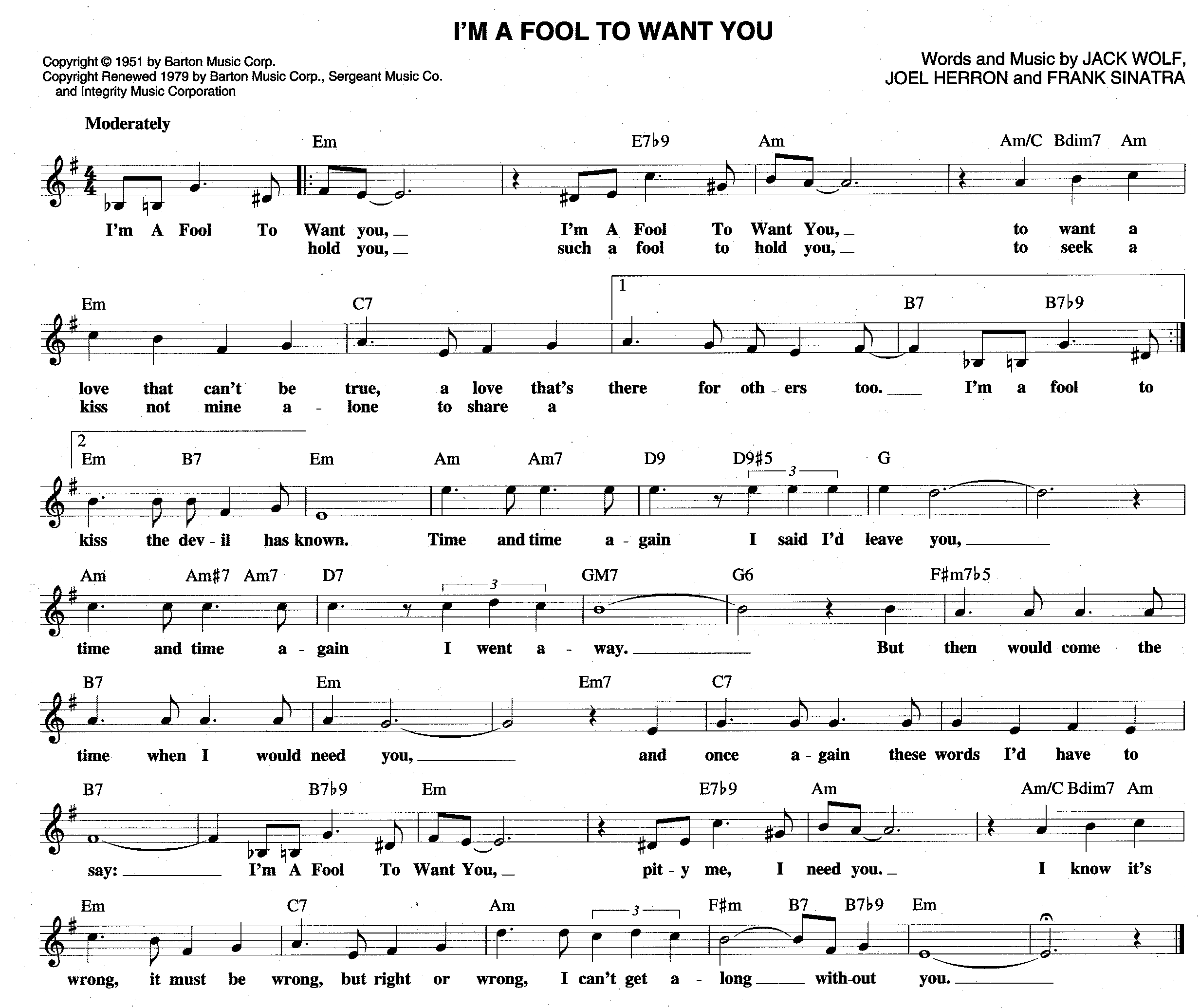
1. Song Overview
| Field | Details |
|---|---|
| Song | I'm a Fool to Want You |
| Composer | Jack Wolf, Joel Herron and Frank Sinatra |
| Lyricist | Jack Wolf, Joel Herron and Frank Sinatra, as credited collectively with “Words and Music” |
| Year | 1951 |
| Original context | Stand-alone popular song; first associated commercially with Frank Sinatra's Columbia recording rather than a stage or film production |
| Lead-sheet key | E minor |
| Form | A1-A2-B-A3, with A1/A2 notated by repeat and alternate endings; 8 + 8 + 16 + 9 performed bars, plus an anacrusis |
| Principal tonal centres | E minor; A minor tonicisations; substantial G-major region in the bridge |
| Common jazz classification | Minor-key torch ballad; vocal and instrumental jazz standard |
I’m a Fool to Want You begins at a psychological point that many love songs postpone until their conclusion. The speaker already knows that the attachment is untenable. The title is not an accusation levelled at the beloved but a judgement against the self. Desire and knowledge therefore coexist from the first phrase: the speaker understands the situation accurately enough to condemn it, yet that understanding has no practical power. The song’s drama is not discovery but repeated failure to act on what has already been discovered.
The music makes that contradiction structural. E minor is unmistakably the global tonic, yet the tune repeatedly leaves it almost as soon as it is reached. E7♭9 pulls towards A minor, C7 colours the route towards the dominant, and the long bridge moves into G major before returning through a classical minor-key iiø-V-i. Home is therefore available but rarely secure. That quality is particularly appropriate to a lyric in which separation repeatedly proves possible for a time but not sustainable.
What distinguishes the song from a more conventional lament for unrequited love is the speaker’s implication that the beloved is actually accessible. The problem is not simple absence. The love is described as shared with others, kisses are available but not exclusive, and the speaker repeatedly returns. The lyric therefore combines longing with jealousy, moral self-consciousness and dependency. By the final cadence the musical problem has been solved, E minor is recovered and firmly closed, but the emotional problem has not.
2. Form and Dramatic Architecture
The lead sheet is in 4/4 and marked “Moderately”. It begins with a short anacrusis. The first two A sections are compressed typographically by a repeat sign: six common bars are followed by a first two-bar ending for the first text and a different two-bar second ending for the second text. For analytical clarity, the following bar numbers refer to the performed sequence rather than the physical numbering of the printed repeat.
| Section | Bars | Tonal centre | Lyrical or dramatic function | Musical function |
|---|---|---|---|---|
| Anacrusis | Before 1 | Dominant-inflected approach to E minor | Immediate self-accusation begins before the tonic | Chromatic pickup propels the melody into i |
| A1 | 1-8 | E minor, with A-minor tonicisation | Desire is identified as irrational because the love is non-exclusive | i moves quickly towards iv; chromatic C7 and B7 return towards E minor |
| A2 | 9-16 | E minor | The abstraction of “wanting” becomes physical possession, kissing and jealousy | Repeats the opening harmonic argument but uses a different ending that closes on i |
| B | 17-32 | G major, then E minor | The speaker narrates repeated attempts to leave and repeated capitulation | Relative-major expansion, then iiø-V-i return to E minor and dominant preparation |
| A3 | 33-41 | E minor | Self-judgement becomes direct supplication and finally admitted dependency | Opening A harmony returns; the cadence is expanded by a predominant-to-dominant-to-tonic ending |
| Final extension | Bar 41 within A3 | E minor | The wordless consequence of the confession | Sustained tonic close with fermata-like finality |
The proportions are important. This is not a regular 32-bar AABA chorus with four equal eight-bar sections. The 16-bar bridge is twice the length of an ordinary eight-bar bridge, and the final A contains an additional bar of tonic closure. The song consequently spends an unusually long time in its middle narrative. The speaker does not merely state the problem, contrast it, and return. The bridge becomes an extended account of recurrence: leaving, returning, needing, confessing.
The two opening A sections are psychologically distinct despite sharing most of their music. A1 concerns wanting an impossible form of exclusivity. A2 makes the situation bodily, moving towards holding and kissing. The repeated music therefore does not merely repeat information. It shows the same compulsion at a more intimate and morally uncomfortable level.
The final A is more radically altered. Instead of describing the beloved’s divided attention, it abandons description and turns towards petition. The added tonic bar is significant because the music supplies an unequivocal ending that the lyric cannot. Harmonically the song has arrived; psychologically the speaker remains inside the cycle.
3. Close Reading of the Lyrics
| Lyric or cue | Literal meaning | Literary and poetic reading | Emotional subtext | Musical and harmonic interaction |
|---|---|---|---|---|
| “I'm a fool to want you” | The speaker judges the desire itself irrational. | The title phrase fuses confession and verdict. “Fool” is deliberately plain diction, closer to spoken self-reproach than elevated romantic language. | The speaker possesses insight without self-control. Knowing that desire is destructive does not reduce it. | The phrase resolves into E minor, but the tonic is immediately destabilised by E7♭9. The music enacts the failure of the apparently settled judgement to remain settled. |
| Repetition of “I'm a fool” | The judgement is restated rather than qualified. | Repetition functions almost as self-persuasion. If the conclusion were emotionally secure, it would not need constant rehearsal. | The repeated accusation sounds increasingly compulsive rather than rational. | The second declaration occurs over harmony already pulling towards A minor. Musical motion contradicts verbal finality. |
| “a love that can't be true” | The relationship cannot be exclusive or legitimate in the desired sense. | “True” is deliberately ambiguous. It can mean faithful, morally proper, emotionally reliable or simply capable of existing as imagined. | The speaker knows that the desired version of the relationship is unavailable. | E7♭9 to Am intensifies the move away from tonic. The harmony treats the acknowledgement as a departure rather than a resting point. |
| “there for others too” | The beloved's love is shared. | The phrasing is notably indirect. Rather than naming betrayal or infidelity explicitly, the lyric uses the mild phrase “others too”. | Jealousy is concealed beneath understatement. The restraint makes the admission more credible than melodramatic denunciation would. | C7 and then B7/B7♭9 darken the end of the first A. The comparatively euphemistic language is given harmonically severe consequences. |
| “I'm a fool to hold you” | The speaker admits that remaining physically attached is irrational. | “Want” becomes “hold”. The second A moves from desire as an interior state to an action that requires proximity and possession. | The speaker is not merely dreaming of an absent person. The relationship is recurrent and physically available. | The return of the same opening progression makes the new verb disturbing: the behaviour changes while the underlying cycle does not. |
| “Such a fool” | The self-accusation intensifies. | “Such” is almost conversational, less formal than the first declaration. It resembles spontaneous self-correction. | Self-disgust is increasing, but still produces no behavioural change. | The repeated melody preserves the circularity of the first A. |
| “kiss not mine alone” | Intimacy is shared with another or others. | The possessive “mine” exposes the underlying conflict between desire and exclusivity. | The pain is not lack of affection but inability to possess it securely. | The phrase crosses harmony moving through C7 towards the contrasting second ending. Instability underlines the lack of ownership. |
| “the devil has known” | The kiss is imagined as morally contaminated. | The sudden religious image is stronger than the lyric's otherwise restrained vocabulary. “Devil” externalises temptation while also intensifying the speaker's own moral judgement. | Jealousy, shame and erotic attraction become inseparable. The beloved is desired precisely within circumstances the speaker condemns. | The second ending moves Em-B7 to Em, producing a surprisingly definite minor cadence. The moral statement is musically closed, but the bridge immediately demonstrates that the behaviour continues. |
| “Time and time again” | This has happened repeatedly. | Repetition becomes the subject of the lyric as well as its compositional method. The song now names the cyclic pattern enacted by its repeated A section. | The speaker's promises have lost credibility, including promises made to the self. | The bridge moves into a G-major ii-V-I environment. The brighter relative major creates temporary narrative distance, as though the speaker is recounting events rather than drowning in them. |
| “I said I'd leave you” | The speaker has repeatedly announced separation. | “Said” is crucial. The lyric reports speech, not achievement. | Departure begins as verbal resolve. | The phrase moves through Am and D9 towards G. Harmonic direction is unusually clear, matching the apparent decisiveness of leaving. |
| “I went away” | Separation actually occurred. | The syntax is more definite than “said I'd leave”. For a moment intention and action coincide. | The problem is not inability to leave physically, but inability to remain absent. | G major provides one of the song's clearest areas of stability. The sustained arrival makes the departure briefly sound possible. |
| “would come the time” | A recurrent moment of reversal inevitably followed. | The modal “would” expresses habitual past action. The lyric no longer describes an exceptional failure but a predictable mechanism. | The speaker is describing dependency almost clinically. | The harmony begins its return towards E minor, weakening the bridge's relative-major security. |
| “I would need you” | Desire is recast as necessity. | “Need” is the decisive semantic escalation. Wanting might be resisted; need claims survival-level importance. | The speaker's self-justification shifts from romance to dependence. | F#m7♭5-B7-Em gives the bridge its strongest minor-key iiø-V-i. The word “need” belongs to the passage in which the home minor key reasserts itself. |
| “once again” | The confession is repeated. | The phrase mirrors “time and time again”. Circularity is now explicit at both ends of the bridge. | The speaker already knows what will be said before saying it. | Em7 and prolonged C7 lead towards an extended B7/B7♭9 preparation. The return is delayed, making recurrence feel inevitable rather than instantaneous. |
| “Pity me” | The speaker asks for compassion. | The lyric changes rhetorical direction. Earlier lines judge the self; now the beloved is asked to respond. | Pride has collapsed. Self-awareness has not produced autonomy, so it becomes an appeal for mercy. | The final A reprises the earlier harmonic route towards iv. The return of familiar changes makes the plea sound like another turn of the same cycle rather than a new solution. |
| “I need you” | The beloved is declared necessary. | The plain monosyllables are stronger because they lack metaphor. | Dependency is no longer disguised as romantic preference. | The A-minor region gives the declaration a darker subdominant gravity before E minor returns. |
| “I know it's wrong” | The speaker explicitly recognises the moral or practical objection. | “Know” is epistemically strong. There is no claim of confusion or innocence. | The tragedy is not ignorance but acknowledged contradiction. | The return to Em does not eliminate chromatic instability. Harmonic certainty and lyrical certainty still fail to produce behavioural certainty. |
| “it must be wrong” | The judgement is reinforced as necessity. | “Must” is stronger than “know”, but its repetition paradoxically suggests the speaker is trying to convince the self. | Rational judgement is at maximum strength immediately before it is abandoned. | C7 interrupts straightforward diatonic motion, colouring the apparently firm statement with harmonic ambiguity. |
| “right or wrong” | Moral distinction is acknowledged and then bracketed. | This is not reconciliation of the contradiction. It is surrender of the argument. | The speaker chooses dependence over judgement. | Am moves towards a raised-sixth predominant, F#m, then B7/B7♭9. Harmonic direction becomes increasingly inevitable as the lyric relinquishes resistance. |
| “can't get along without you” | The speaker claims life is unmanageable in the beloved's absence. | The idiom “get along” is strikingly ordinary after the lyric's language of foolishness, sin and moral wrongness. The understatement prevents the conclusion from becoming rhetorically inflated. | The final position is not romantic triumph but admission of incapacity. | F#m-B7-B7♭9-Em drives firmly into the tonic. The final melodic E and sustained tonic provide musical closure precisely where the psychological cycle remains unresolved. |
The lyric’s rhetorical architecture is unusually economical. It begins with a noun of judgement, “fool”, progresses through verbs of desire and possession, “want”, “hold”, “seek”, then reaches the decisive verb “need”. That progression is more important than any decorative imagery. The speaker gradually loses the ability to describe the relationship as a choice.
The use of tense likewise matters. The A sections are present-tense confession. The bridge moves into habitual past narrative, recounting what has repeatedly happened. The final A returns to the present, but now the speaker knows that past attempts at escape have failed. Consequently the last confession carries more information than the first even where the music deliberately recalls it.
4. Lyrical and Emotional Arc
Opening Position
The opening speaker is already divided against the self. Desire is active, but the judgement upon it is equally active. There is no initial fantasy that the relationship can be made uncomplicated. The beloved’s lack of exclusivity is acknowledged within the first A section, so the song dispenses with discovery and begins with self-knowledge.
Development
The second A intensifies the situation by moving from wanting to holding and kissing. The bridge then supplies history. The speaker has not merely contemplated leaving but has repeatedly done so. This is an important distinction: the dependency cannot be dismissed as passivity. Separation has been attempted, yet need repeatedly overrules decision.
The relative-major bridge briefly creates greater tonal breadth and emotional distance. That distance fails. Its second half moves back towards E minor, and the lyric simultaneously moves from departure to need.
Point of Greatest Tension
The most exposed point is the final sequence in which the speaker affirms that the relationship is wrong and then immediately neutralises the judgement with “right or wrong”. The logical contradiction is fully conscious.
Musically, the final phrase becomes increasingly directional. Am gives way to F#m and then B7/B7♭9, producing a strong approach to E minor. At precisely the moment the speaker abandons moral resistance, the harmony acquires its clearest inevitability.
Resolution or Lack of Resolution
The song has tonal resolution but not psychological resolution. The final E-minor cadence is genuine. There is no harmonic question left hanging, and the final tonic is prolonged.
The lyric, however, ends in resignation. Nothing has been repaired: the beloved has not become exclusive, the speaker has not acquired independence, and the moral judgement has not been withdrawn. The only change is that the speaker has ceased pretending that knowledge alone will alter the attachment.
Central Paradox
The central paradox is that complete self-awareness coexists with complete incapacity to act upon it. The speaker is neither deceived nor naïve. The emotional problem is precisely that the relationship is understood.
A second paradox follows from the title. Calling oneself a “fool” normally implies that clearer thinking could solve the problem. Here the clearest possible thinking has already occurred. The song therefore converts foolishness from an intellectual defect into a condition of desire.
5. Detailed Harmonic Analysis
The global tonic is E minor. The one-sharp key signature and repeated Em cadences establish this unequivocally. A minor is repeatedly tonicised through E7♭9, but it does not become a sustained independent key. The bridge, by contrast, establishes G major strongly enough to function as a genuine secondary tonal centre before returning to E minor.
The lead sheet uses some older chord-symbol practices. In particular, Am#7 is best understood as Am(maj7), an A-minor triad with G♯. Bdim7 in the A section is treated below primarily as a chromatic passing diminished chord because its actual resolution does not support a simple applied-leading-tone interpretation.
A1
| Bars | Lyric cue | Chords | Roman numerals | Tonal centre | Harmonic function and interpretation |
|---|---|---|---|---|---|
| 1 | First “want you” | Em | i | E minor | Tonic statement, although the arrival is brief. |
| 2 | Repeated self-accusation | E7♭9 | V7♭9/iv | E minor → A minor | Applied dominant of Am. G♯ supplies the leading tone to A, immediately pulling away from tonic stability. |
| 3 | “want you” | Am | iv | E minor | Resolution of the applied dominant. The subdominant acquires temporary tonic weight. |
| 4 | Possessive continuation | Am/C - Bdim7 - Am | iv6 - passing °7 - iv | E minor | Descending C-B-A bass motion. Bdim7 is more convincingly heard as a chromatic voice-leading chord than as a functional applied dominant because it returns to Am. |
| 5 | “love that can't...” | Em | i | E minor | Tonic recovered. |
| 6-7 | Non-exclusive love | C7 | VI7 chromatic / possible subV7/V colour | E minor | C7 is outside the diatonic minor collection. In this first ending its eventual semitone descent to B7 allows a tritone-substitute relationship to F#7, V/V, but the prolonged chord also functions simply as chromatic dominant colour. |
| 8 | Pickup to repeated A | B7 - B7♭9 | V7 - V7♭9 | E minor | Dominant intensification. The ♭9, C natural, sharpens the return to Em. |
A2
| Bars | Lyric cue | Chords | Roman numerals | Tonal centre | Harmonic function and interpretation |
|---|---|---|---|---|---|
| 9-14 | “hold”, “kiss” | Em; E7♭9; Am; Am/C-Bdim7-Am; Em; C7 | i; V7♭9/iv; iv; iv6-pass.°7-iv; i; VI7 chromatic | E minor | Repeats the opening six-bar harmonic cycle with more physically intimate text. |
| 15 | “devil...” | Em - B7 | i - V7 | E minor | The second ending replaces the first ending's prolonged chromatic dominant with direct tonic-dominant motion. |
| 16 | “known” | Em | i | E minor | Firm minor tonic close immediately before the bridge. |
B
| Bars | Lyric cue | Chords | Roman numerals | Tonal centre | Harmonic function and interpretation |
|---|---|---|---|---|---|
| 17 | “Time and time...” | Am - Am7 | ii - ii7 in G | G major | Am is reinterpreted from iv of E minor as ii of G, a smooth pivot because it belongs naturally to both regions. |
| 18 | “again / I said...” | D9 - D9#5 | V9 - V9#5 in G | G major | Strong dominant of G. The raised fifth increases altered-dominant tension before resolution. |
| 19-20 | “leave you” | G | I | G major | Clear relative-major arrival and prolongation. |
| 21 | Second “Time and time...” | Am - Am#7 - Am7 | ii - chromatic ii(maj7) - ii7 in G | G major | A line cliché, with the seventh moving through G♯ to G. It destabilises the ostensibly familiar repetition. |
| 22 | “again / I went...” | D7 | V7 in G | G major | Functional dominant. |
| 23 | “away” | GM7 | Imaj7 | G major | Strong major-mode tonic arrival. |
| 24 | Continuation / “But...” | G6 | I6 | G major | Tonic colour rather than functional departure. The sixth softens the major arrival. |
| 25 | “then would come...” | F#m7♭5 | iiø7 | E minor | Pivot back to the global minor tonic. This is the characteristic minor-key predominant. |
| 26 | “time when...” | B7 | V7 | E minor | Dominant of the home key. |
| 27 | “need you” | Em | i | E minor | Strong iiø-V-i recovery of the tonic. |
| 28 | “and...” | Em7 | i7 colour | E minor | Tonic is loosened by the minor seventh, D natural, allowing renewed outward motion. |
| 29-30 | “once again...” | C7 | VI7 chromatic | E minor | Prolonged chromatic dominant sonority. Its semitone relation to B7 makes it a strong approach region even though the resolution is delayed. |
| 31 | “say” | B7 | V7 | E minor | Dominant preparation for the last A. |
| 32 | Pickup “I'm a fool...” | B7♭9 | V7♭9 | E minor | Maximum dominant tension immediately before the final tonic return. |
A3
| Bars | Lyric cue | Chords | Roman numerals | Tonal centre | Harmonic function and interpretation |
|---|---|---|---|---|---|
| 33 | “want you” | Em | i | E minor | Tonic return. |
| 34 | “Pity me...” | E7♭9 | V7♭9/iv | E minor → A minor | Repeats the opening pull towards iv, now under direct supplication. |
| 35 | “I need you” | Am | iv | E minor | Applied-dominant resolution. |
| 36 | Continuation | Am/C - Bdim7 - Am | iv6 - passing °7 - iv | E minor | Descending bass C-B-A and compact chromatic voice leading. |
| 37 | “wrong” | Em | i | E minor | Tonic supports the explicit acknowledgement of wrongness. |
| 38 | “it must be wrong” | C7 | VI7 chromatic | E minor | The chromatic dominant sonority prevents the moral conclusion from sounding entirely settled. |
| 39 | “right or wrong” | Am | iv | E minor | A plagal-side move. The C7 resolves by common tones and semitone motion rather than conventional dominant function. |
| 40 | “can't get along...” | F#m - B7 - B7♭9 | ii - V7 - V7♭9 | E minor | F#m contains C♯, the raised sixth of E melodic minor, producing a brighter predominant before the dominant darkens through ♭9. |
| 41 | “without you” | Em | i | E minor | Definitive tonic cadence and prolonged final E-minor closure. |
The most characteristic harmonic gesture is not one exotic chord but the recurrent instability of tonic. Em repeatedly becomes the launching point for E7♭9 rather than a place of repose. Tonic therefore behaves less like emotional security than like the position from which desire begins again.
The C7 chords deserve particular caution. In the first A section, the eventual C7-B7 semitone motion supports hearing C7 as a practical tritone substitute for F#7, V/V. Elsewhere, especially before Am in the final A, the voice-leading function is stronger than a strict substitute-dominant analysis. Treating every C7 identically would obscure the different resolutions supplied by the lead sheet.
6. Tonal Journey
| Passage | Starting centre | Destination | Mechanism | Dramatic effect |
|---|---|---|---|---|
| Opening A | E minor | A minor region | E7♭9, V7♭9/iv | Desire immediately pulls the music away from home |
| End of A1 | A/E-minor mixture | E-minor dominant | C7 colour → B7/B7♭9 | Increasing compression before recurrence |
| End of A2 | E minor | E minor | Em-B7-Em | Brief genuine closure before the autobiographical bridge |
| Bridge opening | E minor | G major | Am reinterpreted as ii, followed by D9-G | Relative-major expansion creates reflective distance |
| Bridge repetition | G major | G major | Am-Am(maj7)-Am7-D7-G | Chromatic line cliché complicates the otherwise familiar ii-V-I |
| Bridge return | G major | E minor | F#m7♭5-B7-Em | Explicit minor-key iiø-V-i |
| Late bridge | E minor | Dominant of E minor | Em7-C7-B7-B7♭9 | Tonic is destabilised and recurrence becomes inevitable |
| Final A | E minor | A minor region and back | E7♭9-Am, then predominant-dominant cadence | The old compulsion returns unchanged |
| Final cadence | E minor | E minor | F#m-B7/B7♭9-Em | Strong tonal resolution without psychological release |
The bridge’s G major is not merely a routine relative-major excursion. It arrives precisely when the lyric becomes retrospective. The speaker briefly stands outside the immediate confession and narrates a pattern of behaviour. Major tonality does not make the content happy, but it alters perspective.
The return to E minor coincides with the point at which the narrative reaches need. That alignment is structurally persuasive even if one should not assume deliberate text painting at every chord. The home minor key becomes associated less with truth than with dependency.
The final cadence is stronger than several earlier returns. The song therefore does not evade tonic in the literal harmonic sense. Its unresolved quality comes from the discrepancy between that musical finality and a lyric that has merely accepted the continuation of the problem.
7. Melody and Prosody
The melody occupies a relatively compact ballad tessitura but includes striking chromatic detail. In this E-minor lead sheet the written span is approximately B♭3 to E5. Much of the line lies in the central treble register, permitting the most important effects to arise from inflection, duration and harmonic placement rather than spectacular intervallic peaks.
The anacrusis is crucial. The first two low notes are chromatically inflected, beginning below the comfortable diatonic field before the melody reaches the opening tonic phrase. This gives “I’m a fool…” an unsettled quality before E minor has even been established. Later in the opening motive, D♯ functions as the raised seventh of E minor and G♯ belongs naturally to E7, so the melody itself participates in the harmonic-minor and applied-dominant language rather than remaining purely diatonic.
The A-section phrases are built from short conversational cells followed by longer values. Words such as “want” and “you” are not buried inside continuous eighth-note writing. They receive space. The consequence is psychological: the melody sounds as though the speaker is repeatedly arriving at words that are difficult but unavoidable.
There is also an important difference between repeated note material and changed text. The second A uses largely the same melodic grammar for “hold” and the later references to kissing that the first A used for wanting. The music therefore normalises what the lyric makes increasingly uncomfortable. The compulsion sounds familiar to the speaker even as its implications become more explicit.
The bridge introduces several triplet figures, including the settings around “I said I’d” and “I went a-”. These brief accelerations interrupt the otherwise broad ballad pulse. They are effective prosodically because they approximate conversational narration: connective words are compressed while words of consequence, particularly the destinations of phrases, receive longer values.
Long notes are especially significant in the bridge. The sustained arrival on G during the description of leaving creates unusual temporal spaciousness. Separation appears briefly stable. Later, the return to E minor and the extended dominant preparation reduce that spaciousness and lead back into the old confession.
The final melodic cadence is more conclusive than the lyric. The last “you” settles onto E over Em and is sustained through the final bar. Scale degree 1 is therefore not withheld. The melody grants the song tonal certainty while the words leave the relationship morally and psychologically unchanged.
Prosodically, the setting avoids forcing the language into overly symmetrical stress. Pickups allow phrases such as “I’m a fool to…” to retain a spoken quality, with the semantic destination often arriving after the bar line or on a structurally stronger beat. The metre supports the syntax rather than making every textual unit begin squarely on beat one.
8. Word, Melody, and Harmony: Key Moments
| Moment | Lyric cue | Musical event | Interpretive significance |
|---|---|---|---|
| Opening anacrusis | “I'm a fool...” | Chromatically inflected low pickup before Em | The confession begins before harmonic security exists |
| First tonic | “want you” | Arrival on Em followed almost immediately by E7♭9 | The apparent statement of fact cannot remain at rest |
| Recognition of divided love | “others too” | C7 region moving towards B7/B7♭9 | Mildly worded jealousy receives disproportionately tense harmony |
| Second A | “hold you” | Opening progression returns almost unchanged | Physical intimacy is shown as another cycle of the same compulsion |
| Moral image | “devil...” | Second ending closes Em-B7-Em | The strongest moral language receives a real cadence, but not a lasting solution |
| First bridge arrival | “leave you” | D9/D9#5 resolves to sustained G | Leaving is given one of the song's clearest temporary destinations |
| Repeated bridge | “Time and time...” | Am-Am(maj7)-Am7 chromatic line cliché | Recurrence is written into the inner voice as well as the lyric |
| Dependency | “need you” | F#m7♭5-B7-Em | The home minor returns with a textbook minor iiø-V-i as desire becomes necessity |
| Final plea | “Pity me” | Reprise of E7♭9 → Am | The old harmonic cycle returns under language that is more exposed |
| Final admission | “right or wrong” | Am → F#m → B7/B7♭9 → Em | Once resistance is abandoned, the harmony becomes strongly goal-directed |
| Last “you” | Final word | Sustained tonic E over Em | Music resolves what the speaker cannot resolve psychologically |
One of the composition’s most effective forms of musical irony occurs at the end. The text does not solve the contradiction, yet melody and harmony supply a perfectly intelligible conclusion. That discrepancy prevents the final tonic from sounding uncomplicatedly reassuring.
9. Historical and Cultural Context
The lead sheet itself gives a 1951 copyright to Barton Music Corp. and credits Jack Wolf, Joel Herron and Frank Sinatra jointly with the words and music. Contemporary and later catalogue data likewise identify the three as the writers. MusicBrainz records all three as writers of the 1951 work, while commercial sheet-music metadata identifies E minor as the original published key. (MusicBrainz)
The song did not originate in a Broadway musical or Hollywood film. Its primary early context was the commercial popular-song and recording industry. Sinatra recorded it for Columbia on 27 March 1951 with Axel Stordahl’s arrangement and the Ray Charles Singers; Columbia/Legacy metadata continues to credit Stordahl as arranger and conductor. (Qobuz)
That date places the performance during a turbulent period in Sinatra’s personal and professional life. The song has consequently accumulated a strong autobiographical association with Ava Gardner. The safest historical formulation is narrower than the legend. Gay Talese’s later profile records a studio witness remembering Sinatra as unusually emotionally affected and saying that he completed the performance in one take. Talese also discusses Gardner in the surrounding account. That supports the historical association, but it does not prove that every detail of the lyric was composed as a literal documentary account of their relationship. (Esquire)
Sinatra returned to the song on 1 May 1957 for Where Are You?, this time in Gordon Jenkins’s orchestral setting. The album represented a different phase of Sinatra’s Capitol work and was his first album recorded with Jenkins rather than Nelson Riddle as principal arranger. The later version is considerably more expansive than the concise Columbia performance. (Wikipedia)
The song’s movement into the jazz repertoire accelerated through interpretations that detached it from Sinatra’s biography. Billie Holiday recorded it on 20 February 1958 with Ray Ellis and his orchestra for Lady in Satin. Session records identify multiple takes and the issued composite master, while Columbia’s release metadata credits Ellis’s large orchestral forces. (Billie Holiday)
Instrumentalists subsequently demonstrated that the tune’s value did not depend on its lyric. Donald Byrd recorded it in September 1961 with Pepper Adams, Herbie Hancock, Butch Warren and Billy Higgins for the session that produced Royal Flush. Dexter Gordon recorded another substantial instrumental reading in May 1965 with Freddie Hubbard, Barry Harris, Bob Cranshaw and Billy Higgins; the session was eventually issued as Clubhouse. (Jazz Disco)
The historical trajectory is therefore unusual. A song initially inseparable from one singer’s persona became a vehicle for Billie Holiday’s late vocal art, then for hard-bop trumpet and tenor players, and eventually for later singers returning to pre-rock popular repertory. That breadth explains why the song functions simultaneously as torch song, standard and improvising vehicle.
10. Significant Interpretations
| Performer | Recording or period | Interpretive character | What it reveals about the song |
|---|---|---|---|
| Frank Sinatra | Columbia, 27 March 1951; Axel Stordahl | Compact, direct, intensely text-centred | Establishes the song as confession rather than decorative ballad. The famous studio recollection of a highly charged first take became part of the recording's reception. ([Esquire][3]) |
| Frank Sinatra | Where Are You?, 1957; Gordon Jenkins | Slower and more spacious orchestral treatment | Shows that the song can support broad symphonic-ballad pacing rather than the compressed intensity of the 1951 single. ([Apple Music - Web Player][7]) |
| Billie Holiday | Lady in Satin, 1958; Ray Ellis | Fragile, late-career vocal phrasing against lush orchestration | Intensifies the distance between a vulnerable individual voice and an opulent harmonic background. Holiday's reading helped separate the composition from Sinatra alone. ([Billie Holiday][5]) |
| Donald Byrd | Royal Flush session, 1961 | Hard-bop instrumental ballad | Demonstrates that the long bridge, minor ii-V language and chromatic dominant movement provide ample material without the lyric. ([Jazz Disco][6]) |
| Dexter Gordon | Clubhouse, recorded 1965 | Extended tenor-ballad treatment | Gives the form room for melodic paraphrase and improvised development, showing the durability of the tune's harmonic architecture over a longer performance. ([Jazz Disco][8]) |
| Chet Baker | Tokyo, 14 June 1987 | Extended late-career ballad interpretation | Baker's restrained trumpet language makes the composition function as a meditation rather than a dramatic vocal confession. The performance lasts more than eleven minutes in the complete concert issue. ([Apple Music - Web Player][9]) |
| Bob Dylan | Shadows in the Night, 2015 | Sparse, weathered vocal reading with reduced instrumentation | Strips away much of the traditional orchestral torch-song apparatus and demonstrates that the lyric can survive with an austere, almost chamber-like accompaniment. ([YouTube][10]) |
Sinatra’s two studio versions are particularly useful as a paired study. The 1951 performance treats the song almost as an event happening in real time; the 1957 remake places it within a cultivated orchestral melancholy. The composition tolerates both because its dramatic force does not depend on one particular tempo or arrangement.
Holiday’s recording is equally important because it changes the implied speaker. The lyric no longer feels tethered to Sinatra’s biography. Its central contradiction, knowingly returning to a damaging attachment, becomes transferable to a very different vocal personality.
The Byrd and Gordon recordings confirm something less obvious from the lyric-centred history. The bridge is harmonically substantial enough to sustain improvisation, and the repeated pull between E minor, A minor and G major gives an instrumental soloist several distinct harmonic climates within a single chorus.
11. Place in the Jazz Canon
The song has endured as a genuine jazz standard, although it is less ubiquitous at open jam sessions than forms such as Autumn Leaves, There Will Never Be Another You or All the Things You Are. Jazz repertory databases document interpretations by a wide range of singers and instrumentalists, including Holiday, Milt Jackson, Kenny Burrell, Lee Morgan, Art Farmer, Donald Byrd, Oscar Peterson, Dexter Gordon and others. (MusicBrainz)
For improvisers, the attraction lies partly in the contrast between very stable functional passages and ambiguous chromatic ones. E7♭9-Am is straightforward applied-dominant syntax. The G-major bridge offers conventional ii-V-I material. F#m7♭5-B7-Em is archetypal minor-key cadence. Against those familiar structures, the C7 passages and Bdim7 passing chord create areas where voice leading matters more than memorising scale labels.
The unusual formal dimensions also matter. A player who assumes a generic 32-bar AABA form will mishear the tune. The bridge is 16 bars, not eight, and the final A is expanded. The lead sheet’s alternate endings likewise mean that the first two A sections do not end identically.
An improviser should therefore know the lyric-level architecture even when playing instrumentally. The first two A sections are not simply redundant repetitions. Their different endings and the bridge’s extended duration create a longer dramatic span than the surface familiarity of the opening progression suggests.
The tune also rewards melodic paraphrase. Its melody contains sufficient space for delayed attacks, anticipations and chromatic decoration without losing its identity. That makes it particularly suitable for ballad playing, where rhythmic interpretation can become as important as harmonic substitution.
12. Interpretive Considerations for Performers
A singer need not present the speaker as helpless from the outset. The lyric is more interesting when the opening self-judgement retains some clarity and composure. If the first phrase is already maximally anguished, there is little room for the bridge’s history of failed separation or the final “Pity me” to deepen the stance.
The word “fool” should remain intelligible as self-judgement rather than ornamental pathos. “Want”, “hold” and especially “need” mark an important progression. A performance that gives all three verbs the same emotional weight loses much of the lyric’s architecture.
The first two A sections benefit from rhythmic restraint. Their similarity is part of the design. Excessive melodic alteration on the second A can obscure the sense that the speaker is repeating a familiar behavioural pattern. Subtle changes in articulation can distinguish “hold” from “want” without destroying the recurring motive.
The bridge permits greater narrative flexibility. The triplet figures around the accounts of leaving can be stretched or compressed slightly because the underlying prose is conversational. The sustained G-major arrivals should still be perceptible. If reharmonisation removes the relative-major clearing entirely, the return to E minor loses dramatic force.
Harmonically, E7♭9-Am and F#m7♭5-B7-Em are structural landmarks worth preserving. Reharmonising the C7 passages is less dangerous because those chords already function partly through chromatic voice leading. Even there, replacing them with generic diatonic ii-V material can make the song more ordinary and erase the semitone-root tension characteristic of the lead sheet.
The Bdim7 between Am/C and Am should be voiced as motion rather than as an isolated exotic sonority. Its usefulness lies in the C-B-A bass descent and surrounding chromatic voice leading. Heavy emphasis can make a passing event sound disproportionately structural.
The final cadence can support several emotional readings. At a very slow tempo, the F#m-B7/B7♭9-Em approach may sound like exhausted surrender. At a somewhat firmer ballad tempo, it can suggest grim acceptance. Either is consistent with the composition because the words do not specify whether the speaker experiences the final dependency as relief or defeat.
Instrumentalists should retain the final tonic quality of the melody even when paraphrasing it. An intentionally unresolved ending can be effective as an arrangement choice, but it changes the composition’s central irony: the published song achieves musical closure while leaving the human problem intact.
13. Final Reading
I’m a Fool to Want You is fundamentally about the limits of self-knowledge. The speaker understands nearly everything that would normally constitute the lesson of a love song. The relationship is divided, the desire is irrational, leaving has been attempted, returning has become predictable, and the entire pattern is recognised as wrong. No revelation remains to be discovered. The song asks the more difficult question of what knowledge is worth when desire is stronger than the will that possesses it.
Its economy is central to its power. The lyric rarely seeks decorative metaphor. Even its strongest image, the reference to the devil, is brief. Most of the language consists of common verbs and blunt judgements: want, hold, leave, need, wrong. That plainness prevents the song from disguising dependency as romantic grandeur. When the speaker finally asks for pity, the humiliation is effective precisely because the language has nowhere ornamental to hide.
The harmony complicates that restraint. E minor repeatedly appears and then becomes unstable; E7♭9 pulls towards A minor, C7 introduces chromatic ambiguity, and B7♭9 repeatedly compresses the music towards another return. The G-major bridge briefly creates a broader, more reflective world in which departure seems conceivable. Yet the minor iiø-V-i arrives as the speaker admits need, drawing the narrative back into the home key and therefore back into the emotional condition established at the beginning.
The melody contributes through proportion rather than display. Short speech-like pickups lead into sustained destination words. Triplets animate the narrative bridge. Chromatic notes emerge where the harmony itself is unstable. Most importantly, the final phrase does not evade the tonic. The melody settles on E and the harmony accepts it completely. The composition therefore refuses the obvious device of leaving longing musically unresolved.
That ending is why the song can withstand interpretations as different as Sinatra, Holiday, Byrd, Gordon, Baker and Dylan. A performer may hear the final cadence as acceptance, exhaustion, surrender, self-knowledge or renewed entrapment. The notes do not dictate which one. They merely establish that the cycle has reached its inevitable harmonic destination.
The central artistic insight is severe: the speaker’s tragedy is not that love has made judgement impossible, but that judgement remains perfectly intact and proves powerless.