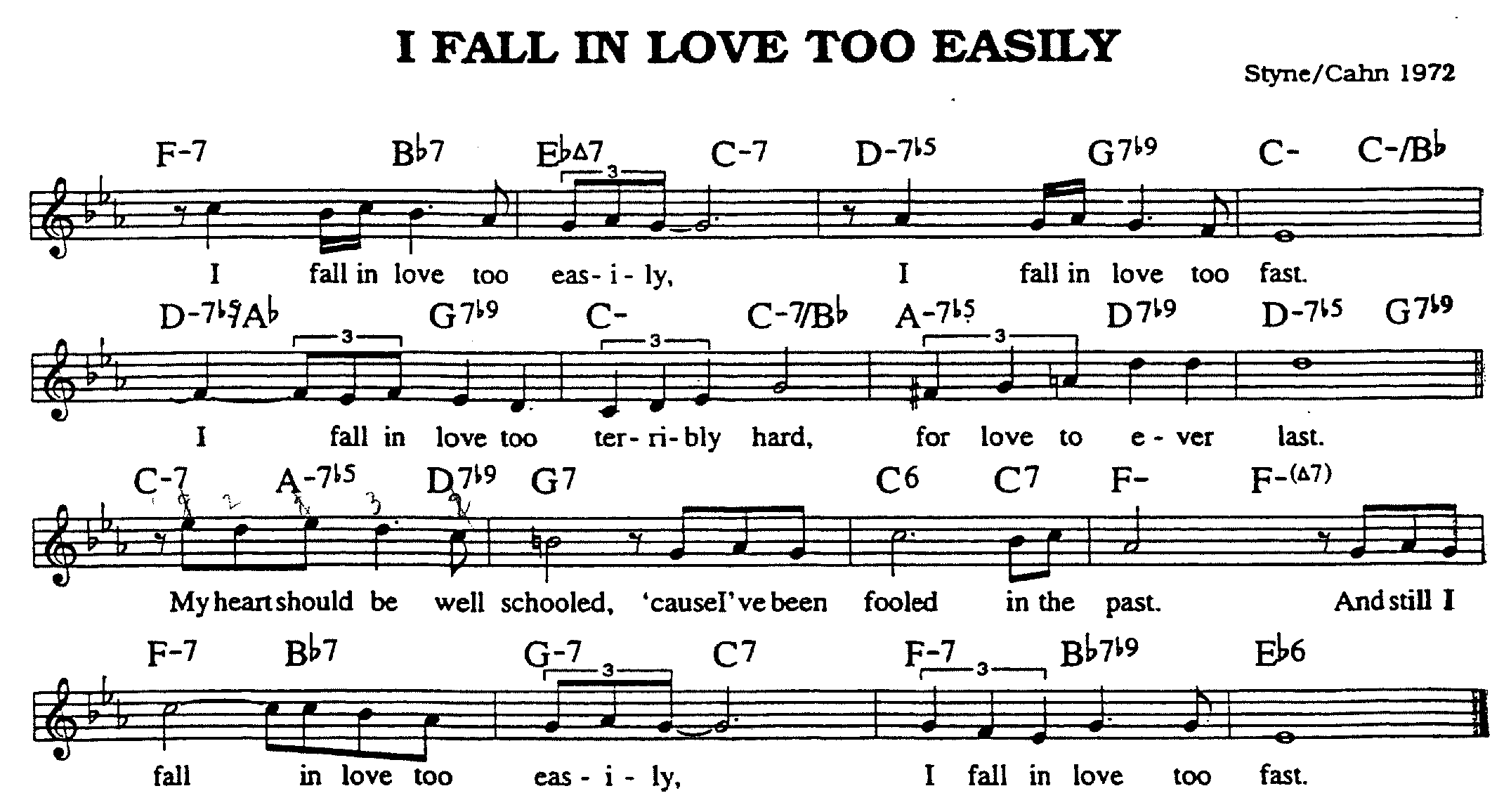
1. Song Overview
| Field | Details |
|---|---|
| Song | I Fall in Love Too Easily |
| Composer | Jule Styne |
| Lyricist | Sammy Cahn |
| Year | 1944. The attached sheet's "1972" is not the composition date. Published sheet music bears a 1944 copyright, while later authorised charts explicitly identify 1972 as the copyright-renewal year. ([Sheet Music Singer][1]) |
| Original context | Written for the MGM film Anchors Aweigh (1945), where it was introduced by Frank Sinatra. The song received an Academy Award nomination for Best Song. ([Oscars][2]) |
| Lead-sheet key | E-flat major |
| Form | 16 bars, best understood macroscopically as AB, 8 + 8 bars, with an internal four-bar rhetoric of a - a' - b - a''. The lead sheet places a double bar after bar 8. |
| Principal tonal centres | E-flat major; extended C minor emphasis; implied G minor; brief C major tonicisation; F minor tonicisation; return to E-flat major |
| Common jazz classification | 16-bar Great American Songbook ballad and jazz standard; commonly performed at ballad or medium-ballad tempo. ([JGC][3]) |
The song’s premise is unusually compressed. The speaker does not describe a particular beloved, an encounter, or even the circumstances of a romance. Instead, the lyric is a diagnosis of the speaker’s own behaviour. Falling in love is presented simultaneously as effortless and excessive: entry into love happens “too easily”, while the emotional commitment that follows is “terribly hard”. That collision between ease and intensity is the governing contradiction of the song. The problem is not inability to love, but an inability to regulate love. The speaker recognises the pattern, understands that previous experience ought to have corrected it, and nevertheless repeats it.
Styne’s setting makes that psychological circularity audible. The melody begins away from the tonic, over a ii-V progression, and the harmony repeatedly diverts towards C minor before the home key has had time to become secure. The song therefore begins as though the speaker has entered an emotional process already in motion. Temporary dominant chains, descending bass motion, and tonicisations of C and F keep the centre mobile. Yet the melody itself is concise, largely stepwise, and memorable. The tension is not between an extravagant tune and restrained words. It is the reverse: the words admit emotional excess while the music contains that admission within an exceptionally economical 16-bar structure.
What distinguishes the song from many standards about romantic vulnerability is the degree of self-awareness. The speaker does not wonder whether love will be returned, nor blame a lover for betrayal. The central evidence has already been collected: previous love has produced painful experience, the heart “should” have learnt from it, and it has not. The final return therefore carries a particular irony. The harmony ultimately achieves E-flat major, but the lyric has made no comparable psychological progress. Musical closure and behavioural repetition coexist.
The attached lead sheet is also notably leaner than some later jazz charts. It retains direct functional progressions, the descending Cm to Cm/B-flat motion, the Fm to Fm(maj7) colour, and a clear final ii-V-I. Later jazz editions sometimes introduce more substitute dominants and reharmonisation. Those variants are useful historically, but they are not substituted into the analysis below.
2. Form and Dramatic Architecture
The lead sheet contains 16 bars, four bars per system, with a double bar after bar 8. There are no rehearsal letters, written introduction, coda, tag, first or second endings, or explicit repeated strains. The final E-flat6 is the written conclusion.
The most useful formal description is 16-bar AB, 8 + 8, but that description alone conceals the song’s internal symmetry. At four-bar phrase level it behaves like a compressed a - a’ - b - a” design. The first two four-bar units present and intensify the speaker’s diagnosis. The third becomes reflective and argumentative. The final four bars recover the opening melodic language and complete the cadence.
| Section | Bars | Tonal centre | Lyrical or dramatic function | Musical function |
|---|---|---|---|---|
| A, first phrase a | 1-4 | E-flat major moving towards C minor | States the fundamental problem: love arrives too readily and too quickly. | Opens with ii-V-I, immediately moves to vi/C minor, and ends without a full home-key cadence. |
| A, second phrase a' | 5-8 | C minor with an implied G minor detour | Intensifies the diagnosis and gives its consequence: such love cannot endure. | Reworks minor ii-V material, introduces a descending bass and an applied ii-V towards G minor, then redirects to the dominant of C minor. |
| B, contrasting phrase b | 9-12 | C minor, implied G minor, C major, then F minor | The speaker appeals to experience and reason: the heart ought to have learnt from past failure. | Reaches the melody's highest register, uses a chain of dominants, briefly brightens to C6, then converts C into C7 and tonicises F minor. |
| B, returning phrase a'' | 13-16 | F minor moving decisively to E-flat major | The adversative "And still I" collapses the attempted self-correction and restates the original pattern. | Recovers opening melodic material, passes through iii-V7/ii and ii-V, and finally gives an unambiguous E-flat6 cadence. |
This compression is central to the song’s effect. A conventional 32-bar AABA standard usually permits eight or sixteen bars of contrasting material before the opening idea returns. Here the entire psychological argument occupies half that span. Sammy Cahn later recalled that Styne seemed to expect the song to continue, but Cahn felt the final thought had already said everything necessary. That recollection accords unusually well with the finished form: the song stops because the speaker’s problem does not develop into a solution. (Wikipedia)
The most important formal transformation occurs between bars 9-12 and 13-16. The reflective material seems to initiate a new argument: experience ought to have educated the heart. Yet the syntax “And still I” is placed so that the sentence spills into the returning melodic material. The return is therefore not merely a reprise. It is the musical proof that the attempted lesson has failed.
3. Close Reading of the Lyrics
| Lyric or cue | Literal meaning | Literary and poetic reading | Emotional subtext | Musical and harmonic interaction |
|---|---|---|---|---|
| "I fall in love" | The speaker describes becoming romantically attached. | "Fall" is conventional romantic diction, but here its involuntary implication matters. One does not normally choose to fall. The verb places the speaker in the paradoxical role of both observer and victim of their own behaviour. | The confession is not triumphant. Even before the qualifiers arrive, the first-person declaration has the quality of a diagnosis. | The melody begins after a rest rather than with a square downbeat assertion. It starts over Fm7-B-flat7, ii-V in E-flat, so the sentence begins in harmonic motion rather than at tonic rest. |
| "too easily" | Love happens with insufficient resistance or discrimination. | "Too" converts what might otherwise be praise of emotional openness into criticism. "Easily" describes the mechanism of falling, not necessarily the depth of feeling. | The speaker already judges the impulse while admitting its power. | The three syllables of "easily" are compressed into a triplet figure. The word therefore moves with conspicuous fluency. The rhythmic ease mirrors its meaning without becoming caricatural. |
| "too fast" | Attachment develops more quickly than the speaker believes it should. | The repetition of "too" gives the lyric the syntax of an inventory: the speaker is listing symptoms. "Fast" adds time to the problem established by "easily". | The judgement becomes more severe because the behaviour is not only uncontrolled but premature. | "Fast" is sustained rather than hurried. This creates a small but telling musical irony: the word denoting speed is granted temporal space. Its first occurrence settles on E-flat melodically, but over Cm/Cm-B-flat rather than a stable E-flat tonic harmony. |
| "terribly hard" | The speaker falls deeply or intensely in love. | The phrase deliberately collides with "easily". Falling is easy; loving is hard. "Terribly" can mean extremely, but it also retains an undertone of suffering. | The problem is not superficial infatuation alone. Emotional investment is disproportionate to the ease with which it begins. | The second four-bar statement moves lower before climbing again, and the harmony remains centred on C minor. The darker tonal field makes the intensifier sound less playful than the opening admission. |
| "for love to ever last" | Love entered in this way is unlikely to endure. | The syntax converts personality into consequence. The speaker is not merely saying that love ends; the speaker identifies their own manner of loving as one reason permanence is impossible. "Ever" broadens the claim from one affair to a recurring pattern. | Fatalism enters the lyric. The speaker appears to know the outcome before a particular romance has even been described. | "Last" receives a long duration over the Dm7b5-G7b9 dominant area. The word literally lasts, but harmonically it is denied resolution. The sustained melodic D remains above harmony that still demands continuation towards C. |
| "My heart should be well schooled" | Experience ought to have taught the speaker emotional caution. | The heart is personified as a student. "Schooled" turns failed romances into lessons, while "should" introduces the language of rational obligation. Mind and heart are implicitly divided. | The speaker believes knowledge ought to produce self-control, but the modal verb already betrays the gap between what ought to happen and what does. | The line begins in the song's highest register. Instead of sounding coolly rational, the attempt at self-discipline produces the melody's greatest exposure. Harmonically the passage remains mobile, moving through Cm7, Am7b5 and D7b9 rather than resting. |
| "I've been fooled" | Previous romantic experience has involved disappointment or deception. | The passive construction is significant. The person who fooled the speaker is omitted. This keeps the lyric inward-looking but also permits a slight evasion of agency: the speaker remembers being acted upon while admitting that the larger behavioural pattern is their own. | Past hurt is the evidence upon which the speaker's self-criticism rests. The lyric briefly allows vulnerability to replace irony. | The dominant chain around D7 and G7 prevents the recollection from becoming a static memory. The past is harmonically active in the present. |
| "in the past" | These disappointments have already occurred. | The phrase seems to place pain safely behind the speaker, but the subsequent adversative immediately disproves that separation. | Past experience has produced knowledge without producing change. | The C6 sonority offers a brief, surprisingly bright point of local arrival. It is immediately converted to C7, so even apparent harmonic stability becomes preparation for another departure. |
| "And still I" | Despite everything just admitted, the speaker repeats the behaviour. | "Still" is the lyric's decisive word. It is temporal, adversative and psychological at once. It means despite the evidence, continuing even now. The sentence deliberately withholds the main verb until the opening idea returns. | This is the moment at which self-knowledge becomes helplessness. | The phrase sits over Fm and Fm(maj7), where the raised seventh E-natural gives the minor harmony an unsettled semitone tension. The syntax crosses the formal boundary into the returning phrase, pulling the music back towards the original confession. |
| Final return of "fall in love" | The original behaviour continues. | Repetition becomes argument. The lyric does not need a new image or conclusion because its failure to change is itself the conclusion. | Resignation replaces the earlier diagnostic distance. | The returning melodic motive is reharmonised through Fm7-B-flat7, Gm7-C7 and finally another Fm7-B-flat7. The ultimate E-flat6 cadence closes the composition while the words describe continuing instability. |
| Final "too fast" | The pattern remains unchanged. | Ending on the same judgement with which the first four bars concluded creates circularity rather than narrative resolution. | The speaker understands the problem completely and has solved none of it. | The final E-flat is now supported by E-flat6. The same melodic point that earlier occurred over relative-minor harmony finally receives tonic support. Harmonic resolution therefore arrives precisely where psychological resolution does not. |
Several literary devices operate with unusual economy. Anaphora is fundamental: the repeated first-person construction makes the lyric sound both confessional and compulsive. The adverbs form a progression from manner to speed to degree: easily, fast, terribly hard. The wording gradually reveals that the speaker’s vulnerability has more than one dimension. Love begins too readily, accelerates too quickly, and then acquires excessive emotional weight.
The opposition between “easily” and “hard” is particularly important. It is not a contradiction that needs resolving. It describes two stages of the same behaviour. The threshold into intimacy is too low; once crossed, emotional investment is too high. Cahn thereby avoids the simpler cliché of someone who merely has bad luck in love.
The lyric also changes its grammatical mode halfway through. The opening is declarative: this is what I do. The middle introduces obligation and explanation: this is what I ought to have learnt, and why. The final return abandons the argument. The most intellectually sophisticated part of the lyric produces no behavioural consequence.
4. Lyrical and Emotional Arc
Opening Position
The speaker begins with unusually complete self-knowledge. There is no gradual revelation that love may be dangerous. The defect is named immediately. This makes the tone closer to rueful confession than romantic discovery.
Yet the opening also contains a defensive element. By turning the problem into a general personal tendency, the speaker can speak about love without naming the person currently provoking it. The lyric therefore occupies an intermediate space between confession and concealment. The speaker reveals the pattern while withholding the immediate object of desire.
Development
The first development is quantitative. The initial problem is speed and susceptibility; the next statement reveals intensity. The emotional danger is therefore not merely that the speaker makes poor choices, but that each choice becomes serious too quickly.
The second development is retrospective. Past experience enters as evidence. The speaker invokes a rational model of learning: pain should produce caution. The heart is imagined as an educable faculty. This produces the song’s nearest approach to emotional distance.
That distance lasts only a few bars. “And still I” destroys the argument from experience. The song’s return is not a failure of compositional development. It is the dramatic result of that development.
Point of Greatest Tension
The most exposed passage is bars 9-12, beginning with the “heart” and “schooled” imagery and continuing through the recollection of being fooled. The melody rises to its highest register here, while the harmony becomes more mobile rather than less. Rational self-analysis is therefore set at the point of greatest musical pressure.
An equally important micro-climax occurs on “last”. The word is sustained while the harmony remains dominant-oriented. The speaker speaks of duration on music that refuses to arrive. The tension is not spectacular, but conceptually exact.
Resolution or Lack of Resolution
The composition achieves genuine tonal resolution and no genuine psychological resolution.
Bars 15-16 provide a conventional ii-V-I into E-flat6. There is no ambiguity about the written cadence. The lyric, however, has completed a circle. Experience has been acknowledged, judgement has been made, and the behaviour has been restated.
This is closer to resignation than acceptance. Acceptance would imply some changed relation to the pattern, perhaps compassion or deliberate choice. The song offers neither. The speaker simply knows.
Central Paradox
The central paradox is expressed in the collision between ease and difficulty: love begins too easily but is experienced too intensely.
A second paradox follows from it. The speaker is highly self-aware yet apparently unable to act on that knowledge. The lyric’s intelligence therefore becomes part of its sadness. Nothing is hidden from the speaker except the means of changing.
5. Detailed Harmonic Analysis
The global tonic is E-flat major. The three-flat key signature, opening Fm7-B-flat7-E-flatmaj7 progression and final E-flat6 all confirm this.
The song nevertheless gives C minor exceptional weight. C minor is not merely the diatonic vi chord of E-flat major. Bars 3-10 repeatedly use its minor ii-V vocabulary, so the relative minor becomes a psychologically important secondary centre. There are also brief implied or actual tonicisations of G minor, C major and F minor. None warrants describing the whole song as modulating permanently away from E-flat.
One notational point deserves mention. At bar 5 the scan appears to read Dm7b5/A-flat, although the slash is faint in the reproduction. The reading is strongly supported by the descending C-B-flat-A-flat bass logic across the surrounding bars. I therefore analyse it as Dm7b5 over A-flat rather than as a separate A-flat chord.
Roman numerals below are relative to the tonal centre identified in each row. Where a global E-flat-major interpretation is more illuminating, it is given explicitly.
| Bars | Lyric cue | Chords | Roman numerals | Tonal centre | Harmonic function and interpretation |
|---|---|---|---|---|---|
| 1 | Opening confession | Fm7 - B-flat7 | ii7 - V7 | E-flat major | A textbook predominant-dominant opening, but the song withholds tonic until the following bar. Beginning on ii produces immediate forward motion. |
| 2 | "easily" | E-flatmaj7 - Cm7 | Imaj7 - vi7 | E-flat major | Home is reached only briefly before slipping to the relative minor. The tonic therefore functions more as a point passed through than a place inhabited. |
| 3 | Second declaration | Dm7b5 - G7b9 | iiø7 - V7b9 in C minor; globally viiø7 - V7/vi | C minor | A complete minor ii-V strongly tonicises C minor. The altered dominant gives the relative-minor pull considerably more weight than a simple diatonic vi progression. |
| 4 | First "fast" | Cm - Cm/B-flat | i - i/B-flat bass | C minor | Resolution to C minor is immediately destabilised by the descending bass. The C-minor sonority is prolonged while the bass falls from C to B-flat. |
| 5 | Renewed "I fall..." | Dm7b5/A-flat - G7b9 | iiø7/A-flat - V7b9 | C minor | The A-flat bass continues the descending line C-B-flat-A-flat. The upper Dm7b5 sonority retains predominant function while inversion makes voice leading more important than root motion alone. |
| 6 | "terribly hard" | Cm - Cm7/B-flat | i - i7/B-flat bass | C minor | Another C-minor arrival again refuses root-position permanence. The repeated bass descent makes instability structural rather than decorative. |
| 7 | "for love to..." | Am7b5 - D7b9 | iiø7 - V7b9 of G minor | G minor implied | This is an applied minor ii-V towards G. The expected Gm does not materialise as a stable tonic, so the progression functions as an anticipatory dominant chain rather than a full modulation. |
| 8 | "last" | Dm7b5 - G7b9 | iiø7 - V7b9 | C minor | The harmony redirects immediately to the minor ii-V of C. The phrase therefore ends on G7b9, not on a resolved tonic. "Last" is supported by unresolved harmonic demand. |
| 9 | "My heart..." | Cm7 - Am7b5 | i7; then iiø7 of implied G minor | C minor, then G minor implication | Cm finally resolves the previous dominant. Am7b5 immediately begins another applied progression, preventing the reflective lyric from becoming harmonically static. |
| 10 | "schooled / fooled" area | D7b9 - G7 | V7b9 of G -> V7 of C | G implied, then C | D7 reaches the expected root G but not the expected minor quality. G becomes a dominant seventh instead. This "dominant conversion" creates a descending-fifths chain D7-G7-C rather than a settled G-minor tonicisation. |
| 11 | "in the past" | C6 - C7 | I6 -> V7 of F | C major -> F minor | G7 resolves to an unexpectedly bright C major sonority. C6 is then converted into C7, so local tonic immediately becomes applied dominant. Globally this is a chromatic majorised VI moving to V7/ii. |
| 12 | "And still I" | Fm - Fm(maj7) | i - i(maj7) | F minor | C7 resolves to F minor. The major seventh E-natural produces the classic minor-major-seventh semitone tension, turning what might have been a restful ii chord into expressive tonic-minor colour. |
| 13 | Returning confession | Fm7 - B-flat7 | ii7 - V7 | E-flat major | The opening home-key ii-V returns. The F-minor tonicisation of bar 12 is retrospectively reinterpreted as the diatonic ii of E-flat. |
| 14 | "easily" | Gm7 - C7 | iii7 - V7/ii | E-flat major | Gm7 is diatonic iii. C7 is the applied dominant of Fm. The pair can be heard as a mixed-mode ii-V aimed at F, but because the target is Fm7, the home-key reading iii7-V7/ii is more precise. |
| 15 | Final "I fall..." | Fm7 - B-flat7b9 | ii7 - V7b9 | E-flat major | The definitive home-key predominant-dominant cadence. B-flat7b9 adds minor-colour tension without obscuring the dominant's function. |
| 16 | Final "fast" | E-flat6 | I6 | E-flat major | The first unequivocally sustained home-key closure. The added sixth softens the final sonority and keeps the cadence idiomatic to popular song rather than symphonically conclusive. |
The progression’s most characteristic feature is not chromatic substitution but sequential functional motion. Much of the chromaticism arises from applied dominants and minor ii-Vs. It would be misleading to call D7 or C7 tritone substitutions. D7 is an applied dominant whose expected G-minor resolution is transformed into G7; C7 is a straightforward dominant of F.
Voice leading is crucial. Bars 4-6 establish C and C/B-flat, with the bar-5 A-flat bass continuing a stepwise descent. The harmonic identity above that line changes, but the ear perceives the bass motion as connective tissue. This is one reason the passage feels inevitable rather than merely chord-dense.
Another notable device is the conversion of arrival chords into new dominants. G, rather than resolving as G minor, becomes G7; C, rather than remaining the local major tonic, becomes C7. Each apparent destination becomes another point of departure. That process is especially appropriate to a lyric about emotional behaviour that never settles where experience says it should.
Bar 12’s Fm(maj7) deserves separate emphasis. In global E-flat major, Fm is ordinary ii. The E-natural is not. It creates a semitone below the F root and gives the chord the sonority of tonic F minor rather than a purely functional predominant. Because C7 has just resolved to F, the ear can momentarily hear a genuine F-minor tonicisation. Bar 13 then lowers E-natural to E-flat within Fm7 and restores the chord’s home-key predominant identity.
Some common jazz charts use more elaborate substitutions in the latter half, including altered dominants and backdoor-type motion. One authorised New Real Book chart is considerably more reharmonised than the attached sheet. (Miguel Colombo) The present lead sheet’s relative simplicity is analytically important: its drama comes primarily from tonicisation, dominant conversion, bass-line motion and modal colouring, not from dense substitute harmony.
6. Tonal Journey
| Passage | Starting centre | Destination | Mechanism | Dramatic effect |
|---|---|---|---|---|
| Bars 1-2 | E-flat major, initially implied | E-flat major then C minor | ii-V-I followed immediately by vi | The home key is established but not allowed to stabilise. |
| Bars 3-6 | E-flat major | C minor | Dm7b5-G7b9-Cm; repeated C-minor prolongation | The relative minor becomes the emotional centre of gravity while the lyric catalogues the speaker's problem. |
| Bars 7-8 | C minor | G minor implied, then back towards C minor | Am7b5-D7b9 followed by Dm7b5-G7b9 | A possible new destination is raised and abandoned. Harmonic expectation itself becomes unstable. |
| Bars 9-11 | C minor | C major | Cm resolution, then D7-G7-C6 dominant chain | The reflective lyric briefly produces a brighter parallel-major arrival, as though rational understanding might clarify the situation. |
| Bars 11-12 | C major | F minor | C6 becomes C7, then resolves to Fm | Apparent clarity is immediately converted into another minor destination. |
| Bars 12-13 | F minor | E-flat major trajectory | Fm(maj7) becomes Fm7, then B-flat7 | Local tonic is reinterpreted as home-key ii. |
| Bars 14-16 | E-flat major | E-flat major | iii7-V7/ii, ii-V-I | The harmonic system finally behaves conventionally and closes, even though the lyric restates the unresolved behaviour. |
The tonal journey repeatedly sets up the possibility of settlement and then repurposes the would-be tonic. This occurs most clearly with G and C. The D7 suggests G as a destination, but G arrives as G7. G7 points to C, but C rapidly becomes C7. C7 points to F minor, and even F minor is converted into the ii chord of E-flat.
That chain produces a perceptual analogue for the lyric’s central condition. The speaker falls towards successive destinations but cannot remain in them.
The final tonic therefore matters. E-flat has appeared earlier, but only briefly in bar 2. Bar 16 is the first place where the music permits the home tonic to function as genuine closure. The irony is exact: the music achieves the stability the speaker cannot.
7. Melody and Prosody
The lead-sheet melody spans approximately C4 to E-flat5, a minor tenth, with most of its activity concentrated in the middle register around G4-C5. Published E-flat editions give the same vocal range. (Musicnotes.com) The range is modest enough for conversational delivery, but Styne reserves the upper part of it for the self-reflective middle passage rather than for the obvious opening refrain.
The opening motive begins around C5, scale degree 6 of E-flat major, rather than on the tonic. A characteristic chromatic B-natural acts as a lower neighbour to C. Some authorised jazz editions explicitly note that this B-natural, and the analogous E-natural inflection later in the melody, may alternatively be flattened. (Miguel Colombo) In the sharper reading, the semitone neighbour gives the apparently simple opening a small catch of instability before the line descends through B-flat and A-flat.
That detail matters because the melody otherwise avoids theatrical angularity. The phrase is primarily stepwise. Its emotional effect comes from timing, chromatic neighbours and harmonic placement rather than large leaps.
The principal phrases occupy two-bar units. Many begin after a rest, giving the melody an anacrustic, almost spoken quality. The speaker sounds as though the thought has formed before the voice enters. This quality is particularly effective at slow tempo, where silence becomes part of the sentence.
Triplet figures are integral to the lead sheet. “Easily” repeatedly receives a triplet subdivision, and similar triplet compression appears elsewhere in polysyllabic phrases. These figures reconcile natural speech with 4/4 metre. They also prevent the lyric from sounding overly square. The result is a melody that can be sung close to speech rhythm without losing formal symmetry.
Several word settings are especially pointed.
The first “fast” ends on E-flat, the global tonic pitch, but over C-minor harmony. Melody and key memory therefore imply arrival while the bass and chord deny it. At the final “fast”, essentially the same tonic pitch is supported by E-flat6 itself. The melodic destination has not changed; its harmonic meaning has.
“Last” is set to a prolonged D in the dominant region. D is scale degree 7 of E-flat, but more immediately it remains a stable upper note across the Dm7b5-G7 area. The duration is literal text-painting, yet the harmony underneath is unresolved. The word lasts while the relationship, harmonically, cannot.
Bars 9-10 rise into the highest part of the melody. The phrase concerned with the heart being “schooled” begins around E-flat5 and descends. This reversal is psychologically revealing. The speaker’s attempt to become rational is not set lower and calmer; it is the most exposed melodic statement in the piece.
The melodic chromaticism around bars 9-12 also intensifies. B-natural functions effectively against the G-dominant environment, while D-flat around the C7 region supplies an altered colour as the lyric turns towards remembered disappointment. These notes are not gratuitous “blue notes”. They articulate the harmonic chain.
The final return is rhythmically important. “And still I” functions as a lead-in to the reprise. The pronoun belongs syntactically to the returning sentence but is placed before the formal return. The music therefore does not merely start the opening phrase again. The previous reflective section pushes directly into it.
At the end, the final E-flat is long enough to register as closure but not melodramatically extended. The E-flat6 harmony underneath gives the cadence a relatively open popular-song sonority. The speaker’s statement stops cleanly, without a grand final gesture.
8. Word, Melody, and Harmony: Key Moments
| Moment | Lyric cue | Musical event | Interpretive significance |
|---|---|---|---|
| 1 | Opening "I" | Entry after a rest over Fm7 rather than tonic | The confession begins in medias res. Harmonic motion precedes emotional certainty. |
| 2 | "fall in love" | C-centred opening figure with a chromatic lower-neighbour inflection | The line circles its starting point rather than confidently progressing, foreshadowing the lyric's eventual circularity. |
| 3 | First "easily" | Triplet syllabification over E-flatmaj7-Cm7 | The word physically passes easily through the metre, while the harmony reaches tonic and immediately leaves it. |
| 4 | First "fast" | Long E-flat melodic note over Cm/Cm-B-flat | The word "fast" is temporally prolonged. The melody sounds locally conclusive while the harmony remains in relative minor. |
| 5 | "last" | Sustained D over Dm7b5-G7b9 | The word literally lasts, but the dominant refuses to resolve within the phrase. Permanence is represented by duration and contradicted by harmony. |
| 6 | "My heart should be well schooled" | Melody reaches its highest register while harmony moves through Cm7-Am7b5-D7b9 | The claim of rational self-discipline is the most emotionally exposed musical moment. Knowledge has not produced calm. |
| 7 | "in the past" | G7 resolves to C6, which immediately becomes C7 | A fleeting sense of clarity is transformed into another dominant. The past cannot be sealed off from the present. |
| 8 | "And still I" | Fm to Fm(maj7), with semitone tension, leading directly into the reprise | The adversative word is harmonically coloured by one of the song's most poignant sonorities. The attempted lesson collapses into repetition. |
| 9 | Returning "easily" | Familiar melodic material now supported by Gm7-C7 rather than the opening E-flatmaj7-Cm7 environment | The repetition is not psychologically identical. The same confession is now caught inside stronger dominant motion. |
| 10 | Final "fast" | E-flat melody over E-flat6 | Harmonic closure is complete. The lyric remains circular. Music has resolved what the speaker has not. |
The comparison between the two settings of “fast” is particularly revealing. The pitch itself does not need to change for its meaning to change. In bar 4, E-flat belongs to the global tonic but is harmonised as the third of C minor. At bar 16, E-flat finally becomes both melodic tonic and harmonic root. The song thus distinguishes tonal recognition from tonal possession in much the same way that the lyric distinguishes self-knowledge from self-control.
9. Historical and Cultural Context
“I Fall in Love Too Easily” was copyrighted in 1944 by Leo Feist, Inc. The surviving published sheet identifies Sammy Cahn as lyricist, Jule Styne as composer and Frank Sinatra as the singer associated with MGM’s Anchors Aweigh. (Sheet Music Singer) The attached lead sheet’s “1972” consequently should not be read as the year of composition. Authorised later charts explicitly print “©1944 (renewed 1972)”, which almost certainly explains the number reproduced in this chart. (Miguel Colombo)
Styne and Cahn were already an important Hollywood songwriting partnership by this period. Styne had worked as a film arranger and vocal coach before becoming one of the major popular-song and theatre composers of his generation. PBS notes that the Styne-Cahn partnership produced several romantic ballads closely associated with Sinatra, including this song. (PBS)
The original context is MGM’s Anchors Aweigh, released in 1945 and starring Gene Kelly, Frank Sinatra and Kathryn Grayson. Sinatra plays Clarence Doolittle, a shy and comparatively inexperienced sailor, in deliberate contrast with Kelly’s more confident Joe Brady. The film’s plot sends the sailors through a comic romantic entanglement during shore leave in Hollywood. (Wikipedia)
The song is performed by Sinatra at the Hollywood Bowl, in a comparatively solitary setting. Contemporary and later accounts repeatedly note the empty or deserted Bowl as an essential part of the sequence. (Jazz Standards) That context matters. Within a film otherwise rich in spectacle, dance and comic energy, the song temporarily suspends external action. Clarence does not seduce someone with it. He analyses himself.
The screen situation also clarifies the lyric’s lack of a named addressee. It is effectively an interior monologue. The person listening most critically is the speaker.
The film received five Academy Award nominations and won for scoring of a musical picture. “I Fall in Love Too Easily” itself was nominated for Best Song; the award went to Rodgers and Hammerstein’s “It Might as Well Be Spring” from State Fair. (Oscars)
Sinatra recorded the song for the film in Hollywood in September 1944, and he made a separate Columbia recording on 1 December 1944 with Axel Stordahl’s orchestra. (MusicBrainz) The commercial recording helped detach the song from its film narrative and establish it as a stand-alone popular ballad.
Its movement into jazz was facilitated by several compositional features. It is only 16 bars long, the melody is clear and singable, and the harmony is sufficiently functional to be memorable while containing enough minor ii-V material and dominant chains for improvisational development. The tune could therefore be reduced from MGM orchestral scale to a quartet, piano trio, trumpet feature or voice-and-piano performance without losing its identity.
Chet Baker’s recordings in the early 1950s were particularly important to its jazz identity. Discographical records show Baker recording the song in October 1953 and again in February 1954 with Russ Freeman, Carson Smith and Bob Neel; it became part of the material associated with Chet Baker Sings. (Jazz Disco) His restrained vocal manner shifted the song away from Hollywood crooning towards the cool-jazz language of the period.
Miles Davis subsequently made it a significant instrumental ballad. His studio version was recorded on 16 April 1963 and issued on Seven Steps to Heaven. Davis’s official site describes it as a trumpet feature that he continued to favour in live performances through the 1960s. (Miles Davis Official Site) This persistence is notable because Davis’s repertoire was changing rapidly during those years. The tune proved capable of surviving not only stylistic modernisation but a progressively more abstract approach to standard harmony.
The song’s endurance is therefore not simply a consequence of the Sinatra film performance. It has repeatedly supported radically different kinds of intimacy: Sinatra’s young crooner, Baker’s cool vulnerability, Davis’s muted instrumental austerity, Evans’s piano-trio introspection and Horn’s extreme patience.
10. Significant Interpretations
| Performer | Recording or period | Interpretive character | What it reveals about the song |
|---|---|---|---|
| Frank Sinatra | Anchors Aweigh film performance, 1944 recording / 1945 film; Columbia recording, 1944 | Direct, youthful and introspective; the Hollywood Bowl setting gives the number the feeling of a private admission made in a public space. ([Jazz Standards][9]) | Establishes the lyric as self-address rather than conventional serenade. The relatively unembellished dramatic situation makes the song's economy central. |
| Chet Baker | Chet Baker Sings, sessions 1953-54 | Light vocal weight, restrained vibrato, cool-jazz understatement, with trumpet and voice inhabiting similar lyrical space. ([Jazz Disco][11]) | Demonstrates how little overt emotional rhetoric the song requires. Baker's detachment can sound more vulnerable than an overtly tragic reading because the lyric itself supplies the pain. |
| Bill Evans Trio | Moon Beams, 1962 | Compact piano-trio ballad, finely voiced harmony, subdued pulse and brush texture. The recording features Evans, Chuck Israels and Paul Motian. ([Craft Recordings][13]) | Reveals the composition's suitability for instrumental interpretation. Without lyrics, harmonic colour and delayed melodic phrasing carry the psychological ambiguity. |
| Miles Davis | Seven Steps to Heaven, 1963, and later live versions | Spacious trumpet ballad with substantial use of silence and melodic reduction. The studio version features Victor Feldman, Ron Carter and Frank Butler. ([Miles Davis Official Site][12]) | Shows that the tune can sustain extreme melodic economy. Its short form and functional harmony become a frame for phrasing rather than an invitation to fill every change. Davis's continued use of the tune into the late 1960s shows unusual durability within his rapidly changing repertoire. |
| Keith Jarrett, Gary Peacock, Jack DeJohnette | Standards, Vol. 2, recorded 1983, released 1985 | Expansive piano-trio treatment with flexible pulse and interactive time. ([YouTube][14]) | Demonstrates that a 16-bar popular song can support a much larger improvisational timescale. The compact written form becomes a recurring harmonic cycle rather than a restriction. |
| Shirley Horn | I Remember Miles, 1998 | Very slow, spare vocal-piano treatment, framed as part of a tribute to Miles Davis. Contemporary commentary specifically noted Horn's unhurried ballad aesthetic and the connection to Davis's repertoire. ([The Washington Post][15]) | Returns the song to words while retaining the spaciousness associated with Davis. At very slow tempo, the lyric sounds less like rueful wit and more like mature recognition of an enduring pattern. |
Sinatra and Baker offer a particularly revealing contrast. Sinatra’s original performance exists within a narrative in which the singer is young, shy and newly susceptible. Baker’s delivery strips away much of that narrative specificity. His near-neutral tone can make the words sound less like a complaint about one infatuation and more like a fixed condition of personality.
Davis goes further by removing the lyric altogether. The melodic hesitations, dominant deferrals and minor regions remain sufficient to imply vulnerability without words. This is one reason the composition became more than a singer’s standard.
Horn’s later performance effectively closes that historical circle. I Remember Miles explicitly engages with Davis’s repertoire, and her treatment restores the lyric to a musical world of very large spaces. The result makes the text sound retrospective in a different sense from Sinatra’s youthful version. The words have not changed; the implied life behind them has.
11. Place in the Jazz Canon
The tune has endured because its brevity is an advantage rather than a limitation. A 16-bar form permits improvisers to cycle through the composition quickly, but the harmonic rhythm is dense enough to prevent monotony. Minor ii-Vs, applied dominants and reinterpretations of destination chords provide multiple routes for voice leading.
Its strongest improvisational lesson is that the chord symbols should not be treated as sixteen unrelated harmonic events. The first half is largely a conversation between E-flat major and C minor. The applied Am7b5-D7b9 progression suggests G minor but does not grant it independent structural status. D7 then participates in a larger D-G-C descending-fifths sequence. C becomes the dominant of F, and F minor is ultimately absorbed back into E-flat as ii.
An improviser who understands those destinations can make long lines across several chords. Someone who merely applies a different scale to every symbol risks making this very short form sound fragmented.
The descending bass logic is equally important. Cm to Cm/B-flat and the A-flat bass under Dm7b5 give the early section a contrapuntal identity. A strong solo can acknowledge that bass descent melodically without literally outlining each root.
The melody also provides excellent motivic material. Its small intervals, chromatic neighbours and repeated rhythmic shapes invite diminution, rhythmic displacement and sequence. Because the original tune is restrained, even modest alterations register clearly.
The short form presents a practical challenge at jam-session tempo: it is easy to lose the midpoint or assume a 32-bar cycle through habit. The distinction between bar 8’s unresolved G7b9 and bar 16’s genuine E-flat6 is therefore essential to formal orientation.
Reharmonisation is possible and historically common, but the composition does not need dense substitution to become harmonically interesting. The danger is obscuring the very functional trajectories that give the lyric and melody their shape. In particular, the C-minor emphasis and the final return through Fm7-B-flat7 should remain perceptible even in a modernised arrangement.
12. Interpretive Considerations for Performers
The song benefits from an emotional stance that recognises the difference between confession and self-pity. The speaker already understands the pattern and states it with unusually little rhetorical decoration. Excessively tragic delivery can therefore weaken the lyric by supplying an emotional conclusion that Cahn deliberately avoids.
The repeated phrase “I fall in love” should not necessarily be performed identically each time. The first statement is diagnostic. The second intensifies the problem. The final return follows the admission that experience has failed to change anything. Identical notes can therefore carry different degrees of resignation.
The adverbs are important, but they should not all receive equal emphasis. “Easily” has natural rhythmic animation because of the triplet setting. Over-accenting it can make the prosody fussy. “Too”, by contrast, is structurally significant because it converts romantic susceptibility into excess.
“Still” is arguably the most important word in the lyric. It marks the failure of the entire rational middle argument. A singer can make this audible through timing rather than volume. A slight suspension before or after the word can be more effective than dramatic stress.
The long settings of “fast” and “last” deserve restraint. Their semantic irony already exists in the composition. Overplaying it risks turning sophisticated text-setting into obvious word-painting.
At ballad tempo, the rests before phrases should remain audible. Filling them with vocal ornament or instrumental pickups changes the character from hesitant self-observation to continuous melodic display.
For instrumentalists, the melody’s chromatic neighbour tones should not automatically be normalised into chord tones. The semitone gestures near the opening and bar 5 are part of the tune’s identity. Likewise, the sustained dominant-region note on “last” is expressive precisely because it does not resolve conventionally within the phrase.
Harmonic landmarks worth preserving include the opening ii-V-I, the repeated Dm7b5-G7b9 pull towards C minor, the Am7b5-D7b9 applied progression, the G7-C6 resolution, the immediate conversion of C6 to C7, Fm-Fm(maj7), and the final home-key ii-V-I.
The Fm(maj7) is especially vulnerable to over-reharmonisation. Replacing it with a busier dominant sequence can be effective in an instrumental arrangement, but it removes one of the lead sheet’s clearest instances of expressive inner-voice tension.
Tempo alters the speaker’s apparent psychology. At a very slow tempo, the song can sound retrospective, exhausted or painfully self-aware. At a moderate ballad tempo, its wit and economy become clearer. Faster versions bring the paradox of “too fast” to the foreground but risk losing the stillness in which the lyric’s self-observation operates.
A singer may also choose whether the final cadence sounds resigned or merely factual. Holding the last tonic too long can create a sense of closure stronger than the words justify. A relatively plain ending can preserve the distinction between harmonic completion and an unchanged emotional pattern.
13. Final Reading
“I Fall in Love Too Easily” is fundamentally about the failure of knowledge to govern desire. Its speaker is not naïve. Every element required for rational correction is already present: repeated experience, memory of disappointment, the ability to identify the pattern, and even a theory of why the pattern is destructive. None of these produces change. The song’s sadness lies less in failed romance than in the discovery that understanding oneself is not the same as controlling oneself.
Cahn makes that idea unusually powerful by refusing narrative detail. There is no portrait of the beloved, no accusation, no scene of separation. The lyric therefore cannot externalise its problem. The speaker is both witness and subject. Even the passive recollection of having been “fooled” ultimately returns to the first-person verb “I fall”. Whatever other people may have done, the recurring mechanism belongs to the speaker.
Styne’s harmony complicates that self-knowledge by repeatedly converting destinations into transitions. E-flat is reached early but immediately gives way to C minor. G is approached but transformed into G7. C arrives as a bright C6 and almost at once becomes C7. F minor sounds temporarily like a destination before being reinterpreted as the ii chord that returns the music to E-flat. The harmonic grammar therefore embodies a condition in which arrival is perpetually provisional.
The melody is more restrained than the harmony. It avoids grand theatrical leaps and instead depends on small intervals, semitone inflections, triplet compression and carefully chosen sustained notes. That restraint is essential. A more demonstrative melody might make the lyric sentimental. Styne instead allows a relatively conversational line to pass through harmonies that reveal more instability than the speaker’s diction does.
The two long words “fast” and “last” summarise the sophistication of the setting. “Fast” is slowed by duration. “Last” is allowed to last while the harmony beneath it remains unresolved. Neither device is merely pictorial. Both expose the mismatch between what the speaker wants language to mean and what the musical process actually permits.
The final E-flat6 is therefore both satisfying and deceptive. The ear receives the cadence it has been denied for much of the song. Yet nothing comparable has happened in the speaker. The final statement describes the same tendency with which the song began. Formally, the composition has completed a journey; psychologically, the speaker has completed a circle.
The song’s central artistic insight is that self-awareness can coexist perfectly with repetition. The harmony eventually finds home. The speaker already knows where home is, but keeps falling before reaching it.