1. Song Overview
| Field | Details |
|---|---|
| Song | I'm in the Mood for Love |
| Composer | Jimmy McHugh |
| Lyricist | Dorothy Fields |
| Year | 1935 |
| Original context | Walter Wanger's film Every Night at Eight, released by Paramount; introduced on screen by Frances Langford |
| Lead-sheet key | C major |
| Form | 32-bar AABA, more precisely A-A'-B-A' because of the alternative endings |
| Principal tonal centres | C major; brief D-minor and C-minor colouring; E minor tonicisation; dominant-side motion towards G |
| Common jazz classification | Great American Songbook ballad; 32-bar AABA jazz standard |
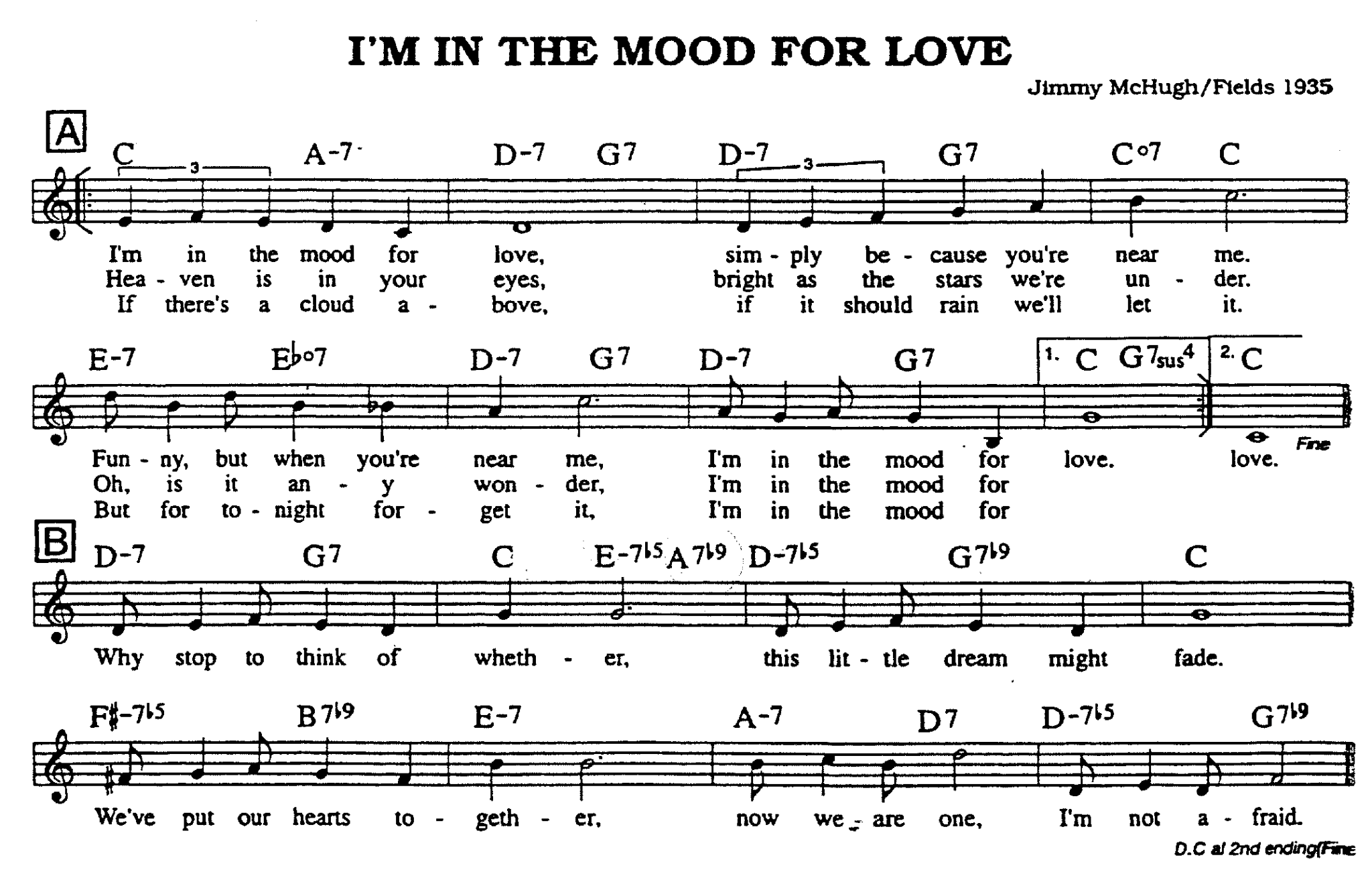
The attached lead sheet presents only the familiar 32-bar refrain. It does not include the introductory verse found in fuller versions of the song. That omission is consistent with later jazz practice, where the refrain became effectively autonomous. The song was written by Jimmy McHugh and Dorothy Fields for the 1935 film Every Night at Eight, in which Frances Langford introduced it; contemporary bibliographic evidence also confirms Robbins Music’s 1935 publication of the song. (AFI Catalog)
Its central premise is deliberately smaller than the grand declarations common to romantic popular song. The speaker does not initially announce permanent love, destiny or fidelity. The crucial noun is “mood”: love is presented first as a present state generated by physical proximity. Fields then spends the remainder of the lyric trying to enlarge that temporary state into something that sounds permanent. The progression is therefore from sensation to idealisation, from idealisation to anxiety, and finally from anxiety to a conscious decision not to examine the future too closely.
McHugh’s setting makes that progression more complicated than the lyric’s surface ease suggests. The A sections repeatedly return to an accessible C-major framework, but they are filled with ii-V motion and chromatic diminished chords rather than static tonic harmony. The bridge introduces still darker half-diminished and altered-dominant sonorities exactly when the possibility of loss is admitted. Most revealingly, the assertion of fearlessness near the end of the bridge is made over an unresolved G7b9 sonority. The words claim emotional security while the music remains intensely prospective. Only the final second ending supplies an unambiguous melodic and harmonic C.
The song therefore differs from a simple romantic affirmation. Its deeper subject is the deliberate suspension of doubt. Love is experienced as real in the present, while the speaker recognises that permanence cannot actually be guaranteed. The final A section does not defeat the imagined storm; it declares that the storm can be ignored for one night. That temporal limitation is the lyric’s most important qualification.
2. Form and Dramatic Architecture
| Section | Bars | Tonal centre | Lyrical or dramatic function | Musical function |
|---|---|---|---|---|
| A1 | 1-8 | C major | Establishes the speaker's present state and attributes it to the lover's proximity | Introduces the principal melody; repeated ii-V motion surrounds rather than merely confirms tonic; first ending turns back through G7sus4 |
| A2 | 9-16 | C major | Idealises the lover through celestial imagery and restates the refrain with greater confidence | Reuses the A melody and harmony; second ending gives firmer C-major closure before the bridge |
| B | 17-24 | C major with D-minor/C-minor colouring, E-minor tonicisation and dominant-side motion | Introduces the possibility that the relationship may be temporary; the speaker argues against dwelling on that possibility | Harmonic density increases markedly through half-diminished chords, altered dominants and applied ii-V progressions |
| A3 | 25-32 | C major | Recasts anxiety as an external storm and chooses present enjoyment over future speculation | Returns literally to the A strain; second ending and Fine provide final tonic closure |
The notation economises the form. Rehearsal mark A is an eight-bar strain with three lyric layers. The first pass uses the first ending, whose C to G7sus4 turnaround sends the music back to the beginning for A2. The second pass takes the second ending into rehearsal B. After the eight-bar bridge, the instruction D.C. al 2nd ending (Fine) sends the performer back to A for the third set of lyrics, bypassing the first ending and finishing on the second-ending C.
Conceptually, therefore, the listener hears the standard 32-bar architecture:
A1 - A2 - B - A3
The dramatic effectiveness comes partly from the fact that the same A music acquires three different meanings. In A1 it expresses spontaneous attraction. In A2 it becomes idealisation. In A3, after the bridge has exposed the possibility of loss, identical musical material functions as reassurance. The return has not erased what the bridge revealed.
The first ending is especially important. A1 does not conclude decisively because its C harmony is immediately connected to G7sus4 and the repeat. A2 and A3 use the second ending, where the final tonic is allowed to stand. Formally, the score therefore distinguishes provisional affirmation from completed affirmation even before the lyric is considered.
3. Close Reading of the Lyrics
| Lyric or cue | Literal meaning | Literary and poetic reading | Emotional subtext | Musical and harmonic interaction |
|---|---|---|---|---|
| "mood for love" | The speaker presently feels romantically receptive. | "Mood" is deliberately provisional language. It describes a condition rather than a permanent identity or promise. | The opening is confident but carefully limited. The speaker reports feeling rather than making a vow. | The melody begins around scale degree 3 and descends through 4-3-2-1. The word associated with love reaches C while the underlying progression is already moving through Am7 towards ii-V territory, so melodic tonic does not yet equal structural finality. |
| "because you're near me" | The lover's physical presence causes the feeling. | Fields makes proximity, not abstract destiny, the efficient cause of love. The diction is almost conversationally logical: emotion is explained by "because". | The speaker's emotional state appears dependent upon circumstance. That dependency will matter once impermanence is considered. | The phrase is one of the score's clearest melodic gestures: a largely stepwise ascent from the lower register towards the upper tonic C. The ascent converts the simple causal explanation into the first real melodic expansion, with the arrival associated with the beloved's nearness. |
| "Funny, but when..." | The speaker remarks on the curious consistency of the reaction. | "Funny" creates self-observation. The speaker briefly stands outside the emotion and notices its mechanism. | There is mild self-consciousness beneath the romantic ease. | Em7 moves through E-flat diminished seventh towards Dm7. The chromatic bass motion E-E-flat-D and diminished colour give this apparently light observation a more unsettled harmonic character than the diction suggests. |
| Repeated "near me" idea | The lover's presence again produces the romantic state. | Repetition makes physical proximity the central condition of the first A section. It also creates a circular argument: love is proven by the feeling that occurs when the lover is present. | The speaker sounds certain about the present but says nothing about absence. | The repeated ii-V framework keeps the phrase moving forward. The music repeatedly departs from tonic and returns, mirroring the lyric's cycle of stimulus and emotional response. |
| "Heaven ... your eyes" | The speaker sees something heavenly in the lover's eyes. | This is conventional romantic hyperbole, but Fields uses it economically. The beloved is not described physically beyond the eyes; they become a portal through which idealisation occurs. | Immediate attraction has become elevation. The lover is being transformed from nearby person into romantic ideal. | It is sung to the same opening melody that previously described a mere "mood". The reuse enlarges the significance of the original tune without changing its musical syntax. |
| "stars we're under" | The lover's eyes are compared with the stars above the couple. | The image connects intimate and cosmic space. The eyes and the actual stars occupy parallel imaginative planes. | The speaker is now constructing a romantic environment around the relationship. | The A-section's rising second phrase again moves towards the upper register. What previously intensified "near me" now enlarges the surrounding scene. |
| "any wonder" | The speaker asks rhetorically whether the resulting emotion is surprising. | The question is not intended to invite doubt; its purpose is to make love appear inevitable. | The speaker is beginning to argue a case, not merely report a feeling. | The line sits over Em7-E-flat diminished seventh-Dm7-G7. The chromatic passing diminished chord introduces a slight contradiction: the language says the conclusion is obvious while the harmony briefly destabilises the route to it. |
| Second refrain | The speaker again asserts the romantic mood. | Repetition has changed function. The first refrain named a condition; the second sounds increasingly like confirmation. | Confidence has increased, but it remains confidence constructed through repetition. | The second ending permits a clearer C-major conclusion than the first ending. The resulting closure makes the claim sound more settled immediately before the bridge questions it. |
| "Why stop to think..." | The speaker asks why they should consider possible problems. | The line is rhetorically defensive. Merely asking the question introduces the very thought the speaker claims should be avoided. | Anxiety enters the song through attempted suppression. | The bridge initially gives an orthodox Dm7-G7-C gesture, but C is rapidly followed by Em7b5-A7b9. As the speaker advises against thinking, the harmony becomes more complicated and less securely major. |
| "little dream" | The relationship is acknowledged as something dreamlike that could end. | "Little" is both affectionate and diminishing. "Dream" retrospectively weakens the earlier certainty by admitting that the romance may depend on an idealised state. | This is the first explicit recognition of impermanence. | Dm7b5-G7b9 introduces minor-mode ii-V colour into C. The flattened fifth and altered dominant darken the sound precisely where fading becomes imaginable. |
| "might fade" | The dream could disappear. | The modal verb "might" is crucial. Nothing has been lost, but loss has entered consciousness as possibility. | The speaker is vulnerable because certainty can no longer be maintained without qualification. | The altered minor ii-V resolves to C, but the melodic cadence does not need to overstate tonic finality. Harmonic resolution arrives while the psychological question remains alive. |
| "hearts together" | The lovers have committed themselves emotionally. | The physical metaphor of joining hearts answers the preceding image of fading. It converts feeling into supposed union. | This is the speaker's principal evidence against insecurity. | F-sharp minor seventh flat five-B7b9 forms an applied minor ii-V into Em7. The music temporarily leaves the tonic's immediate orbit just as the lyric claims greater union. |
| "now we are one" | The speaker declares complete unity with the lover. | "One" is the lyric's strongest absolute. It is much more categorical than the opening word "mood". | The psychological escalation is complete: temporary feeling has been converted verbally into identity. | The melodic line reaches one of its highest and most emphatic points around D5 on "one". The underlying Am7-D7 points towards G rather than resting in C, so maximum verbal certainty coincides with forward-moving harmony. |
| "not afraid" | The speaker explicitly denies fear. | The need to deny fear demonstrates that fear has become relevant. This is Fields's most revealing piece of emotional indirection. | The line can be heard as courage, self-persuasion or both. | Dm7b5-G7b9 is one of the score's darkest cadential preparations. The melody holds F over G7b9, the dominant seventh requiring resolution to E when C returns. The claim of fearlessness therefore occurs at the point of maximum unresolved harmonic tension. |
| "cloud above" / "rain" | Adverse circumstances are imagined as weather. | The abstract fear of the bridge becomes externalised as a conventional storm metaphor. This makes anxiety easier to manage because it can now be treated as weather rather than as a flaw in the relationship. | The speaker is no longer denying possible trouble, only minimising its authority. | The familiar A melody returns. Its recognisability makes the threat sound containable, even though the listener remembers the altered dominants of the bridge. |
| "we'll let it" | If trouble comes, the lovers will allow it to happen. | This sounds almost stoic. The speaker no longer claims there will be no storm. | There is a genuine increase in composure, though not necessarily in certainty. | The rising A-section phrase again reaches its upper register. The melodic expansion that originally celebrated proximity now supports an act of acceptance. |
| "for tonight forget it" | Future difficulties will be ignored for the present evening. | "Tonight" is the lyric's decisive temporal qualifier. It quietly restores the provisional meaning embedded in the opening "mood". | The resolution is intentionally limited. The speaker chooses present experience over prediction. | The Em7-E-flat diminished seventh-Dm7 motion again introduces chromatic passing colour. The phrase of deliberate forgetting is therefore not set over untroubled tonic stasis. |
| Final refrain | The speaker returns to the original statement. | Because the bridge has intervened, identical words now mean something different. The final statement contains knowledge of fragility that the first statement lacked. | Love has not become certain; the speaker has chosen it despite uncertainty. | The second ending removes the G7sus4 turnaround and finishes on C. The final low tonic gives the strongest musical closure in the song, even though the lyric's temporal qualification remains psychologically active. |
Fields’s principal literary technique is not elaborate imagery but strategic qualification. “Mood”, “might” and “tonight” form a quiet semantic network. The song begins with temporariness, confronts possibility, and ends by accepting a limited temporal horizon. Against those words stand larger assertions such as heaven, united hearts and becoming “one”. The lyric’s depth comes from the friction between those two vocabularies.
The weather imagery is therefore not merely decorative. The bridge first allows doubt to exist internally as thought. The final A section relocates it outside the lovers as cloud and rain. Psychologically, that is a useful manoeuvre: an uncertain future becomes something that can happen around the relationship rather than something that defines it.
4. Lyrical and Emotional Arc
Opening Position
The speaker begins from immediate experience. The emotional state is presented as uncomplicated because its cause is visible and present: the lover is nearby. Yet the word “mood” prevents the opening from becoming a vow. The speaker knows what is happening now, not what will happen later.
The first A section therefore contains a subtle dependency. The beloved’s nearness produces the mood; absence is not considered. Musically, repeated ii-V motion reinforces this distinction between a secure tonal centre and a harmony that rarely remains still for long.
Development
The second A section intensifies the emotional language without changing the music. Physical proximity becomes celestial idealisation. The lover’s eyes are equated with heaven and stars, and the resulting emotion is declared self-evident.
The bridge changes the mode of discourse. The speaker begins arguing against reflection, which means reflection has already begun. The relationship is called a dream, and the possibility that it could disappear is openly named. The rhetoric then responds by escalating commitment: joined hearts become complete unity.
Point of Greatest Tension
The greatest tension occurs at “I’m not afraid”. It is simultaneously the lyric’s strongest denial of insecurity and the harmony’s most conspicuous refusal to settle.
The progression reaches Dm7b5-G7b9, a minor-coloured predominant-dominant pair, while the melody leaves the dominant seventh F unresolved. The next tonic is structurally inevitable, but it has not yet occurred. The speaker’s confidence therefore sounds less like proof than an act of will.
The preceding melodic emphasis on “one” strengthens this reading. The claim of absolute union occupies a high point, but the harmony beneath it is Am7-D7, a progression pointing away from the global tonic towards G. Verbal certainty is literally placed in harmonic motion.
Resolution or Lack of Resolution
The final A section produces genuine musical resolution but only qualified psychological resolution.
The tonal structure returns to C, the familiar melody is restored, and the final second ending closes on tonic rather than turning back through G7sus4. From the standpoint of form and cadence, the song concludes decisively.
The lyric does something more complicated. The threat has not been disproved. Instead, the lovers will allow the rain if it comes and suspend concern “for tonight”. This is acceptance mixed with emotional avoidance. It is more mature than the bridge’s denial, but less permanent than the language of becoming “one” initially suggests.
Central Paradox
The central paradox is certainty built upon acknowledged impermanence.
The speaker progresses from a temporary “mood” to an absolute declaration of unity, yet the decisive final strategy is to stop asking whether the relationship will last. The song can therefore be sung either as uncomplicated romantic optimism or as the portrait of someone consciously choosing present love in the absence of guarantees.
The harmony strongly supports the latter reading. C major is always recoverable, but it is repeatedly surrounded by chromatic diminished harmony, minor-mode ii-Vs and applied dominants. Security exists, but it is something repeatedly regained rather than passively possessed.
5. Detailed Harmonic Analysis
The global tonic is C major. The score does not establish any long secondary key strongly enough to require a full modulation in the classical sense. Rather, it uses tonicisation, modal colouring and chains of applied dominants to create temporary local centres.
The most important distinction is between C as structural tonic and the darker regions traversed in the bridge. E minor receives the clearest local tonicisation through F-sharp minor seventh flat five-B7b9-Em7. D minor is approached through Em7b5-A7b9, but its expected resolution is immediately darkened to Dm7b5, which is then reinterpreted as the half-diminished predominant of C.
| Bars | Lyric cue | Chords | Roman numerals | Tonal centre | Harmonic function and interpretation |
|---|---|---|---|---|---|
| 1, 9, 25 | Opening A phrases | C - Am7 | I - vi7 | C major | Tonic prolongation. Am7 shares C and E with the tonic and introduces gentle root motion without meaningfully weakening C. |
| 2, 10, 26 | First-line conclusion | Dm7 - G7 | ii7 - V7 | C major | Standard predominant-dominant motion. The phrase moves away from tonic immediately rather than resting on it. |
| 3, 11, 27 | Rising second phrase | Dm7 - G7 | ii7 - V7 | C major | Repetition of ii-V creates sustained directional energy beneath the scalar melodic ascent. |
| 4, 12, 28 | "near me" / "under" / "let it" | C°7 - C | CT°7/I - I | C major | C°7 is best heard as a common-tone diminished embellishment of tonic rather than a functional leading-tone chord. C is retained while E-flat and G-flat can resolve by semitone into E and G. |
| 5, 13, 29 | Third A-line opening | Em7 - E-flat°7 | iii7 - flat-III°7 | C major | Chromatic passing diminution. The bass descends E-E-flat on its way to D, while the diminished sonority intensifies otherwise smooth voice leading. |
| 6, 14, 30 | Third-line continuation | Dm7 - G7 | ii7 - V7 | C major | Conventional ii-V restoration after the chromatic passing chord. |
| 7, 15, 31 | Refrain preparation | Dm7 - G7 | ii7 - V7 | C major | A further ii-V delays final tonic and keeps the refrain cadentially active. |
| 8, first pass | First A ending | C - G7sus4 | I - V7sus4 | C major | Tonic is immediately converted into turnaround function. G7sus4 avoids a hard close and points back to bar 1. |
| 16, 32 | Second ending | C | I | C major | Full structural tonic. At bar 16 it closes A2 before the bridge; at bar 32 it supplies the Fine. |
| 17 | "Why stop..." | Dm7 - G7 | ii7 - V7 | C major | The bridge begins deceptively conventionally with an ordinary ii-V. |
| 18 | "...whether" | C - Em7b5 - A7b9 | I - iiø7/ii - V7b9/ii | C major, approaching D minor | C is reached but not allowed to remain stable. Em7b5-A7b9 forms a minor ii-V aimed at D. |
| 19 | "little dream..." | Dm7b5 - G7b9 | iiø7 - V7b9 | C with borrowed minor-mode colour | Instead of the expected Dm7, A7 resolves to Dm7b5. The chord is immediately reinterpreted as iiø of C minor, followed by an altered dominant of C. |
| 20 | "...fade" | C | I | C major | Major tonic resolves the minor-mode cadence. The return sounds brighter because of the preceding flattened scale degrees. |
| 21 | "hearts together" | F-sharp m7b5 - B7b9 | iiø7/iii - V7b9/iii | E minor | A clear applied minor ii-V prepares Em. Roots F-sharp-B-E create orthodox fifth motion. |
| 22 | "...together" | Em7 | iii7, locally i7 | E minor within C | Brief tonicisation of iii. It is the bridge's clearest local arrival away from C. |
| 23 | "now we are one" | Am7 - D7 | ii7/V - V7/V | G implied | A ii-V aimed at G. The expected G arrival is withheld. |
| 24 | "not afraid" | Dm7b5 - G7b9 | iiø7 - V7b9 | C, minor-mode dominant preparation | Rather than resolving D7 to G, D7 is transformed into Dm7b5: F-sharp falls to F and A to A-flat while D remains common. The harmony is thereby rerouted towards C. |
The A section’s harmonic language is predominantly functional but unusually mobile for such an apparently uncomplicated lyric. Bars 1-3 move from tonic prolongation into repeated ii-V progressions. Tonic is approached several times but rarely allowed to become inert.
The C°7 in bar 4 should not be called a tritone substitute. Its root is the tonic itself, and its most persuasive explanation is common-tone diminished embellishment. The chord’s chromatic pitches surround the stable notes of C major by semitone, creating a brief shimmer before tonic clarification.
The Em7-E-flat°7-Dm7 motion in bars 5-6 is a different diminished usage. Here the principal structural feature is the descending bass line:
E - E-flat - D
E-flat°7 is therefore a chromatic passing diminished chord. Its effect is contrapuntal as much as functional.
The bridge makes fifth relationships much more explicit. Bars 18-20 produce the root chain:
E - A - D - G - C
Yet the expected intermediate stability is repeatedly denied through half-diminished quality and altered dominants. Em7b5-A7b9 points towards D minor, but the arrival is Dm7b5 rather than Dm7. That alteration instantly converts the supposed destination into another predominant.
Bars 21-22 repeat the minor ii-V process one step higher in function:
F-sharp m7b5 - B7b9 - Em7
This is the most credible temporary tonal centre outside C. Even here, however, Em7 remains structurally iii of C.
Bars 23-24 contain one of the score’s best voice-leading devices. Am7-D7 initially promises a ii-V in G. G never arrives. Instead, D7 changes to Dm7b5 while retaining D and C-class material and lowering F-sharp to F and A to A-flat. The apparent dominant of G is transformed into the predominant of C. The progression does not merely change direction by roots; its internal voices perform the reinterpretation.
6. Tonal Journey
| Passage | Starting centre | Destination | Mechanism | Dramatic effect |
|---|---|---|---|---|
| A1 | C major | C major | Tonic prolongation, repeated ii-Vs, common-tone and passing diminished chords | Establishes emotional security while keeping the harmony in motion |
| A2 | C major | C major | Same structure with firmer second-ending tonic | Makes the repeated romantic claim sound more settled before doubt is introduced |
| Bridge opening | C major | D-minor region, then C | Em7b5-A7b9 followed by Dm7b5-G7b9-C | Introduces minor colour as the lyric acknowledges that the dream could disappear |
| Bridge middle | C major | E minor | F-sharp m7b5-B7b9-Em7 | Creates the strongest temporary departure from home during the assertion of emotional union |
| Bridge end | E-minor/G-oriented region | G7b9, then C | Am7-D7 is diverted into Dm7b5-G7b9 | Converts an apparent move towards G into a return preparation for C |
| A3 | C major | C major | Restoration of the complete A strain and second ending | Familiarity becomes reassurance after the bridge's instability |
The tonal journey is notable less for modulation than for repeated reinterpretation. C is never forgotten, yet the bridge makes it temporarily less inevitable. Half-diminished chords allow the harmony to borrow the rhetoric of minor-key ii-V progressions without permanently abandoning the major tonic.
The move towards E minor is particularly effective because iii is already diatonically contained within C major. The song can therefore sound as though it has travelled without actually severing its relationship to home. This makes the tonal drama analogous to the lyric’s psychology: the speaker enters more troubled territory while remaining inside the same basic emotional world.
The Am7-D7 progression is another deliberate feint. A conventional jazz ear anticipates G. Instead, D7 darkens into Dm7b5 and redirects towards G7b9-C. The return is therefore achieved through reinterpretation rather than simple reversal.
The final C consequently feels earned. It is not powerful because the song has travelled to remote keys, but because C has repeatedly been made provisional, ornamented, tonicised around and briefly withheld.
7. Melody and Prosody
The notated melody spans approximately C4 to D5, a compact ninth suited to conversational ballad singing. Its expressive organisation is more important than its size. Most of the A material occupies the middle register, while a few carefully placed ascents give specific words greater rhetorical weight.
The opening is immediately memorable because it behaves almost like speech shaped into contour. The first phrase begins around scale degree 3 and traces approximately:
3 - 4 - 3 - 2 - 1
That small rise and descent gives the title phrase a relaxed, self-contained character. It does not begin with an ecstatic leap. The speaker sounds as though the thought has simply occurred.
McHugh then answers that compact phrase with a striking diatonic expansion. The phrase associated with the lover’s proximity rises stepwise through much of the C-major scale towards the upper tonic. In broad terms the line moves:
2 - 3 - 4 - 5 - 6 - 7 - 1
The expressive logic is unusually clear. The title phrase moves inward and downward; the explanation of why the mood exists opens outward and upward.
Triplet indications in the opening A phrases are also significant. They soften the square divisions of 4/4 and give the melody a lilting, spoken flexibility. In performance these figures should not become mechanically equalised. They function as part of the lyric’s conversational ease.
Because all three A sections use the same melody, textual substitution creates a form of semantic counterpoint. The same rising gesture culminates first in proximity, later in celestial imagery, and finally in acceptance of whatever weather may come. The melody itself does not grow more dramatic. The listener’s interpretation of it does.
The bridge is less circular and more argumentative. Its phrases extend the range and place stronger emphasis on individual declarations. The melodic high point around D5 on “one” is particularly important. In the global key it is scale degree 2, not tonic. The strongest verbal claim therefore receives a high note that still points beyond C rather than embodying C itself.
That D is also structurally appropriate over D7. It is the chord root, so the intensity does not depend upon harmonic dissonance. The emphasis comes instead from register and placement. McHugh reserves the melodic summit for the lyric’s most absolute statement.
The treatment of “afraid” is more psychologically ambiguous. The melody settles on F against G7b9. F is the dominant seventh of G7 and therefore possesses a strong tendency to descend to E when C returns. The note is harmonically legitimate but unresolved. This is an unusually precise musical equivalent of professed courage under pressure.
The final second-ending “love” falls to low C. That register matters. McHugh does not finish with the song’s melodic summit but with the fundamental pitch of the key in a comparatively grounded position. The effect is repose rather than triumph.
Prosodically, Fields’s short words and McHugh’s largely syllabic setting are mutually advantageous. Important nouns such as mood, love, eyes, dream, hearts and one remain intelligible. The music rarely forces unnatural stress onto them. Even the triplet figures feel like speech inflected by swing rather than syllables fitted awkwardly into metre.
8. Word, Melody, and Harmony: Key Moments
| Moment | Lyric cue | Musical event | Interpretive significance |
|---|---|---|---|
| 1 | "mood for love" | Compact 3-4-3-2-1 opening contour over tonic prolongation moving towards ii-V | The lyric begins as observation rather than proclamation; even its apparent melodic tonic is embedded in ongoing harmony |
| 2 | "you're near me" | Extended stepwise rise towards the upper tonic C | Physical proximity produces the song's first substantial melodic expansion |
| 3 | "Funny..." | Em7-E-flat°7-Dm7 with chromatic bass E-E-flat-D | Self-conscious amusement is accompanied by the A section's clearest passing chromaticism |
| 4 | "any wonder" | Rhetorical certainty occurs over another diminished-to-ii-V progression | The harmony is less self-evident than the speaker claims the emotion to be |
| 5 | "whether" | C is immediately followed by Em7b5-A7b9 | The advice not to think coincides with the moment the harmony itself becomes more analytically complex |
| 6 | "dream might fade" | Dm7b5-G7b9-C | Minor-mode cadence colours the first explicit acknowledgement of impermanence |
| 7 | "hearts together" | F-sharp m7b5-B7b9 resolves to Em7 | The assertion of union receives the bridge's clearest temporary tonicisation away from C |
| 8 | "we are one" | Melodic peak around D5 over Am7-D7 | Absolute verbal certainty is given registral emphasis while the harmony points onward towards an unrealised G |
| 9 | "not afraid" | F is held against Dm7b5-G7b9 and awaits resolution | The speaker denies fear over the strongest unresolved dominant tension in the form |
| 10 | "for tonight" | Familiar A melody returns over Em7-E-flat°7-Dm7 | The temporal qualification is accompanied by chromatic movement rather than static reassurance |
| 11 | Final "love" | Second ending settles on C without the first ending's G7sus4 turnaround | Formal and tonal circularity finally stop; the psychological question, however, has merely been bracketed for the night |
The eighth and ninth moments are especially revealing when heard together. The melody first climbs to support “one”, then the harmony refuses to ratify that absolute claim with tonic. The following denial of fear occurs on a dominant whose very function is to demand what comes next.
This is not necessarily deliberate word-painting in every compositional detail. Dm7b5-G7b9 is also a conventional jazz-era minor-mode preparation for C. Nevertheless, the coincidence is musically consequential regardless of whether it was conceived as explicit psychological symbolism.
9. Historical and Cultural Context
“I’m in the Mood for Love” was written by Jimmy McHugh and Dorothy Fields for the 1935 Walter Wanger production Every Night at Eight, directed by Raoul Walsh. Frances Langford, making her feature-film debut, introduced the song in the picture, and it became closely identified with her career. AFI dates the film’s release to 2 August 1935. (AFI Catalog)
McHugh and Fields were already an established songwriting partnership. Their collaboration had begun in the late 1920s and produced such durable songs as “I Can’t Give You Anything but Love”, “Exactly Like You”, “On the Sunny Side of the Street” and “Don’t Blame Me”. Their work moved from Cotton Club and Broadway contexts into Hollywood, part of a broader migration of prominent theatrical songwriters towards film during the Depression era. (Songwriters Hall of Fame)
That movement was part of a substantial transformation in American popular entertainment. The Library of Congress notes that film musicals had expanded rapidly after the arrival of synchronised sound, and that the contraction of Broadway employment during the Depression drew many leading songwriters to Hollywood. Movies, radio, swing and big-band music simultaneously served enormous popular audiences during the 1930s. (The Library of Congress)
The economic circumstances were still severe in 1935. The United States remained within the Great Depression, even though the worst contraction had bottomed in 1933. Federal Reserve historical material places the Depression across 1929-41 and records continuing very high unemployment in the middle of the decade. It would be reductive to turn “I’m in the Mood for Love” into a direct economic allegory, but its insistence upon immediate pleasure rather than future certainty belongs comfortably within a popular culture in which romance, musical comedy and cinematic escape had obvious appeal. (Federal Reserve History)
The song achieved commercial circulation almost immediately. Frances Langford recorded it for Brunswick on 31 July 1935. Contemporary hit versions also included Little Jack Little, Louis Armstrong and Leo Reisman; later chart research credits Little’s version with reaching number one, Armstrong’s with number three and Langford’s with number fifteen. (mgthomas.co.uk)
Armstrong’s recording is particularly important to the song’s jazz history. He recorded it in New York on 3 October 1935 at his first Decca session after returning to an American recording studio, with trumpet, vocal and a large orchestra. The song therefore entered jazz practice almost simultaneously with its life as a current popular hit rather than being rediscovered decades later as an old show tune. (michaelminn.net)
Its most extraordinary jazz afterlife came through James Moody. In 1949, while in Sweden, Moody recorded an improvised alto-saxophone performance over the song’s progression. Moody later recalled that the instrument was a borrowed alto rather than his usual tenor. Eddie Jefferson subsequently fitted words to Moody’s improvisation; King Pleasure’s 1952 recording helped turn the result into “Moody’s Mood for Love” and made it a landmark in the development and popularisation of vocalese. The National Endowment for the Arts identifies the episode as one of the defining events of Moody’s career. (American History Museum)
That development gave the composition an unusual double existence. One tradition treats McHugh’s original melody as a ballad standard. Another treats the harmonic framework as the foundation of a famous improvised melody that itself became standard repertoire. Few Great American Songbook tunes possess such a visible demonstration of the way jazz improvisation can generate a secondary composition.
10. Significant Interpretations
| Performer | Recording or period | Interpretive character | What it reveals about the song |
|---|---|---|---|
| Frances Langford | 1935 film and Brunswick recording | Period popular-ballad delivery closely tied to the song's Hollywood origin | Establishes the lyric as direct romantic address rather than as an abstract jazz vehicle. Langford recorded the title on 31 July 1935 after introducing it in Every Night at Eight. ([AFI Catalog][1]) |
| Louis Armstrong and His Orchestra | 3 October 1935, Decca | Vocal and trumpet interpretation in which melodic paraphrase and rhythmic personality displace the polite symmetry of the popular-song model | Demonstrates how quickly a current film song could become material for jazz individuality. The session personnel included Armstrong, Luis Russell, Pops Foster and Paul Barbarin. ([michaelminn.net][6]) |
| Nat King Cole Trio | 15 March 1946 | Intimate small-group setting with piano, guitar, bass and Cole's vocal | Reduces the composition to conversational scale. The absence of a large arrangement exposes both the economical melody and the continuous harmonic movement. The session featured Cole, Oscar Moore and Johnny Miller. ([jazzdisco.org][8]) |
| Charlie Parker with Strings | 1950 | Instrumental alto-saxophone reading in the lush Parker-with-strings aesthetic | Shows that the melody can withstand bebop-inflected phrasing while retaining its identity as a ballad. Parker's treatment places the standard inside the post-war meeting point between modern jazz improvisation and orchestral popular-song sonority. ([YouTube][9]) |
| James Moody | 1949 Swedish recording | Improvised alto line over the changes, eventually functioning almost as a new composition | Reveals the unusually fertile relationship between the progression and melodic improvisation. Moody's solo became the basis for Eddie Jefferson's vocalese and King Pleasure's 1952 hit "Moody's Mood for Love". ([National Endowment for the Arts][10]) |
| Julie London, Barney Kessel and Ray Leatherwood | Julie Is Her Name, 1955 | Extremely sparse voice-guitar-bass treatment; intimacy replaces orchestral sentiment | Demonstrates how little accompaniment the lyric requires. London's restrained delivery allows words such as "mood" and "tonight" to sound more provisional and sensual than theatrical. The recording features Kessel on guitar and Leatherwood on bass. ([Apple Music - Web Player][11]) |
Armstrong and Moody illustrate two fundamentally different jazz responses. Armstrong keeps the song recognisable while inflecting it with personal time, tone and paraphrase. Moody uses its harmonic skeleton as the basis for an improvisation sufficiently distinctive to acquire its own title, lyric and performance tradition.
The contrast between the Nat King Cole Trio and Julie London is equally instructive for singers. Both reduce orchestral weight, but Cole’s trio retains a gently swinging instrumental conversation, while London’s guitar-bass setting makes silence and breath unusually important. The lyric can therefore move from urbane swing to near-confessional intimacy without structural alteration.
Parker demonstrates another possibility: the words can disappear entirely while the song remains dramatically viable. The bridge’s chains of dominant function and the A section’s strong melodic landmarks provide enough architecture for an instrumentalist to create a coherent narrative without verbal explanation.
11. Place in the Jazz Canon
The composition’s durability comes first from structural efficiency. Its 32-bar AABA design is immediately legible, yet the internal harmony contains more detail than the lyric’s apparent simplicity suggests. The A strain gives the improviser repeated ii-V opportunities, smooth tonic prolongation and diminished passing colour. The bridge then supplies applied minor ii-Vs, a iii tonicisation and a deceptive dominant-side redirection.
The melody is equally practical. Its opening cell is concise enough to paraphrase freely, while the long scalar ascent of the answering phrase is distinctive enough to preserve identity even under ornamentation. This combination is valuable in jazz: a melody needs to be memorable without being so rhythmically or intervallically rigid that variation becomes awkward.
The tune also tolerates substantial tempo variation. At ballad tempo the half-diminished chords and altered dominants become expressive events in their own right. At medium swing the same progression becomes a fluid chain of voice-leading targets. The tune therefore survives both lyrical and instrumental approaches.
James Moody’s 1949 improvisation provides exceptional evidence of its improvisational fertility. The resulting “Moody’s Mood for Love” became sufficiently influential to establish a separate vocalese tradition, and the NEA specifically identifies it as one of the defining recordings of Moody’s career. (National Endowment for the Arts)
For an improviser, knowing the chord symbols is not enough. Several structural distinctions matter:
- C remains the true tonic even when half-diminished chords make the bridge sound briefly minor.
- Em7b5-A7b9 is an applied ii-V aimed at D, but D does not become a stable new key.
- F-sharp m7b5-B7b9 genuinely tonicises Em more strongly than most other secondary centres.
- Am7-D7 suggests G but is redirected before G can arrive.
- Dm7b5-G7b9 should be heard as a minor-mode approach to C rather than as evidence that the song has modulated to C minor.
- The diminished chords in the A section have different jobs: C°7 is a common-tone tonic embellishment, whereas E-flat°7 primarily participates in chromatic passing motion.
Those distinctions determine good melodic voice leading. Treating every chord as an isolated scale produces a far less coherent improvisation than hearing the progression as long-range movement towards C.
The tune is therefore pedagogically useful precisely because it sits between elementary and sophisticated harmony. Its surface contains familiar I-vi-ii-V grammar, while the bridge teaches applied minor ii-Vs, altered dominants, modal mixture and harmonic reinterpretation without abandoning the 32-bar standard form.
12. Interpretive Considerations for Performers
The principal danger for a singer is to make the lyric more certain than it is. A uniformly luxuriant romantic delivery can obscure the distinction between immediate feeling and permanent commitment. The opening benefits from conversational directness because the speaker is reporting a state rather than proclaiming destiny.
The word “mood” deserves particular attention. Overemphasising it can make the lyric sound cynical, but ignoring it removes the song’s essential qualification. The most effective readings generally allow the word’s provisional meaning to register without turning it into irony.
The first two A sections need not be emotionally identical merely because the melody is. A1 can remain observational. A2 can broaden through the celestial imagery and the rhetorical “wonder”. The bridge should then register as a genuine change in thought, not simply another eight bars before the final A.
The phrase concerning the fading dream is a natural place for increased harmonic awareness. Dm7b5-G7b9 already supplies sufficient darkness. A singer does not need to exaggerate vulnerability through excessive rubato or dynamic weight. Restraint often allows the harmonic alteration to do more of the dramatic work.
“Now we are one” is an obvious potential climax because of both the text and the melodic register. It need not be sung at maximal volume. A more restrained high point can make the following denial of fear more psychologically revealing.
The final bridge phrase deserves special care. The F over G7b9 is structurally active. Flattening the phrase into an indiscriminate blues inflection or resolving too early removes an important piece of tension. Instrumentalists should likewise be conscious that the dominant seventh’s resolution into the returning C harmony is one of the form’s strongest voice-leading events.
At the return to A3, an experienced performer can choose among several emotional stances. A buoyant return treats the bridge as doubt successfully overcome. A quieter return implies that the speaker has learned to live with uncertainty. A lightly ironic treatment of the “tonight” phrase can expose the temporal limitation without making the entire lyric cynical.
Tempo changes the song’s psychology substantially. At a slow ballad tempo, “mood”, “dream”, “afraid” and “tonight” acquire greater semantic weight, and the altered bridge harmony becomes conspicuous. At a medium swing, the same lyric can sound less defensive and more urbane, with the final decision to forget tomorrow functioning almost as wit.
Reharmonisation should preserve the distinction between the A section and bridge. Adding altered dominants to every ordinary ii-V can make the chromatic bridge less special. Conversely, simplifying all the half-diminished material into generic Dm7-G7 patterns removes exactly the harmonic darkening that gives the bridge its dramatic identity.
The C°7 and E-flat°7 chords are useful landmarks rather than obligatory museum pieces. A performer may substitute related voice-leading sonorities, but replacing both with generic dominants changes the texture. Their value is that they achieve chromatic movement without making every bar sound like an applied dominant sequence.
For an instrumental interpretation, familiarity with the lyric remains valuable. The ascending A phrase, the bridge’s high “one” and the unresolved “afraid” note offer natural structural points for improvisational contour. A solo that understands those locations can retain the composition’s dramatic proportions even when McHugh’s melody has largely disappeared.
13. Final Reading
“I’m in the Mood for Love” is fundamentally about the decision to inhabit a present emotional truth without demanding proof that it will survive. Its title is more precise than its familiarity sometimes allows us to hear. A mood is authentic while it lasts, but by definition it need not be permanent. Fields begins there and then lets the speaker spend the remainder of the lyric attempting to transform that temporary condition into something more absolute.
The speaker understands that love feels convincing in the beloved’s presence. What the speaker cannot know is whether feeling guarantees duration. The second A section responds to that uncertainty through idealisation: eyes become heaven, the surrounding sky fills with stars, and emotion begins to appear self-evident. Yet idealisation cannot logically answer the question of time. The bridge therefore introduces the question the earlier imagery had postponed.
McHugh’s harmony becomes most interesting precisely there. The A sections never lack motion, but their chromaticism is largely decorative and connective: common-tone diminution, passing diminished harmony, familiar ii-Vs. In the bridge, chromatic harmony becomes structural. Half-diminished chords and flat-nine dominants form entire applied cadential chains. C remains the global tonic, but its psychological security is temporarily weakened.
The lyric’s boldest statement, that the lovers have become one, does not produce a tonic apotheosis. The melody rises to one of its highest notes while Am7-D7 projects forward towards G. The subsequent assertion of fearlessness is still more revealing: Dm7b5-G7b9 places the voice on an unresolved dominant seventh. The composition does not have to contradict the speaker aggressively. It merely declines to confirm the claim until the next phrase.
The last A section is therefore not a return to innocence. Clouds and rain acknowledge the existence of the future problem. The speaker’s solution is neither proof nor surrender. The lovers will allow events to occur, but they will refuse to let hypothetical trouble invalidate the present evening. “Tonight” quietly brings the lyric back to the provisional world implied by “mood”.
The final tonic C is consequently both more and less conclusive than it appears. Musically, it is genuine closure. The second ending removes the turnaround, the low tonic settles the melodic line, and there is no remaining dominant obligation. Psychologically, however, nothing has established that tomorrow will resemble tonight. The song ends not with knowledge of permanence but with a choice about attention.
Its enduring artistic insight is that romantic certainty and romantic doubt need not cancel one another. The harmony repeatedly leaves security and finds it again; the lyric repeatedly approaches the future and retreats to the present. The final cadence does not prove that the love will last. It proves only that, for this moment, the speaker has decided that uncertainty is not sufficient reason to refuse it.