1. Song Overview
| Field | Details |
|---|---|
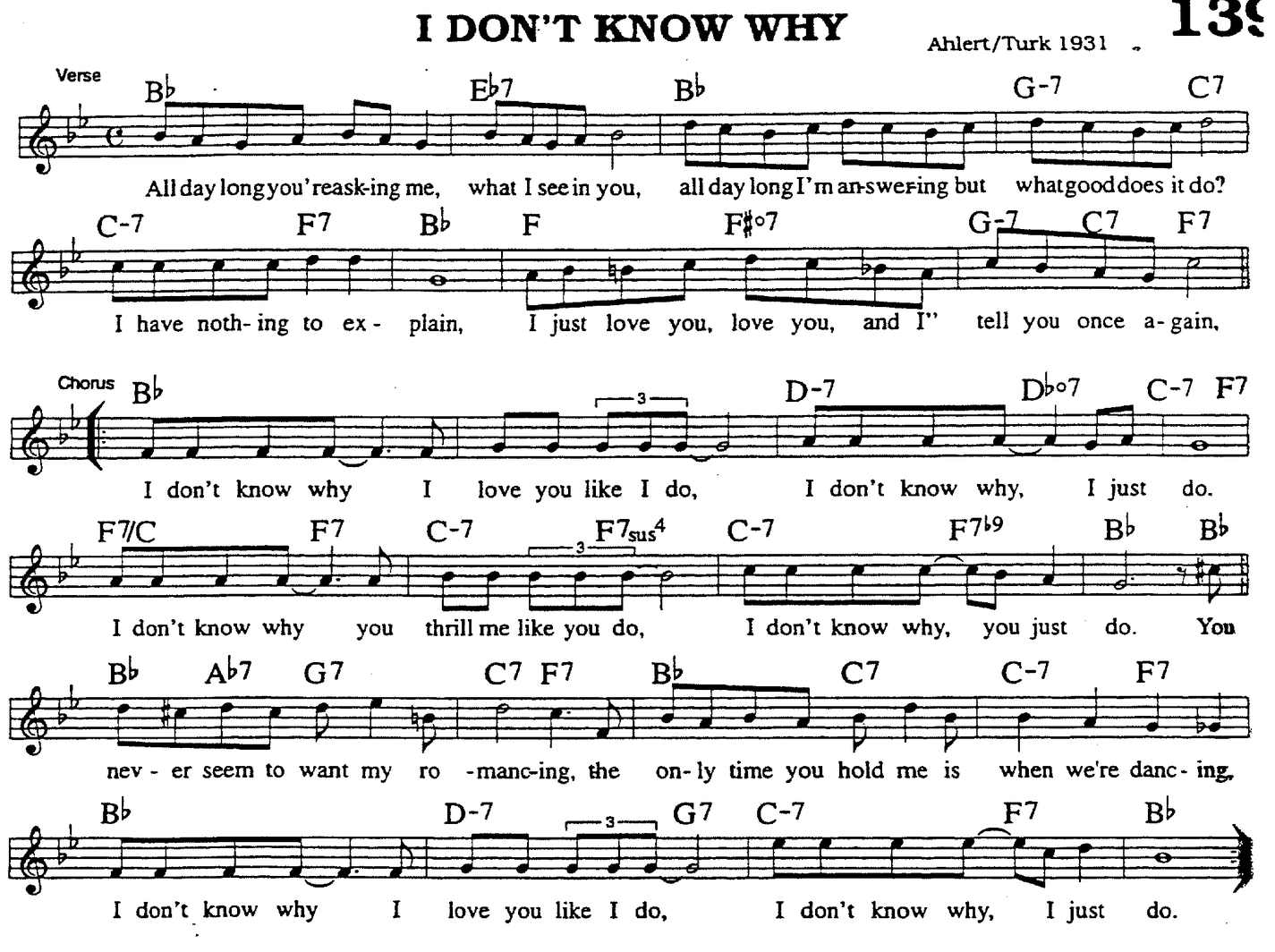
| Song | I Don't Know Why (I Just Do), headed I Don't Know Why on the attached lead sheet |
| Composer | Fred E. Ahlert |
| Lyricist | Roy Turk |
| Year | 1931 |
| Original context | Stand-alone Tin Pan Alley popular song, published by Leo Feist rather than originating in a named stage or film production |
| Lead-sheet key | B-flat major |
| Form | 8-bar verse + 16-bar chorus; the chorus divides naturally into four 4-bar phrases, A1-A2-B-A3 |
| Principal tonal centres | B-flat major throughout, with temporary emphasis on F and a chain of applied dominants in the contrasting phrase |
| Common jazz classification | Great American Songbook / Tin Pan Alley standard; compact 16-bar standard, adaptable to ballad or medium-swing treatment |
The central proposition is deliberately irrational: the speaker is asked to justify an attachment and finds that love cannot be reduced to reasons. The verse establishes this as an ongoing argument. The beloved asks what the speaker sees in them, the speaker repeatedly answers, and explanation proves useless. The chorus then turns that failure of explanation into the song’s refrain. “I don’t know why” sounds uncertain, but the answer that follows is anything but uncertain. The speaker does not know the cause of the feeling, yet never questions the fact of it.
That distinction gives the song more tension than its plain diction initially suggests. The relationship described in the chorus is not straightforwardly reciprocal. The beloved appears resistant to courtship, and physical intimacy occurs only within the socially sanctioned frame of dancing. The speaker therefore possesses extraordinary certainty about their own feeling while possessing very little evidence of corresponding romantic commitment. The song is not simply about being inexplicably in love. It is about remaining certain of love in the presence of emotional asymmetry.
Ahlert’s musical setting preserves that ambiguity. The melody is compact, repetitive and speech-like rather than theatrically expansive. Much of the harmony is equally plain, yet strategically placed diminished harmony, altered dominants and chromatic dominant motion complicate the words precisely where their implications become less comfortable. Most revealingly, the first declaration of ignorance begins over stable tonic harmony, while the final declaration receives an emphatic iii-VI-ii-V-I return to B-flat. The words profess incomprehension; the harmonic syntax increasingly supplies certainty.
2. Form and Dramatic Architecture
The attached lead sheet contains an 8-bar verse followed by a 16-bar chorus. There is no written introduction, coda or tag, and no independent bridge label. The chorus nevertheless divides clearly into four 4-bar phrases. The first two phrases are parallel statements, the third is contrasting in both lyric and harmonic motion, and the final phrase returns to the opening melodic material.
| Section | Bars | Tonal centre | Lyrical or dramatic function | Musical function |
|---|---|---|---|---|
| Verse | V1-V4 | B-flat major, with dominant-of-dominant colour | Establishes the argument between speaker and beloved; explanation is requested and found inadequate | I-IV7-I gives local stability, then Gm7-C7 begins to destabilise the tonic |
| Verse | V5-V8 | B-flat major, increasingly dominant-directed | The speaker abandons explanation and prepares to restate the emotional fact | ii-V-I motion is followed by F-F#-G chromatic motion and a final dominant that launches the chorus |
| A1 | C1-C4 | B-flat major | First confession: love exists without intelligible cause | Tonic prolongation gives way to iii-biii°-ii-V chromatic descent |
| A2 | C5-C8 | B-flat major, strong F-dominant emphasis | The beloved's power to "thrill" is stated with the same inexplicability | Extended dominant region with F7/C, F7sus4 and F7b9 finally resolves to I |
| B | C9-C12 | B-flat major with chromatic dominant chain | The lyric finally supplies evidence of relational imbalance | B-flat-Ab7-G7-C7-F7 and the C7-to-Cm7 change produce the chorus's greatest harmonic mobility |
| A3 | C13-C16 | B-flat major | The original confession returns after the uncomfortable evidence of the B phrase | I-iii-VI-ii-V-I produces the clearest cadential confirmation in the song |
The verse is dramatically important even though it is frequently omitted in jazz performance. Without it, the chorus can sound like a self-contained aphorism about inexplicable attraction. With it, the refrain becomes an answer to another person. “I don’t know why” is not private introspection at first; it is a response to questioning. That changes the psychological situation from simple romantic wonder to a dialogue in which one partner demands an explanation the other cannot provide.
The 16-bar chorus behaves like a compressed AABA design. A1 and A2 repeat the grammatical pattern of ignorance followed by assertion. The B phrase is where the song stops speaking abstractly about feeling and produces concrete relational evidence: resistance to courtship and affection restricted to dancing. The return of A after that disclosure does not erase what has been revealed. Instead, the same declaration acquires a more troubling implication. The speaker now knows something about the relationship, but it does not alter the feeling.
The song is therefore circular rather than developmental in the conventional narrative sense. Nothing is solved. What develops is the listener’s understanding of what “I don’t know why” actually means.
3. Close Reading of the Lyrics
| Lyric or cue | Literal meaning | Literary and poetic reading | Emotional subtext | Musical and harmonic interaction |
|---|---|---|---|---|
| "All day long..." | The beloved repeatedly asks the speaker a question. | The phrase is mild hyperbole. Its repetition later in the verse makes the questioning seem habitual rather than incidental. | The relationship already contains scrutiny. The speaker is being asked to account for feeling as though love requires evidence. | V1 begins on Bb, the most stable possible harmonic ground. The conflict is verbal before it is musical. |
| "what I see in you" | The beloved asks what qualities inspire the speaker's affection. | "See" makes love sound observational and rational, as though attraction should be itemised. | The beloved may be insecure, teasing, sceptical or emotionally distancing. The lyric leaves the motive unresolved. | The move to Eb7 in V2 introduces Db, foreign to diatonic B-flat major. The first demand for explanation therefore receives the verse's first pronounced chromatic colour. |
| Second "all day long..." | The speaker has repeatedly tried to answer. | Parallel syntax establishes a call-and-response relationship: asking versus answering. | The speaker is not unwilling to explain, only unable to make explanation satisfy the question. | V3 returns to Bb. The music momentarily restores stability even though the argument continues. |
| "what good does it do?" | Repeated explanation has failed. | The rhetorical question rejects the premise that reasons can settle an emotional matter. "Good" makes the exchange sound almost practical or transactional. | Mild frustration appears for the first time. | V4 moves through Gm7-C7. C7 is V7/V, but it does not immediately resolve to F. The harmony itself opens a question and postpones its expected answer. |
| "nothing to explain" | The speaker claims no rational account is available. | The phrasing is strikingly plain. Rather than idealising the beloved with metaphors, the speaker rejects descriptive proof altogether. | The statement can be heard as confidence or evasion. | Cm7-F7 in V5 supplies one of the score's most conventional functional progressions. The lyric says there is nothing to explain while the harmony is unusually explicable. The coincidence need not be literal text-painting, but it is theatrically effective. |
| "love you, love you" | Love itself is offered as the only answer. | Immediate repetition functions as epizeuxis: the word is repeated without grammatical development because no further argument is available. | Feeling replaces reasoning. The repetition is both emphatic and slightly helpless. | Bb followed by F in V6 begins securely and then turns towards dominant function. The music does not allow the declaration to remain entirely at rest. |
| "once again" | The speaker prepares to repeat the same answer. | The phrase openly acknowledges circularity. Repetition is not a flaw in the argument; it becomes the argument's form. | The speaker expects no new conclusion. | F#°7 in V7 leads strongly towards Gm7, after which Gm7-C7-F7 in V8 drives to the dominant. The words "once again" therefore lead literally into the musical return represented by the chorus. |
| First "I don't know why..." | The speaker cannot identify the cause of love. | The refrain begins with epistemic uncertainty, but its syntax immediately separates knowing from feeling. | The speaker is uncertain about explanation, not affection. | C1-C2 remain on Bb. Verbal uncertainty is set over tonal certainty, establishing the song's central musical irony. |
| "...love you like I do" | The fact and degree of love are unquestioned. | "Do" is a compact pro-verb replacing the larger idea of loving. Its simplicity prevents the sentiment from becoming ornate. | Certainty enters through action rather than argument. | The melody remains narrow and conversational, while a recurrent triplet loosens the strict common-time pulse near the end of the phrase. |
| Second "I don't know why" | The speaker repeats the admission. | Anaphora turns uncertainty into a refrain. The repetition paradoxically makes the speaker sound more certain, because the same answer survives every attempt to explain it. | The speaker has accepted the inadequacy of reason. | Dm7-Db°7-Cm7 creates a descending D-Db-C harmonic line in C3-C4. The chromatic passing diminished chord places instability directly inside an otherwise familiar phrase. |
| "I just do" | Love is asserted as irreducible fact. | "Just" shuts down further argument. It can mean simply, merely or unquestionably. | The phrase combines resignation with stubbornness. | Cm7-F7 does not immediately provide tonic closure. F7 is prolonged into C5, so the first answer is harmonically less final than the words imply. |
| "you thrill me..." | The beloved produces an involuntary emotional or physical response. | The syntax shifts from the speaker's action to the beloved's effect on the speaker. | The speaker becomes passive. Attraction is something being done to them. | C5-C7 remain dominated by F7/C, F7, Cm7 and altered forms of F7. The prolonged dominant makes the claim feel suspended rather than settled. |
| Second "you just do" | The beloved's effect is treated as equally inexplicable. | The parallel with "I just do" distributes agency symmetrically at the grammatical level: the speaker loves, the beloved thrills. | The apparent symmetry masks the relational asymmetry soon disclosed. | F7b9 intensifies the final dominant before Bb arrives in C8. This is the first unequivocal tonic release of the chorus. |
| "never seem to want..." | The beloved appears resistant to the speaker's courtship. | "Seem" softens what "never" makes absolute. The sentence simultaneously accuses and retreats from accusation. | The speaker recognises rejection but leaves room to deny its finality. | C9 moves Bb-Ab7. The root descent away from tonic darkens the texture at precisely the point where the lyric becomes less idealised. |
| "my romancing" | The beloved does not welcome deliberate romantic advances. | The slightly old-fashioned noun makes courtship sound performative, almost as though the speaker is undertaking a recognised social ritual. | The love may be more one-sided than the refrain has admitted. | Ab7 leads into G7-C7-F7 across C9-C10. The dominant chain is more mobile and less settled than the tonic-centred opening. |
| "only time you hold me" | Physical affection occurs under limited circumstances. | "Only" is more devastating than the earlier "never": it supplies a precise exception. | Intimacy exists, but perhaps only ceremonially. | C11 begins on Bb but immediately moves to C7. Even the brief return to tonic cannot remain stable once the lyric specifies the relationship's limitation. |
| "when we're dancing" | Embrace happens during dance. | Dancing can imply romance, but it also provides a socially legitimate reason for physical closeness. The line therefore leaves open whether the embrace expresses desire or merely fulfils the dance. | The speaker may be converting ambiguous physical contact into evidence of intimacy. | C7 changes to Cm7 as the root remains C and E-natural falls to E-flat, after which F7 points home. The major-to-minor transformation is an economical musical analogue for the lyric's shift from apparent intimacy to uncertainty. |
| Final return of "I don't know why..." | The speaker repeats the original confession unchanged. | Repetition after the B phrase is psychologically different. The listener now knows why the attachment is perplexing. | The speaker's persistence may be devotion, self-deception or an acceptance that feeling is independent of reciprocity. | C13-C16 use Bb, Dm7-G7, Cm7-F7, Bb. The classic iii-VI-ii-V-I turnaround gives the strongest structural resolution in the chorus. |
| Final "I just do" | The speaker ends with the same irreducible assertion. | The lyric closes an argument by declining to argue. | Nothing about the relationship has been repaired; only the speaker's own position has been reaffirmed. | The final Bb supplies clean tonal closure. Harmonic certainty exceeds psychological certainty. |
The rhyme vocabulary is deliberately modest. “Do” is repeatedly paired with itself rather than elaborated through more ingenious rhyme, which suits a lyric whose central claim is that elaboration is futile. By contrast, “romancing”/“dancing” is the song’s most conspicuous rhyme, and it arrives exactly where the lyric becomes most concrete. The neat rhyme almost prettifies an uncomfortable fact.
The syntax is equally important. “I don’t know” normally signals weakness of knowledge. Turk repeatedly follows it with unqualified present-tense verbs: “love”, “thrill” and “do”. No future conditional is offered, no memory is narrated, and no fantasy is projected. The emotional problem exists entirely in the present tense.
4. Lyrical and Emotional Arc
Opening Position
The speaker begins under interrogation. The beloved wants a rational account of attraction, and the speaker has apparently attempted to provide one repeatedly. This is not the first time the question has arisen. The verse’s repeated “all day long” establishes fatigue and recurrence before the chorus begins.
The speaker nevertheless remains composed. There is no accusation in the opening verse, only the growing conclusion that causal explanation is the wrong category for what is being experienced.
Development
The chorus first turns failure of explanation into a declaration. The speaker cannot say why love exists but can say with absolute certainty that it does. The second 4-bar phrase extends the same structure from love to excitement: not only is affection inexplicable, the beloved’s effect on the speaker is involuntary.
The song changes dramatically in the contrasting phrase. For the first time, the speaker offers observable facts. The beloved does not appear to welcome romantic advances, and physical closeness occurs only in dancing. The song therefore moves from abstract uncertainty about love’s cause to concrete evidence that the relationship itself may be uncertain.
Point of Greatest Tension
The greatest tension lies in the “romancing”/“dancing” passage, C9-C12.
Lyrically, this is where the speaker comes closest to admitting that the relationship may not be reciprocal. Harmonically, it is also the least stable passage. Bb-Ab7-G7-C7-F7 produces chromatic descent followed by a circle-of-fifths dominant chain. C7 then becomes Cm7 rather than functioning as an uncomplicated dominant of F. The harmony is not modulating to another established key, but it is temporarily far more restless than the opening tonic field.
The convergence is persuasive without requiring literal text-painting: the relationship becomes hardest to describe at the moment when the harmony becomes hardest to hear as simple tonic prolongation.
Resolution or Lack of Resolution
There is genuine tonal resolution but no dramatic solution.
The final four bars restore the familiar opening phrase and conclude with a conventional iii-VI-ii-V-I cadence. Musically, B-flat major is recovered without qualification. Psychologically, however, nothing learned in the B phrase has been overturned. The beloved has not become more responsive, and the speaker has discovered no reason for remaining attached.
The ending is therefore acceptance mixed with circularity. The speaker’s feeling has not been resolved because the speaker no longer treats it as a problem requiring resolution.
Central Paradox
The central paradox is the coexistence of ignorance and certainty.
The speaker knows less than the beloved seems to demand, yet feels more certain than explanation could make them. At the same time, the speaker is secure about their own love while confronting evidence that the relationship may be insecure. The final cadence resolves the first problem musically but leaves the second untouched.
5. Detailed Harmonic Analysis
The global tonic is B-flat major. The two-flat key signature, opening and closing Bb chords, repeated ii-V-I motion and final cadence leave no meaningful ambiguity about the home key.
There are several temporary tonicisations, especially of F, and a chain of applied dominants in the contrasting phrase, but the lead sheet does not establish a sustained secondary key. It is therefore more accurate to describe these passages as tonicisation, dominant prolongation and chromatic functional motion rather than modulation.
The analysis below follows the chord symbols exactly as printed. In particular, the tonic is written simply as Bb, not Bbmaj7 or Bb6.
Verse
| Bars | Lyric cue | Chords | Roman numerals | Tonal centre | Harmonic function and interpretation |
|---|---|---|---|---|---|
| V1 | "All day long..." | Bb | I | B-flat major | Direct tonic statement. The verse begins without harmonic ambiguity. |
| V2 | "what I see..." | Eb7 | IV7 | B-flat major | Dominant-quality IV. The Db introduces modal/blues-inflected colour. Because Eb7 returns to Bb rather than resolving to Ab, it is better understood as borrowed/plagal dominant colour than as an active V7/bVII. |
| V3 | Second "all day long..." | Bb | I | B-flat major | Restores tonic after the chromatic IV7. |
| V4 | "what good..." | Gm7 - C7 | vi7 - V7/V | B-flat major, F temporarily tonicised | Gm7-C7 forms ii-V in the dominant key F. C7 does not receive its expected immediate F resolution, so the tonicisation remains incomplete. |
| V5 | "nothing to explain" | Cm7 - F7 | ii7 - V7 | B-flat major | Standard predominant-dominant motion. The preceding C7 becomes Cm7 through E-natural to E-flat, a useful common-root major-to-minor reinterpretation. |
| V6 | "I just love..." | Bb - F | I - V | B-flat major | Tonic resolution followed by a bare dominant triad. The F root also initiates the chromatic bass tendency F-F#-G. |
| V7 | repeated "love you" | F#°7 | vii°7/vi | G minor tonicised | Leading-tone diminished seventh to Gm. F#-A-C-Eb resolves efficiently into G-Bb-D-F by semitone or step. |
| V8 | "once again" | Gm7 - C7 - F7 | vi7 - V7/V - V7 | B-flat major through dominant region | Gm7-C7 again suggests ii-V in F, but F itself appears as F7, the dominant of B-flat. The verse therefore ends on V7 rather than I, compelling the chorus. |
The verse contains two particularly elegant structural devices. The first is the C7-to-Cm7 transformation between V4 and V5. Instead of allowing C7 to resolve conventionally to F, the root remains C while the chord’s E-natural falls to E-flat, converting an applied dominant into the tonic key’s ii7. This is parsimonious voice leading and an effective way of avoiding a premature arrival.
The second is the F-F#-G root progression around V6-V8. The printed F chord is followed by F#°7, which leads into Gm7. The diminished chord is therefore not decorative in an arbitrary sense. It is a functional leading-tone diminished seventh to vi.
Chorus
| Bars | Lyric cue | Chords | Roman numerals | Tonal centre | Harmonic function and interpretation |
|---|---|---|---|---|---|
| C1 | First "I don't know why" | Bb | I | B-flat major | Tonic statement. The verbal uncertainty begins over complete tonal stability. |
| C2 | "love you like..." | Bb | I | B-flat major | Continued tonic prolongation. Harmonic simplicity places attention on the rhythmic shaping of the melodic phrase. |
| C3 | Second "I don't know why" | Dm7 - Db°7 | iii7 - biii°7 | B-flat major | The diminished chord is best heard as a chromatic passing diminished sonority in the descending D-Db-C root line, not as a genuine modulation. |
| C4 | "I just do" | Cm7 - F7 | ii7 - V7 | B-flat major | Conventional ii-V. The phrase ends on dominant function rather than tonic, preventing complete closure. |
| C5 | "I don't know why..." | F7/C - F7 | V7 with 5th in bass - V7 | B-flat major, dominant prolonged | Dominant function is prolonged instead of resolving. The C bass weakens root-position finality while retaining F7's harmonic identity. |
| C6 | "you thrill me..." | Cm7 - F7sus4 | ii7 - V7sus4 | B-flat major | Return to ii followed by a suspended dominant. Bb, the tonic pitch, can remain suspended over F before the leading tone A becomes explicit. |
| C7 | Second "I don't know why" | Cm7 - F7b9 | ii7 - V7b9 | B-flat major | Another ii-V, now intensified by the flat ninth. This is the strongest dominant colour in the first eight bars. |
| C8 | "you just do" | Bb | I | B-flat major | First unequivocal tonic cadence of the chorus. A1 and A2 therefore combine into an 8-bar harmonic arch. |
| C9 | "never seem..." | Bb - Ab7 | I - bVII7 | B-flat major | Bb-Ab7 initiates a descending chromatic root pattern. Ab7 acts principally as a chromatic bVII dominant sonority. An enharmonic tritone-substitution reading against D7 is possible, but the audible descending bass is the more immediate structural fact. |
| C10 | "my romancing" | G7 - C7 - F7 | V7/V/V - V7/V - V7 | B-flat major, dominant chain | Classic circle-of-fifths applied-dominant sequence. Rather than establishing C or F as new keys, the sequence accelerates back towards the home dominant. |
| C11 | "only time..." | Bb - C7 | I - V7/V | B-flat major | Tonic is briefly restored, then immediately destabilised by C7. |
| C12 | "when we're dancing" | Cm7 - F7 | ii7 - V7 | B-flat major | C7 from the preceding bar is converted to Cm7 by E-natural-E-flat voice leading, then functions conventionally as ii before V. |
| C13 | Final "I don't know why" | Bb | I | B-flat major | Return of tonic and opening melodic material. |
| C14 | "love you like..." | Dm7 - G7 | iii7 - V7/ii | B-flat major | Beginning of the standard iii-VI-ii-V turnaround. G7 strongly targets Cm7. |
| C15 | Final "I don't know why" | Cm7 - F7 | ii7 - V7 | B-flat major | Predominant to dominant. The functional route to tonic is now completely explicit. |
| C16 | "I just do" | Bb | I | B-flat major | Final tonic. The tonal argument closes more decisively than the lyrical one. |
The Dm7-Db°7-Cm7 progression in C3-C4 is one of the lead sheet’s most characteristic details. Its purpose is fundamentally voice-leading. The bass descends chromatically D-Db-C, while the symmetrical diminished structure permits several upper voices to move by semitone. Treating Db°7 as a colourful passing diminished chord explains both its placement and its destination more convincingly than assigning it an independent tonal centre.
The extended dominant area in C4-C8 is equally important. A normal four-bar phrase might allow Cm7-F7 to resolve directly to Bb. Here F7 continues through C5, returns after another Cm7, acquires a suspended fourth, is approached again through ii and finally becomes F7b9. Tonic resolution is therefore withheld until C8. The lyric’s repeated insistence accumulates over a dominant that refuses to settle.
C9-C12 contains the chorus’s most unusual harmonic route. Bb-Ab7-G7 produces descending roots B-flat-A-flat-G. From G7 the progression turns into the functional dominant chain G7-C7-F7. The following return to Bb in C11 is short-lived because C7 immediately restarts dominant-directed motion.
The final four bars remove most of that ambiguity. Bb | Dm7 G7 | Cm7 F7 | Bb is a textbook I-iii-VI-ii-V-I turnaround. The song’s conclusion does not discover a new harmonic truth. It confirms the old tonic with increasing conventionality.
6. Tonal Journey
| Passage | Starting centre | Destination | Mechanism | Dramatic effect |
|---|---|---|---|---|
| Verse V1-V3 | B-flat major | B-flat major | I-IV7-I with borrowed Db colour | The song begins securely but allows chromatic doubt to enter the beloved's question. |
| Verse V4-V5 | B-flat major | Back to B-flat predominant/dominant | Gm7-C7 suggests ii-V in F, then C7 becomes Cm7 and proceeds to F7 | An expected secondary resolution is evaded, matching the verse's inability to produce a satisfactory answer. |
| Verse V6-V8 | B-flat major | F7, dominant of B-flat | I-V, F#°7 to Gm7, then Gm7-C7-F7 | The verse increasingly points forward and refuses to close on tonic. |
| Chorus C1-C4 | B-flat major | F7 | Tonic prolongation followed by iii-biii°-ii-V | A simple confession gradually acquires chromatic uncertainty. |
| Chorus C5-C8 | Dominant region | B-flat major | Prolonged F7, ii-Vsus, ii-Vb9, then I | Repeated questioning accumulates tension before the first full chorus cadence. |
| Chorus C9-C10 | B-flat major | F7 | Bb-Ab7-G7-C7-F7 | The relationship's most troubling admission coincides with maximum harmonic mobility. |
| Chorus C11-C12 | B-flat major | F7 | I-V7/V, then common-root C7-Cm7 and ii-V | Tonic appears but cannot yet remain stable. |
| Chorus C13-C16 | B-flat major | B-flat major | I-iii-VI-ii-V-I | The final statement receives unequivocal functional confirmation. |
The tune never truly leaves B-flat major. Its tonal drama comes from degrees of distance rather than modulation. This is important for improvisation: hearing C7 or G7 as isolated temporary keys can make the form sound fragmented. Their larger role is to intensify the gravitational pull towards F7 and ultimately B-flat.
The first eight chorus bars are especially instructive. Tonal security is present at the opening but then deliberately withheld. The first ii-V does not resolve to tonic; instead, F7 is prolonged through several bars and progressively coloured by suspension and flat ninth. The eventual Bb in C8 therefore feels earned.
The contrasting phrase produces a different kind of instability. Its chromaticism is directional rather than suspended. Bb-Ab7-G7 begins a descent, after which G7-C7-F7 moves around the circle of fifths. The listener experiences motion rather than stasis.
The final tonic is consequently convincing as a cadence but incomplete as a dramatic answer. The harmony knows where home is. The speaker still does not know why they remain there.
7. Melody and Prosody
The lead-sheet melody spans approximately F4 to Eb5, a compact minor-seventh range. Most of the line occupies the central portion of that span rather than repeatedly touching its extremes. This relatively narrow compass is important to the song’s character. The singer is not required to produce a climactic high note to prove the sincerity of the feeling. The language remains close to speech.
Common time is specified, but no tempo marking is printed. The melody itself supports considerable flexibility. Repeated quavers and crotchets create conversational momentum, while longer phrase-ending notes permit either ballad-like suspension or a more buoyant medium-swing release.
The refrain’s principal motive is built from repetition and small steps rather than large expressive intervals. “I don’t know why” repeatedly begins in a restricted pitch area. This makes the phrase sound less like a rhetorical question and more like a settled verbal formula. The speaker has said this before.
Triplet figures are particularly important. They appear in corresponding parts of the A material and loosen otherwise square 4/4 subdivision. The triplet setting of words around “like I do” or its parallel phrases prevents the melody from becoming mechanically repetitive. In performance, these figures should feel like natural speech spilling across the beat rather than conspicuous rhythmic effects.
Longer notes regularly occur on the short word “do”. The musical setting therefore enlarges a word that is semantically almost empty on its own. “Do” becomes important because it substitutes for the entire preceding action: love, thrill, persist. Ahlert gives the pro-verb temporal weight even while Turk gives it lexical economy.
The B phrase becomes more active. Its melody moves with the faster-changing harmony and incorporates the chromatic environment created by Ab7, G7 and C7. The score’s accidentals here distinguish the passage from the more diatonic A material. The change is structural as much as expressive: the contrasting phrase must separate itself from the repetitive refrain, and harmonic-melodic chromaticism provides that contrast efficiently.
A pickup into the phrase beginning with “You” links the end of C8 to C9. This is prosodically useful. The lyric does not allow the resolved “you just do” to sit in isolation for long; the next observation about the beloved immediately intrudes. The tonic cadence therefore becomes a launching point into the most uncomfortable part of the lyric.
The melody generally respects natural spoken emphasis. Strong words such as “know”, “why”, “love”, “thrill”, “never”, “only” and “dancing” remain intelligible without forcing unnatural stress onto articles or conjunctions. The setting also uses repeated pitches to accommodate text with many monosyllables. This is a major reason the song can tolerate substantial rhythmic reinterpretation by jazz singers without losing its identity.
There is little need to describe the tune in terms of heroic leaps, dramatic appoggiaturas or an extreme register. Its expressive vocabulary is smaller: repetition, stepwise movement, triplet inflection, occasional chromatic notes, ties and cadential duration. That restraint is fundamental to the composition.
8. Word, Melody, and Harmony: Key Moments
| Moment | Lyric cue | Musical event | Interpretive significance |
|---|---|---|---|
| 1 | "what I see..." | Bb moves to Eb7 in V2 | The beloved's demand for a rational account receives the verse's first non-diatonic colour through Db. |
| 2 | "what good..." | Gm7-C7 implies ii-V of F but avoids immediate F resolution | The rhetorical question coincides with an unresolved secondary harmonic expectation. |
| 3 | "once again" | Gm7-C7-F7 ends the verse on V7 | The promise of repetition literally requires the music to continue into the chorus. |
| 4 | First "I don't know why" | Sustained Bb tonic harmony | The strongest verbal uncertainty occurs over the strongest tonal certainty. |
| 5 | Second "I don't know why" | Dm7-Db°7-Cm7 | Chromatic root descent introduces instability inside a repeated verbal formula. |
| 6 | "thrill me..." | F7 is prolonged through F7/C, F7sus4 and later F7b9 | Attraction is described as involuntary while the music remains caught in unresolved dominant function. |
| 7 | "never seem..." | Bb-Ab7-G7 | The lyric's first acknowledgement of resistance is paired with a conspicuous descending chromatic harmonic gesture. |
| 8 | "only time..." | Bb-C7 followed by C7-Cm7 | A brief tonic recovery is immediately undermined; the C chord's E-natural falls to E-flat as the lyric qualifies the apparent intimacy. |
| 9 | Final confession | Bb-Dm7-G7-Cm7-F7-Bb | The words remain unchanged, but the harmony becomes maximally conventional and conclusive. Musical certainty replaces verbal explanation. |
The most important irony is therefore not that the harmony is uniformly “sad” beneath optimistic words. It is subtler. The music progressively becomes better at explaining where it is going while the speaker continues to insist that emotional causation cannot be explained.
9. Historical and Cultural Context
I Don’t Know Why (I Just Do) was published in 1931 with music by Fred E. Ahlert and words by Roy Turk. Mississippi State University’s Charles H. Templeton sheet-music collection catalogues a 1931 Leo Feist publication for voice and piano, identifying the opening of the verse and chorus found in the present lead sheet. Kent State University’s Dennis Hearn collection also lists a 1931 Leo Feist edition and notes a cover featuring singer Morton Downey. These archival records describe it as popular sheet music rather than a number belonging to a named Broadway show or film. (Scholars Junction)
The song belongs to one of the most productive periods of the Ahlert-Turk partnership. The Songwriters Hall of Fame states that Ahlert met Turk in 1928 and that their collaboration produced, among other titles, “I’ll Get By”, “Mean to Me”, “Walkin’ My Baby Back Home”, “Where the Blue of the Night” and I Don’t Know Why. Turk’s career had developed through vaudeville material and Tin Pan Alley publishing before his later film work, and the Hall of Fame identifies 1928-33 as a particularly close period of collaboration between the two writers. (Songwriters Hall of Fame)
The song was successful quickly. The Songwriters Hall of Fame identifies Wayne King’s 1931 recording as a number-two hit. Contemporary-era discographies also document versions by Russ Columbo, Kate Smith, Benny Krueger and others, illustrating the rapid circulation typical of Tin Pan Alley publishing, where a successful composition could generate several competing recordings rather than being permanently associated with a single originating singer. (Songwriters Hall of Fame)
Its second major period of visibility came during the 1940s. Frank Sinatra recorded the song on 30 July 1945 with Axel Stordahl’s orchestra; Columbia issued it in 1946 as part of the material associated with The Voice of Frank Sinatra. The Songwriters Hall of Fame records a number-16 1946 hit for Tommy Dorsey. Nat King Cole’s trio also recorded the song in 1946, including a documented 11 April session with Cole, Oscar Moore and Johnny Miller. (45cat)
The tune then passed decisively into the jazz repertory. Erroll Garner recorded an instrumental version on 28 June 1950 with John Simmons and Shadow Wilson, released in connection with Piano Moods. That transition is significant because the lyric could now disappear entirely while the 16-bar harmonic structure, melodic repetitions and turnarounds remained sufficient to sustain a jazz performance. (Jazz Disco)
Its popular afterlife extended beyond jazz. Linda Scott revived the song in 1961; Billboard material from the period documents the record’s national activity, and Billboard-derived chart histories place it at number 12 in the US. The recurrence of the song in 1931, the mid-1940s and 1961 shows unusual adaptability across several generations of popular vocal style. (World Radio History)
10. Significant Interpretations
| Performer | Recording or period | Interpretive character | What it reveals about the song |
|---|---|---|---|
| Russ Columbo | 1931, Victor recording made 3 September | Early crooner treatment, placing the lyric's directness ahead of elaborate jazz reinterpretation | Establishes how naturally the song fits intimate microphone-era singing. Its argument works through understatement rather than theatrical declamation. ([YouTube][6]) |
| Frank Sinatra with Axel Stordahl | Recorded 30 July 1945, issued 1946 | Sustained orchestral ballad conception and long vocal line | Brings the song closer to inward confession. The repeated "I don't know why" can sound reflective rather than merely conversational when the tempo and orchestral support are broadened. ([45cat][3]) |
| Nat King Cole Trio | 1946 | Small-group vocal jazz, with piano, guitar and bass keeping the harmonic motion exposed | Shows how easily the song moves from popular ballad to rhythmically supple jazz. The compact form benefits from Cole's conversational delivery because repetition becomes phrasing rather than redundancy. ([Amazon Music][7]) |
| Erroll Garner Trio | 28 June 1950 | Instrumental trio interpretation | Demonstrates that the tune's melodic and harmonic identity survives removal of the lyric. The diminished passing harmony, dominant chains and rapid 16-bar return become material for motivic improvisation. ([Jazz Disco][4]) |
| Linda Scott | 1961 | Concise early-1960s pop revival | Reveals the strength of the refrain as a pop hook independent of its original 1931 stylistic setting. The composition could be shortened and modernised without losing recognition. ([AllMusic][8]) |
| Lou Donaldson | Caracas, 1994 | Instrumental soul-jazz/hard-bop repertory treatment | Demonstrates the tune's continued viability for improvisers long after its period of mass-popularity. Its functional dominants and compact turnaround remain useful in an organ-combo language. ([AllMusic][9]) |
The shift from Columbo and Sinatra to Cole and Garner is especially revealing. In a crooner reading, the song’s meaning is carried primarily by the contradiction between the words “I don’t know” and the singer’s emotional certainty. In instrumental jazz, that contradiction must be translated into musical terms. The performer then inherits a different tension: stable tonic statements, dominant postponement, chromatic passing harmony and the sudden mobility of C9-C12.
Garner’s treatment is consequently important even without claiming that it permanently altered performance practice. It confirms that the song is not dependent on nostalgia for its lyric. A player can hear the refrain as melodic architecture.
11. Place in the Jazz Canon
The tune has endured as a jazz standard, but it occupies a secondary rather than central position in the modern jam-session canon. JazzStandards.com lists it around number 464 in its repertory ranking, far below the most ubiquitous standards, while still documenting it as part of the established literature. (Jazz Standards)
Its suitability for improvisation comes partly from compression. A 16-bar chorus returns twice as quickly as the more common 32-bar AABA form. That can make the piece deceptively demanding. An improviser who simply strings together generic ii-V vocabulary will exhaust the form quickly and obscure its phrase architecture. Motivic development matters more because structural landmarks recur at short intervals.
The harmonic language is conventional enough to be navigable but contains several points of identity: Dm7-Db°7-Cm7, the long F-dominant region, Bb-Ab7-G7, the G7-C7-F7 dominant chain, the C7-Cm7 common-root conversion, and the final Dm7-G7-Cm7-F7-Bb turnaround. These features give a soloist useful voice-leading paths without requiring exotic scales.
The piece is also instructive pedagogically because it demonstrates distinctions that developing jazz musicians often collapse. Db°7 is a passing diminished chord rather than evidence of modulation. G7 and C7 are applied dominants within the B-flat system. Ab7 is not automatically best described as a tritone substitution simply because it is chromatic. F7/C remains dominant function despite the non-root bass.
An experienced improviser should therefore hear the tune horizontally. The root lines D-Db-C, F-F#-G and Bb-Ab-G are at least as important as the isolated chord symbols. Likewise, the guide-tone movement from C7 to Cm7, E-natural to E-flat, should remain audible.
Because the melody is compact and repetitive, reharmonisation is possible without immediately destroying recognisability. That flexibility has helped the song survive in vocal jazz, piano trio, organ combo and popular revival contexts. Yet excessive substitution can remove precisely the chromatic lines that give this otherwise simple tune its identity.
12. Interpretive Considerations for Performers
For a singer, the central risk is treating every occurrence of “I don’t know why” as a climactic declaration. The lyric is more convincing when the words retain conversational plainness. The speaker is not discovering love for the first time. They are repeating an answer they have apparently given many times.
The verse should be considered seriously rather than automatically discarded. Including it changes the chorus from an abstract love lyric into a response addressed to a questioning partner. Omitting it produces a cleaner standard-song form, but removes the dramatic reason for the refrain.
Several words deserve particular weight: “why”, “love”, “thrill”, “never”, “only”, “hold” and “dancing”. “Never” and “only” are especially dangerous to sentimentalise. Their power lies in their factual bluntness. The B phrase becomes stronger when sung almost observationally rather than as melodrama.
Rhythmic freedom is most useful around the recurring triplet figures and phrase-ending “do”. A ballad interpretation can stretch these points substantially, but the internal pulse should remain intelligible enough that the 16-bar form does not lose definition. At medium tempo, the triplets can become lightly swung conversational gestures.
For instrumentalists, the original melodic rhythm is worth preserving during the first statement. The tune’s personality lies more in timing and repetition than in intervallic spectacle. Replacing every repeated note with ornamental runs before the melody has been established weakens the song’s rhetorical economy.
Harmonically, several landmarks merit protection. The Dm7-Db°7-Cm7 descent should remain perceptible even if extensions are added. The F7sus4 should retain the suspension rather than having the leading tone voiced too early. F7b9 should feel like the culmination of the prolonged dominant, not merely another altered chord.
The bridge-like C9-C12 passage is particularly sensitive to reharmonisation. The root movement Bb-Ab-G followed by G-C-F is one of the tune’s strongest fingerprints. A pianist or guitarist can add upper structures or altered extensions, but replacing the entire sequence with unrelated substitutes risks converting a distinctive 1931 progression into generic modern harmony.
Tempo changes the lyric’s apparent meaning substantially. At a slow tempo, the song can sound vulnerable and almost bewildered; the limited physical intimacy described in the B phrase becomes painful. At medium swing, “I just do” can sound closer to a shrug, and the reference to dancing acquires immediate rhythmic relevance. Neither reading is inherently preferable, but they imply different speakers.
The final cadence also offers choices. A clean Bb ending emphasises the paradox of complete tonal closure and incomplete psychological explanation. A repeated tag can intensify obsession or circularity, but it also risks supplying extra drama that the concise original deliberately avoids.
13. Final Reading
I Don’t Know Why is fundamentally about the difference between explanation and conviction. Its speaker is not confused about whether love exists. The confusion concerns causation. The beloved repeatedly asks for a reason, but the speaker’s emotional knowledge operates in a different category from the rational answer being requested. Turk turns that mismatch into syntax: “I don’t know” and “I do” coexist without cancelling each other.
The verse is essential to understanding the economy of the chorus. Before the famous refrain appears, the speaker has already attempted explanation and concluded that the exercise is futile. The dominant ending of the verse makes that conclusion musically incomplete. “Once again” does not merely announce another verbal repetition; the harmony itself must continue. The chorus is therefore structurally the thing the verse promises.
What prevents the song from being merely sentimental is its contrasting phrase. The beloved apparently resists courtship, and the only embrace occurs during dancing. Those details contaminate the innocence of the refrain. Love is no longer inexplicable merely because love is mysterious. It is inexplicable because the available evidence might reasonably persuade someone not to persist. The lyric never says this explicitly, which is precisely why the implication is strong.
Ahlert’s harmony deepens that implication without overwhelming the tune. Stable Bb under the first admission of ignorance creates an immediate contradiction between language and music. The passing Db°7 unsettles the repeated refrain; the prolonged F dominant postpones satisfaction; the Bb-Ab7-G7 descent and dominant chain accompany the lyric’s most uncomfortable information. Yet the final iii-VI-ii-V-I is almost exemplary in its logic. The music gradually becomes more certain about its destination as the speaker abandons the possibility of rational explanation.
The melody refuses to turn this conflict into grand tragedy. Its range is narrow, its motives repetitive and its rhythm conversational. Triplets and held cadential notes are sufficient to make the same few words live differently each time. This restraint matters. A more expansive melody might make the speaker sound self-dramatising. Ahlert instead lets persistence carry the emotion.
The final Bb resolves the key but not the relationship. The beloved has not changed, the speaker has not acquired insight, and the central question remains unanswered. What has changed is the weight of the answer. After the listener hears how little reciprocity is guaranteed, the final “I just do” no longer sounds merely charming. It becomes a statement that feeling can survive both explanation and evidence.
The song’s central artistic insight is compact: the speaker cannot explain love, while the music repeatedly demonstrates that certainty does not require explanation.