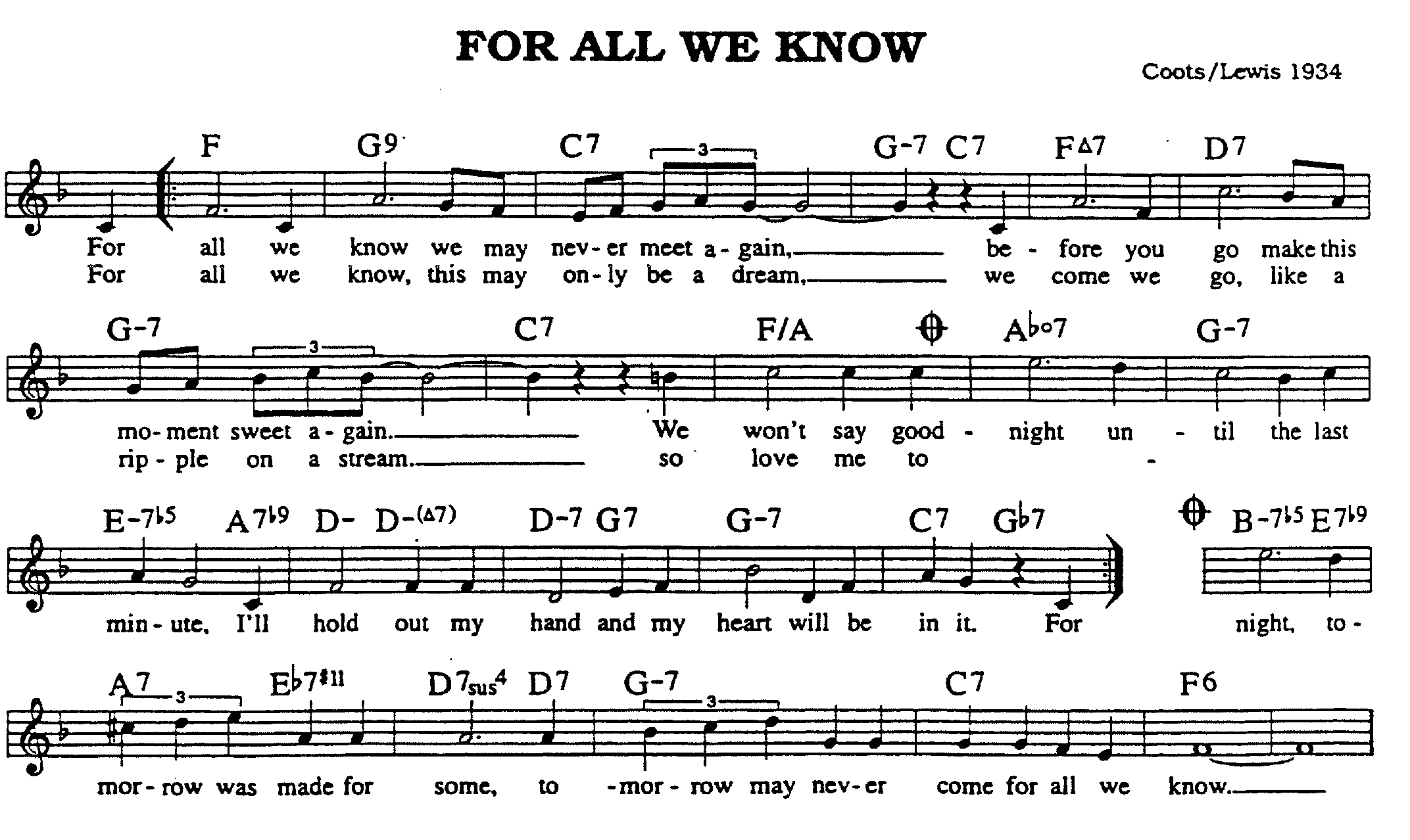
1. Song Overview
| FieldDetails | |
|---|---|
| Song | For All We Know |
| Composer | J. Fred Coots |
| Lyricist | Sam M. Lewis |
| Year | 1934. The song was published that year by Leo Feist, Inc. (scholarsjunction.msstate.edu) |
| Original context | A stand-alone popular song rather than a number written for a stage musical or film. Morton Downey is credited with introducing it on his radio programme. The original published song included an introductory verse beginning before the familiar chorus; the attached lead sheet presents the chorus only. (jazzstandards.com) |
| Lead-sheet key | F major |
| Form | 32-bar ABAC chorus, encoded compactly with return and Coda navigation |
| Principal tonal centres | F major throughout as global tonic, with a pronounced D minor tonicisation in B and chains of applied dominants in C |
| Common jazz classification | Great American Songbook ballad; 32-bar jazz standard |
The lyric is built on an unusually severe premise for a conventional love song: intimacy matters precisely because continuity cannot be assumed. The title phrase is epistemic rather than sentimental. “For all we know” means that the speaker cannot guarantee another meeting, another night, or even the persistence of present experience. From that uncertainty comes a practical argument: do not defer tenderness. The song therefore moves from speculation, through the ritual of parting, towards an explicit demand for love in the present.
What distinguishes it from many separation standards is the absence of a compensating fantasy of reunion. The speaker does not promise to remember forever, anticipate a return, or imagine a secure future. Even the natural world offers no consolation. The image of the “ripple” makes human presence transient rather than cyclical, while the extraordinary formulation “tomorrow was made for some” treats futurity almost as a privilege that may not belong to the two people in the song. The emotional trajectory is consequently not from sadness to hope, but from uncertainty to urgency.
Coots’s musical setting keeps that argument from becoming purely declamatory. The A material is graceful and periodic, with broad sustained notes followed by compact triplet and eighth-note movement. The B and C sections become more continuous and harmonically chromatic. Crucially, the two concluding sections begin with closely related melodic material but diverge harmonically and dramatically. B describes the etiquette of parting; C turns similar melodic material into the direct request to “love me tonight”. The same musical gesture is therefore transformed from restraint into exposure.
2. Form and Dramatic Architecture
The attached sheet gives no rehearsal letters, but the melodic and harmonic design is a clear ABAC, a classification also given in published jazz-standard analysis. The first two bars of B and C are closely related melodically, after which the sections diverge substantially. (jazzstandards.com)
| Section | Bars | Tonal centre | Lyrical or dramatic function | Musical function |
|---|---|---|---|---|
| A1 | 1-8 | F major | Establishes the possibility of permanent separation and asks that the remaining moment be made meaningful | States the principal eight-bar melody; tonic moves quickly into dominant harmony, then returns through ii-V |
| B | 9-16 | F major with D minor tonicisation | Refuses the conventional finality of "good-night"; replaces words of farewell with physical and emotional offering | Begins with descending chromatic bass A-A-flat-G, moves through iiø-V to D minor, then rebuilds dominant pressure towards the return |
| A2 | 17-24 | F major | Recasts the opening uncertainty in more existential terms: present reality itself may be dreamlike and transient | Repeats A's melody and harmony with new words, making identical musical syntax carry a more abstract argument |
| C | 25-32 | F major, with tonicisation of A and a dominant chain through D-G-C | Converts uncertainty into an imperative to love now; rejects reliance on tomorrow | Begins like B, then intensifies through applied ii-V harmony, A7 and its tritone-related E-flat7, D7, ii-V-I and a final F6 |
The form is dramatic because repetition does not mean psychological stasis. A1 concerns separation between two people. A2 broadens the issue: perhaps the whole experience is as unstable as a dream or a ripple. The repeated A music therefore acquires a different weight without requiring melodic development. The constancy of the tune throws the changed thought into relief.
B and C are still more revealing. Their openings are intentionally cognate. B is socially restrained: the lovers will resist saying the expected word of departure, and the speaker offers hand and heart. C begins with related melodic rhetoric but abandons decorum for direct appeal. Harmonic divergence accompanies that change. What had been a chromatic passing-diminished progression in B becomes an applied minor ii-V and a chain of dominants in C.
The lead sheet economises notation through its return and Coda structure rather than writing all 32 measures in uninterrupted succession. Analytically, however, the heard form is ABAC. There is no notated introduction or extended tag in this chart, and the final cadence closes on F6.
3. Close Reading of the Lyrics
| Lyric or cue | Literal meaning | Literary and poetic reading | Emotional subtext | Musical and harmonic interaction |
|---|---|---|---|---|
| "For all we know" | The future is uncertain. | The title functions as a qualifying clause before any actual proposition appears. It immediately places knowledge itself under suspicion. | The speaker begins without confidence or promise. | The pickup leads into F, but the tonic is not allowed to remain self-sufficient for long. Bar 2 moves to G9, V9/V, so harmonic departure begins almost as soon as the premise has been stated. |
| "may never meet again" | This encounter could be the last. | "May" is formally conditional, but "never" introduces the most absolute possible consequence. The line holds possibility and finality in the same syntax. | The speaker imagines the worst outcome without claiming to know it will happen. | C7 dominates the phrase. Instead of immediate tonic resolution, the melody proceeds through a compact triplet figure and the harmony prolongs dominant territory. The uncertainty is structurally sustained rather than immediately answered. |
| "Before you go" | The other person is about to leave. | This is the first concrete temporal marker. The opening speculation becomes an imminent physical event. | Departure is not hypothetical even if permanent separation is. | Fmaj7 briefly restores tonic stability in bar 5, but D7 in bar 6 immediately destabilises it as V7/ii. The fleeting tonic aptly corresponds to the fleeting pause before departure. |
| "moment sweet again" | The speaker asks for renewed tenderness before separation. | The noun "moment" deliberately reduces the requested future from permanence to an instant. "Again" implies prior intimacy without explaining its history. | The speaker asks not for commitment, only for one recovered experience. | D7 resolves to Gm7, then C7 prepares F. The familiar secondary-dominant to ii-V motion lends the plea a conventional lyricism, but the cadence is withheld until the next section. |
| "won't say good-night" | The lovers will avoid formally ending the encounter. | Language itself is treated as performative: saying the word would acknowledge separation. The speaker tries to delay finality by refusing its conventional verbal ritual. | Denial and tenderness coexist. | F/A begins a bass descent A-A-flat-G across bars 9-11. The melodic phrase appears poised, while the accompaniment slips chromatically beneath it. |
| "until the last minute" | Farewell will be postponed as long as possible. | "Last" converts ordinary clock time into a boundary. The phrase is understated, but its temporal vocabulary carries the song's mortality motif. | The speaker can delay the farewell but cannot abolish it. | The A-flat diminished chord passes into Gm7, after which Eø7-A7flat9 tonicises D minor. The harmony becomes darker exactly as the language acknowledges a terminal point. |
| "hold out my hand" | The speaker offers a hand at parting. | The gesture can be read simultaneously as farewell, invitation and physical connection. Its ambiguity suits a lyric that resists categorising the relationship's ending. | Physical contact substitutes for what language cannot guarantee. | The line falls within the D minor region, where Dm and Dm(maj7) prolong the local minor tonic. The harmonic stillness gives the physical gesture unusual gravity. |
| "heart will be in it" | The gesture will be emotionally sincere. | A familiar idiom becomes literalised by proximity to the offered hand. External gesture and internal feeling are deliberately fused. | The speaker insists that the gesture is not mere etiquette. | Dm7-G7 and then Gm7-C7 move back towards dominant function. The statement of sincerity occurs while the harmony is already moving away from the temporary D minor resting point. |
| "only be a dream" | The encounter may be unreal or impermanent. | The second A shifts from future uncertainty to ontological uncertainty. "Only" reduces what seemed emotionally urgent to something insubstantial. | The speaker can no longer rely even on the present as stable evidence. | The melody and principal A harmony recur from A1. Repetition itself becomes expressive: the same musical world now supports a more destabilising idea. |
| "ripple on a stream" | Human lives or meetings pass like disturbances on flowing water. | This is the lyric's principal image. A ripple has form but no permanence, and cannot be separated from the current carrying it away. | Separation becomes part of a larger conception of transience, not merely a private romantic accident. | The return through Fmaj7, D7, Gm7 and C7 gives the image graceful inevitability. Structural cadence contrasts with the image's impermanence. |
| "love me tonight" | The speaker explicitly asks for present love. | The argument finally turns imperative. "Tonight" opposes a knowable present to an unknowable tomorrow. | Restraint gives way to direct vulnerability. | C begins with F/A as B did, but its continuation is reharmonised. Bø7-E7flat9 produces a stronger applied dominant pull than B's passing diminished harmony. Similar melody now bears greater harmonic pressure. |
| "tomorrow was made for some" | A future exists for others, perhaps not for these lovers. | The past tense "was made" is striking. Tomorrow is treated as something already allocated, but not universally. The phrase borders on aphorism while remaining deeply personal. | The speaker excludes the couple from assumptions other people take for granted. | A7 is followed by E-flat7sharp11, its tritone-related substitute dominant. The abrupt dominant side-slip refuses tonal comfort at the point where the lyric refuses confidence in the future. |
| "may never come" | There may be no tomorrow available to them. | The opening modal verb returns. The lyric never converts possibility into certainty, even at its darkest point. | The plea remains based on uncertainty rather than prophecy. | D7 resolves to Gm7, then C7. The dominant chain finally becomes a conventional return towards F, giving musical direction to words that deny temporal certainty. |
| "for all we know" | The original qualification is repeated. | The song ends where its argument began. Nothing has been proved; the title phrase survives intact. | The speaker has reached a decision about the present without gaining knowledge about the future. | C7 resolves to F6. Tonal closure is genuine, but epistemic closure is absent. The added sixth softens the final sonority rather than turning it into a severe plain triad. |
The lyric’s strength lies partly in how little narrative information it supplies. We are not told why one person is leaving, whether the relationship is established or new, whether separation is voluntary, or whether the feared finality has any concrete cause. That absence universalises the situation while preserving dramatic immediacy.
There is also a carefully controlled movement from modal language to imperative language. “May” and “for all we know” repeatedly qualify what can be asserted. Only the request itself becomes unqualified: love must happen now because the future cannot be depended upon.
4. Lyrical and Emotional Arc
Opening Position
The speaker begins in uncertainty, not despair. The first claim is deliberately conditional: another meeting may be impossible. This distinction matters because the lyric’s urgency depends on not knowing. A certain farewell would produce grief; an uncertain farewell produces a different psychology, one in which every gesture might retrospectively become the last.
The opening also reveals that the separation is immediate. “Before you go” establishes a practical deadline. The speaker’s attention therefore contracts from an indefinite future to the remaining minutes of the present encounter.
Development
B converts abstract anxiety into behaviour. The speaker proposes not to say the conventional word of departure until forced to do so, then substitutes touch and emotional sincerity for verbal closure. The movement into D minor at the centre of the section deepens the sense that a social farewell ritual has acquired private existential significance.
A2 then enlarges the argument. It is no longer merely possible that the lovers will not meet again; experience itself may be dreamlike. The ripple image places the couple within an impersonal flow of time. That image makes the subsequent request in C more consequential because the speaker is now arguing against transience itself.
Point of Greatest Tension
The greatest tension occurs around “tomorrow was made for some”. Lyrically, this is the song’s starkest proposition. The speaker does not merely doubt a reunion but denies that tomorrow can be treated as a universal possession.
Musically, the phrase coincides with A7 and E-flat7sharp11. These chords share the essential dominant tritone, so the second can be heard as a substitute continuation of the first. The harmony seems to turn sideways rather than arrive. It then settles onto D7, beginning the final circle towards Gm7-C7-F. The most fatalistic language thus appears at the point of maximum chromatic dominant concentration.
Resolution or Lack of Resolution
The music resolves. The lyric does not.
The final C7-F6 cadence establishes F unmistakably, but the last words restore the title’s uncertainty. No new fact has emerged, no promise has been made, and no external obstacle has been removed. What changes is the speaker’s response to uncertainty. The opening treats not knowing as a source of anxiety; the ending has converted it into a reason to act now.
The result is acceptance only in a limited sense. The speaker accepts that tomorrow cannot be guaranteed, but does not accept emotional distance in the present.
Central Paradox
The song’s central paradox is that uncertainty produces decisiveness. The speaker cannot make a confident statement about tomorrow, yet that very inability generates an absolute emotional demand in the present.
A second, subtler contradiction lies in the treatment of farewell. The speaker refuses to say “good-night”, but every subsequent image confirms that separation cannot be prevented. Language delays finality while the harmony continues inexorably through cadential cycles.
5. Detailed Harmonic Analysis
The global tonic of the attached lead sheet is F major. There is no sustained modulation away from F. Instead, the song uses secondary dominants, diminished passing harmony, brief minor tonicisation and substitute dominants to create local instability.
The A sections remain strongly related to F despite their frequent dominant chords. B gives D minor the clearest local tonic emphasis. C constructs a long dominant route back to F rather than establishing another independent key.
A1, bars 1-8
| Bars | Lyric cue | Chords | Roman numerals | Tonal centre | Harmonic function and interpretation |
|---|---|---|---|---|---|
| 1 | Title opening | F | I | F major | Direct tonic statement. |
| 2 | "know..." | G9 | V9/V | F major | Secondary dominant of C. The ninth enriches the dominant without changing its function. |
| 3 | "never meet..." | C7 | V7 | F major | Primary dominant. Its prolonged presence delays an expected return to F. |
| 4 | Phrase continuation | Gm7 C7 | ii7-V7 | F major | Conventional cadential preparation. |
| 5 | "Before you..." | Fmaj7 | Imaj7 | F major | First clear tonic recovery, softened by the major seventh. |
| 6 | "go..." | D7 | V7/ii | F major | Applied dominant targeting Gm7. |
| 7 | "moment..." | Gm7 | ii7 | F major | Resolution of D7 and preparation for the final dominant. |
| 8 | "sweet again" | C7 | V7 | F major | Dominant closes the A section and carries directly into I6 at the beginning of B. |
The central feature is not harmonic complexity but withholding. Bars 2-4 create an expanded dominant region: G9 moves to C7, then C7 is reapproached through its own ii-V. The phrase therefore spends more time preparing tonic than occupying it.
B, bars 9-16
| Bars | Lyric cue | Chords | Roman numerals | Tonal centre | Harmonic function and interpretation |
|---|---|---|---|---|---|
| 9 | "We won't say..." | F/A | I6 | F major | Tonic in first inversion. The bass begins a chromatic descent. |
| 10 | "good-night..." | A-flat°7 | flatIII°7, passing | F major | Chromatic passing diminished chord between F/A and Gm7. A-flat-D-F are heard less as an autonomous dominant than as voice-leading material. |
| 11 | "until the last..." | Gm7 | ii7 | F major | Completes the bass descent A-A-flat-G. |
| 12 | "minute..." | Eø7 A7flat9 | iiø7/vi-V7flat9/vi | D minor tonicisation | A complete minor ii-V strongly points to D minor. |
| 13 | "hold out..." | Dm Dm(maj7) | vi, vi(maj7); locally i-i(maj7) | D minor | Temporary minor tonic. The major seventh C-sharp introduces chromatic inward tension within the tonic sonority. |
| 14 | "hand..." | Dm7 G7 | vi7-V7/V | F major re-emerging | Dm loses its major seventh to C natural; G7 then points towards C. |
| 15 | "heart..." | Gm7 | ii7 | F major | G7 does not resolve to C. Its root is retained while B natural drops to B-flat, changing a dominant into the diatonic ii chord. |
| 16 | "in it" | C7 G-flat7 | V7-subV7/I | F major | C7 is followed by its tritone substitute G-flat7. Both can lead to F, the latter by semitone root motion. |
The most elegant detail is bars 9-11. F/A, A-flat°7 and Gm7 create a bass descent A-A-flat-G while upper voices can move economically. A-flat°7 contains A-flat-B-D-F; Gm7 contains G-B-flat-D-F. D and F remain common tones while the two altered tones resolve by semitone. The chord is therefore better understood as chromatic passing diminished harmony than as a displaced functional leading-tone chord.
Bars 12-14 deepen the harmonic field through D minor. Eø7-A7flat9 supplies a textbook minor ii-V, and Dm is prolonged sufficiently to register perceptually as a local tonic. Yet the tonicisation is brief. The music soon reinterprets Dm7 within the F-major network and begins rebuilding dominant motion.
A2, bars 17-24
| Bars | Lyric cue | Chords | Roman numerals | Tonal centre | Harmonic function and interpretation |
|---|---|---|---|---|---|
| 17 | Title return | F | I | F major | Exact recovery of tonic and A material. |
| 18 | "this may..." | G9 | V9/V | F major | Applied dominant, as in bar 2. |
| 19 | "only be..." | C7 | V7 | F major | Prolonged dominant. |
| 20 | Phrase continuation | Gm7 C7 | ii7-V7 | F major | Cadential preparation. |
| 21 | "we come..." | Fmaj7 | Imaj7 | F major | Tonic recovery. |
| 22 | "we go..." | D7 | V7/ii | F major | Secondary dominant. |
| 23 | "ripple..." | Gm7 | ii7 | F major | ii function. |
| 24 | "stream" | C7 | V7 | F major | Dominant into the final C section. |
The important analytical fact is psychological rather than functional: the harmony does not change when the lyric becomes more metaphysical. The listener hears the same secure syntax while the words undermine the security of experience itself.
C, bars 25-32
| Bars | Lyric cue | Chords | Roman numerals | Tonal centre | Harmonic function and interpretation |
|---|---|---|---|---|---|
| 25 | "love me..." | F/A | I6 | F major | C deliberately recalls the opening of B. |
| 26 | "tonight..." | Bø7 E7flat9 | iiø7-V7flat9 of A | A tonicisation | Minor-form applied ii-V points forcefully towards A. |
| 27 | "tomorrow was..." | A7 | V7/vi | F major, dominant chain | The expected A minor is majorised and dominantised. A7 now points towards D. |
| 28 | "made for..." | E-flat7sharp11 | subV7/vi | F major | Tritone substitute for A7. A7 and E-flat7 share the dominant tritone C-sharp/D-flat-G. The sharp 11, A, also preserves a direct connection with the preceding chord. |
| 29 | "some..." | D7sus4 D7 | V7/ii | F major | Dominant of G minor. The suspension delays the appearance of F-sharp, then releases into full D7. |
| 30 | "tomorrow may..." | Gm7 | ii7 | F major | Resolution of D7 and beginning of the final diatonic ii-V. |
| 31 | "come..." | C7 | V7 | F major | Primary dominant. |
| 32 | Final title cue | F6 | I6 | F major | Full tonic resolution, coloured by the added sixth. |
C is more directional than B. Beneath its rhetorical urgency lies a nearly continuous dominant chain. Bø7-E7flat9 points to A; A7 implies D; E-flat7 substitutes chromatically for that same A7 function and resolves by semitone into D7; D7 reaches Gm7; Gm7-C7 reaches F.
This is one of the chart’s most consequential distinctions from superficially similar ballad harmony. The chromatic chords are not interchangeable decorations. A-flat°7 in B is principally linear passing diminished harmony. E-flat7sharp11 in C is genuinely tritone-related dominant substitution.
6. Tonal Journey
| Passage | Starting centre | Destination | Mechanism | Dramatic effect |
|---|---|---|---|---|
| A1 bars 1-4 | F major | Dominant region of F | I-V/V-V, followed by ii-V | The tonic is established but almost immediately made provisional. |
| A1 bars 5-8 | F major | F dominant preparation | I-V/ii-ii-V | The apparent return to stability turns back into forward motion. |
| B bars 9-11 | F major | ii region | First-inversion tonic followed by chromatic diminished passing chord | The bass slips downward while the melody remains comparatively poised. |
| B bars 12-14 | F major | D minor | Eø7-A7flat9-Dm | The song's strongest temporary move into the relative-minor area corresponds with the imagery of final minutes and emotional offering. |
| B bars 14-16 | D minor region | F dominant | Dm7-G7, mutation to Gm7, then C7/G-flat7 | D minor is not allowed to become a separate key. Dominant pressure is rebuilt for the return. |
| A2 bars 17-24 | F major | F major | Repeat of A1 | Musical recurrence contrasts with the lyric's stronger assertion of transience. |
| C bars 25-29 | F major | A and D dominant regions | Bø-E7 to A7, tritone substitution E-flat7, then D7 | Harmonic pressure accumulates beneath the most direct emotional appeal. |
| C bars 30-32 | G minor region | F major | ii-V-I | The song finally grants unambiguous tonal closure. |
F major is therefore never genuinely displaced by another tonic. D minor has the strongest local claim because it receives its own iiø-V and a prolonged Dm sonority, but even this remains a tonicisation rather than a full modulation.
The tonic itself is repeatedly recoverable but not continuously inhabited. That perceptual pattern suits the lyric unusually well. F represents not so much emotional safety as the possibility of returning to a familiar frame. Every return is followed by renewed dominant motion until the final cadence.
The ending matters precisely because it does something the words cannot. Harmony answers the question of tonal destination with F6; the speaker’s question about tomorrow remains unanswered.
7. Melody and Prosody
The melody is relatively compact, lying approximately within C4-E5 in common F-major notation of the song, a range also given for a published F-major vocal arrangement. (Musicnotes.com) The expressive interest therefore comes less from spectacular range than from register, duration and the placement of motion against harmony.
The A melody alternates broad sustained notes with shorter arcing figures. JazzStandards’ melodic analysis similarly describes the A material as sustained leaps followed by curving eighth-note movement, while B and C become more flowing. (jazzstandards.com) This distinction is dramatically useful. The title phrase sounds spacious enough to accommodate reflection, but the quicker figures towards the ends of phrases give the sense that thought is gathering momentum.
Triplets are particularly important. They soften the square metre and bring the melodic line closer to conversational speech. Around phrases concerning meeting again, the sweetening of the moment and the stream image, the triplet figures avoid a rigid declamatory character. They also give singers considerable scope to place syllables behind or ahead of the beat without breaking the contour.
The A sections repeatedly begin from a pickup. Consequently, significant words do not all fall on blunt downbeats. The line sounds spoken into the bar rather than announced from its beginning. That is valuable for a lyric whose argument is intimate rather than public.
B changes the prosodic character. “We won’t say…” is more syllabic and continuous. The chromatic bass descent beneath it allows the melodic line to preserve composure while the accompaniment becomes less stable. This creates one of the composition’s best examples of expressive counterpoint between layers: the singer can sound controlled while the harmony quietly acknowledges what the words are resisting.
The repeated melodic opening of C is structurally crucial. “So love me tonight” initially resembles B’s opening gesture. The listener recognises the shape before fully registering that its harmonic continuation has changed. Bø7-E7flat9 beneath the C continuation gives familiar melodic material a more pressing, exposed quality.
The closing phrase gradually relinquishes that pressure. D7 moves to Gm7-C7, and the final melodic arrival is on the tonic F over F6. After a lyric dominated by conditional verbs, the melody is permitted an unequivocal terminal pitch. The added sixth in the accompaniment prevents the cadence from becoming overly monumental.
Prosodically, the most important words should not be identified merely by pitch height. “Tonight”, “tomorrow”, “never” and the recurring word “know” derive much of their force from harmonic context and duration. The title word gains meaning through recurrence: each occurrence sounds musically familiar, but what the speaker now understands about uncertainty has changed.
8. Word, Melody, and Harmony: Key Moments
| Moment | Lyric cue | Musical event | Interpretive significance |
|---|---|---|---|
| 1 | Opening title | F moves almost immediately to G9, V/V | The statement begins on tonic but refuses to remain there. Certainty of key and uncertainty of thought diverge almost immediately. |
| 2 | "never meet again" | C7 is prolonged and followed by another ii-V approach | A thought about permanent separation is kept harmonically unresolved. |
| 3 | "Before you go" | Fmaj7 returns, then D7 redirects to ii | The momentary tonic sounds like a temporary reprieve rather than secure arrival. |
| 4 | "good-night" | F/A-A-flat°7-Gm7 creates A-A-flat-G bass motion | A socially restrained farewell is accompanied by quietly descending chromatic instability. |
| 5 | "last minute" | Eø7-A7flat9 tonicises D minor | The lyric's first explicit terminal boundary receives the strongest minor-directed cadence in the song. |
| 6 | "heart will be in it" | D-minor material turns back through G7, Gm7 and C7 | Sincerity is expressed while the harmony refuses to settle, making the offering feel active rather than retrospective. |
| 7 | "only be a dream" | A music returns substantially unchanged | Identical music now supports a more destabilising idea. Repetition becomes psychological reinterpretation. |
| 8 | "love me tonight" | C recalls B melodically but changes the second-bar harmony to Bø7-E7flat9 | The transformation from restrained farewell to direct desire is registered harmonically before the form fully diverges. |
| 9 | "tomorrow was made for some" | A7-E-flat7sharp11-D7 | A functional dominant, its tritone substitute and a new applied dominant form a concentrated chromatic chain beneath the lyric's bleakest temporal assertion. |
| 10 | Final title cue | C7 resolves to F6 and the melody settles on F | Musical closure is complete while the statement "for all we know" preserves uncertainty at the level of meaning. |
9. Historical and Cultural Context
J. Fred Coots and Sam M. Lewis wrote “For All We Know” in 1934. A surviving copy in the Mississippi State University sheet-music collection identifies Leo Feist, Inc. as publisher and confirms the song’s 1934 publication. That source also shows that the original song contained an introductory verse before the familiar chorus. The attached jazz lead sheet omits that verse and begins directly with the chorus. (scholarsjunction.msstate.edu)
Contemporary jazz-standard documentation credits vocalist Morton Downey with introducing the song on his radio programme. It quickly entered the commercial dance-band repertory. Hal Kemp’s orchestra, with Skinnay Ennis singing, reached number 3 in 1934, while Isham Jones’s recording with Joe Martin reached number 16. (jazzstandards.com) The song therefore belongs initially to the interwar American popular-song economy of radio, dance orchestras and sheet music rather than to the jazz repertory in the narrower modern sense.
Its lyric is well suited to that period’s popular ballad language but is more severe than its elegant surface initially suggests. There is no elaborate narrative and little period-specific vocabulary. Its argument rests on perennial concepts of departure, time and uncertainty. That abstraction helped the song survive changes in performance idiom.
The King Cole Trio recorded it in New York on 22 March 1949, with Cole on piano and vocal, Irving Ashby on guitar, Joe Comfort on bass and Jack Costanzo on percussion. (jazzdisco.org) JazzStandards credits Cole’s recording with returning the song to mainstream attention fifteen years after its composition. (jazzstandards.com) Whether described as revival or rediscovery, the recording is an important point in the song’s transition from 1930s popular repertory into the post-war jazz-standard canon.
The tune subsequently attracted both singers and instrumentalists. Paul Desmond developed a particularly sustained association with it, including performances with Dave Brubeck and later with Jim Hall; jazz discographies also document interpretations by Stan Getz and Cal Tjader, Benny Carter, Wes Montgomery, Grant Green, Cedar Walton and Wynton Marsalis. (jazzstandards.com) Its survival is therefore not primarily a matter of nostalgia for a 1934 hit. The ABAC form, strong melody, compact dominant logic and chromatic interior sections give improvisers enough structure to reinterpret it without obscuring its identity.
The song should not be confused with the unrelated later “For All We Know” associated with the 1970 film Lovers and Other Strangers. The Coots-Lewis composition is the 1934 standard analysed here. (jazzstandards.com)
10. Significant Interpretations
| Performer | Recording or period | Interpretive character | What it reveals about the song |
|---|---|---|---|
| Hal Kemp and His Orchestra, Skinnay Ennis vocal | 1934 | Sweet-band popular-ballad treatment from the song's first year; the recording reached number 3. ([jazzstandards.com][2]) | Establishes the composition's origin as polished commercial popular song rather than a tune conceived primarily as an improvisational vehicle. |
| Nat King Cole Trio | 22 March 1949 | Voice and piano with Irving Ashby, Joe Comfort and Jack Costanzo in a compact small-group setting. ([jazzdisco.org][4]) | The reduced texture brings the lyric's conversational scale to the foreground and shows how effectively the song can migrate from dance-band repertoire to intimate jazz performance. |
| Billie Holiday with Ray Ellis's orchestra | Lady in Satin, 1958 | Vocal reading against large orchestral and string forces; the recording session took place in February 1958. ([jazzdisco.org][5]) | The contrast between orchestral breadth and intensely personal vocal phrasing makes the lyric's refusal of emotional distance especially stark. |
| Nina Simone | Recorded December 1957; issued on Nina Simone and Her Friends | Simone sings and plays piano with Jimmy Bond and Albert Heath. ([Nina Simone][6]) | The trio setting exposes the harmonic skeleton and allows the lyric to function less as orchestral romance and more as direct personal address. |
| Dave Brubeck Quartet, Paul Desmond | At Carnegie Hall, February 1963 | Extended instrumental treatment with Brubeck, Desmond, Eugene Wright and Joe Morello. The Carnegie Hall set documents the tune as an established improvisational standard. ([jazzdisco.org][7]) | Without the words, the ABAC architecture and long dominant trajectories become the primary expressive argument. Desmond's spacious melodic approach demonstrates how much of the lyric's restraint is already encoded in Coots's melody. |
| Donny Hathaway | 1971, associated with the Roberta Flack & Donny Hathaway sessions | Soul-oriented reading, with Hathaway vocal and Roberta Flack credited on piano in discographic data; Arif Mardin supplied orchestral arranging. ([jazzdisco.org][8]) | Shows that the song's present-tense plea can survive a substantial change of stylistic vocabulary. The composition does not depend on 1930s dance-band mannerisms for its dramatic logic. |
| Wynton Marsalis | Hot House Flowers, 1984 | Instrumental ballad with jazz rhythm section and orchestral colours; the album documents Marsalis, Kenny Kirkland, Ron Carter and Jeff Watts among the core personnel. ([jazzdisco.org][9]) | Returns the song to an expansive ballad aesthetic while preserving improvisational space, confirming the durability of the melody independently of the lyric. |
The contrast between Cole and Holiday is particularly instructive. JazzStandards specifically singles out both vocal performances while noting their very different instrumental backgrounds. (jazzstandards.com) Cole’s small-group environment allows the song to sound almost conversational. Holiday’s orchestral frame magnifies the distance between public arrangement and private utterance.
Brubeck and Desmond demonstrate the opposite process. Once the lyric disappears, the delayed cadences, chromatic bass motion and B/C contrast must communicate the architecture unaided. The song withstands that removal because the tune and harmony already possess a coherent dramatic sequence.
11. Place in the Jazz Canon
“For All We Know” endures because it occupies a useful space between harmonic familiarity and structural individuality. Its basic materials are accessible to improvisers: secondary dominants, ii-V motion, relative-minor tonicisation and circle-of-fifths resolution. Yet their arrangement is sufficiently distinctive that a player cannot simply treat the tune as an interchangeable 32-bar ballad.
The ABAC form is the first essential point. A player expecting AABA can easily lose the final section because C initially recalls B but then diverges. This similarity is precisely what makes the form elegant and what makes inattentive improvisation hazardous.
The second issue is functional hierarchy. G9 in A is genuinely V/V. A-flat°7 in B is primarily chromatic voice-leading harmony. E-flat7sharp11 in C has a much stronger substitute-dominant interpretation. Treating all three as generic “outside” chords erases the logic that makes the progression easy to hear.
The third issue is the D minor region. Eø7-A7flat9-Dm is not merely a string of altered chords; it produces the principal temporary tonicisation of the song. An improviser who hears D minor locally can build a phrase across the cadence rather than changing scales mechanically at every chord symbol.
The tune is also flexible across performance styles. Recordings range from 1930s dance-band balladry to Cole’s trio, Holiday’s orchestral setting, Brubeck’s extended quartet performance and later soul and post-bop treatments. (jazzstandards.com) That breadth reflects the strength of the underlying form rather than dependence on one canonical arrangement.
For improvisers, the real task is therefore to hear long spans: G9-C7 as expanded dominant motion, bars 9-11 as one chromatic bass gesture, bars 12-14 as a D minor episode, and bars 26-32 as a dominant chain whose goal is the final F. The chord symbols become considerably easier once those trajectories are heard.
12. Interpretive Considerations for Performers
The lyric benefits from restraint because its language is already extreme. A singer does not need to make every reference to “never”, “last” or “tomorrow” sound tragic. If those words are delivered conversationally, the implications can emerge from the harmonic setting. Excessive pathos too early can leave C with nowhere to develop.
The title phrase should remain flexible. Its first appearance is speculative, the second follows a much more intimate B section, and the final appearance comes after the direct appeal and the chromatic dominant chain. Repeating identical inflection on all three occurrences loses part of the lyric’s architecture.
The A sections tolerate rhythmic elasticity, especially around the triplet figures, but their long notes should preserve the sensation of suspended thought. Over-filling them with ornament can obscure Coots’s contrast between spacious openings and more active cadential figures.
The bass descent F/A-A-flat°7-Gm7 is worth preserving even in substantial reharmonisation. It gives B a clear physical trajectory and makes the move into Eø7-A7flat9 feel inevitable. Replacing those chords with unrelated colour harmony may produce sophistication at the cost of form.
Similarly, the distinction between B and C should remain audible. If both sections are reharmonised with the same generic chromatic substitutions, the dramatic escalation into “love me tonight” is weakened. C benefits from a stronger applied-dominant profile than B.
The A7-E-flat7sharp11-D7 sequence offers room for alteration because the tritone relationship between A7 and E-flat7 is already structurally explicit. Extensions, altered fifths and upper structures can intensify the passage without destroying its direction, provided D7 still arrives as a clear dominant of Gm7.
Instrumentalists should retain the melodic identity of the beginnings of B and C. Their resemblance is not accidental filler; it is part of the composition’s rhetoric. The second occurrence becomes meaningful because the listener recognises the first.
At very slow tempos, the song becomes more existential. Chromatic passing harmony can be savoured, and the distance between phrases acquires dramatic weight. At a medium ballad tempo, the lyric sounds less fatalistic and more urgent, while the form’s circle motion becomes more apparent. A light medium swing can reveal how rhythmically viable the tune is beyond its customary torch-song treatment, as instrumental interpretations have demonstrated. (jazzstandards.com)
The final F6 should not necessarily be inflated into a grand emotional conclusion. Its significance lies in its simplicity. After the dominant sequence, a clear tonic is enough. The words have not solved the problem that began the song.
13. Final Reading
“For All We Know” is fundamentally about the ethical and emotional consequence of not possessing the future. Lewis does not ask the speaker to predict catastrophe. The lyric is more disciplined than that. It repeatedly insists only that tomorrow cannot be guaranteed, then asks what one should do with the present under those conditions. The answer is intimacy without postponement.
The speaker understands transience with unusual clarity but does not fully accept separation. Refusing to say “good-night” is a small act of magical resistance, as though withholding the word might delay the event it names. Yet the speaker’s imagery continually defeats that impulse. Minutes expire, dreams dissolve, ripples disappear into moving water. The lyric is compelling because it allows emotional resistance and intellectual recognition to coexist.
Coots’s harmony keeps the composition from sinking into unqualified sentimentality. The opening tonic is repeatedly displaced by dominant function. B’s chromatic A-A-flat-G descent undermines its outward composure, and the D minor tonicisation gives the middle of the song a temporary darkness without transforming the entire piece into minor-key lament. C intensifies rather than simply repeats that process. Applied dominant harmony accumulates beneath the direct appeal for love.
The melody is equally controlled. Its range is modest enough for speech-like intimacy, and its combination of sustained notes and triplet motion permits an interpreter to move between reflection and urgency without changing the composition’s basic character. Most importantly, repeated melodic material acquires new meaning from altered text and harmony. The melody does not have to announce psychological development because the form makes the listener hear familiar gestures differently.
The final cadence is therefore both satisfying and insufficient. C7 resolves to F6; the tonal problem has been solved. The verbal problem survives unchanged. The title phrase still means that neither person knows what follows. What the song has achieved is not knowledge but a changed relationship to ignorance: uncertainty has become the reason for emotional presence rather than an excuse for hesitation.
That distinction is why the song continues to reward radically different singers and improvisers. It can be intimate, elegiac, lightly swinging, orchestral or harmonically exploratory without losing its premise. The argument is embedded not only in Lewis’s words but in Coots’s form: leave home, postpone arrival, revisit what seemed familiar, intensify the route back, and finally arrive somewhere the lyric itself cannot guarantee.
The central artistic insight is precise: the music can resolve because the future cannot.