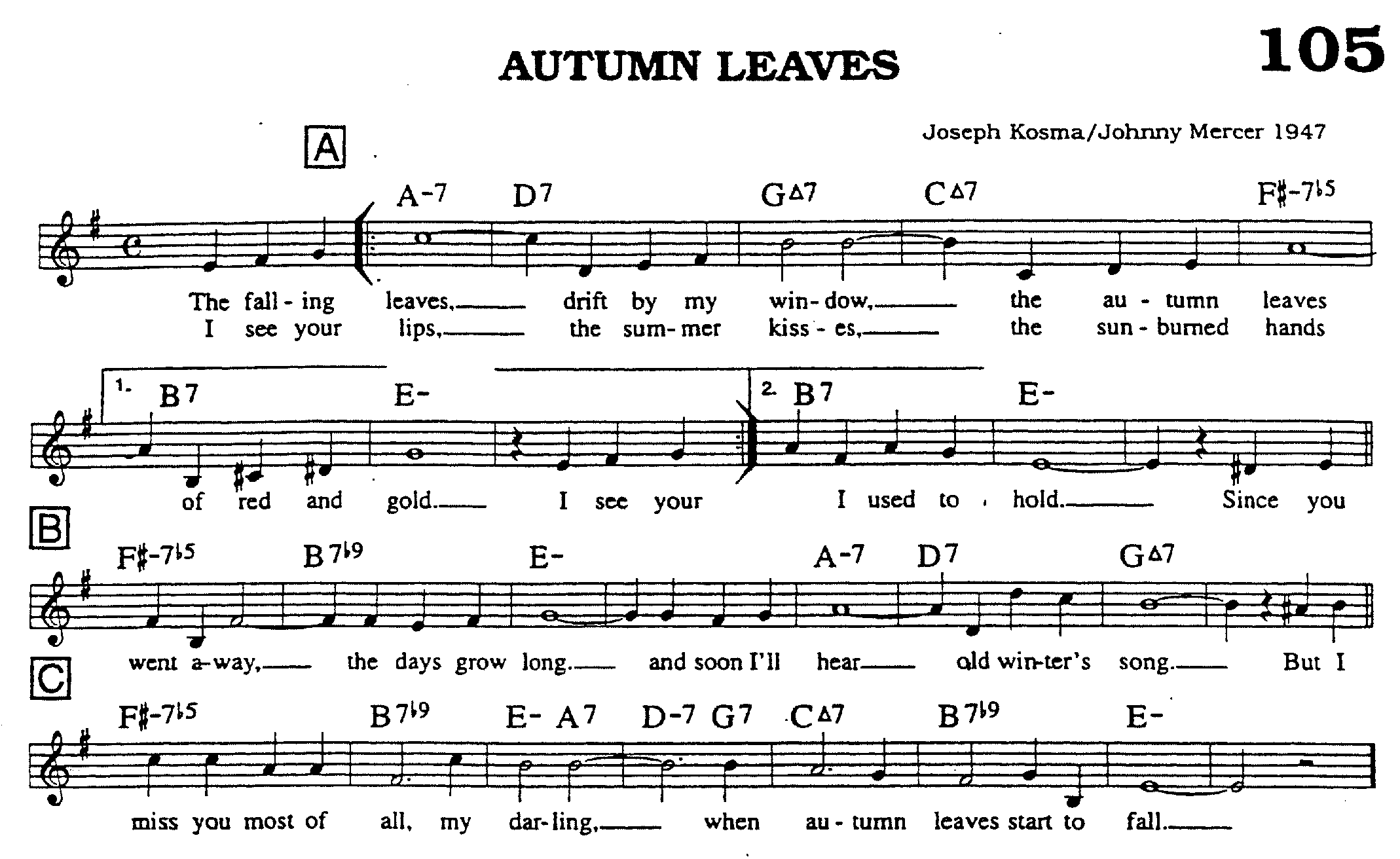
1. Song Overview
| Field | Details |
|---|---|
| Song | Autumn Leaves |
| Composer | Joseph Kosma |
| Lyricist | Johnny Mercer, English lyric on the attached lead sheet; Jacques Prévert wrote the original French lyric |
| Year | 1947 as printed on the attached lead sheet; the French antecedent was associated with the 1946 film Les Portes de la nuit, while institutional sources differ on the exact date of Mercer's English adaptation |
| Original context | English adaptation of Kosma and Prévert's Les Feuilles mortes, associated with Marcel Carné's film Les Portes de la nuit and ultimately derived from material Kosma had written for Roland Petit's ballet Le Rendez-vous |
| Lead-sheet key | E minor, one-sharp key signature, with extensive use of the relative major G |
| Form | 32-bar AABC, organised on the page as a repeated eight-bar A strain with first and second endings, followed by B and C |
| Principal tonal centres | E minor, G major, with a brief but structurally important tonicisation of C major |
| Common jazz classification | 32-bar minor-key jazz standard; major/minor ii-V-I study; ballad or medium-swing vehicle |
The English lyric constructs its drama with remarkable economy. It begins not by naming loss but by observing the environment. Falling leaves become a sensory trigger, and only gradually does the speaker admit what the season signifies personally. The first A section moves from landscape to colour; the repeated A turns the same melodic and harmonic machinery towards remembered physical intimacy. The bridge finally states the fact of separation, while the C section makes the confession that the previous images have been avoiding. The lyric therefore proceeds from observation, through memory, to admission.
That progression is inseparable from Kosma’s musical design. The A melody repeatedly makes a small local ascent while its principal arrival notes descend, C-B-A-G in this E-minor version. The harmony behaves similarly: it moves with strong circle-of-fifths inevitability, but alternates between the apparent brightness of G major and the darker gravitational pull of E minor. The result is not a uniformly sad song. Major and minor remain neighbours throughout, just as remembered summer and anticipated winter coexist in the lyric.
What distinguishes Autumn Leaves from many seasonally melancholic standards is the precision of its temporal structure. Summer exists only as memory, winter only as anticipation, and autumn as the present trigger between them. Mercer’s phrase about the days growing long is especially telling: in literal autumnal terms daylight is shortening, so “long” describes subjective rather than astronomical time. Absence has altered the speaker’s experience of duration. The song’s final return to falling leaves closes the circle without solving the loss.
2. Form and Dramatic Architecture
| Section | Bars | Tonal centre | Lyrical or dramatic function | Musical function |
|---|---|---|---|---|
| A1 | 1-8 | G major moving to E minor | External observation: autumn landscape and colour | Establishes the characteristic descending-fifths sequence and alternation of relative major with home minor |
| A2 | 9-16 | G major moving to E minor | The same external frame becomes bodily memory: lips, kisses and hands | Repeats the A architecture almost exactly, converting formal repetition into psychological deepening |
| B | 17-24 | E minor moving to G major | Separation is finally stated; memory gives way to anticipation of winter | Reverses the order of the two principal cadential regions, beginning in minor and ending in the relative major |
| C | 25-32 | E minor, C major, E minor | Direct confession of missing the absent lover, followed by return to the seasonal image | Begins with a minor cadence, expands into a chromatic iii-VI-ii-V-I motion in C major, then returns decisively through B7b9 to E minor |
The attached chart contains no written introduction, coda or tag. The melody begins with a three-note anacrusis before A. The first sixteen bars are economically engraved as an eight-bar repeat with first and second endings. Harmonically the endings are equivalent, B7 resolving to Em, but the outgoing pickups differ because the lyric continues into a new verbal unit on each pass.
The form is best understood as AABC rather than AABA. Bars 17-24 do not introduce completely foreign harmonic material. Instead, B rearranges the two cadential territories already heard in A. The first four bars concentrate on E minor; the next four recover G major. This makes the bridge psychologically effective without requiring a remote modulation. The speaker has moved from image to statement, while the harmony rearranges familiar material rather than abandoning it.
C is the true point of formal departure. Its first two bars promise another minor cadence, but the progression then uses Em as a hinge into a longer chain towards C major. The eventual B7b9-to-Em cadence makes the ending sound structurally conclusive, yet the lyric is circular rather than conclusive. Musically the form closes; psychologically the situation persists.
3. Close Reading of the Lyrics
| Lyric or cue | Literal meaning | Literary and poetic reading | Emotional subtext | Musical and harmonic interaction |
|---|---|---|---|---|
| "falling leaves" | Leaves are passing through the autumn landscape. | The song begins with an impersonal natural process rather than a declaration of grief. The image is transitional by definition: leaves are detached from what sustained them. | The speaker initially displaces emotion into observation. Nothing personal has yet been admitted. | The three-note pickup E-F#-G rises into a long C over Am7. Locally the gesture rises, but the subsequent principal melody notes descend through the A section. This coexistence of local ascent and large-scale descent is central to the tune's expressive logic. |
| "my window" | The leaves are seen from an interior vantage point. | The window establishes a boundary between observer and world. The speaker is stationary while the season moves outside. | The image suggests solitude without naming it. The possessive "my" quietly establishes a private space from which memory is being experienced. | The phrase arrives in the relative-major region at Gmaj7. The major sonority gives the image clarity rather than overt sorrow, preventing the opening from becoming melodramatic. |
| "red and gold" | The leaves are vividly coloured. | Mercer's diction is unusually economical. Colour supplies sensory richness immediately before the lyric turns to the absent person. | The warmth of the colours anticipates the remembered warmth of summer and touch. | The phrase ultimately reaches Em. The warm visual vocabulary therefore closes in the minor tonic, gently undermining the surface beauty. |
| "your lips" | The speaker remembers the absent person's face. | The landscape becomes metonymic: autumn has triggered a fragment of the lover's body rather than a complete portrait. | Memory is selective and sensuous. The speaker is no longer merely observing the season. | A2 repeats the opening melody. The same long C that previously carried the natural image now carries intimate memory. Formal identity shows how the external scene has become psychologically internalised. |
| "summer kisses" | The speaker remembers past kisses associated with summer. | Summer is the temporal opposite of the present season: warmth, fullness and presence are retrospectively idealised. | The relationship is remembered through sensation rather than narrative. Mercer gives no account of how or why it ended. | The phrase occupies the relative-major side of the harmonic cycle. The association of summer with this brighter region is perceptible, though it is primarily produced by the tune's pre-existing structure rather than literal text-painting. |
| "sun-burned hands" | The addressee's hands are remembered as tanned or sun-exposed. | The detail is tactile and unusually specific. It avoids generic romantic imagery by remembering a physical trace of lived summer. | The absent person is remembered through touch and bodily detail. | The corresponding A-section phrase descends to the F#m7b5-B7 region. Warm memory is already moving towards the minor cadence. |
| "used to hold" | The speaker once held those hands but no longer does. | "Used to" quietly transforms reminiscence into loss. It is the first unequivocal grammatical marker that the intimacy belongs to the past. | The lyric finally lets absence enter the sentence, but still indirectly. | The A section resolves to Em. The arrival at home coincides with a recognition of what is no longer possessed. The tonal resolution therefore does not equate to emotional comfort. |
| "went away" | The loved person has left. | The bridge removes the metaphorical screen. Separation is stated directly for the first time. | The speaker no longer needs the landscape to speak on their behalf. | B begins with F#m7b5-B7b9, the most explicit minor ii-V of the form. Direct verbal acknowledgement coincides with sharpened dominant tension. |
| "days grow long" | Time seems to pass slowly after the separation. | The phrase reverses seasonal fact: autumn daylight is shortening. "Long" therefore refers to experienced duration rather than daylight. The absent lover alters time itself. | Loneliness is expressed through temporal distortion rather than explicit complaint. | The word "long" receives durational emphasis in the melody. The musical extension makes the semantic idea audible without requiring harmonic exaggeration. |
| "winter's song" | Winter is expected to arrive soon. | Winter is personified as having a song of its own. It is also a reflexive image: the speaker imagines hearing a song while already singing one. | Future cold is anticipated before it arrives. The lyric moves from memory into foreknowledge. | The phrase ultimately reaches Gmaj7 rather than the minor tonic. The major arrival beneath winter imagery creates expressive ambiguity instead of simplistic darkening. |
| "miss you most" | The speaker directly admits the intensity of longing. | "Most of all" ranks the loss above all the seasonal associations that have preceded it. The metaphor gives way to confession. | This is the point at which emotional concealment is least sustainable. | The C section begins on F#m7b5. The melodic C at the opening is the diminished fifth of that chord, so the central confession begins on a structurally unstable sonority rather than on tonic repose. |
| "my darling" | The absent person is directly addressed with an intimate term. | The vocative appears remarkably late. The lyric has spent most of the song speaking about the beloved before speaking to them. | The addressee becomes psychologically present at the moment their absence is most openly acknowledged. | The harmony moves through Em-A7 towards Dm7-G7. Rather than settling after the confession, it opens a new harmonic route, extending vulnerability rather than resolving it. |
| "start to fall" | Falling leaves repeatedly trigger the speaker's sense of loss. | The ending returns to the song's opening object. The seasonal event is cyclical, so the grief is potentially recurrent each year. | Nothing about the relationship has changed. The speaker has merely articulated what the season causes them to remember. | The lead sheet places C natural, the b9 of B7, near the final dominant phrase before the melody resolves to E on "fall". The final tonic is acoustically conclusive, but the verbal return to the opening image makes the narrative circular. |
4. Lyrical and Emotional Arc
Opening Position
The speaker begins in a state of controlled observation. There is no accusation, plea or explicit declaration of loneliness. Autumn is first presented as an objective scene viewed through a window. That framing matters because it allows the lyric to seem descriptive before the repetition of the A material reveals that the landscape is functioning as a mnemonic device.
The first eight bars therefore establish emotional distance. The world is changing outside, but the speaker’s interior state remains unstated. Even the colours are warm rather than morbid. The loss enters only when “used to” converts bodily memory into grammatical past tense.
Development
The second A changes the significance of the first without changing its musical mechanism. The same descending sequence that first organised leaves, window and colour now organises lips, kisses and hands. The repetition establishes a direct equivalence between the landscape and the beloved. Autumn is not simply a metaphor imposed upon grief; it is the sensory trigger through which the lost relationship becomes present again.
The bridge then changes temporal direction. The A sections look backwards to summer. B states the separation in the past and anticipates winter in the future. The speaker consequently occupies an unstable present between an idealised past and an unwelcome future.
Point of Greatest Tension
The greatest exposure occurs at the beginning of C, with the admission that the speaker misses the beloved above everything else. Several earlier lines imply loss, but this is the first unqualified declaration of emotional dependence.
Musically the moment is not granted tonic stability. It begins over F#m7b5, and the melody’s C natural is a defining diminished fifth of that sonority. The following B7b9 intensifies the dominant field. Even after Em arrives, the harmony does not remain there: A7 redirects the phrase into the C-major sequence. The confession therefore causes harmonic expansion rather than immediate closure.
Resolution or Lack of Resolution
The final cadence is genuine in tonal terms. B7b9 resolves to Em, and the concluding melodic E confirms the tonic. There is no ambiguity about the home key at the end of this lead-sheet version.
The dramatic resolution is much weaker. The lyric returns to the recurring event that began the song. The beloved has not returned, the speaker has not relinquished the memory, and no decision has been made. What has changed is the degree of articulation. The speaker finishes able to say directly what the opening could express only through scenery.
The result is best described as acknowledgement without release.
Central Paradox
The song’s central paradox is that it becomes more emotionally explicit while remaining formally circular. The speaker progresses from image to confession, but the final image sends the song back to its beginning.
A second paradox operates in the music. The A melody is made from rising local gestures organised into an overall descending sequence. The harmony repeatedly reaches secure major and minor cadences, yet those cadences do not produce psychological security. Closure is continually achieved at the level of syntax while withheld at the level of experience.
5. Detailed Harmonic Analysis
The global tonic of the attached lead sheet is E minor. The one-sharp key signature is shared with G major, and Kosma exploits that relative-key relationship continuously. G major is not merely a fleeting tonicisation: it forms one of the composition’s two principal harmonic territories. Nevertheless, the eventual cadential hierarchy, the repeated B7-to-Em resolutions and the final cadence establish E minor as the global home.
The lead sheet also makes an important notational distinction. The A sections specify plain B7, whereas B and C explicitly specify B7b9. That difference should not be silently homogenised. The A-section melody includes C#, the natural 9 of B7, so automatically imposing a b9 voicing there can create an avoidable semitone clash.
| Bars | Lyric cue | Chords | Roman numerals | Tonal centre | Harmonic function and interpretation |
|---|---|---|---|---|---|
| 1 | "leaves" | Am7 | iv7 in E minor; ii7 in G | G major region | Predominant opening. Heard retrospectively as ii of the coming G-major ii-V-I. |
| 2 | "drift" | D7 | bVII7 in E minor; V7 in G | G major | Functional dominant of G. The A-D-G roots begin the descending-fifths cycle. |
| 3 | "window" | Gmaj7 | bIIImaj7 in E; Imaj7 in G | G major | Clear relative-major arrival. |
| 4 | "the autumn" | Cmaj7 | bVImaj7 in E; IVmaj7 in G | G major / pivot | Extends the relative-major region while preparing the shift towards the minor cadence. |
| 5 | "leaves" | F#m7b5 | iiø7 | E minor | Predominant of E minor. Cmaj7 -> F#m7b5 is not a root-fifth move, but shares C and E while G moves to F# and B can move to A, producing efficient voice leading. |
| 6 | "of red and" | B7 | V7 | E minor | Dominant of the global tonic. The plain symbol is significant because the melody uses the natural 9, C#. |
| 7-8 | "gold" | Em | i | E minor | Tonic arrival and prolongation; the latter part supplies the pickup into A2. |
| 9-16 | second A | Am7 - D7 - Gmaj7 - Cmaj7 - F#m7b5 - B7 - Em - Em | iv7 - bVII7 - bIIImaj7 - bVImaj7 - iiø7 - V7 - i - i; equivalently ii-V-I-IV in G, then iiø-V-i in E | G major -> E minor | Exact harmonic restatement of A1. The psychological change comes from the lyric, not reharmonisation. |
| 17 | "went away" | F#m7b5 | iiø7 | E minor | The bridge starts directly in the minor predominant, omitting the relative-major preparation heard at the beginning of A. |
| 18 | "days" | B7b9 | V7b9 | E minor | Strong altered dominant. C natural is the b9 and resolves naturally into the minor tonic field. |
| 19-20 | "grow long" | Em | i | E minor | Tonic resolution and prolongation. The longer tonic span matches the bridge's more declarative melodic pacing. |
| 21 | "soon I'll hear" | Am7 | iv7 in E; ii7 in G | Moving towards G major | Begins the familiar relative-major cadence. |
| 22 | "winter's" | D7 | bVII7 in E; V7 in G | G major | Dominant preparation. |
| 23-24 | "song" | Gmaj7 | bIIImaj7 in E; Imaj7 in G | G major | Bridge closes in the relative major. This is a structurally bright cadence beneath verbally bleak anticipation. |
| 25 | "miss you" | F#m7b5 | iiø7 | E minor | C opens with the minor predominant, increasing directness immediately. |
| 26 | "most of all" | B7b9 | V7b9 | E minor | Intensified dominant. |
| 27, first half | "my darling" | Em | i | E minor | Expected tonic resolution. |
| 27, second half | continuation | A7 | V7/ii in C | Pivot towards C major | Em is reinterpretable as iii in C major; A7 then functions as the applied dominant of Dm7. The C# is the principal chromatic inflection. |
| 28, first half | continuation | Dm7 | ii7 in C | C major | Resolution of A7 and predominant in the new local centre. |
| 28, second half | "when" | G7 | V7 in C | C major | Functional dominant. |
| 29 | "autumn" | Cmaj7 | Imaj7 in C; bVImaj7 in E | C major | The strongest C-major tonicisation in the song. It is a local arrival, not a global modulation. |
| 30 | "leaves start to" | B7b9 | V7b9 in E minor | E minor | Root descends by semitone C->B. B7 immediately cancels C major and restores the E-minor dominant. |
| 31-32 | "fall" | Em | i | E minor | Final tonic and prolongation. No harmonic tag is printed. |
The first six bars of A are sometimes loosely described as one circle-of-fifths progression. That is broadly perceptible, but the exact construction deserves finer distinction. A-D-G-C forms a regular descending-fifths chain. The move Cmaj7-F#m7b5 breaks the root pattern by a tritone, although the chords are closely connected by common tones. The cycle then resumes F#-B-E. What the ear experiences as continuity is therefore produced by both root motion and parsimonious upper-voice movement.
The B7-to-Em cadences depend strongly on guide-tone resolution. D# rises to E; A normally falls to G; in the B7b9 sonority C can fall to B. At the end, those semitone and whole-step resolutions make the cadence exceptionally compact. Cmaj7-B7b9-Em is particularly effective because the bass descends C-B before leaping to E while the upper voices can contract chromatically around the tonic chord.
The C-section excursion through A7-Dm7-G7-Cmaj7 is not a tritone-substitution passage. A7 is an applied dominant, best heard as V7/ii in C. Dm7-G7 is a conventional ii-V, and Cmaj7 is its local tonic. The harmonic interest comes from reinterpretation and circle motion, not substitute-dominant syntax.
6. Tonal Journey
| Passage | Starting centre | Destination | Mechanism | Dramatic effect |
|---|---|---|---|---|
| A1, bars 1-3 | G-major region | G major | Am7-D7-Gmaj7, ii-V-I | The song initially sounds more open and major than its ultimate tonic would suggest. |
| A1, bars 4-7 | G major | E minor | Cmaj7 pivots by common-tone voice leading into F#m7b5-B7-Em | The relative-major surface folds into the darker home key without a violent modulation. |
| A2 | G major | E minor | Exact repeat of the same major/minor trajectory | The unchanged tonal path now carries intimate memory rather than landscape description. |
| B, bars 17-20 | E minor | E minor | iiø-Vb9-i | The speaker's direct acknowledgement of separation is accompanied by the most explicit minor cadence. |
| B, bars 21-24 | E-minor environment | G major | Am7-D7-Gmaj7 | The bridge recovers the relative major even as the lyric looks towards winter. |
| C, bars 25-27 | E minor | E minor | iiø-Vb9-i | The confession initially receives an orthodox home-key cadence. |
| C, bars 27-29 | E minor | C major | Em reinterpreted as iii in C, then A7-Dm7-G7-Cmaj7 | Instead of remaining settled after the confession, the harmony opens sideways into a new major region. |
| C, bars 29-31 | C major | E minor | Cmaj7 -> B7b9 -> Em | Semitone bass motion into the dominant sharply reasserts home and supplies the final cadence. |
The tonal journey matters because neither major nor minor is sufficient by itself to describe the song’s emotional world. G major repeatedly represents a region of recollection, visual clarity and harmonic openness, while E minor provides the stronger sense of gravitational truth. Yet the major region is not merely “happy”, nor the minor simply “sad”. The bleak phrase concerning winter ends in G major, while memories of summer ultimately return to E minor.
C major in the final section broadens this ambiguity. It is harmonically more remote than G major but still closely related to E minor through shared pitch material. The tonicisation momentarily prevents the direct confession from simply collapsing into the home tonic. Only after that detour does B7b9 impose the final E-minor cadence.
The tonic is therefore not withheld at the conclusion. What remains unresolved is not key but meaning.
7. Melody and Prosody
The lead-sheet melody occupies roughly B3 to D5, a minor tenth, with most of the line concentrated between E4 and C5. This is a singer-friendly range, but the tune’s identity depends less upon range than upon the exact construction of its sequential A-section phrases.
The opening anacrusis is E-F#-G, scale degrees 1-2-b3 in E minor. It then leaps to C over Am7. From the local perspective of Am7, the pickup is 5-6-b7 leading to the chord’s minor third. That four-note profile becomes a generating cell. Similar scalar pickups lead to successive principal notes B, A and G. Thus the important A-section arrival tones trace C-B-A-G, descending one scale step every two bars, even though the short pickup gestures themselves rise.
This creates a striking double motion: the melody repeatedly gathers itself upward and then finds each new principal plateau lower than the previous one. It is tempting to hear this as musical “falling”, and the correspondence is certainly apt, but the device is fundamentally a compositional sequence rather than a one-off piece of word-painting. Its importance is demonstrated by the fact that the same sequence carries completely different words in A2.
The principal notes also organise the lyric:
- In A1, important long notes fall on images such as the leaves, window, leaves again, and the final colour phrase.
- In A2, the same pitches now support lips, kisses, hands and the remembered act of holding.
- The musical sequence therefore equates natural imagery with bodily memory without requiring the lyric to say so explicitly.
The bridge loosens this rigid two-bar sequencing. Longer values and repeated or returning pitches become more prominent, giving the verbal statement greater declarative weight. “Away”, “long” and “song” are allowed to occupy more temporal space. The lengthening of “long” is particularly effective prosody: the word’s semantic content is reproduced by its duration.
C becomes more exposed melodically. The phrase beginning with “miss” enters on C over F#m7b5. C is the diminished fifth of the chord, so a direct emotional admission is placed not on a benign tonic note but on a defining instability. The final dominant contains another important C natural, now functioning as the b9 of B7. From that compressed dominant tension, the melody resolves to E on the final “fall”. The tonic pitch is therefore saved for the end of the verbal cycle.
The melody generally respects natural speech accent while exploiting pickups. Many verbal phrases begin before a strong barline, so the line retains conversational forward motion instead of sounding declamatory. Major nouns and emotional words then receive longer notes or stronger harmonic positions. This balance between anacrustic speech and structural arrival is one reason the tune survives both strict vocal interpretation and extensive instrumental paraphrase.
8. Word, Melody, and Harmony: Key Moments
| Moment | Lyric cue | Musical event | Interpretive significance |
|---|---|---|---|
| 1 | "falling leaves" | E-F#-G pickup rises to long C over Am7 | The song begins with motion towards a note that is stable within the chord but not the global tonic, immediately placing the listener inside an unfolding sequence. |
| 2 | "window" | Gmaj7 arrival with structural B in the melody | The private visual scene is momentarily clarified by the relative-major tonic. |
| 3 | "red and gold" | B7 resolves to Em | Warm colour imagery closes in the minor home key, preventing the autumn scene from remaining merely picturesque. |
| 4 | "your lips" | A2 reuses the same long C and sequential design as A1 | Landscape and lover become musically interchangeable categories of memory. |
| 5 | "used to hold" | Minor dominant resolves to Em | The first explicit grammatical recognition of past intimacy coincides with home-key resolution, but resolution now signifies loss rather than reassurance. |
| 6 | "went away" | F#m7b5-B7b9 initiates B | The first direct statement of separation receives the clearest minor predominant-dominant tension. |
| 7 | "days grow long" | Melodic duration expands over tonic Em | Subjective time is represented directly in musical time. |
| 8 | "winter's song" | Phrase reaches Gmaj7 | The lyric anticipates cold while the harmony arrives in the relative major. The contradiction prevents simplistic harmonic text-painting. |
| 9 | "miss you most" | C in the melody over F#m7b5 | The emotional climax begins on the chord's diminished fifth, making the confession acoustically exposed. |
| 10 | "start to fall" | C natural functions as b9 of B7 before final E on Em | Maximum dominant friction occurs immediately before the word that returns the lyric to its opening image; tonal closure and dramatic circularity happen simultaneously. |
9. Historical and Cultural Context
Autumn Leaves began as Les Feuilles mortes. Kosma’s music has roots in material written for Roland Petit’s ballet Le Rendez-vous in 1945. Marcel Carné subsequently adapted the ballet’s world into the 1946 film Les Portes de la nuit, with Jacques Prévert as screenwriter and Kosma as composer. La Cinémathèque française specifically credits Prévert and Kosma with Les Feuilles mortes in the film, while the Bibliothèque nationale de France catalogues printed music connected with the film from 1946 and a copyright edition from 1947. (Cinémathèque)
The song belongs to the immediate post-war French chanson environment rather than to Broadway or Tin Pan Alley at its point of origin. That context matters. Les Portes de la nuit is set in post-Liberation Paris and presents a dark world of damaged relationships, compromised histories and fatalism. La Cinémathèque describes the film as a sombre portrait of post-war Paris, and the song’s original French identity is consequently more closely tied to European poetic chanson and cinema than to American popular-song conventions. (Cinémathèque)
Mercer’s English lyric is an adaptation rather than a literal translation. It dramatically compresses the French material and reorganises it around a small set of seasonal images. The exact date of the English version is not entirely consistent across sources. The attached lead sheet prints 1947. Music cataloguing sources sometimes assign Mercer 1947, while the Songwriters Hall of Fame and the Johnny Mercer Foundation date his English version to 1950. The safest conclusion is therefore to retain 1947 as the date printed by this source while treating the precise date of Mercer’s adaptation as historically disputed. (MusicBrainz)
The song’s American life accelerated around 1950. Jo Stafford issued “Autumn Leaves” on Capitol in 1950, helping establish Mercer’s English text in the American popular-song market. Mercer was himself a co-founder of Capitol Records, placing the adaptation within the commercial recording culture in which he was unusually influential as both lyricist and industry figure. (WikiZero)
A decisive popular breakthrough came with pianist Roger Williams’s 1955 instrumental recording. It reached number one in the United States and remained there for four weeks; contemporary chart histories identify it as the first instrumental number-one hit of the rock era. Its commercial success is important to the song’s jazz history because it demonstrated that Kosma’s melody could function independently of any language. (Los Angeles Times)
Jazz musicians were already adopting the tune, but the 1950s firmly transformed it from chanson and pop song into an improvisational standard. Erroll Garner recorded it at his September 1955 Concert by the Sea. Cannonball Adderley’s Somethin’ Else, recorded on 9 March 1958 with Miles Davis, Hank Jones, Sam Jones and Art Blakey, gave the tune one of its most influential hard-bop readings. Bill Evans recorded it with his trio on 28 December 1959 for Portrait in Jazz. (Erroll Garner)
The attraction for jazz players is readily explained by the composition itself. Its melody is highly identifiable but leaves substantial rhythmic space; its 32-bar form is conventional enough for collective memory; and its harmony offers repeated major and minor ii-V resolutions without being harmonically static. The C-section departure supplies just enough chromatic complication to prevent the piece becoming a mechanical exercise.
10. Significant Interpretations
| Performer | Recording or period | Interpretive character | What it reveals about the song |
|---|---|---|---|
| Yves Montand | French recordings around the turn of the 1950s | Chanson-oriented, text-centred and dramatically declaimed | Restores the song to its French cultural origin, where verbal memory and cinematic fatalism matter more than jazz harmonic display. The BnF catalogues a Montand recording issued in 1950 and earlier printed arrangements naming him as interpreter. ([BnF Catalogue][6]) |
| Jo Stafford | Capitol, 1950 | Smooth American popular-vocal treatment with controlled legato | Demonstrates how naturally Mercer's compressed English lyric entered mid-century American song culture. Her Capitol single pairing "Autumn in New York" with "Autumn Leaves" appeared in 1950. ([WikiZero][3]) |
| Roger Williams | 1955 | Virtuosic piano instrumental, strongly arpeggiated and pictorial | Separates the melody from the lyric almost completely and turns falling motion into keyboard texture. Its number-one success proved the tune could function as an autonomous instrumental popular composition. ([Los Angeles Times][4]) |
| Erroll Garner Trio | Concert by the Sea, recorded 19 September 1955 | Propulsive swing, elastic phrasing and orchestral piano texture | Shows that the tune's melancholy does not depend upon slow tempo. Garner converts the cyclic harmony into rhythmic momentum while retaining melodic recognisability. The performance was part of the famous Carmel concert. ([Erroll Garner][5]) |
| Cannonball Adderley with Miles Davis | Somethin' Else, 1958 | Spacious opening treatment followed by extended hard-bop improvisation | Perhaps more than any other jazz recording, it demonstrates how completely the composition can become an improvisational framework. Miles's economy and Adderley's more expansive alto language expose different possibilities inside the same harmonic cycle. The session was recorded on 9 March 1958. ([Miles Davis Official Site][7]) |
| Bill Evans Trio | Portrait in Jazz, recorded 28 December 1959 | Interactive trio texture, contrapuntal motion and less hierarchical accompaniment | Reveals the progression as a network of linear voice-leading possibilities rather than merely a sequence of chord symbols. The bass and piano can participate melodically without obscuring the form. ([Apple Music - Web Player][8]) |
The Adderley-Davis reading deserves particular attention because later jazz performance practice often hears Autumn Leaves through the lens of instrumental improvisation rather than through Mercer’s text. Its extended scale and spacious introduction make the tune feel less like a compact popular song and more like an open jazz form.
Evans takes the transformation further. In a trio setting, the repeated cadential cycles become opportunities for contrapuntal negotiation. The tune’s harmonic simplicity is exposed as deceptive: because the functions are so clear, small alterations of voicing, bass direction, rhythmic placement and phrase length become unusually audible.
The vocal tradition remains essential, however, because the melody’s phrase structure was designed to support language. Instrumentalists who know only the chord changes can easily miss why certain melody notes, particularly the long structural tones of A and the C-natural tensions near the end, carry such weight.
11. Place in the Jazz Canon
The tune has endured partly because it occupies an unusually productive middle ground between simplicity and depth. Its basic grammar can be understood quickly: major ii-V-I, minor iiø-V-i, repeated in closely related keys. That makes it pedagogically useful. Yet the exact transitions are subtle enough that advanced improvisers can spend considerable time refining how they hear and voice them.
Its suitability for improvisation is unusually high. Most of the harmonic rhythm is one chord per bar, giving lines enough time to articulate function without forcing constant arpeggiation. Bars 27-28 accelerate to two chords per bar, creating a useful contrast. The form is regular and memorable, while the relative-major/minor relationship permits long melodic lines to be conceived across several chords rather than as isolated scale assignments.
For a developing player, Autumn Leaves is often a first serious encounter with the fact that a key signature does not describe tonal hierarchy by itself. G major and E minor contain almost the same diatonic pitch collection, but they do not have the same gravitational structure. D# on B7 is crucial to E-minor dominant function. The improviser must hear the change from G-major ii-V-I language into E-minor iiø-V-i language rather than merely running one shared scale.
For an advanced player, the challenge becomes the opposite: not overcomplicating a progression whose strength is its direction. Tritone substitutions, altered dominants, passing diminished chords and chromatic approach harmony can all work, but excessive reharmonisation can destroy the long root trajectory and the elegant common-tone connections that give the original progression coherence.
The C section is the principal formal checkpoint. Em-A7-Dm7-G7-Cmaj7 should be heard as a process, not a collection of unrelated chords. Em becomes iii of C, A7 is V7/ii, and Dm7-G7-Cmaj7 completes the local cadence. A solo that fails to project this movement tends to make the final eight bars sound harmonically arbitrary.
The tune also rewards knowledge of the melody during improvisation. Its descending sequence, C-B-A-G in this version, supplies a simple structural skeleton that can be fragmented, displaced or inverted. The strongest improvisations often retain some sense of this directed line even when the surface vocabulary is highly chromatic.
12. Interpretive Considerations for Performers
The lyric benefits from restraint. Its emotional force comes from indirection: the speaker spends most of the song avoiding a direct declaration. Beginning with maximum pathos leaves nowhere for the bridge or C section to develop. A singer can allow the first A to remain almost observational, let bodily memory enter A2, and reserve the greatest verbal exposure for “miss you most”.
“Days grow long” should retain its double meaning. It need not be exaggerated theatrically. A slight expansion of time is already written into the melodic setting, and the contradiction between shortening autumn daylight and lengthening subjective time is more effective when allowed to register naturally.
The opening three-note pickup should remain recognisable even when rhythmically loosened. The identity of the A melody depends upon the relationship between those rising pickup figures and the descending series of structural arrival notes. Excessive ornamentation of every pickup can obscure the very sequence that makes the melody memorable.
For accompanists, the distinction between B7 and B7b9 in this lead sheet is important. During the A sections, the melody contains C#, the natural 9 of B7. A dense voicing that simultaneously insists on C natural as b9 can blur the line unnecessarily. The explicit B7b9 symbols in B and C provide the appropriate places for the darker altered dominant colour.
The C section should retain its harmonic geography. Reharmonisation around Em-A7-Dm7-G7-Cmaj7 can be effective, but replacing the whole passage with generic E-minor turnaround language weakens one of the composition’s few genuinely chromatic departures. The temporary C-major cadence gives the final B7b9 greater force precisely because the listener has been displaced from E minor.
The final dominant also supports an important melodic relationship: C natural is the b9 of B7. If the melody is being ornamented, retaining or clearly implying that tension before the final E preserves much of the cadence’s identity.
Tempo changes the apparent psychology substantially. At ballad tempo, the temporal imagery becomes prominent and every harmonic arrival can sound reflective. Medium swing allows the tune’s circularity and conversational pickups to emerge with less sentimentality. At a brisker tempo, the song can acquire resilience or even buoyancy, as Garner demonstrates; the sadness then resides in the composition rather than in overtly mournful delivery.
Instrumentalists can profit from phrasing the melody as though the words were present. The pickups should point towards nouns and emotional arrivals rather than merely occupying beat subdivisions. Conversely, singers can profit from understanding the harmonic skeleton well enough to delay or anticipate notes without obscuring the crucial G-major and E-minor cadences.
13. Final Reading
Autumn Leaves is fundamentally a song about involuntary remembrance. The speaker does not decide to revisit a lost relationship. The season performs that work. A change in the visible world summons colour, touch, summer and finally absence. This is why the window matters: the speaker begins as an observer, but observation proves impossible to keep separate from memory.
Mercer’s English lyric gains strength from what it omits. There is no account of betrayal, death, reconciliation or blame. The beloved simply “went away”. That absence of narrative causes the listener’s attention to fall instead on the mechanics of remembering. Lips, kisses and hands survive as fragments. The relationship itself is inaccessible, but sensory traces remain unusually vivid.
Kosma’s melody gives those fragments an architecture. Each A-section cell rises locally, yet the principal notes descend. The result is neither a simple falling gesture nor an uncomplicated ascent. The melody repeatedly strives upward and arrives lower. That structural contradiction is a precise musical analogue for memory: each new recollection seems to recover something, but the larger process confirms increasing distance.
The harmony complicates the song in a different way. G major and E minor are so closely related that the music can move between them without rupture, yet their psychological effects remain distinct. The relative major repeatedly offers clarity without permanence. E minor repeatedly provides home without consolation. The C-major episode in the final section briefly opens another space altogether, only for B7b9 to pull the music decisively back to E.
The final cadence therefore solves the musical problem and leaves the human one untouched. The last E is genuine tonic. Nothing in the harmony requires continuation. Yet the lyric has returned to the same falling leaves with which it began. The speaker now understands the meaning of the image more clearly, but understanding has not produced detachment.
The central artistic achievement of Autumn Leaves is this separation between cadence and closure: the music can arrive home even when the person singing it cannot.