1. Song Overview
| Field | Details |
|---|---|
| Song | But Beautiful |
| Composer | Jimmy Van Heusen |
| Lyricist | Johnny Burke |
| Year | 1947 ([National Museum of American History][1]) |
| Original context | Written for the Paramount film Road to Rio; introduced in the film by Bing Crosby. The film was released on 25 December 1947. ([AFI Catalog][2]) |
| Lead-sheet key | G major |
| Form | 32-bar A-B1-A-B2, often described equivalently as ABAC, with 8-bar sections ([Jazz Standards][3]) |
| Principal tonal centres | G major, with tonicisations of A minor, B minor and E minor; strong D-dominant regions; modal borrowing from G minor |
| Common jazz classification | Great American Songbook film ballad; 32-bar jazz standard, normally treated as a ballad |
But Beautiful is built around an unusually precise proposition: contradictory experiences do not cancel one another, and beauty does not require the removal of pain, uncertainty or failure. Johnny Burke’s title is therefore not merely an attractive refrain. The conjunction “but” performs the song’s entire philosophical operation. The lyric repeatedly establishes apparently incompatible alternatives, then refuses to choose between them. Beauty becomes a category capable of containing both terms. The result is more complicated than the conventional romantic assertion that love is worthwhile “despite” suffering. By the end, the song implies that vulnerability, risk and even heartache are part of what makes love beautiful.
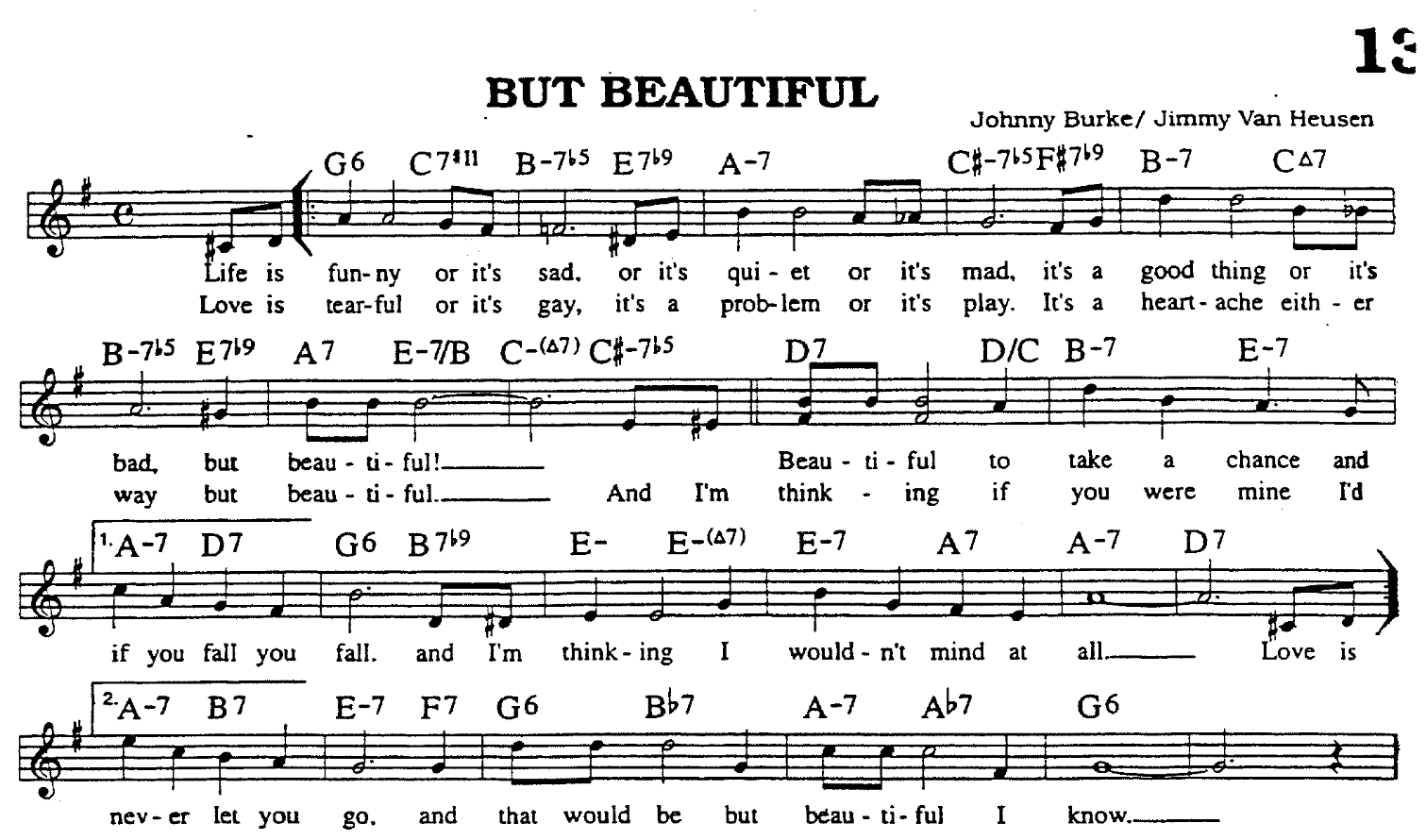
The attached lead sheet introduces an especially interesting textual detail. Its first A section begins with “Life”, whereas commonly published modern versions begin with “Love”; Musicnotes, for example, identifies the published lyric as beginning with “Love”. (Musicnotes.com) Because the attached lead sheet is the primary source here, its “Life” is retained. That single word materially changes the dramatic architecture. The first eight bars become a general proposition about existence; only in the repeated A section does the speaker narrow the proposition specifically to love. The second A therefore does more than repeat the first: it reveals what the apparently philosophical opening was really preparing to discuss.
Van Heusen’s music behaves similarly. G major is the unquestioned global tonic, but it is rarely allowed to remain uncomplicated. Applied half-diminished and dominant pairs, dominant-quality subdominant colour, borrowed minor harmony and chromatic approaches continually qualify the home key. The harmony therefore behaves rather like Burke’s syntax: every apparent statement acquires a counterstatement. Yet the tune is not harmonically evasive in the manner of a song whose tonic is genuinely uncertain. Its instability occurs inside an intelligible tonal frame. That distinction is essential. But Beautiful knows where home is; it simply insists that reaching home need not mean avoiding everything difficult on the way.
2. Form and Dramatic Architecture
The refrain is a 32-bar form conventionally described as A-B1-A-B2, or ABAC when the differing second halves are given separate letters. Jazz references consistently identify the original key as G major and the form as A-B1-A-B2; another repertoire source gives the equivalent ABAC designation with four 8-bar units. (Jazz Standards)
The attached engraving economises space through repetition and first and second endings. There are no printed bar numbers, and several chords are tightly compressed. The bar numbers below therefore follow the standard 32-bar formal count rather than the physical system breaks. Where beat-level placement is not completely secure from the scan, the harmonic analysis later groups the relevant bars rather than inventing an exact subdivision.
| Section | Bars | Tonal centre | Lyrical or dramatic function | Musical function |
|---|---|---|---|---|
| A1 | 1-8 | G major, with A-minor and B-minor tonicisations | Establishes a general philosophy of life's contradictions in this lead-sheet version | Presents the principal melodic sequence while repeatedly destabilising tonic through applied harmony |
| B1 | 9-16 | Dominant region, G major, then E minor and back towards G | Moves from abstract proposition to personal risk: taking a chance and accepting a possible fall | Broadens the phrase, makes D dominant structurally important, then tonicises vi before a ii-V turnaround |
| A2 | 17-24 | As A1 | Repeats the musical argument but replaces general "Life" with explicitly romantic "Love"; the negatives become more intimate | Repetition makes the same harmony sound psychologically different because the lyric has become more exposed |
| B2 | 25-32 | Dominant region, E minor, then chromatic return to G | Converts contemplation into direct fantasy: possession, permanence and finally asserted certainty | Replaces the first ending with a more chromatic conclusion involving backdoor and substitute-dominant motion before G6 |
The form is important because there is no conventional 8-bar “bridge” that simply supplies contrast and then yields to a final A. Instead, the two B sections are related continuations with different endings. B1 asks what accepting emotional risk might feel like; B2 imagines actually possessing the beloved. The second ending is therefore not merely an alternate cadence. It completes an argument that the first ending could not complete.
A1 and A2 are especially revealing. The music is essentially a return, but the lyric changes the ontological scale of the proposition. “Life” becomes “Love”. The speaker first appears to be making an observation about experience in general, then admits that the real subject is romantic attachment. That retroactively changes the opening. What initially sounded detached becomes a form of emotional indirection.
The B sections perform the opposite movement. B1 cautiously approaches the personal through conditional language and understatement. B2 goes much further, culminating in an absolute declaration at the melodic apex. Thus the song progresses from generalisation to hypothesis, then from explicit love to imagined possession. The repetition conceals a steadily increasing degree of self-revelation.
3. Close Reading of the Lyrics
The cues below are deliberately short. They identify each passage without reconstructing the lyric continuously.
| Lyric or cue | Literal meaning | Literary and poetic reading | Emotional subtext | Musical and harmonic interaction |
|---|---|---|---|---|
| "Life is..." | The speaker begins by describing existence itself. | In this lead-sheet version, the opening is aphoristic rather than immediately romantic. It establishes the speaker as an observer making general propositions. | Detachment may be partly defensive. Speaking about "life" permits discussion of emotionally dangerous material at a safe distance. | G is immediately coloured by C7#11 and then by the applied Bm7b5-E7b9 pair. The tonic exists, but the harmony refuses plain stability from the outset. |
| "funny ... sad" | Life can be amusing or sorrowful. | Burke begins a sequence of binary oppositions. The words are ordinary and conversational rather than poetic in themselves; their force comes from accumulation and symmetry. | The speaker refuses to privilege either happiness or unhappiness as the authentic condition. | Van Heusen's recurring leap-and-step melodic construction gives the antitheses a patterned, almost enumerative character. The music makes the list sound considered rather than impulsive. |
| "quiet ... mad" | Experience can be calm or tumultuous. | The contrast is more extreme than the preceding one. "Mad" can imply anger, frenzy, irrationality or passionate excess, giving the pair psychological breadth. | The emotional range widens. The speaker is gradually admitting that beauty may include loss of control. | The move through Am7 towards C#m7b5-F#7b9 increases chromatic tension while the syntax continues to sound neatly balanced. |
| "good ... bad" | Something may be beneficial or harmful. | The third pair shifts from emotional state to judgement. The sequence therefore progresses from feeling to behaviour or moral valuation. The triplet of "sad/mad/bad" makes "bad" sound like a formal culmination. | The speaker has run out of qualifications. Even the negative extreme is about to be admitted into the argument. | The B-minor and C-major colours, followed by another Bm7b5-E7b9 applied progression, prevent the line from resting securely in G. |
| "but beautiful" | Regardless of the preceding alternative, the experience is beautiful. | "But" is the crucial word. Beauty is not another item in the binary list. It supersedes the binary structure itself. | The speaker does not deny pain. Instead, value is assigned to the whole contradictory experience. | The title phrase is structurally emphasised. Allen Forte notes that its first two syllables acquire conspicuous weight through placement on a strong beat after the preceding repeated rhythmic figures. ([pdfcoffee.com][5]) In this chart, the A-section close is harmonically coloured rather than simply tonic, so verbal conclusion and harmonic conclusion are not identical. |
| "take a chance" | Love or life is worth risking. | Beauty becomes an activity rather than a static quality. The speaker moves from classification to action. | The abstract philosophy is beginning to implicate the speaker personally. | The phrase enters a dominant-oriented region rather than settling into tonic. The musical grammar therefore places "chance" inside unresolved motion. This need not be literal text-painting, but it strongly supports the lyric's openness to risk. |
| "if you fall" | Failure is a possible consequence of the risk. | The conditional is followed by repetition of the verb rather than reassurance. There is no promise that the fall will be prevented or repaired. | This is unusually unsentimental. The speaker accepts vulnerability as a condition of participation. | The first ending's Am7-D7 and subsequent tonic arrival give the idea of falling a cadential context. The effect is less "disaster" than surrender to tonal gravity. |
| "you fall" | Failure, if it happens, simply happens. | The tautology strips the event of melodrama. Its almost shrugging diction is central to Burke's restraint. | Acceptance replaces fear. This is one of the lyric's most mature gestures. | The line can be phrased conversationally against the regular harmonic movement. Excessive rubato risks making a deliberately plain statement sound self-pitying. |
| "I'm thinking" | The speaker tentatively reports a private thought. | The present progressive is evasive. It is weaker than "I know" or "I want". The phrase allows the speaker to confess without formally committing. | Emotional distance is collapsing, but slowly. | The first ending soon turns towards the tonicised E-minor region. The shift from public proposition to private thought coincides with increased harmonic inwardness. |
| "wouldn't mind" | The speaker says the risk would be acceptable. | This is litotes: a deliberately weak negative formulation standing in for a stronger positive desire. "I wouldn't mind" means considerably more than it says. | The understatement is a protective disguise. The speaker wants the possibility but does not yet risk stating that desire directly. | The Em-Em(maj7)-Em7 colour intensifies underneath deliberately mild language. The chromatic seventh motion gives the music more emotional specificity than the words admit. |
| Second A: "Love is..." | The subject is now explicitly romantic love. | In this chart the substitution of "Love" for "Life" reveals the latent subject of A1. Formally identical music becomes retrospective disclosure. | The speaker is less protected by abstraction. | Returning to the opening harmony after B1 produces circularity, but the repeated progression no longer sounds philosophically neutral because the listener now knows what is at stake. |
| "tearful ... gay" | Love may bring sadness or cheerfulness. | "Gay" has its ordinary 1947 sense here: cheerful or light-hearted. The emotional opposition is direct and conventional, but the preceding "Life" stanza makes it feel like a deliberate narrowing of the argument. | Pain has become explicitly relational rather than existential. | The repeated A melody creates a formal parallel with the first list, while the listener's interpretation has changed. |
| "problem ... play" | Love may be a difficulty or a form of pleasurable play. | The compact alliteration of the two p-words sharpens the contrast. "Play" also introduces ambiguity: spontaneity, game, theatrical role or lack of seriousness. | The speaker acknowledges that love can be both burden and recreation. | Applied motion towards B minor repeats the earlier instability. Structural repetition makes the new romantic vocabulary sound like another test of the same proposition. |
| "heartache either way" | Pain may occur regardless of which version of love is experienced. | This pair is no longer symmetrical. "Heartache" dominates the alternatives rather than merely balancing a positive counterpart. "Either way" also collapses the earlier binaries. | The speaker's philosophy has darkened. The risk of pain now appears unavoidable. | The return of the title after this line is therefore psychologically heavier than its first appearance, even if much of the musical material is repeated. |
| Second "but beautiful" | Heartache does not invalidate beauty. | The refrain now has evidential force. The first title statement was a proposition; the second has survived an explicit admission of pain. | The speaker sounds more committed but also more vulnerable. | Repeated music makes the altered meaning particularly clear: identical or near-identical musical material carries greater emotional weight because of the new text. |
| "if you were mine" | The speaker imagines a relationship that is not presently real. | The conditional "were" marks unreality or hypothesis. The possessive "mine" introduces a more intimate and more potentially controlling vocabulary. | Desire has finally acquired a specific addressee. The beloved appears to be unattained. | The chromatic transition into the final ending prevents the fantasy from sounding like an accomplished fact. |
| "never" | The imagined relationship would be permanent. | This is the lyric's first major absolute. The earlier language was conditional, balanced and qualified; "never" abruptly abandons moderation. | The real intensity of the speaker's desire becomes visible. | Forte identifies the syllable at the beginning of "never" as the only occurrence of the melody's apex E. ([pdfcoffee.com][5]) Van Heusen therefore reserves the highest pitch for the moment when restraint fails. |
| "let you go" | The speaker imagines never relinquishing the beloved. | The phrase can be heard tenderly as devotion, but its possessive grammar is worth noticing. The song moves from acceptance of falling to a fantasy of preventing separation. | The speaker who claimed to accept uncertainty now imagines permanence. This introduces a subtle contradiction. | The E-minor tonicisation and subsequent F7/G6 motion place this declaration amid strong harmonic redirection rather than stable tonic confirmation. |
| "that would be..." | The imagined relationship would fulfil the song's proposition. | The conditional returns. Even after "never", the speaker remains grammatically outside the desired reality. | The fantasy has become vivid but not actual. | Chromatic dominant colours approach the final tonic by indirect routes. The harmony acknowledges desire while retaining contingency. |
| "I know" | The speaker asserts certainty. | The final epistemic verb contrasts strikingly with "I'm thinking". Yet the proposition immediately preceding it is still conditional. | The assertion may be genuine conviction, self-persuasion, or both. The lyric deliberately provides no external evidence. | The final Ab7-G6 motion gives a decisive semitone resolution, but it reaches tonic through a substitute dominant rather than an orthodox D7-G cadence. Certainty arrives by a chromatic route. |
Burke’s rhyme scheme reinforces the architecture without drawing attention to itself. The first A gathers the conspicuous sad/mad/bad rhyme, while the second answers it with gay/play/way. B1 uses the repeated “fall” and the rhyme with “all”, turning acceptance into a verbal echo. B2 closes with the simpler go/know pair. The title itself remains outside those rhyme chains. That is appropriate: “beautiful” functions less as another poetic answer than as the proposition under which all the rhymed alternatives are gathered.
The diction is also conspicuously unornamented. There is almost no concrete imagery. Burke does not tell us what the beloved looks like, where the lovers are, what event has occurred or even whether a relationship exists. The lyric is therefore closer to philosophical argument than romantic scene-setting. Its emotional power depends on syntax, qualification and the gradual shift in pronouns and modality: general proposition, conditional speculation, possession, absolute promise, claimed knowledge.
4. Lyrical and Emotional Arc
Opening Position
The speaker begins in the posture of an observer. In this particular lead-sheet text, the use of “Life” is decisive: the subject appears universal, and the repeated oppositions give the impression of someone who has already reached an accommodating philosophy. Good and bad, quiet and tumultuous, humour and sadness can apparently be held together without crisis.
The composure is not equivalent to emotional security. Harmonically, the opening G is almost immediately subjected to chromatic qualification. That makes the philosophical tone sound less like settled wisdom than a method of managing uncertainty.
Development
B1 exposes the personal motive beneath the aphorism. “Taking a chance” converts a philosophical claim into behavioural possibility. The speaker’s willingness to fall is then followed by understatement rather than declaration. The decisive phrase is not “I want this” but the much weaker “wouldn’t mind”. The emotional strategy is clear: desire is admitted only through linguistic minimisation.
A2 removes another layer of protection. “Life” becomes “Love”, and the earlier abstract oppositions now become specifically romantic. More importantly, the second stanza introduces heartache as something that persists “either way”. Love’s contradictions are no longer a clever list. Pain appears structurally unavoidable.
B2 makes the final transition from theory to fantasy. The unspecified “you” becomes an imagined possession, and the singer moves from accepting risk to imagining an unbreakable attachment. The word “never” provides the lyric’s most unqualified statement and receives the melody’s highest pitch. What the speaker has been containing for nearly the entire song finally exceeds the restrained diction.
Point of Greatest Tension
The greatest tension occurs around “never”. It is both lyrical and musical. The speaker’s earlier vocabulary is full of alternatives, qualifications and conditionals. “Never” is absolute. Van Heusen compounds the change by assigning the word the only occurrence of the melodic apex E. (pdfcoffee.com)
That coincidence does not merely make the word dramatic. It reveals the speaker. The song that has presented itself as an elegant philosophy of accepting uncertainty suddenly contains a desire for permanence. The speaker can accept the possibility of falling, apparently, but once the desired person is imagined as actually possessed, separation becomes intolerable.
Resolution or Lack of Resolution
The ending provides tonal resolution but only qualified psychological resolution. G6 is restored, and the final chromatic approach gives the cadence clarity. Yet the lyric has not moved from fantasy to fulfilment. Its grammar remains conditional.
“I know” attempts to convert that conditional fantasy into certainty. It can be sung as conviction, but it can also be heard as self-persuasion. The song gives no narrative event that justifies the transformation from “I’m thinking” to “I know”. What changes is not the external situation but the speaker’s willingness to state a belief more strongly.
The ending is therefore best understood as acceptance mixed with unresolved longing. The tonic is real. The relationship is not.
Central Paradox
The central paradox is explicit but deeper than the title alone suggests: love is beautiful not because it defeats contradiction but because contradiction is inseparable from loving.
A second, subtler paradox emerges during B2. The speaker praises willingness to take a chance and accept falling, yet when the desired relationship is imagined, the speaker immediately wants permanence. Acceptance of uncertainty and resistance to loss coexist. The song never solves that contradiction. It lets both be true.
5. Detailed Harmonic Analysis
The global tonic is G major. Temporary tonicisations of A minor, B minor and E minor occur frequently, and D is repeatedly emphasised as the dominant region, but none of these is sustained long enough in this lead sheet to require description as a full structural modulation.
The chart is notably chromatic for a song whose tonic remains clear. It repeatedly employs applied half-diminished/dominant pairs, modal mixture and chromatic substitute-dominant approaches. JazzStandards likewise describes the opening as using the Bm7b5-E7b9 applied progression in place of a simpler rising diminished-chord mechanism. (Jazz Standards)
Chord spellings below normalise the lead sheet’s typographical shorthand: -7 becomes m7, triangle symbols become maj7, and -(maj7) is written m(maj7).
Because the scan does not print measure numbers and several bars contain tightly spaced chord changes, grouped bar ranges are used where the printed order is more certain than an exact beat assignment.
| Bars | Lyric cue | Chords | Roman numerals | Tonal centre | Harmonic function and interpretation |
|---|---|---|---|---|---|
| 1-2 | Opening antitheses | G6 C7#11 | Bm7b5 E7b9 | I6 - IV7(#11) | iiø7/ii - V7b9/ii | G, then A minor tonicisation | G6 establishes tonic economically. C7#11 is best heard first as chromatic IV7 colour, with Lydian-dominant inflection from F#. Because its root descends by semitone to B, it can alternatively be heard as substitute-dominant approach to the following B-root chord. Bm7b5-E7b9 is an applied minor ii-V directed towards Am. |
| 3-4 | "quiet ... mad" | Am7 | C#m7b5 F#7b9 | ii7 | iiø7/iii - V7b9/iii | A minor, then B minor | Am7 is simultaneously diatonic ii in G and the local tonic implied by the preceding applied ii-V. C#m7b5-F#7b9 then tonicises B minor, giving the A section a chain of temporary gravitational centres. |
| 5-6 | "good ... bad" | Bm7 Cmaj7 | Bm7b5 E7b9 | iii7 - IVmaj7 | iiø7/ii - V7b9/ii | G with renewed A-minor pull | Bm7 confirms the B-minor tonicisation only lightly before Cmaj7 returns to diatonic G-major territory. Changing Bm7 to Bm7b5 in the following motion is particularly efficient voice leading: F# falls to F natural, converting iii into an applied predominant. |
| 7-8 | First title | A7 | Em7/B Cm(maj7) C#m7b5 | V7/V | vi7/B - ivm(maj7) - viiø7/V | Dominant preparation | A7 is the applied dominant of D. Instead of a plain immediate arrival, the chart inserts an unusually colourful sequence. Em7/B retains diatonic material over B; Cm(maj7) is borrowed ivm(maj7) from G minor; C#m7b5 then functions efficiently as viiø7/V, pointing to D. The C to C# root motion and mixture of C-natural/C-sharp sharpen the transition. |
| 9-12 | B1: chance and risk | D7 | D/C Bm7 | Em7 with continuation | V7 | V7/C - iii7 | vi7 | D dominant region moving through G's diatonic mediants | D7 finally discharges the extended dominant preparation. D/C places the dominant's seventh in the bass, producing downward bass pressure. Bm7-Em7 continues by descending-fifth root relation and softens the dominant into diatonic iii-vi rather than delivering an immediate emphatic tonic. |
| 13-16 | First ending | Am7 D7 | G6 B7b9 | Em Em(maj7) Em7 A7 | Am7 D7 | ii7-V7 | I6-V7b9/vi | vi-vi(maj7)-vi7-V7/V | ii7-V7 | G, then E minor, then dominant preparation | The ii-V finally gives a recognisable G-major cadence. B7b9 immediately destabilises that arrival by tonicising vi. The Em-Em(maj7)-Em7 succession creates a minor line cliché, with D# relaxing chromatically to D natural. A7 and the closing Am7-D7 then restore applied-dominant and turnaround motion. |
| 17-18 | A2 opening | G6 C7#11 | Bm7b5 E7b9 | I6-IV7(#11) | iiø7/ii-V7b9/ii | G to A minor | Musically the opening argument returns, but the lyric has changed from general life to love. Harmonic repetition therefore acquires a more personal reading without needing new chords. |
| 19-20 | Second antitheses | Am7 | C#m7b5 F#7b9 | ii7 | iiø7/iii-V7b9/iii | A minor to B minor | Repeated applied motion recreates the feeling of continually redefining the local centre. |
| 21-22 | "heartache" approach | Bm7 Cmaj7 | Bm7b5 E7b9 | iii7-IVmaj7 | iiø7/ii-V7b9/ii | G with A-minor pull | The shift from Bm7 to Bm7b5 again turns a stable diatonic sonority into an applied predominant by lowering F# to F natural. That semitone is more important functionally than the relatively small root movement would suggest. |
| 23-24 | Second title | A7 | Em7/B Cm(maj7) C#m7b5 | V7/V | vi7/B-ivm(maj7)-viiø7/V | Dominant preparation | The repeated title now follows the explicit admission of heartache. The borrowed ivm(maj7) colour sounds less ornamental on the second pass because the lyric has become darker. |
| 25-28 | Final personal disclosure | D7 | D/C Bm7 | Em7 with continuation | V7 | V7/C-iii7 | vi7 | D region towards E minor | The common continuation now carries the conditional fantasy. A descending bass from D towards C and onward weakens any sense that the dominant will simply resolve in an orthodox manner. |
| 29 | "never ..." | Am7 B7 | ii7 - V7/vi | Towards E minor | Am7 begins as diatonic ii, but B7 immediately reorients the ear towards E minor. The abrupt applied dominant suits the lyric's sudden move from qualification to an absolute promise. |
| 30 | Possessive climax | Em7 F7 | vi7 - bVII7 | E minor back towards G | Em7 supplies the expected vi arrival. F7 is the classic backdoor dominant colour in G, bVII7, whose resolution upward by whole tone to G differs markedly from an orthodox D7-G cadence. |
| 31 | Final approach | G6 Bb7 | I6 - subV7/ii | G, then towards A minor | G is reached, but immediately destabilised again. Bb7 can be heard as the tritone substitute for E7, the dominant of Am, and resolves down by semitone to Am7. Here the tritone-substitution label is functionally justified because of its target. |
| 32 | Final assertion | Am7 Ab7 G6 | ii7 - subV7/I - I6 | G | Ab7 is the tritone substitute for D7 and resolves chromatically down to G6. The bass motion A-Ab-G gives the final cadence exceptional smoothness. Instead of a conventional dominant-to-tonic root motion by fifth, the chart reaches certainty through semitone compression. |
Several voice-leading details are more important than their chord labels alone suggest. The progression repeatedly transforms stable diatonic notes through semitone inflection: Bm7 becomes Bm7b5 by F#-F; borrowed C minor is followed by C# half-diminished; the E-minor line cliché moves D#-D; the final bass descends Bb-A-Ab-G across successive dominant and tonic functions. The harmony therefore creates continuity precisely through chromatic alteration.
The Cm(maj7) is especially telling. Calling it merely “borrowed iv” misses its internal tension. In G minor, Cm would be ordinary iv, but its major seventh B retains a pitch belonging strongly to G-major tonic harmony. The chord therefore combines borrowed C-Eb-G with B natural, making it simultaneously dark and tonically connected. It is a particularly elegant common-tone colour.
Likewise, not every dominant is evidence of a new key. E7b9 and F#7b9 produce clear tonicisations, but the surrounding eight-bar context keeps G audible as the governing centre. A7 functions primarily as V7/V; F7 functions as the backdoor bVII7; Bb7 and Ab7 have credible substitute-dominant destinations because they resolve by semitone to Am7 and G respectively. Those are functionally distinct phenomena.
6. Tonal Journey
| Passage | Starting centre | Destination | Mechanism | Dramatic effect |
|---|---|---|---|---|
| A1 opening | G major | A minor | Bm7b5-E7b9 applied minor ii-V | The supposedly universal opening immediately acquires instability. |
| A1 middle | A minor | B minor | C#m7b5-F#7b9 | The song shifts local gravity again before any tonicisation becomes a full modulation. |
| A1 close | G-related diatonic region | D dominant | A7 followed by chromatic predominant material and C#m7b5 | The title does not produce complete repose; it opens into the next phrase. |
| B1 | D dominant | G, then E minor | D7 region, ii-V-I, then B7b9 to Em | Personal disclosure coincides with a move away from the apparent security just achieved. |
| End of B1 | E minor | G-directed dominant | A7 and Am7-D7 | The first personal confession remains harmonically provisional because the turnaround compels repetition. |
| A2 | G major | Same A-minor/B-minor excursions | Repetition of A1 | The same tonal wandering is reinterpreted after the subject becomes explicitly romantic. |
| B2 opening | D region | E minor | D/C-Bm7-Em7 followed by B7 | The conditional fantasy acquires a darker local centre. |
| B2 close | E minor | G major | F7 backdoor dominant, G6, Bb7-Am7, Ab7-G6 | The home tonic is repeatedly touched and disturbed before the final chromatic cadence; resolution is achieved, but only after one last sequence of alternatives. |
The tonal plan is therefore not a chain of modulations. It is better understood as repeated temporary departures from a stable but porous tonic. G is psychologically present even when local dominant relationships point elsewhere.
That matters dramatically. The speaker is not lost. The song’s subject is not confusion about what is wanted, but the coexistence of certainty and uncertainty. Harmony repeatedly confirms that distinction: local destinations are clear, but none supersedes the global home key.
The most striking example is the ending. A conventional D7-G cadence would make the final “I know” sound uncomplicated. The attached chart instead gives the singer a more circuitous route through F7, Bb7 and Ab7 colours. The final G is convincing precisely because it has been approached from harmonies foreign to the key.
7. Melody and Prosody
The melody in G spans approximately C#4 to E5, a minor tenth. iReal Pro uses But Beautiful as a vocal-key example and gives that same C#4-E5 range in G. (iReal Pro) This is a moderate compass for a standard, but Van Heusen uses the range economically: the top is not repeatedly exploited for easy climax.
The opening pickup begins below the diatonic collection with a chromatic C#, functioning as a lower-neighbour or approach gesture into the principal melodic material. JazzStandards specifically warns performers to notice the tune’s chromatic lower-neighbour and passing tones and summarises the melodic motion as upward leaps followed by downward steps. (Jazz Standards) The effect is characteristic of the whole refrain. Energy is repeatedly generated by an intervallic rise and then released through stepwise descent.
That gesture is particularly effective for Burke’s antithetical syntax. Each pair of adjectives sounds less like a flowing lyrical sentence than another item submitted for consideration. The recurrent melodic shapes give the list coherence without making it mechanical. Because the phrases often descend after an initial rise, emphatic words can be stated and then relaxed rather than held at a continuously elevated emotional level.
Prosodically, the repeated little units attached to constructions such as “is” and “or it’s” are crucial. Forte observes that Van Heusen builds a sequence of related rhythmic figures and then alters their accentual effect when the title arrives: the first two syllables of the title fall conspicuously on a strong beat. (pdfcoffee.com) The melody therefore makes “beautiful” sound like the conclusion of an argument, not merely the next adjective in the list.
The title’s elongated syllabification also changes the temporal scale. Most of the opening language is conversational and relatively quick. “Beautiful” occupies more melodic space. That expansion is semantically appropriate: the word interrupts the binary logic and asks the listener to remain with a third category that cannot be reduced to the preceding oppositions.
Van Heusen reserves the principal melodic climax with even greater discipline. Forte identifies E5 as the sole apex and places it on the first syllable of “never” in the final section. (pdfcoffee.com) This is perhaps the most important word-setting in the song. The absolute word receives the absolute top of the range. Had the same pitch been spent earlier on “beautiful”, the final confession would have less structural force.
The result also complicates the lyric. The highest note is not attached to beauty itself, nor to love, nor to “know”. It belongs to the speaker’s refusal to imagine separation. The melody therefore identifies the point of maximum emotional investment more accurately than the speaker’s restrained language has done.
The long notes elsewhere matter for a different reason. They allow the harmony to change underneath a comparatively stable melodic pitch. In a ballad, this creates one of the tune’s central improvisational and vocal pleasures: a sustained melodic note can change from chord tone to extension, tension or common tone as the harmony moves. The lead sheet’s dense chromatic accompaniment should therefore not tempt a performer into decorating every sustained pitch. Often the changing harmonic meaning of an unchanged note is already expressive enough.
The ending reverses some of the opening’s intervallic behaviour. Forte notes descending perfect- and diminished-fifth relationships near the refrain’s close that relate to the earlier ascending shapes by contour reversal. (pdfcoffee.com) The song thus creates melodic closure not by simply repeating its opening but by turning its intervallic character downward.
Natural speech accent remains essential. Phrases such as the repeated conditional around falling and the understated first-person confession can easily be damaged by treating every notated beat as equally important. The melody’s written rhythm should establish shape, but a singer can permit slight anticipations, delays and consonant placement so that Burke’s deliberately colloquial syntax remains audible.
8. Word, Melody, and Harmony: Key Moments
| Moment | Lyric cue | Musical event | Interpretive significance |
|---|---|---|---|
| 1 | Opening "Life..." | Chromatic C# pickup into G, followed almost immediately by C7#11 and applied harmony | The universal proposition begins from outside the plain diatonic collection. Stability is stated and qualified almost simultaneously. |
| 2 | First oppositions | Sequential leap-and-step melodic figures over changing applied functions | The lyric lists mutually opposed states while the music continually redefines local harmonic gravity. |
| 3 | First title | Strong-beat accentuation of the title after repeated preceding figures ([pdfcoffee.com][5]) | "Beautiful" is formally separated from the adjectives it judges. It sounds like a conclusion rather than another item. |
| 4 | "take a chance" | Phrase opens into D-dominant territory rather than settled tonic | The lyric advocates risk while the harmony itself remains in transit. |
| 5 | Understated confession | Em-Em(maj7)-Em7 chromatic line within the first ending | Mild verbal language is accompanied by unusually exposed semitone colour. The music admits more feeling than the diction. |
| 6 | Second title | Return of essentially the same A material after "Life" has become "Love" and heartache has been named | Repetition proves that musical identity does not imply dramatic identity. The same cadence now carries greater psychological cost. |
| 7 | "never" | Sole melodic apex E5 ([pdfcoffee.com][5]) | The singer's strongest absolute receives the highest note. Restraint breaks precisely where imagined permanence enters the lyric. |
| 8 | E-minor arrival | B7 points strongly towards Em | The romantic fantasy momentarily creates a darker local home away from G. |
| 9 | Final chromatic route | F7-G6, then Bb7-Am7 and Ab7-G6 | The song reaches home through backdoor and substitute-dominant colours rather than a single orthodox V-I. The final certainty contains the memory of chromatic uncertainty. |
| 10 | "I know" | Ab7 resolves down by semitone to G6 | A categorical verbal claim is finally paired with genuine tonic resolution, yet the non-diatonic route prevents the result from sounding naively uncomplicated. |
9. Historical and Cultural Context
But Beautiful was published in New York in 1947 with words by Johnny Burke and music by James “Jimmy” Van Heusen. The Smithsonian’s surviving sheet music documents the 1947 publication and its association with Road to Rio. (National Museum of American History) The American Film Institute lists the song among five Burke-Van Heusen numbers used in the film and dates the film’s release to 25 December 1947. (AFI Catalog)
The song belongs specifically to Hollywood’s adaptation of Tin Pan Alley craft rather than to the Broadway-musical tradition from which many other standards emerged. Burke had moved into Paramount’s orbit in the 1930s, and his long collaboration with Van Heusen produced a large body of songs for films, many associated with Bing Crosby. The Songwriters Hall of Fame describes Burke’s work on more than fifty films, twenty-five starring Crosby, while its Van Heusen biography identifies Burke and Van Heusen as a major Tin Pan Alley partnership that moved into Hollywood under Paramount. (Songwriters Hall of Fame)
Road to Rio was the fifth Crosby-Hope “Road” film. AFI identifies Crosby, Bob Hope and Dorothy Lamour as its principals and Robert Emmett Dolan as musical director. (AFI Catalog) That context matters because the song’s sophistication is not dependent on a complicated stage plot. It was written for a popular film vehicle in which songs needed to function immediately, independently and memorably. Burke and Van Heusen therefore achieve complexity inside an apparently simple ballad surface.
The song was commercially successful almost immediately. JazzStandards, drawing its chart data from Joel Whitburn, records 1948 chart versions by Frank Sinatra at number 14, Bing Crosby at number 20, Margaret Whiting at number 21 and Art Lund at number 25. (Jazz Standards) The multiplicity of successful vocal versions is significant: the composition had already detached itself from the film before jazz musicians fully made it their own.
Its transition into jazz was exceptionally quick. JazzStandards credits tenor saxophonist Eddie “Lockjaw” Davis with the first jazz-instrumental recording in 1947, the same year as the song’s publication. (Jazz Standards) That rapid adoption suggests that musicians recognised something structurally useful beneath the film-ballad identity: a strong melody, compact 32-bar architecture and a harmonic framework that could accept further jazz reharmonisation without losing its identity.
The complete published song also had material that jazz performance largely discarded. Allen Forte’s analysis describes a 16-bar verse set unusually in D major, the dominant of the refrain’s G-major tonic. (pdfcoffee.com) The attached lead sheet contains only the 32-bar refrain. This is typical of jazz-standard practice, where introductory theatrical verses were often omitted once a song became an autonomous improvisational vehicle. In this case, the omission is especially interesting because the original verse’s dominant key would have given the refrain’s G-major arrival an additional large-scale tonal function that is absent when the refrain is performed alone.
There is also a textual transmission issue. The attached fake-book chart begins with “Life”, while modern published listings and most familiar vocal performances use “Love” at the opening. (Musicnotes.com) For performance practice this should not simply be treated as inconsequential. “Love” gives the song immediate thematic unity; “Life” creates a deliberate dramatic narrowing when the second A finally names love. The latter is the more philosophically expansive reading, irrespective of whether it arose as an authorised variant or later lead-sheet transmission.
10. Significant Interpretations
| Performer | Recording or period | Interpretive character | What it reveals about the song |
|---|---|---|---|
| Bing Crosby | Road to Rio and contemporary 1947 treatment | Conversational crooner phrasing, relatively direct and unspectacular | Crosby demonstrates how naturally the lyric works when treated as speech rather than as a grand torch-song declaration. His connection with the film remains the historical starting point. ([National Museum of American History][1]) |
| Frank Sinatra | 1947 Columbia recording, which became a 1948 number 14 hit | More sustained orchestral legato and heightened romantic concentration | Sinatra shows how the song can become a self-contained popular ballad almost immediately after leaving its film context. The recording is documented with the Axel Stordahl Orchestra. ([classic Jazz standards][9]) |
| Billie Holiday | Lady in Satin, 1958 | Fragile, time-flexible vocal line against Ray Ellis's orchestral setting | Holiday changes the meaning of Burke's understatement. Statements about falling, heartache and not minding can sound less hypothetical because the vocal timbre itself carries accumulated experience. The song was recorded during the February 1958 Lady in Satin sessions with Ray Ellis's orchestra. ([Billie Holiday Songs][10]) |
| Freddie Hubbard | Open Sesame, 1960 | Instrumental ballad reading with clear melodic projection and hard-bop harmonic awareness | Removing the words demonstrates that Van Heusen's phrase structure can retain the lyric's conversational logic instrumentally. Blue Note identifies it as a ballad feature on Hubbard's debut, with Tina Brooks, McCoy Tyner, Sam Jones and Clifford Jarvis. ([Blue Note Records][11]) |
| Stan Getz and Bill Evans | Recorded 6 May 1964; first issued on the Verve Getz-Evans collection in the 1970s | Highly interactive instrumental interpretation in which tenor and piano can treat melody, harmony and space as equal partners | The recording shows how readily the tune survives removal of the singer because the melodic syntax itself remains vocal. The session personnel were Getz, Evans, Ron Carter and Elvin Jones. ([Jazz Discography Project][12]) |
| Tony Bennett and Bill Evans | The Tony Bennett/Bill Evans Album, 1975 | Voice and piano only; exposed, elastic and conversational | Without rhythm section or orchestral cushion, the lyric's conditional grammar becomes unusually audible. Evans can alter harmonic density while Bennett preserves narrative direction. The album was deliberately recorded with only voice and piano. ([Craft Recordings][13]) |
| Shirley Horn | Recorded November 1988, issued in the Close Enough for Love period | Extreme spaciousness, deliberate pacing and attention to silence | Horn demonstrates what happens when the song is allowed to unfold at very slow speed: every qualification and every change of harmonic colour becomes exposed. Her session documentation lists Horn on voice and piano with Charles Ables and Steve Williams. ([Jazz Discography][14]) |
These interpretations reveal an important property of the composition: its emotional stance is not fixed by tempo or orchestration. Crosby can make the song sound nearly conversational; Holiday can make the same understatement sound wounded; Hubbard can remove the words and preserve the architecture; Bennett and Evans can reduce the texture almost to chamber music without losing its identity.
The Bennett-Evans approach is particularly important to later singers and pianists because the arrangement cannot hide weak command of form or text behind ensemble momentum. Concord’s retrospective material explicitly notes the absence of bass and drums and describes the arrangements as worked out directly by the two performers. (Craft Recordings) The performance illustrates how much harmonic freedom the tune can tolerate when the melodic and verbal argument remains intact.
11. Place in the Jazz Canon
But Beautiful endured because it offers an unusually favourable balance between memorability and harmonic mobility. Its 32-bar form is easy to retain, yet its interior is not harmonically static. Applied ii-Vs to ii and iii, a prominent dominant region, minor tonicisation and opportunities for modal mixture mean that an improviser can trace genuine long-range function rather than merely decorate a sequence of diatonic chords.
Its adoption by Eddie “Lockjaw” Davis in 1947 demonstrates that jazz musicians recognised this potential almost as soon as the song appeared. (Jazz Standards) Freddie Hubbard’s inclusion of the tune on his 1960 Blue Note debut further shows that it could function comfortably within the hard-bop repertoire without ceasing to be a ballad. (Blue Note Records)
The tune is also unusually hospitable to reharmonisation because the melody is strong enough to survive substantial alterations beneath it. That does not mean every substitution is equally useful. Many melodic tones derive their expressiveness from being upper extensions, chromatic neighbours or common tones against changing chords. Reharmonisation that makes every important note a bland chord tone can actually reduce the composition’s expressive information.
An improviser therefore needs more than the chord symbols. The crucial task is to hear hierarchy:
- G remains the global tonic.
- Bm7b5-E7b9 is directed towards ii, not a new E-dominant universe.
- C#m7b5-F#7b9 temporarily points towards iii.
- A7 anticipates the dominant region.
- D7 and its inversions establish structural dominant weight.
- E minor is a significant local destination in the endings but not a replacement tonic.
- Backdoor and substitute dominants near the final cadence should be heard as routes home rather than isolated altered chords.
At ballad tempo, harmonic density creates a particular improvisational challenge. Because a single bar may contain several functional events, outlining every chord vertically can produce a solo that sounds like an exercise. The stronger strategy is usually to connect guide tones across the applied progressions and allow the line to reveal the semitone logic: F# to F, D# to D, C to C#, Bb to A, Ab to G.
Melodically, an improviser should also retain awareness of the lyric. The tune’s phrases are built as sentences, not merely eight-bar harmonic units. Instrumental performances by Getz, Evans and Hubbard are effective partly because their phrasing continues to imply breath, punctuation and speech even when the words disappear.
The tune is consequently more useful pedagogically than its reputation as a slow romantic ballad might suggest. It teaches the distinction between tonicisation and modulation, functional dominant and substitute dominant, harmonic rhythm and melodic rhythm, and written melody versus underlying lyric phrase.
12. Interpretive Considerations for Performers
The principal danger is premature emotional inflation. The opening language is deliberately plain. A singer who treats the first adjective as a confession of devastating heartbreak leaves nowhere for the song to develop. Restraint is structurally useful because the lyric itself becomes progressively more personal.
The lead sheet’s “Life” variant deserves a conscious decision. Retaining it makes A1 genuinely philosophical and allows “Love” in A2 to function as revelation. Changing the opening to the commonly sung “Love” produces a more immediately coherent romantic lyric but removes that dramatic narrowing. Neither effect should happen accidentally.
The title should not necessarily be sung as an enormous climax on every occurrence. Its structural importance comes partly from rhythmic placement and expansion. Allowing the first title statement simply to arrive can make the second substantially more meaningful.
Conversational phrases around the possibility of falling and the first-person understatement benefit from rhythmic flexibility. That does not require abandoning metre. Slightly late consonants, anticipations or compressions can preserve ordinary speech while the rhythm section maintains harmonic time. Excessive rubato in every phrase weakens the contrast when genuine freedom is later required.
The apex on “never” should be treated with particular care. Because E5 occurs only there, its structural importance is already composed into the melody. A singer need not make it louder. A restrained or even fragile apex can be more revealing than a climactic belt because the pitch itself supplies the emphasis.
For an instrumentalist, that same E should still be understood as the lyrical climax even when there is no singer. Changing the melodic octave, flattening the contour or decorating the note beyond recognition alters the dramatic hierarchy. A player is free to do so, but should understand what is being surrendered.
The borrowed Cm(maj7) and subsequent C#m7b5 are valuable harmonic landmarks in this particular chart. They provide a chromatic hinge into D7. Simplifying the passage to a routine dominant preparation may make the chart easier to navigate but removes one of its most distinctive colours.
Similarly, the final F7, Bb7 and Ab7 colours should not automatically be treated as invitations for maximum altered-scale activity. Their strongest effect is voice leading. In particular, Bb7-Am7 and Ab7-G6 derive much of their force from downward semitone root resolution. Comping that obscures those lines with unrelated substitutions can weaken the cadence.
Tempo changes the lyric’s apparent philosophy. At a very slow tempo, the negative terms and harmonic tensions acquire weight; “heartache” becomes difficult to treat casually. At a somewhat more flowing ballad tempo, Burke’s wit, parallel syntax and acceptance of contradiction become clearer. The song can therefore move perceptually from torch song towards reflective popular song without a single word changing.
For singers, the Em-Em(maj7)-Em7 motion in the first ending is an especially effective place to underplay rather than intensify. The harmony already supplies the ache. For pianists and guitarists, voicing a clear D# to D inner motion can reveal that colour without adding extensions merely for density.
The final “I know” presents the largest interpretive choice. Sung firmly, it converts the ending into acceptance and conviction. Sung softly or slightly behind the beat, it can sound like self-persuasion. The final G6 supports either interpretation because it is genuinely tonic, while the preceding Ab7 ensures that the tonic arrives out of chromatic uncertainty.
13. Final Reading
But Beautiful is fundamentally a song about the refusal to make emotional value dependent on emotional safety. Burke begins with a catalogue of opposites because the song’s argument requires both sides to remain valid. Humour does not cancel sadness; calm does not cancel turmoil; pleasure does not abolish heartache. The title’s conjunction does not erase the negative term. It insists that beauty can survive it.
In the attached lead sheet, the progression from “Life” to “Love” makes that philosophy especially revealing. The speaker first presents the proposition as if it were impersonal wisdom, then gradually shows that it is an argument needed for a particular emotional situation. The shift towards “I’m thinking”, “if you were mine” and finally “I know” is therefore a movement from abstraction towards self-disclosure. What looks at first like philosophy becomes autobiography without ever supplying a narrative.
Van Heusen’s harmony makes the same journey in tonal language. G major remains real, but almost every straightforward possibility is qualified. Applied dominants point towards secondary centres; a diatonic Bm7 becomes Bm7b5 through a single altered note; the borrowed Cm(maj7) darkens the dominant preparation while retaining B natural as a tonal memory; E minor becomes temporarily important; the final cadence approaches G through chromatic substitute dominants. Home is never abolished. It is continually seen from another angle.
The melody is even more discriminating. Van Heusen does not spend his highest note on the title. He reserves it for the speaker’s “never”. That decision exposes what the lyric itself nearly conceals. The deepest desire in the song is not simply for beauty, nor even for love, but for permanence. The speaker who has elegantly accepted the possibility of falling discovers, when imagining the beloved as actually attainable, that letting go is another matter.
That is why the final “I know” should not be reduced either to naïve certainty or to pure irony. The harmony genuinely returns home, so the assertion has musical authority. Yet the relationship itself remains conditional, and the route to G has been chromatic until the last moment. The cadence gives the speaker a place to stand without proving that the imagined future exists.
But Beautiful endures because its resolution does not eliminate contradiction. It converts contradiction into form. The lyric says that beauty can contain pain; the harmony demonstrates that a tonic can contain chromatic instability; the melody shows that restraint can contain an unguarded climax. The final G6 is convincing not because uncertainty has disappeared, but because the song has discovered how to live inside it.