1. Song Overview
| Field | Details |
|---|---|
| Song | All the Things You Are |
| Composer | Jerome Kern |
| Lyricist | Oscar Hammerstein II |
| Year | 1939 |
| Original context | Very Warm for May, Broadway musical; an Act I ensemble number embedded in a play-within-a-play. The Broadway production opened at the Alvin Theatre on 17 November 1939. ([Lyric Opera][1]) |
| Lead-sheet key | A-flat major, four-flat key signature |
| Form | 36-bar AA₂BA₃: 8 + 8 + 8 + 12 bars |
| Principal tonal centres | A-flat major, C major, E-flat major, G major, E major; F minor also functions as a local pivot area |
| Common jazz classification | Great American Songbook standard; major swing, bebop and post-bop improvisational vehicle |
The lyric begins as an act of definition. The speaker repeatedly tells the beloved what they “are”, but the definitions are not descriptive in any ordinary sense. The beloved becomes seasonal promise, suspended evening silence, light and finally the collection of everything the speaker values. Hammerstein therefore approaches desire through metaphor rather than confession. Only late in the song does the language become physical and explicitly future-oriented, when imagined embrace replaces atmospheric imagery. The final movement from “you are” to “mine” exposes what the earlier metaphors conceal: the speaker does not yet possess the intimacy being celebrated.
Kern’s harmony gives this lyric an unusually unstable foundation. A-flat major is the global tonic, yet the first chord is Fm7, and even the first A section abandons A-flat for C major. The second A section repeats the design a perfect fourth lower and ends in G major; the bridge reaches E major before the final section returns home. The beloved is verbally presented as absolute and complete, while the music continually relocates the point of tonal certainty. The composition therefore achieves much of its expressive character through a discrepancy between rhetorical confidence and harmonic mobility.
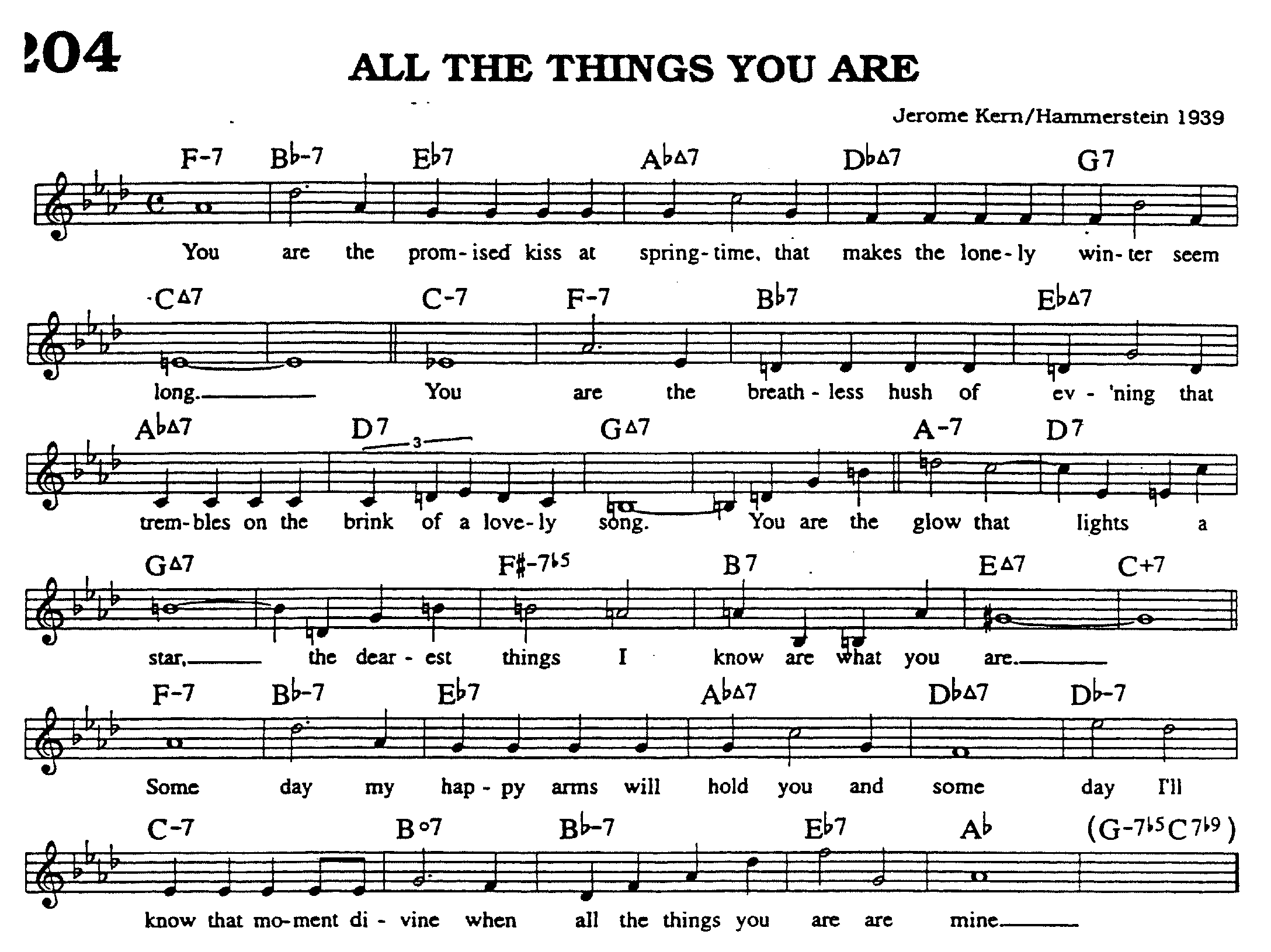
The supplied lead sheet is particularly important because it differs in several respects from familiar modern fake-book versions. Its first modulation uses Dbmaj7 directly to G7 without an inserted Dm7; the analogous second modulation uses Abmaj7 directly to D7 without Am7; bar 21 is F#m7♭5 rather than F#m7; bar 24 is C+7, best read as C7#5; and the final return uses Dbm7 without the Gb7 sometimes added in later jazz charts. The text also appears to read “kiss at spring-time” rather than the familiar “of springtime”, and it omits “angel” before “glow”. A surviving page for Artie Shaw’s 1939 recording gives the more familiar “of springtime” and “angel glow”, so these are genuine textual differences in the supplied source rather than assumptions silently imported from the standard lyric. (Artie Shaw)
2. Form and Dramatic Architecture
| Section | Bars | Tonal centre | Lyrical or dramatic function | Musical function |
|---|---|---|---|---|
| A₁ | 1-8 | A-flat major to C major | Defines the beloved through seasonal imagery; desire is expressed indirectly through promise and absence | Establishes the main melodic design and vi-ii-V-I-IV sequence, then makes an abrupt applied-dominant move to C |
| A₂ | 9-16 | E-flat major to G major | Repeats the act of definition with evening and musical imagery | Transposes the entire A₁ harmonic and melodic design down a perfect fourth |
| B | 17-24 | G major to E major, then dominant of F minor | Intensifies idealisation, moving from atmosphere to radiance and value judgement | Initially stabilises G, pivots through F#m7♭5 to E, then uses C7#5 to prepare the return |
| A₃ | 25-36 | A-flat major, with chromatic subdominant colouring | Abandons metaphor for future physical fulfilment and possession | Recalls A₁ for five bars, diverges through iv minor and diminished passing harmony, then reaches the home tonic and optional turnaround |
The 36-bar design resembles AABA but resists literal repetition. A₂ is not a recurrence in the home key. It is A₁ transposed down a perfect fourth, melody and harmony moving together. Thus the listener recognises the architecture while being denied the security normally supplied by a repeated A strain. The form simultaneously repeats and relocates itself.
A₃ is even more consequential. Its opening five bars reproduce the beginning of A₁, yet the lyric has changed from present-tense definition to future fulfilment. “You are” becomes “Some day”. The same musical material consequently acquires a different psychological function. What previously sounded like contemplation now sounds like anticipation. At bar 30, instead of making another remote modulation, the harmony turns inward through Dbm7, Cm7, B°7, Bbm7 and Eb7, allowing the extended twelve-bar section finally to cadence in A-flat.
The lead sheet contains no written introduction, coda or rehearsal letters. The A₁, A₂, B and A₃ labels are therefore analytical rather than printed markings. Bar 36 contains the parenthesised turnaround Gm7♭5-C7♭9, which is appropriate for returning to bar 1. On a final chorus, the preceding A-flat arrival can instead function as the actual ending.
3. Close Reading of the Lyrics
The table uses brief cues rather than reconstructing the lyric. The supplied lead sheet is treated as the primary textual source.
| Lyric or cue | Literal meaning | Literary and poetic reading | Emotional subtext | Musical and harmonic interaction |
|---|---|---|---|---|
| "You" | Direct address to the beloved | The opening pronoun places the entire song outside the speaker's self at first. The beloved is grammatically the subject of nearly every proposition. | The speaker conceals personal need by concentrating on the other's qualities. | Bar 1 begins on Fm7 rather than tonic A-flat. The opening melodic A-flat is simultaneously the global tonic pitch and the third of Fm7, so "You" sounds central without yet receiving tonic harmony. |
| "promised kiss" | The beloved represents anticipated affection | "Promised" makes desire prospective rather than fulfilled. The kiss is both sensual and symbolic, a guarantee of renewal. | Hope intensifies absence because the fulfilment remains ahead. | The A-flat-area cycle Fm7-Bbm7-Eb7-Abmaj7 provides unusually clear functional motion beneath language about promise. Tonal arrival occurs before the thought itself is finished. |
| "spring-time" | The beloved is associated with spring | Seasonal renewal becomes a metaphor for romantic fulfilment. The supplied wording "at spring-time" makes the image more temporal than the familiar "of springtime". | The desired event belongs to an anticipated season rather than the present. | Dbmaj7 in bar 5 initially broadens the established A-flat field, but G7 in bar 6 suddenly redirects the phrase towards C major. The seasonal image coincides with the music leaving home. |
| "lonely winter" | Absence makes winter feel prolonged | Winter is emotional duration rather than meteorology. The adjective "lonely" reveals the speaker's condition more directly than the preceding praise. | The paradox is important: the promise of spring does not shorten winter psychologically; it makes the waiting more noticeable. | The direct Dbmaj7-G7 shift creates a perceptual jolt. The eventual Cmaj7 is stable locally, but it is remote from A-flat, turning "long" into both temporal description and tonal distance. |
| "long" | Winter seems extended | The monosyllable is deliberately simple after elaborate seasonal imagery. | The speaker momentarily admits the cost of anticipation. | The word is sustained over the Cmaj7 arrival. Its extended duration constitutes literal text-painting without requiring ornament. |
| "breathless hush" | Evening is intensely quiet | The phrase is paradoxical. "Breathless" implies bodily excitation while "hush" suggests complete stillness. Silence is personified as something capable of physiological tension. | Desire is now suspended at the threshold of expression. | A₂ restarts the same melodic-harmonic pattern a perfect fourth lower. The structural repetition suggests that the speaker is circling the same feeling through a new image rather than progressing beyond it. |
| "brink" | Something is about to happen | Threshold diction continues the lyric's fascination with what has not yet arrived: promised spring, impending song, future embrace. | Fulfilment repeatedly exists one instant beyond the present. | Bar 14's D7 contains a marked triplet figure in the melody. The brief rhythmic acceleration on the approach to the phrase's culmination makes the suspended scene momentarily unstable. |
| "lovely song" | The silence seems ready to become music | This is almost metapoetic. A song describes silence poised on the edge of becoming a song. | The beloved becomes the latent cause of expression itself. | The phrase settles onto Gmaj7, and the concluding word is prolonged. As with "long", Kern permits a noun associated with duration or completion to occupy an extended note. |
| "glow" | The beloved is a source of light | In this lead sheet the usual modifier "angel" is absent, making the image less explicitly devotional and more abstract. The beloved does not merely resemble a star but supplies its radiance. | Idealisation reaches its most hyperbolic stage. | The bridge moves into a higher, more exposed melodic register while initially remaining in G major. The brighter registral placement is perceptually congruent with the imagery, although the harmonic design is principally structural. |
| "dearest things" | The beloved embodies everything most valued | The lyric moves from individual metaphors to a totalising category. Instead of adding another image, the speaker declares that all valued objects collapse into the beloved's identity. | Idealisation becomes absolute. There is almost no distance left between admiration and worship. | F#m7♭5 darkens the sonority after G major. It functions both as viiø7 in G and as iiø7 of E minor, preparing B7. The harmonic ambiguity appears precisely as the verbal claim becomes most comprehensive. |
| "what you are" | The beloved's qualities are everything precious | The phrase returns to the verb that has organised the lyric from the beginning. "Are" is ontological rather than active: value lies in being, not doing. | The declaration sounds certain, yet the relationship itself remains unresolved. | Emaj7 gives the phrase a luminous remote tonic. C+7 then destabilises that arrival. The melody's G-sharp can remain sounding while becoming the #5 of C7#5 and then A-flat over Fm7. Identity remains constant while harmonic meaning changes underneath it. |
| "Some day" | Fulfilment is deferred to an unspecified future | The phrase quietly exposes what the preceding praise has concealed. The desired union does not exist yet. | The speaker's certainty is aspirational. "Will" sounds confident, but "Some day" admits distance. | Bars 25 onward restore the opening melody and harmony. The same musical gesture that once accompanied "You are" now carries future tense, changing its psychological meaning without changing its basic material. |
| "happy arms" | The speaker imagines embracing the beloved | Abstract seasonal and celestial imagery becomes physical. "Arms" functions metonymically for the whole speaker and for reciprocal intimacy. | Desire is finally embodied rather than displaced into metaphor. | The return through Fm7-Bbm7-Eb7-Abmaj7 produces the strongest recognition of home so far, but the phrase immediately continues to Dbmaj7 rather than stopping. |
| "moment divine" | The imagined union is elevated into a transcendent event | "Divine" converts physical fulfilment into quasi-religious experience. It continues the idealising register even after the lyric has become bodily. | The future encounter carries the burden of total emotional completion. | Dbm7 introduces modal mixture. Its movement to Cm7 is exceptionally smooth if voiced chromatically: Db-Fb-Ab-Cb can descend towards C-Eb-G-Bb. The darkening of the subdominant gives the future fantasy a moment of ache. |
| "all the things" | Every admired quality is gathered into one final formulation | The title phrase retrospectively gathers the preceding metaphors into a single conceptual object. | The speaker converts a catalogue of admiration into a claim of totality. | Cm7-B°7-Bbm7 produces a descending chromatic root line C-B-B-flat. B°7 is best heard as a chromatic approach diminished chord, with F and A-flat retained into Bbm7 while B and D descend by semitone. |
| "mine" | The speaker imagines the beloved belonging to them | The ending changes the song from definition to possession. The beloved's independent "are" becomes subordinated to the speaker's "mine". | This is both fulfilment and the lyric's central unease. The union is asserted only as future possibility. | The word arrives on the global tonic A-flat. The music gives the claim more certainty than the tense of the lyric does. If the optional bar-36 turnaround is used, that certainty is immediately converted back into motion. |
Two textual peculiarities of the supplied sheet matter interpretively. First, “at spring-time” makes the kiss an event located in the future season rather than a metaphorical embodiment “of springtime”. Secondly, omitting “angel” before “glow” removes an explicit sacred adjective while retaining the celestial hyperbole. Familiar published and recorded versions commonly contain the other readings. (Artie Shaw)
4. Lyrical and Emotional Arc
Opening Position
The speaker begins from idealisation rather than confession. The beloved is addressed directly, but the speaker initially avoids saying what they themselves want. Seasonal metaphor performs the emotional work. The beloved is imagined as promise, renewal and release from loneliness, while the actual state of the relationship remains unspoken.
The first important disclosure is therefore indirect. Winter is “lonely”, and the anticipated spring makes it feel longer. Desire has altered the speaker’s perception of time. What superficially resembles uncomplicated praise already contains absence.
Development
The second A section intensifies the strategy of indirection. Evening silence is not merely quiet but “breathless” and “trembling”, language transferred from an excited body to the surrounding world. The environment begins to behave as the speaker presumably feels. The lyric therefore externalises emotion while maintaining rhetorical restraint.
The bridge moves beyond atmosphere. Light, stars and “dearest things” elevate the beloved from a source of sensation to the organising principle of value itself. By the end of the bridge, the speaker has effectively claimed that the beloved encompasses everything worth knowing.
Point of Greatest Tension
The greatest tension begins with “Some day”. The entire first twenty-four bars have spoken in the present tense, asserting what the beloved “is”. The sudden future orientation reveals that possession, embrace or complete union has not yet occurred.
Musically this admission coincides with the return of the opening material. The listener hears familiar harmony, but its dramatic meaning has changed. The apparent return home does not initially represent achieved fulfilment. It represents the speaker imagining fulfilment.
Resolution or Lack of Resolution
There is a genuine tonal resolution. The final cadence reaches A-flat, and the melody settles onto the tonic pitch. Compared with the earlier arrivals in C, G and E, this has unmistakable structural authority.
The lyric is less conclusive. “Some day” never becomes “now”. The final possessive claim remains embedded inside a future prediction. The cadence therefore resolves the composition more completely than the narrative situation. The ending is musically fulfilled but temporally hypothetical.
Central Paradox
The song’s central paradox is that certainty of valuation coexists with absence of possession. The speaker knows exactly what the beloved means but does not yet have the relationship being imagined. The more absolute the praise becomes, the more clearly the final future tense reveals the distance between ideal and reality.
A secondary paradox lies in the closing grammar. “All the things you are” celebrates the beloved’s being, yet “are mine” converts that being into possession. The lyric moves from reverence towards appropriation. That tension need not be read cynically, but it prevents the closing line from being merely decorative romanticism.
5. Detailed Harmonic Analysis
The global tonic is A-flat major. The four-flat key signature confirms that orientation, and the final authentic cadence establishes it unequivocally. Nevertheless, tonic A-flat is withheld at the opening because the first chord is Fm7, vi7. Bars 1-5 establish A-flat through a circle progression, after which the harmony repeatedly leaves the global key for genuine temporary tonic centres.
Several common jazz editions add ii chords before the applied dominants at bars 6 and 14, alter F#m7♭5 to F#m7, or reharmonise the later A section. This analysis does not do so. It follows the supplied chord symbols exactly.
| Bars | Lyric cue | Chords | Roman numerals | Tonal centre | Harmonic function and interpretation |
| ----- | ---------------------- | ---------- | -------------------------------------------- | ------------------------------- | ------------------------------------------------------------------------------------------------------------------------------------------------------------------------------------------------------------------------------------------------------------------------------------------------- | ------------------- | ----------------------- | ------------------------------------------------------------------------------------------------------------------------------------------------------------------------- | -------------------------------------------------------------------------------------------------------------------------------------------------------------------------------------------------------------------------------------- |
| 1-5 | Opening seasonal image | Fm7 | Bbm7 | Eb7 | Abmaj7 | Dbmaj7 | vi7-ii7-V7-Imaj7-IVmaj7 | A-flat major | A complete functional cycle establishes A-flat despite beginning on vi. The progression moves by descending fifth/ascending fourth roots and reaches tonic only at bar 4. Dbmaj7 then broadens tonic function towards the subdominant. |
| 6 | “winter” area | G7 | V7/C | C major destination | G7 is a direct applied dominant. The preceding Dbmaj7 is not itself a tritone substitution for G7; the chords occur successively. Their roots are a tritone apart, but the connection is justified by voice leading: F can remain common, Db can rise to D, C can fall to B and Ab can fall to G. |
| 7-8 | “long” | Cmaj7 | Imaj7 | C major | A genuine local tonic arrival. Two bars of Cmaj7 make the C centre perceptually stable enough to count as more than a passing tonicisation. |
| 9-13 | Evening image | Cm7 | Fm7 | Bb7 | Ebmaj7 | Abmaj7 | vi7-ii7-V7-Imaj7-IVmaj7 | E-flat major | This is the exact harmonic design of bars 1-5 transposed down a perfect fourth. Formal repetition is therefore combined with tonal relocation. |
| 14 | “brink” | D7 | V7/G | G major destination | As in bar 6, an applied dominant appears without its usual jazz ii7 preparation. From Abmaj7 to D7, C can remain common while Ab-A, G-F-sharp and Eb-D supply strong semitone voice leading. |
| 15-16 | “song” | Gmaj7 | Imaj7 | G major | Local tonic. Its two-bar duration completes the transposed A₂ design. |
| 17-20 | “glow” / “star” | Am7 | D7 | Gmaj7 | Gmaj7 | ii7-V7-Imaj7-Imaj7 | G major | The bridge initially confirms rather than abandons the tonal centre reached at the end of A₂. This gives the formal boundary continuity beneath the new melodic material. |
| 21 | “dearest things” | F#m7♭5 | viiø7 in G; reinterpreted as iiø7 in E minor | G to E | This is a particularly economical pivot. F#-A-C-E belongs naturally to G major as viiø7, while the same chord is iiø7 in E minor. Its next chord confirms the reinterpretation. |
| 22 | “I know” area | B7 | V7/E | E | B7 functions as dominant of E. Because the preceding predominant was minor-mode iiø7, an E-minor resolution would be expected, but Kern instead moves to E major. |
| 23 | “what you are” | Emaj7 | Imaj7 | E major | The E-major tonic constitutes modal brightening after the minor-mode predominant. It is remote from the home key but strongly established. |
| 24 | end of bridge | C+7 | V7#5/F | F minor destination | The C+7 symbol is most plausibly C7#5: C-E-G#-Bb. It retains E and G-sharp from Emaj7, while B can fall to B-flat. It functions as an altered dominant of F minor and prepares bar 25. |
| 25 | “Some” | Fm7 | i7 in F minor; simultaneously vi7 in A-flat | F minor / A-flat major | This is a pivot arrival. C7#5 resolves functionally to Fm7, but Fm7 immediately resumes its original role as vi of A-flat. |
| 26-29 | “day” / “hold” | Bbm7 | Eb7 | Abmaj7 | Dbmaj7 | ii7-V7-Imaj7-IVmaj7 | A-flat major | Bars 25-29 reproduce the first five bars of A₁. The familiar progression now leads towards genuine home-key closure rather than another remote tonic. |
| 30 | second “some day” area | Dbm7 | ivm7 | A-flat major with modal mixture | Borrowed minor subdominant. The shift from Dbmaj7 to Dbm7 lowers F to Fb and C to Cb while retaining Db and Ab, one of the song’s most expressive colour changes. |
| 31 | “moment” | Cm7 | iii7 | A-flat major | Cm7 resumes diatonic harmony. From a suitably voiced Dbm7, all four voices can move downward with exceptional smoothness, reinforcing the chromatic descent. |
| 32 | “divine” area | B°7 | chromatic approach °7 | A-flat major | B°7 is better understood here as a voice-leading diminished chord than as a conventional applied leading-tone chord. Into Bbm7, B descends to B-flat and D to D-flat while F and A-flat can remain common tones. |
| 33 | title phrase begins | Bbm7 | ii7 | A-flat major | The chromatic detour finally reaches the diatonic predominant. |
| 34 | “you are” | Eb7 | V7 | A-flat major | Dominant preparation of the final tonic. |
| 35 | “mine” | Ab | I | A-flat major | The chart gives a plain A-flat triad rather than Abmaj7. This slightly more elementary sonority strengthens the sense of finality. |
| 36 | optional repeat | Gm7♭5-C7♭9 | iiø7-V7♭9 of vi | F minor destination | Parenthesised turnaround. In the global key, this is a minor ii-V aimed at Fm7, the opening chord. If repeated, the completed tonic cadence is immediately converted into renewed motion. |
The harmonic architecture is remarkable less because it contains exotic individual chords than because ordinary functional modules are placed at unusual distances. The first five bars are completely conventional in A-flat. What is unconventional is the immediate G7-Cmaj7 modulation. The second A repeats the process one perfect fourth lower, so the apparently surprising move becomes part of an intelligible large-scale sequence.
The two direct major-seventh-to-dominant shifts, Dbmaj7-G7 and Abmaj7-D7, are especially characteristic of this lead sheet. Adding Dm7 before G7 or Am7 before D7 makes the progression more recognisably idiomatic to later jazz ears, but it also reduces the original abruptness. Kern’s version relies on semitone inner-voice connections rather than conventional ii-V preparation.
The bridge is more subtly integrated than it may first appear. F#m7♭5 is not merely an anomalous altered ii chord. It belongs to G major as viiø7 and simultaneously anticipates E minor as iiø7. B7 then establishes the new dominant, but the expected minor tonic arrives as Emaj7. That major resolution produces one of the tune’s clearest examples of modal reinterpretation.
Bar 24 is another model of economy. Emaj7 contains E-G#-B-D#. C7#5 contains C-E-G#-Bb. Two tones can remain unchanged, one voice falls by semitone from B to B-flat, and the new C root supplies dominant function towards F. The melody’s G-sharp can survive the process, then be respelled A-flat over Fm7. Harmonic distance is concealed inside minimal voice movement.
6. Tonal Journey
| Passage | Starting centre | Destination | Mechanism | Dramatic effect |
|---|---|---|---|---|
| Bars 1-4 | Relative-minor region within A-flat | A-flat major | vi-ii-V-I | Establishes home indirectly rather than announcing it |
| Bars 5-8 | A-flat / subdominant Db | C major | Dbmaj7 to direct G7, then Cmaj7 | First major displacement; the lyric's promised renewal is accompanied by actual tonal relocation |
| Bars 9-13 | E-flat major | E-flat major | Transposed repetition of opening cycle | Familiarity returns in a different tonal frame |
| Bars 13-16 | E-flat / Abmaj7 | G major | Direct D7 to Gmaj7 | Repeats the first A section's remote-modulation strategy |
| Bars 17-20 | G major | G major | ii-V-I confirmation | The bridge initially stabilises the preceding destination rather than escaping it |
| Bars 21-23 | G major | E major | F#m7♭5 pivot, B7, major-mode resolution | A dark predominant turns unexpectedly luminous |
| Bars 23-25 | E major | F minor / A-flat region | Emaj7 to C7#5 to Fm7, with G# becoming A-flat | Remote harmony folds back into home through enharmonic identity |
| Bars 25-35 | A-flat major | A-flat major | Recalled opening sequence, borrowed iv minor, chromatic diminished approach, ii-V-I | The final section stays within gravitational reach of home for the first time |
| Bar 36 | A-flat | F minor | Gm7♭5-C7♭9 turnaround | On repeats, apparent completion is converted back into longing and motion |
The tune repeatedly establishes convincing local tonics without allowing any of them to replace A-flat as the deeper referential centre. C, G and E are not fleeting applied chords; they receive enough duration and cadential definition to become perceptible key areas. Yet their dramatic purpose is displacement rather than permanent modulation.
This process parallels the lyric without requiring literal word-painting. The speaker declares the beloved complete and certain, but the music cannot remain in one harmonic world. Each confident descriptive image inhabits a new tonal location. The composition repeatedly demonstrates how certainty can exist locally while the larger journey remains unresolved.
The final A is different because its chromaticism no longer carries the harmony towards another remote tonic. Dbm7, Cm7, B°7 and Bbm7 all intensify the approach to A-flat. The music has stopped searching geographically and begun decorating the route home. That structural change coincides with the lyric ceasing to invent new metaphors and finally stating the desired outcome.
7. Melody and Prosody
The refrain has an unusually broad range for a popular song of its period, approximately B3 to F5 in this notated key. A scholarly study of the published song similarly gives B3-F5 for the refrain and notes the prevalence of chromatic pitches and comparatively large intervals. (IUScholarWorks) The breadth of range is not used for continuous virtuosity. Much of the melody proceeds in long notes and compact repeated-note figures, so the occasional leaps become structurally conspicuous.
The opening is a model of economy. Bar 1 places A-flat over Fm7, making the global tonic pitch the minor third of the opening chord. The next phrase leaps upward a perfect fourth to D-flat before descending. Underneath the surface melody runs a particularly important long-range line: A-flat-G-F-E-natural through A₁. The same design is transposed in A₂ as E-flat-D-C-B-natural. The bridge continues the principle through C-B-A-G-sharp. These descending strands allow the melody to traverse the changing keys more smoothly than the chord roots alone would suggest.
The E-natural at the end of A₁ is especially significant. In A-flat major it is foreign, but once C major has been established it becomes the tonic triad’s third. Similarly, B-natural at the end of A₂ is the major third of G. Chromatic melodic tones therefore do not function merely as decoration. They announce the next tonal environment. Kern frequently lets the melody explain the modulation before the listener consciously analyses the chords.
The most elegant enharmonic event occurs across bars 23-25. G-sharp belongs naturally to E major. As the harmony passes through C7#5 and resolves to Fm7, the same sounding pitch becomes A-flat. It is now the minor third of Fm7 and, at a larger level, the tonic pitch of the home key. One pitch is heard first as evidence of distance and then as evidence of return. This is one reason the modulation feels far smoother than its key signatures suggest.
Rhythmically, the setting is mostly syllabic and speech-conscious. Long values fall on semantically weighty words such as the first “You”, “long”, “song”, the bridge’s sustained assertion of being, and the final “mine”. The repeated quarter-note figures carry the more syntactically active material between those pillars. The conspicuous triplet in bar 14 briefly compresses the text around the threshold image before the melody settles again on “song”. That change of subdivision is small but highly effective because the surrounding rhythmic language is comparatively spacious.
The return at bar 25 demonstrates prosody through formal memory. The melody that originally supported a present-tense “You are” statement now carries “Some day”. Nothing fundamental has changed melodically, yet the listener hears the phrase differently because its grammar has changed. Kern does not need a new melody to signal the lyric’s revelation; reuse itself becomes dramatic.
The final cadence is correspondingly restrained. The melody eventually comes to A-flat on the home tonic rather than reaching for a theatrical high note. The lyric’s most possessive statement is therefore delivered through settlement rather than climax. The effect is less one of conquest than of imagined completion.
8. Word, Melody, and Harmony: Key Moments
| Moment | Lyric cue | Musical event | Interpretive significance |
|---|---|---|---|
| Opening | "You" | A-flat melody note over Fm7 | The home pitch is present immediately, but home harmony is not. The beloved sounds central while the relationship remains harmonically incomplete. |
| First tonal departure | "winter" | Dbmaj7 moves directly to G7 | The root motion is abrupt, but semitone voice leading makes it convincing. Longing produces tonal displacement without melodrama. |
| First A ending | "long" | Sustained melody over Cmaj7 | Duration enacts the word's meaning while a remote tonic makes emotional distance audible. |
| A₂ transformation | "breathless hush" | Entire opening design returns a perfect fourth lower | Repetition without tonal sameness mirrors the speaker's repeated attempt to define the beloved through another metaphor. |
| Threshold image | "brink" | Triplet figure over D7 | The regular declamation briefly quickens just before resolution, making the verbal threshold perceptible rhythmically. |
| Bridge pivot | "dearest things" | F#m7♭5 shifts function from viiø7/G to iiø7/E minor | The lyric's broadest valuation coincides with a chord whose identity itself depends on context. |
| Ontological assertion | "what you are" | Emaj7 passes to C7#5 while G-sharp can remain common | The words imply stability while the harmony beneath them changes function radically. |
| Return | "Some day" | Opening Fm7-Bbm7 material returns | Familiar musical certainty is reinterpreted as future hope rather than present description. |
| Final intensification | "moment divine" | Dbmaj7 becomes Dbm7 and descends towards Cm7-B°7 | Modal mixture and chromatic descent introduce ache precisely where the imagined future is most idealised. |
| Closing claim | "mine" | Melody settles on A-flat over I | Music grants actual closure to a statement that remains grammatically future and therefore psychologically unfulfilled. |
9. Historical and Cultural Context
All the Things You Are was written for Jerome Kern and Oscar Hammerstein II’s Very Warm for May. The original Broadway production opened at the Alvin Theatre on 17 November 1939 and closed on 6 January 1940 after 59 performances. Hammerstein wrote the book and lyrics, Kern the music, Vincente Minnelli staged the production, and Russell Bennett handled the orchestration and musical arrangements. (IBDB) A possible first edition of the vocal score is catalogued by the Morgan Library as a Chappell publication from 1939. (The Morgan Library & Museum)
The song occupied an unusual dramatic setting. IBDB lists it in Act I for the characters Ogdon Quiler, Liz Spofford, Carroll and Charles. The original cast assigned those roles to Hiram Sherman, Frances Mercer, Hollace Shaw and Ralph Stuart respectively. (IBDB) Contemporary institutional programme notes describe the number as occurring within a play-within-a-play, which helps explain why the lyric can function so successfully outside the surrounding narrative: it is already somewhat detached from ordinary plot dialogue. (Lyric Opera)
The supplied jazz lead sheet contains only the refrain. The published song also had a sixteen-bar verse, but jazz performance practice largely separated the 36-bar refrain from that theatrical introduction. A scholarly study of the song describes the verse as sixteen bars and the refrain as the familiar extended four-section design. (IUScholarWorks) This omission is not trivial. Without the verse, the jazz standard begins immediately with idealising address rather than with whatever narrative preparation the theatrical song originally supplied.
The show’s short Broadway life did not impede the song’s popular circulation. Artie Shaw and his Orchestra recorded it with Helen Forrest on 26 October 1939, several weeks before the Broadway opening, and the Shaw recording later charted in 1940. (Artie Shaw) Tommy Dorsey, Artie Shaw and Frankie Masters all had commercially successful early recordings around the show’s premiere period, evidence that the number detached from its unsuccessful stage vehicle almost immediately. (Classic Jazz Standards)
Its transformation into a jazz vehicle accelerated during the 1940s. Coleman Hawkins recorded an instrumental version on 27 July 1944. (Mosaic Records - Home for Jazz fans!) Dizzy Gillespie’s sextet, with Charlie Parker, recorded the tune on 28 February 1945 alongside material central to the emerging bebop language. (Jazz Disco) In this setting Kern’s harmonic architecture became more important than the theatrical narrative: the circle movement, remote tonic centres and 36-bar form offered improvisers a sequence of strongly directed but rapidly changing environments.
The progression subsequently generated numerous new jazz melodies and contrafacts. Charlie Parker’s Bird of Paradise, Kenny Dorham’s Prince Albert, Dexter Gordon’s Boston Bernie and other compositions use the harmonic design as a point of departure. (Jazz Language Workbooks) The existence of this derivative repertoire is strong evidence that jazz musicians came to hear the changes themselves as an independent compositional object.
10. Significant Interpretations
| Performer | Recording or period | Interpretive character | What it reveals about the song |
|---|---|---|---|
| Artie Shaw and His Orchestra, Helen Forrest | 26 October 1939 | Early big-band vocal and foxtrot treatment | Demonstrates the song before bebop reinterpretation, when lyric delivery and dance-band orchestration were still central. It also preserves familiar lyric readings that differ from the supplied lead sheet. ([Artie Shaw][2]) |
| Coleman Hawkins | 27 July 1944 | Tenor-led small-group instrumental reading | Shows how readily the melody and harmonic progression can survive without theatrical text. The recording date and personnel place it immediately before the major bebop codification of the tune. ([Mosaic Records - Home for Jazz fans!][7]) |
| Dizzy Gillespie Sextet with Charlie Parker | 28 February 1945 | Early bebop treatment | Makes the harmonic sequence a platform for fast, linear improvisation. The underlying tonality must be implied through voice leading rather than treated as a succession of isolated chords. ([Jazz Disco][8]) |
| Charlie Parker, Bird of Paradise | 1947 | Contrafact based on the progression | Reveals how thoroughly the harmony had become independent of Hammerstein's lyric and Kern's original melody. The changes themselves could support new melodic composition. ([Jazz Language Workbooks][9]) |
| Sonny Rollins Trio | Village Vanguard, 3 November 1957 | Chordless tenor, bass and drums setting | Removes a comping instrument and therefore forces the harmonic rhythm to be projected by melodic line, bass movement and form. The tune's progression remains recognisable even when no pianist or guitarist states the chords continuously. ([MusicBrainz][10]) |
| Ella Fitzgerald with Nelson Riddle | 1963, Ella Fitzgerald Sings the Jerome Kern Song Book | Orchestral vocal reading | Restores the lyric to the foreground without abandoning jazz phrasing. Riddle's arrangement demonstrates how the song can retain harmonic sophistication at a measured, text-centred pace rather than functioning primarily as a blowing vehicle. ([Jazz Disco][11]) |
These performances expose two distinct traditions. One treats the song as a literary vocal composition whose harmonic mobility supports Hammerstein’s language. The other treats the 36-bar progression as a formal and harmonic matrix for improvisation. Neither tradition requires rejecting the other. The tune’s unusual strength lies in supporting both.
The Gillespie-Parker and later chordless-trio approaches are especially revealing because they demonstrate that the harmonic logic remains audible even when the surface arrangement becomes radically different. Conversely, Fitzgerald’s recording shows why an instrumentalist benefits from knowing the lyric: the long notes, phrase endings and structural returns acquire clearer dramatic meaning when their words are understood.
11. Place in the Jazz Canon
The song endures partly because its harmony is complex without being arbitrary. Most individual events are familiar: vi-ii-V-I, ii-V-I, applied dominants, minor subdominant, diminished approach harmony. The challenge lies in how quickly these modules change their tonal frame. An improviser who understands only isolated chord scales can survive the progression, but one who hears A-flat, C, E-flat, G and E as connected destinations can construct much longer and more coherent lines.
Its 36-bar form is equally important. A player expecting a routine 32-bar AABA design can easily lose four bars in the final section. A₂ creates another trap because it sounds structurally familiar while being transposed. The form therefore rewards musicians who track large-scale melody and tonal centres rather than relying exclusively on memorised chord shapes.
The progression’s use as the basis of numerous contrafacts demonstrates its compositional fertility. Bird of Paradise, Prince Albert and related pieces treat Kern’s harmonic scheme as shared jazz syntax rather than simply accompaniment to one melody. (Jazz Language Workbooks) That history also explains why the tune became pedagogically important. It concentrates several core jazz-harmonic problems into a compact form: rapid modulation, guide-tone continuity, minor ii-V relationships, modal mixture and altered dominants.
The melody is equally instructive. It does not fight the harmony with constant chromatic activity. Instead, long structural descents and carefully chosen thirds make remote modulations sound inevitable. An improviser should therefore study the original melodic line, particularly the A-flat-G-F-E, E-flat-D-C-B and C-B-A-G-sharp strands, rather than treating the head as something to dispense with before soloing.
The essential performance problem is not “how to play over many chords”. It is how to preserve continuity while the meaning of pitches changes. G-sharp becoming A-flat at the end of the bridge is the clearest example. Good improvisation on this tune often depends on exactly that principle: retain or resolve a line across a harmonic boundary rather than announcing every chord separately.
12. Interpretive Considerations for Performers
The lyric benefits from restraint. The imagery is already elevated, and an overly sentimental reading can flatten its internal distinctions. The opening is strongest when the speaker sounds observant rather than overwhelmed. “Some day” is the point at which vulnerability can become more audible, because that phrase reveals the absence concealed by the earlier metaphors.
The words associated with duration and threshold deserve particular attention. “Long” is sustained and can tolerate space. The triplet near “brink” should retain its change of motion rather than being regularised into generic swing phrasing. “Song” can settle. The final “mine” should not automatically be treated as a vocal climax; the score’s tonic resolution suggests repose rather than display.
For instrumentalists, several melodic relationships are worth preserving even during ornamentation. The opening A-flat to D-flat leap, the successive structural descents, the B-natural at the end of A₂, the G-sharp to A-flat enharmonic return, and the final tonic A-flat all articulate the architecture more clearly than decorative passing notes do. An interpretation that erases those landmarks risks turning the head into an undifferentiated chord-scale exercise.
Reharmonisation should respect the source version’s strongest structural features. Inserting Dm7 before G7 or Am7 before D7 creates familiar ii-V preparation, but it softens Kern’s direct chromatic pivots. Replacing F#m7♭5 with F#m7 removes the bridge’s dual G-major/E-minor function. Altering C+7 to a generic C7alt is idiomatically reasonable but can obscure the precise common-tone connection through E and G-sharp. None of those substitutions is inherently wrong, but each changes the composition’s voice-leading argument.
The final A should retain some sense of the Dbmaj7-Dbm7 transformation. That major-to-minor subdominant change is not merely decorative colour. It initiates the final chromatic descent into Cm7-B°7-Bbm7 and helps explain why the last ii-V-I feels earned rather than routine.
Tempo changes the song’s meaning substantially. At a ballad or moderate tempo, the future tense of “Some day” and the sustained nouns become psychologically prominent. At medium swing, the lyric’s elegance coexists with clearer harmonic propulsion. At fast bebop tempo, the song becomes primarily architectural: the challenge is to connect tonal regions at speed while preserving form. The tune supports all three because the composition is not dependent on one rhythmic identity.
On a final chorus, the parenthesised Gm7♭5-C7♭9 turnaround should be treated deliberately. If it is played automatically after the tonic arrival, the ending no longer sounds final. That may be desirable for a circular, unresolved interpretation, but it contradicts the strongest cadential implication of the lyric unless a tag or further chorus follows.
13. Final Reading
All the Things You Are is fundamentally a song about the difference between knowing what someone means and possessing what that knowledge seems to promise. Hammerstein’s speaker begins with confidence. The beloved can apparently be defined without qualification: season, silence, radiance and everything held dear. Yet these definitions are evasions as much as praises. They allow the speaker to discuss longing without initially acknowledging that the desired relationship belongs to the future.
Kern’s harmonic structure refuses to let those declarations settle. A-flat major is the governing key, but the music repeatedly discovers persuasive temporary homes elsewhere. C major, G major and E major are not vague colourations of A-flat; each receives enough functional support to feel momentarily complete. The composition therefore creates a chain of local certainties inside a larger state of displacement. That is precisely the emotional condition of the lyric. Each metaphor sounds complete when uttered, but none resolves the underlying fact of waiting.
The melody mediates between those two worlds. Its long descending lines make the harmonic journey coherent, often transforming a chromatic note from foreign pitch into structural chord tone. The famous G-sharp/A-flat pivot is the most concentrated example. At the end of the bridge, G-sharp confirms E major. A moment later the same sounding pitch is A-flat, the defining pitch of home. Nothing has physically moved, yet its meaning has changed. That transformation is almost a model of the lyric itself: the beloved remains what they are, while the speaker’s relationship to that identity changes.
The final section is powerful because it abandons the lyric’s earlier strategy. The speaker no longer needs another image. Instead comes an imagined embrace, an unspecified future moment and finally the title phrase. Correspondingly, the harmony stops searching for another remote tonic. Its chromaticism turns inward, from Dbmaj7 through borrowed Dbm7 and the descending approach to Bbm7-Eb7-Ab. The musical language becomes more complicated locally precisely because the tonal destination has become simpler.
Yet the conclusion should not be mistaken for complete dramatic resolution. The tonic is real; the possession is hypothetical. The music says “arrived” while the grammar still says “some day”. If the optional turnaround is used, even the harmonic arrival can be converted back into another circuit of desire. The standard therefore accommodates both fulfilment and recurrence without altering its fundamental material.
Its lasting force lies in that imbalance. The beloved is described as absolute, the speaker sounds certain, and the final cadence is unequivocal, but the desired future has not actually occurred. Kern gives Hammerstein’s romantic idealism a musical world in which arrival is repeatedly possible and repeatedly provisional. The song does not simply celebrate “all the things” the beloved is. It asks how certainty about another person can coexist with distance from them.