1. Song Overview
| Field | Details |
|---|---|
| Song | The Way You Look Tonight |
| Composer | Jerome Kern |
| Lyricist | Dorothy Fields |
| Year | 1936 |
| Original context | RKO film Swing Time, introduced by Fred Astaire |
| Lead-sheet key | E-flat major |
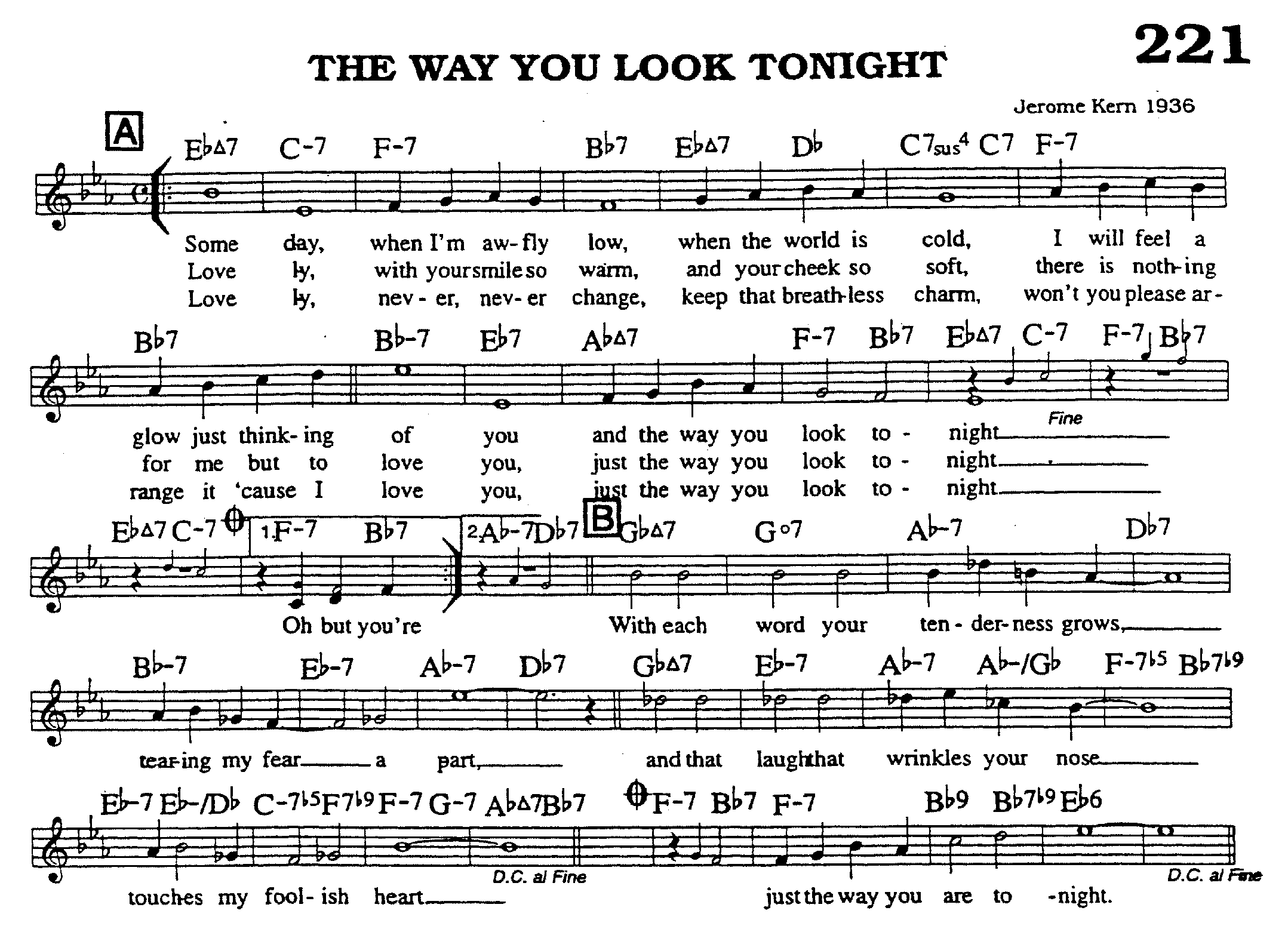
| Form | 64-bar AABA refrain, 16 bars per section, compressed on the lead sheet through repeats, endings, D.C. and Fine; short optional coda/tag |
| Principal tonal centres | E-flat major; temporary A-flat major; G-flat major in the bridge; brief minor-side tonicisations during the bridge return |
| Common jazz classification | Great American Songbook standard; long-form AABA ballad and swing vehicle |
Jerome Kern and Dorothy Fields wrote “The Way You Look Tonight” for the 1936 RKO film Swing Time. The attached chart is in E-flat major and preserves the composition’s unusually spacious 64-bar AABA architecture, each letter occupying sixteen rather than the more usual eight bars. Contemporary sheet music held by the Smithsonian confirms Kern as composer, Fields as lyricist, Chappell & Co. as the 1936 publisher, and Swing Time as the original film context. (National Museum of American History) The song subsequently won the Academy Award for Music (Song) at the 1937 ceremony honouring films released in 1936. (Oscars)
The lyric is more psychologically interesting than its title initially suggests. It is not merely a present-tense compliment about someone’s appearance. The opening projects the speaker into an imagined future in which the present evening has become memory. When life is bleak, the remembered image of the beloved will provide warmth. “Tonight” therefore contains two times simultaneously: the immediate romantic present and the future memory into which that present is already being converted. This gives the song a faint awareness of impermanence even before the final A section explicitly asks the beloved never to change.
The film setting sharpens that distinction between outward appearance and loving perception. Astaire sings while Ginger Rogers’s character is washing her hair and does not regard herself as especially presentable; the comic circumstances deliberately undercut any literal interpretation of the title as praise of formal glamour. (Dorothy Fields Foundation) The lyric eventually confirms this more intimate standard of beauty through the conspicuously unidealised detail of a laugh that wrinkles the beloved’s nose. The central tension is therefore not between beauty and ugliness, but between love as acceptance of a living person and the speaker’s wish to preserve one perfect perception permanently.
2. Form and Dramatic Architecture
The attached lead sheet economises the notation. One sixteen-bar A strain carries three sets of lyrics, with first and second endings; the B strain is written separately, after which the roadmap returns to A. In performed form this produces A1-A2-B-A3, a 64-bar refrain. An independent analysis of the published song likewise identifies a 64-bar AABA refrain with sixteen-bar sections and no separate verse, although the original publication includes introductory material not reproduced in this fakebook chart. (IUScholarWorks)
| Section | Bars | Tonal centre | Lyrical or dramatic function | Musical function |
|---|---|---|---|---|
| A1 | 1-16 | E-flat major, with A-flat tonicisation | Imagines future loneliness and establishes the beloved's remembered appearance as emotional refuge | Establishes tonic; departs through bVII and V7/ii; tonicises IV; returns through ii-V-I |
| A2 | 17-32 | E-flat major, then prepares G-flat | Replaces hypothetical future with tactile, present-tense admiration | Repeats A harmony, then second ending Abm7-Db7 functions as ii-V into G-flat |
| B | 33-48 | G-flat major, then transitional chromatic harmony back towards E-flat | Moves from admiration to confession: tenderness penetrates the speaker's defences | Chromatic-third modulation, diminished passing harmony, minor ii-V tonicisations, then a reorientation towards the home dominant |
| A3 | 49-64 | E-flat major | Converts description into a plea that the beloved remain unchanged | Harmonic homecoming gives apparent stability while the lyric becomes more psychologically anxious |
| Coda/tag | Outside the core 64-bar refrain | E-flat major | Reiterates the final sentiment, with the striking chart variant "are" rather than "look" | Prolonged ii-V, increasingly altered dominant, then final Eb6 |
The first A section is prospective. Its grammar begins with a future condition: the speaker imagines some later period of discouragement and claims that the memory of this particular evening will still generate warmth. A2 changes the temporal focus. The beloved is now described directly through smile and cheek; affection becomes sensory and immediate. The little pickup “Oh but you’re” before the repeated strain contributes to the impression of spontaneous speech rather than a formally symmetrical second stanza.
The bridge changes the nature of the disclosure. “With each word” introduces process: intimacy is not merely being observed but actively changing the speaker. This psychological movement coincides with the clearest tonal displacement of the composition, from E-flat to G-flat major. The return to A therefore has genuine dramatic weight. A3 sounds musically familiar, but Fields alters its premise decisively. The speaker no longer describes what love does; the speaker attempts to bargain with time, asking the beloved not to change.
The chart’s roadmap is compact enough to deserve caution. Fine, first and second endings, coda signs and D.C. al Fine are compressed into a small space, and the final tag is engraved separately at the lower right. The chord order of the tag is clear, but its precise performance routing is less explicit than the underlying 64-bar AABA form. The structural analysis therefore treats AABA as primary and the coda as an optional final extension rather than forcing a single interpretation of the fakebook’s abbreviated navigation.
3. Close Reading of the Lyrics
The three A texts occupy the same melodic and substantially the same harmonic framework. This creates a particularly useful form of dramatic repetition: musical circumstances recur while the speaker’s psychological position changes.
| Lyric or cue | Literal meaning | Literary and poetic reading | Emotional subtext | Musical and harmonic interaction |
|---|---|---|---|---|
| "Some day" | The speaker imagines an unspecified future moment. | The indefinite expression immediately displaces the song from pure present-tense romance. The speaker is already imagining tonight as memory. | Happiness is accompanied by an implicit consciousness that the present cannot last unchanged. | The opening begins securely on Ebmaj7, yet the melody starts on G, scale degree 3, rather than the tonic. Stability is present without being stated with maximal finality. |
| "when I'm awfully low" | The future self is imagined as discouraged or depressed in spirits. | "Awfully" is conversational rather than elevated diction. The lyric establishes vulnerability without theatricalising it. | The speaker admits susceptibility to emotional decline before making any declaration of love. | The opening melodic descent from G to C spans a perfect fifth. The registral fall lends physical shape to "low", though the subsequent phrase begins recovering upward rather than remaining submerged. |
| "when the world is cold" | External circumstances will feel hostile or comfortless. | "Cold" extends an established metaphor of emotional temperature. The individual beloved will shortly be opposed to an entire cold world. | The problem is larger than romantic separation; the beloved becomes a defence against alienation itself. | The second four-bar unit contains the striking Db to C7sus4-C7 movement. The borrowed bVII darkens the diatonic field, while the suspended secondary dominant postpones settlement. |
| "I will feel a glow" | Remembering the beloved will produce warmth. | "Glow" answers "cold" through direct antithesis. It can suggest bodily warmth, emotional reassurance and remembered light simultaneously. | The speaker describes love as something internally regenerative. | Bb7 leads into Bbm7-Eb7-Abmaj7, a tonicisation of IV. The harmony literally opens away from tonic at the moment the emotional world becomes warmer. |
| "just thinking of you" | Thought alone is sufficient consolation. | Physical presence is unnecessary; memory becomes a substitute presence. | This anticipates possible absence without explaining its cause. The lyric is tender precisely because separation is accepted as imaginable. | The applied ii-V into A-flat gives the phrase temporary harmonic spaciousness before the home-key cadence is re-established. |
| "the way you look tonight" | The remembered image is specifically the beloved's appearance on this evening. | "Tonight" fixes an otherwise universal declaration to one transient moment. The title is therefore about memory as much as appearance. | The speaker wants to preserve one perception of the beloved against future change. | Fm7-Bb7-Ebmaj7 gives the title an orthodox ii-V-I arrival. The cadence makes the remembered image sound momentarily definitive, although the turnaround prevents the refrain from ending permanently. |
| "with your smile so warm" | The beloved's smile is affectionate and comforting. | Fields transfers the thermal imagery from the environment to the beloved: the world is "cold", the smile "warm". | The beloved is not simply visually attractive but affectively restorative. | Because A2 reuses the opening harmony, the previously introspective material now receives a more immediate, embodied meaning. |
| "your cheek so soft" | The speaker notices tactile delicacy. | The move from sight to implied touch broadens the sensory field. "Soft" also describes emotional gentleness. | Distance decreases. What began as future memory becomes present intimacy. | The phrase again encounters the Db-C7sus4-C7 region. Harmonic colour complicates what would otherwise be a straightforward catalogue of physical qualities. |
| "nothing for me but to love you" | The speaker regards loving the addressee as inevitable. | The syntax turns affection into necessity rather than choice. Its apparent simplicity masks a surrender of agency. | Romantic certainty grows, but so does dependence. | Bbm7-Eb7-Abmaj7 temporarily confirms A-flat, then the music heads back towards E-flat. The strong functional motion gives the declaration greater inevitability than the words alone. |
| "With each word" | Every utterance by the beloved increases intimacy. | Language itself becomes causative. The addressee's speech alters the speaker internally. | This is the first explicit indication that the speaker is being transformed rather than merely admiring. | The second ending Abm7-Db7 has already detached the song from E-flat and prepared Gbmaj7. The bridge therefore begins in a genuinely changed harmonic environment. |
| "your tenderness grows" | The speaker perceives increasing tenderness. | "Grows" is an organic metaphor. Tenderness is treated as a living process rather than a static attribute. | The relationship is intensifying in real time. | Gbmaj7-Gdim7-Abm7-Db7 contains the chromatic bass rise G-flat-G-A-flat. The passing diminished sonority makes "growth" musically incremental without requiring literal word-painting. |
| "tearing my fear apart" | The beloved's tenderness destroys the speaker's fear. | The violent verb "tearing" is deliberately disproportionate to "tenderness". Gentleness performs the destructive action. | This is the lyric's clearest admission that fear pre-existed the present intimacy. | The bridge's cycle through Bbm7-Ebm7-Abm7-Db7 gives the sentence sustained harmonic propulsion. Security has not disappeared, but the music is less domestically settled than the A material. |
| "that laugh that wrinkles your nose" | The speaker treasures a particular facial mannerism. | This is Fields's most important anti-glamour image. A wrinkle, conventionally something beauty culture might hide, becomes the very evidence of beloved individuality. | The affection is directed towards an involuntary human detail, not an idealised mask. | The lyric occurs as the bridge begins to move away from its first stable G-flat cadence towards increasingly chromatic return harmony. Personal specificity coincides with harmonic complexity. |
| "touches my foolish heart" | The mannerism emotionally affects the speaker. | "Foolish heart" belongs to an older romantic idiom and introduces mild self-mockery. The speaker knows that susceptibility can appear irrational. | The confession acknowledges both sincerity and vulnerability. | Ebm7-Ebm/Db, followed by Cm7b5-F7b9, destabilises the bridge before the eventual return preparation. The harmonic floor shifts precisely as the speaker names emotional weakness. |
| "Lovely, never, never change" | The beloved is asked to remain as they are. | The repeated "never" is rhetorically excessive. A compliment becomes an impossible imperative against time. | The speaker's fear, supposedly torn apart in the bridge, reappears in another form: fear of change. | The return of the original E-flat A music creates striking counterpoint. Harmonically everything is restored, but the lyric is more anxious than before. |
| "keep that breathless charm" | The beloved should preserve the quality that enchants the speaker. | "Breathless" can describe both charm and the observer's response to it. The word blurs quality and effect. | Admiration acquires possessiveness, albeit gently expressed. | The familiar Db-C7sus4-C7 passage reappears. The request for constancy is therefore placed over harmony that itself departs chromatically from tonic stability. |
| "won't you please arrange it" | The beloved is asked to make permanent constancy possible. | "Arrange it" is deliberately light, almost comic diction for an impossible demand. Fields prevents the plea from becoming ponderous. | The speaker knows, at some level, that what is being requested cannot literally be arranged. | The A-flat tonicisation again supplies expansion before the final cadence. The tonal detour prevents the request from sounding as categorical as its words might imply. |
| "'cause I love you" | Love is offered as the reason for the request. | The contraction returns the diction to ordinary speech after the more elevated "breathless charm". | The speaker uses sincerity, rather than logic, to justify an impossible wish. | The harmony turns through Fm7-Bb7 towards tonic, making the causal statement function as a cadential preparation. |
| Final title return | The speaker restates the central admiration. | Repetition now carries everything learned in the bridge. "The way" means manner, personality and remembered presence, not merely facial appearance. | What sounded like uncomplicated admiration in A1 now includes vulnerability and fear of change. | The ii-V-I return to Ebmaj7 gives musical closure without solving the temporal contradiction embedded in the words. |
| Coda cue, "the way you are tonight" | The chart's tag shifts from appearance to being. | If treated as intentional rather than editorial, "are" radically broadens the title from visual perception to the beloved's whole present self. | Acceptance becomes deeper, but still temporally bounded by "tonight". | Repeated Fm7-Bb7 motion, followed by Bb9-Bb7b9-Eb6, intensifies the dominant before resolving to a warmer tonic sixth rather than Ebmaj7. |
Fields’s rhyme is unobtrusive but structurally efficient. “Low” and “glow” bind distress to its remedy; “grows” and “nose” connect abstract tenderness with an almost comic physical detail; “apart” and “heart” connect the destruction of fear with the organ traditionally associated with romantic vulnerability. The rhyme scheme therefore repeatedly links an emotional abstraction with the concrete image that either answers or exposes it.
The lyric’s sensory vocabulary also progresses purposefully. It begins with environmental temperature, moves through remembered sight, then warmth and softness, then the sound of words and laughter. The title’s apparent emphasis on visual appearance is steadily undermined by a lyric in which the beloved is experienced through several senses and, most importantly, through emotional effect.
4. Lyrical and Emotional Arc
Opening Position
The speaker begins from within a happy present but mentally stands outside it. Rather than saying simply that the beloved looks wonderful, the speaker imagines a future in which the present relationship is recalled during adversity. That temporal displacement makes the opening unusually mature for a conventional love song. The speaker understands that moods and circumstances change, and perhaps that physical proximity itself cannot be guaranteed.
This perspective also gives the beloved unusual psychological power. The future “glow” will not depend upon what the beloved does then. It will be generated by memory. The lover has become an internalised source of warmth.
Development
A2 moves from abstraction towards bodily specificity. Smile, cheek, warmth and softness bring the beloved nearer. The bridge then abandons description and reveals what the relationship is doing to the speaker. Tenderness is dismantling fear.
The most important development, however, is that fear does not disappear. It changes object. Once intimacy has made the speaker less afraid of loving, another anxiety emerges: the possibility that the beloved, the relationship or the perfect present moment might change.
Point of Greatest Tension
The bridge’s “tearing my fear apart” is the explicit psychological centre, but the greater contradiction arrives at “never, never change”. The bridge has just celebrated love as a process of growth, yet the final A asks for stasis.
Musically, this contradiction is sharpened by the return to the completely familiar A material. The listener hears “home” while the words reveal a newly urgent need to preserve that home. The conventional recapitulation therefore does not mean that the emotional problem has been solved.
Resolution or Lack of Resolution
The song achieves tonal resolution more convincingly than psychological resolution. The return to E-flat and the familiar title cadence restore musical security. The optional tag can strengthen that closure further through an altered dominant resolving to Eb6.
The lyric cannot provide the same certainty. Nothing guarantees that the beloved will never change, that tonight will remain recoverable in memory, or that the speaker’s future loneliness will actually be healed by recollection. What the song reaches is neither resignation nor denial. It is wish fulfilment expressed with enough verbal lightness that the impossibility of the wish does not break the romantic surface.
Central Paradox
The song’s central paradox is that its declaration of acceptance contains a demand for preservation. The speaker loves the beloved “just the way” they are perceived now, but that very completeness produces the desire that nothing change.
There is a second paradox nested inside it. The bridge praises tenderness for destroying fear, yet the final A demonstrates that intense attachment has created another kind of fear. Greater intimacy makes the speaker safer and more vulnerable at the same time.
5. Detailed Harmonic Analysis
The global tonic of the attached lead sheet is E-flat major. The three-flat key signature, repeated tonic Ebmaj7 sonorities and recurrent Fm7-Bb7-Ebmaj7 cadences establish that centre decisively. The bridge is a genuine temporary modulation to G-flat major, not merely a collection of chromatic chords. A-flat major is tonicised within each A section but does not replace E-flat as the governing tonic.
The chart differs materially from many simplified modern versions. In particular, its A section moves from Ebmaj7 to a plain Db major triad and then C7sus4-C7. That Db should not be silently replaced by a more conventional applied ii chord such as Gm7. Its borrowed bVII colour is part of this lead sheet’s harmonic identity.
| Bars | Lyric cue | Chords | Roman numerals | Tonal centre | Harmonic function and interpretation |
|---|---|---|---|---|---|
| A 1-2 | "Some day..." / equivalent A text | Ebmaj7 | Cm7 | Imaj7 | vi7 | E-flat | Tonic prolongation through the relative-minor substitute. The bass/root descent from E-flat to C begins a familiar diatonic cycle without weakening tonic orientation. |
| A 3-4 | "when I'm awfully low" | Fm7 | Bb7 | ii7 | V7 | E-flat | Conventional predominant-dominant motion. The opening four bars therefore form an almost paradigmatic I-vi-ii-V. |
| A 5 | "when the world..." | Ebmaj7 | Imaj7 | E-flat | Tonic restoration. |
| A 6 | "...is..." | Db | bVII | E-flat | Borrowed subtonic major. It is best understood as modal interchange and chromatic voice-leading towards C7, not automatically as a tritone substitute. |
| A 7 | "...cold" | C7sus4 C7 | V7/ii | E-flat | Applied dominant of F minor. The suspended fourth resolves within the chord, creating local tension before ii. |
| A 8 | continuation | Fm7 | ii7 | E-flat | Resolution of V7/ii to the home-key supertonic. |
| A 9 | "I will feel..." | Bb7 | V7 | E-flat | Dominant function, but it does not immediately resolve to I. |
| A 10 | "...a glow..." | Bbm7 | ii7/IV | Moving towards A-flat | The dominant Bb7 is reinterpreted by continuation rather than resolution. Bbm7 initiates an applied ii-V to IV. |
| A 11 | "thinking..." | Eb7 | V7/IV | A-flat | Applied dominant of A-flat. The D-flat in the chord explicitly removes the E-flat-major leading tone D-natural from the local field. |
| A 12 | "...of you" | Abmaj7 | IVmaj7, locally Imaj7 | A-flat | Temporary confirmation of IV as a tonal resting place. This is tonicisation rather than a large-scale modulation. |
| A 13-14 | title approach | Fm7 | Bb7 | ii7 | V7 | E-flat | Return to the home-key cadential progression. |
| A 15 | "...tonight" | Ebmaj7 Cm7 | Imaj7 vi7 | E-flat | Tonic arrival followed immediately by a continuation chord. The title is resolved, but the form remains open. |
| A 16, first ending | connective turnaround | Fm7 Bb7 | ii7 V7 | E-flat | Standard turnaround into the repeated A. |
| A 16, second ending | bridge preparation | Abm7 Db7 | Locally ii7-V7 of G-flat | G-flat preparation | A functional pivot. Rather than treating the modulation as an unexplained chromatic third jump, the chart explicitly supplies the ii-V of the new tonic. |
| B 1 | "With each..." | Gbmaj7 | Imaj7 | G-flat | Full confirmation of the bridge tonic, a minor third above E-flat. |
| B 2 | "...word..." | Gdim7 | vii°7/ii | G-flat | Passing diminished sonority between Gbmaj7 and Abm7; the chromatic root ascent G-flat-G-A-flat is central. It can also be heard as a voice-leading diminished chord rather than requiring a single dominant derivation. |
| B 3-4 | "tenderness grows" | Abm7 | Db7 | ii7 | V7 | G-flat | Orthodox predominant-dominant motion consolidating the new key. |
| B 5-6 | "tearing my..." | Bbm7 | Ebm7 | iii7 | vi7 | G-flat | Diatonic continuation around the tonic's relative-minor area. |
| B 7-8 | "...fear apart" | Abm7 | Db7 | ii7 | V7 | G-flat | Another ii-V, again directing the ear to G-flat. |
| B 9-10 | "and that laugh..." | Gbmaj7 | Ebm7 | Imaj7 | vi7 | G-flat | Return to tonic followed by relative-minor colouring. |
| B 11 | "...wrinkles..." | Abm7 | ii7 | G-flat | Predominant, but the expected Db7 continuation is disrupted by the following chromatic sequence. |
| B 12 | "...your nose" | Abm/Gb Fm7b5 Bb7b9 | ii7 over tonic bass; iiø7/vi-V7b9/vi | G-flat, then E-flat minor | The G-flat bass prolongs the bridge tonic beneath ii colour. Fm7b5-Bb7b9 then forms a minor ii-V directed to Ebm7, tonicising vi. |
| B 13 | "touches my..." | Ebm7 Ebm/Db | vi7, then vi7 over scale-degree 5 bass | G-flat / E-flat minor colour | The expected E-flat-minor arrival occurs, but the descending E-flat to D-flat bass immediately makes it transitional. |
| B 14 | "...foolish..." | Cm7b5 F7b9 | iiø7/iii-V7b9/iii | Transitional | This pair conventionally points towards B-flat minor, the iii region of G-flat, but the expected B-flat-minor resolution is evaded. It is better heard here as an applied minor ii-V whose voice leading assists the return transition. |
| B 15 | "...heart" | Fm7 Gm7 | ii7 iii7 | Reoriented to E-flat | The chart abruptly becomes diatonic to the home key. Root motion F-G begins an ascending return sequence. |
| B 16 | held phrase / return | Abmaj7 Bb7 | IVmaj7 V7 | E-flat | The ascent continues A-flat-B-flat, ending on the home dominant and making the D.C. return inevitable. |
| Coda/tag | final title variant | Fm7 Bb7 Fm7 Bb9 Bb7b9 Eb6 | ii7 V7 ii7 V9 V7b9 I6 | E-flat | Cadential prolongation. Repeated ii-V motion with increasing dominant alteration concentrates tension before a softer tonic-sixth close. |
Several aspects of the progression deserve emphasis. First, Db in A6 is not an isolated exoticism. Root motion E-flat-D-flat-C gives a clear descending chromatic/whole-step contour, while inner voices can move economically into C7. It colours an otherwise conventional A section without destroying functional continuity.
Second, Bbm7-Eb7-Abmaj7 is an actual applied ii-V-I in IV. Because A-flat is already the subdominant of E-flat, the tonicisation enlarges the harmonic field without creating the perceptual rupture of a full modulation.
Third, the bridge’s return is considerably more sophisticated than its opening. The early G-flat material is functionally straightforward. The later Fm7b5-Bb7b9-Ebm7 supplies a genuine minor ii-V-i tonicisation of the bridge’s vi. The following Cm7b5-F7b9 seems to promise another minor resolution but evades it, after which Fm7-Gm7-Abmaj7-Bb7 unmistakably reinterprets the landscape in E-flat. The transition is therefore accomplished less by one pivot chord than by progressive reorientation.
6. Tonal Journey
| Passage | Starting centre | Destination | Mechanism | Dramatic effect |
|---|---|---|---|---|
| Opening A | E-flat major | E-flat major | I-vi-ii-V, then tonic return | Establishes a secure frame for the speaker's imagined future vulnerability |
| Middle of each A | E-flat major | A-flat major | Bbm7-Eb7-Abmaj7, applied ii-V-I to IV | Broadens the harmonic space as thought turns towards the beloved |
| End of A1/A3 | A-flat region | E-flat major | Fm7-Bb7-Ebmaj7 | Restores the title phrase to home |
| A2 second ending | E-flat major | G-flat major | Abm7-Db7 prepares the new tonic | Opens a distinctly new emotional space for the bridge |
| First half of B | G-flat major | G-flat major | Tonic, passing diminished, repeated ii-V | Makes the new key feel temporarily self-sufficient |
| Later B | G-flat major | E-flat-minor region | Fm7b5-Bb7b9-Ebm7 | Darkens the bridge just as the lyric acknowledges fear and vulnerability |
| End of B | Chromatic bridge region | E-flat major dominant | Evaded applied minor ii-V, then Fm7-Gm7-Abmaj7-Bb7 | Gradually recovers the home-key grammar rather than simply jumping back |
| Final A | E-flat major | E-flat major | Recapitulation of A harmony | Musical security returns while the lyric asks for impossible permanence |
| Coda | E-flat dominant region | E-flat major | Prolonged ii-V and Bb7b9-Eb6 | Gives stronger cadential closure than the psychology of the lyric itself possesses |
The large-scale E-flat to G-flat motion is a chromatic-third relationship. Because the second ending prepares G-flat with its own ii-V, the modulation feels simultaneously surprising in key distance and logical in local syntax. The ear is not asked merely to accept Gbmaj7; it is led there.
This matters dramatically. The bridge is where the speaker admits that tenderness is changing an internal state of fear. The music likewise leaves the home key completely. Yet G-flat does not sound threatening. It is luminous and structurally coherent. Emotional exposure is represented not by harmonic chaos but by relocation.
Only in the second half of the bridge does the harmony become more equivocal. Minor ii-V motion, slash-bass descent and an evaded applied resolution gradually dissolve the bridge’s self-contained world. The recovery of E-flat occurs through a remarkably plain ascent, Fm7-Gm7-Abmaj7-Bb7, as though chromatic uncertainty has been distilled back into familiar home-key functions.
The final tonic consequently feels earned. Nevertheless, the lyric has changed the meaning of that tonic. E-flat can restore the musical environment, but it cannot arrest time. The homecoming is therefore genuine harmonically and provisional psychologically.
7. Melody and Prosody
The melody spans approximately C4 to E-flat5, with most of its tessitura concentrated between E-flat4 and D-flat5; an independent analytical study of the published song gives the same range and identifies the opening perfect-fifth descent, subsequent rising scalar sequence and later upper E-flat peak. (IUScholarWorks) The attached chart is notated in cut time, and its predominant quarter-note, half-note and longer values give the tune a broad melodic gait even when performers increase the tempo.
The opening is exceptionally economical. G, scale degree 3 in E-flat, drops to the lower C, scale degree 6, over the move from Ebmaj7 to Cm7. That perfect fifth is large enough to establish the tune’s profile immediately. Because the word “low” occurs within a phrase whose register has already fallen, Kern does not need exaggerated literal word-painting. The melodic situation has prepared the semantic idea.
The following material reverses that initial downward gesture. Scalar motion and small sequential rises gradually rebuild height. This is important to the emotional premise: the melody does not remain where “awfully low” has placed it. Like the lyric’s anticipated “glow”, it contains its own means of recovery. The contour therefore traces not simply melancholy but restoration.
Kern’s melody is notably economical in chromatic pitch content. Much of the harmonic sophistication lies underneath diatonic or readily singable melodic material. This separation is one reason the composition accepts extensive jazz reharmonisation without losing identity. A singer can project a lucid melodic sentence while the accompaniment supplies bVII colour, secondary dominants, diminished sonorities and the remote bridge key.
Long notes are particularly important. Fields’s conversational text is frequently allowed to stretch across harmonic motion rather than being syllabically busy. Words such as “cold”, “grows”, “nose”, “heart” and especially the title’s terminal “tonight” can occupy durations longer than ordinary speech. The effect is not merely lyrical prettiness. Sustained words permit the harmony to change beneath a stable vocal pitch, so that the semantic object appears momentarily fixed while its harmonic environment moves.
The title phrase is constructed to sound inevitable without becoming square. Its approach through Fm7-Bb7 places the listener inside the most familiar cadential syntax in E-flat, and the melody settles towards the tonic field at precisely the point where the lyric names the remembered image. Yet the continuation into Cm7 and the turnaround means that the melodic cadence is both an arrival and a reopening.
The bridge alters both register and rhetorical pressure. Its repeated tones and longer upper-register shapes make the language sound less observational and more declarative. The eventual E-flat5 is the upper tonic, so the melodic high point remains related to the home key even during a section tonally centred elsewhere. This creates an interesting duality: the bridge’s harmony is furthest from home while the melody reaches one of the clearest manifestations of the home tonic pitch class.
Prosodically, Fields and Kern largely preserve natural speech accent. Strong lexical stresses in phrases such as “tenderness grows”, “fear apart” and “foolish heart” receive ample duration and structural placement. The less formal expressions, notably “awfully”, the pickup “Oh but you’re”, and “‘cause I love you”, prevent the melodic breadth from becoming ceremonious.
The crucial prosodic device is repetition with changed text. The same opening melodic shape has to carry “Some day”, “Lovely, with your smile…” and “Lovely, never, never change”. What initially functions as reflective narration later becomes direct praise and finally an imperative. Kern’s unchanged melody therefore becomes a dramatic measuring device: we hear the speaker becoming more exposed because the musical frame remains recognisable.
8. Word, Melody, and Harmony: Key Moments
| Moment | Lyric cue | Musical event | Interpretive significance |
|---|---|---|---|
| 1 | "Some day" | Opening G descends a perfect fifth to C over Ebmaj7-Cm7 | The tune begins with a falling gesture while the lyric projects into an uncertain future; vulnerability is present before romantic praise begins |
| 2 | "world is cold" | Ebmaj7-Db-C7sus4-C7 | A borrowed bVII and suspended applied dominant disturb the home-key surface at the lyric's bleakest environmental image |
| 3 | "feel a glow" | Dominant motion opens into Bbm7-Eb7-Abmaj7 | The answer to "cold" coincides with expansion towards the warmer subdominant region rather than a simple tonic resolution |
| 4 | First title cadence | Fm7-Bb7-Ebmaj7 | Memory of the beloved is given the strongest conventional home-key cadence in the A section |
| 5 | Entry to bridge | Abm7-Db7-Gbmaj7 | The lyric moves from description to the transformative effect of tenderness precisely as the composition enters a new key |
| 6 | "tenderness grows" | Gbmaj7-Gdim7-Abm7 with G-flat-G-A-flat root/bass rise | The chromatic passing diminished chord creates a literal sense of incremental movement without becoming simplistic word-painting |
| 7 | "tearing my fear apart" | G-flat diatonic cycle leads through Abm7-Db7 | The most explicit statement of vulnerability receives forward harmonic momentum rather than a static sentimental pause |
| 8 | "wrinkles your nose" | Stable G-flat begins giving way to Abm/Gb-Fm7b5-Bb7b9 | The lyric's most concrete, humanising image appears as the harmony becomes most chromatically involved |
| 9 | "foolish heart" | Minor-side ii-V colour gives way to Fm7-Gm7-Abmaj7-Bb7 | The admission of susceptibility occurs during the harmonic process that reconstructs the route home |
| 10 | "never, never change" | Original A music returns unchanged | Musical constancy accompanies a verbal demand for constancy, but the very need to make the request reveals insecurity |
| 11 | Coda's "are" variant | Bb9-Bb7b9-Eb6 | If the chart's wording is intentional, visual admiration becomes acceptance of being; the altered dominant gives this textual broadening unusually strong final emphasis |
The most revealing irony is the return of A3. The harmony tells the listener that home has been recovered, yet the lyric proves that the speaker has not returned to the uncomplicated emotional position of A1. Musical repetition exposes psychological difference.
9. Historical and Cultural Context
“The Way You Look Tonight” was written by Jerome Kern with lyrics by Dorothy Fields for Swing Time, the 1936 RKO musical starring Fred Astaire and Ginger Rogers. The Smithsonian’s surviving sheet music identifies Chappell & Co. as publisher and dates the publication to 1936. (National Museum of American History) Fields’s own archive identifies the song with Kern, Swing Time and 1936. (Dorothy Fields Foundation)
The film context is unusually relevant to literary interpretation. Astaire’s character sings the song while Rogers’s character is washing her hair and appears with it covered in suds. The scene creates comic disjunction between the lyric’s apparent praise of appearance and the heroine’s own sense that she is not at that moment conventionally glamorous. (Dorothy Fields Foundation) Consequently, the title’s “look” is already relational in its original dramatic setting. The beloved appears beautiful because of who is looking and how he feels.
Fields later recalled being intensely moved when Kern first played the melody, particularly by the release. Her recollection is useful because the composition’s bridge and return do in fact depend upon large-scale release rather than merely local harmonic decoration. (Dorothy Fields Foundation) This should not be mistaken for proof of a particular harmonic programme, but it confirms that the architecture of departure and return was central to her experience of Kern’s tune.
The song won the Academy Award for Music (Song) at the 9th Academy Awards, held in March 1937 for films released in 1936. The Academy records explicitly credit Kern for the music and Fields for the lyric. (Oscars) Its success therefore belongs simultaneously to Hollywood musical culture, popular commercial song and the developing body of repertoire that jazz musicians would appropriate as standards.
That appropriation happened almost immediately. Teddy Wilson’s orchestra recorded the song in New York on 21 October 1936 with Billie Holiday’s vocal, only months after its introduction; surviving discographical records list two takes and the Brunswick issue. (Jazz Disco) The speed of that transition matters. “The Way You Look Tonight” did not need decades of retrospective rediscovery before becoming useful to jazz musicians. Its melody, extended AABA form and functional harmonic framework were already compatible with swing-era practice.
The post-war repertoire changed its character further. By the 1950s it could function not merely as a romantic vocal number but as a fast instrumental blowing vehicle. Art Blakey’s quintet recorded it live at Birdland in 1954 with Clifford Brown, Lou Donaldson and Horace Silver. (Jazz Disco) Johnny Griffin’s 1957 A Blowin’ Session, with Hank Mobley and John Coltrane alongside Griffin, pushed the tune still further towards virtuosic, high-tempo improvisation. Discographical sources identify the Kern-Fields composition in a session featuring Lee Morgan, the three tenor saxophonists, Wynton Kelly, Paul Chambers and Art Blakey. (MusicBrainz)
That transformation illustrates why Great American Songbook material became so durable in jazz. The lyric can support intimate rubato singing, while the same 64-bar harmonic structure can withstand aggressive swing and extended improvisation. In instrumental performance, the romantic narrative recedes but the composition’s architecture remains: long A sections, a remote bridge centre, recurrent ii-V grammar and a strong melody whose identity survives considerable rhythmic alteration.
10. Significant Interpretations
| Performer | Recording or period | Interpretive character | What it reveals about the song |
|---|---|---|---|
| Fred Astaire with Johnny Green and His Orchestra | 1936 Brunswick 7717; contemporary reviews identify "The Way You Look Tonight" as the reverse side of "Pick Yourself Up". ([The New Yorker][9]) | Light, conversational popular-song delivery rather than a grand romantic declamation | Preserves the song's dramatic origin and helps explain why Fields's colloquial diction works so naturally |
| Billie Holiday with Teddy Wilson and His Orchestra | 21 October 1936, New York. ([Jazz Disco][6]) | Swing-era vocal phrasing makes the written melody more rhythmically elastic and less theatrical | Demonstrates how quickly the song could be detached from Hollywood staging and treated as jazz material |
| Art Blakey Quintet | Birdland, New York, 21 February 1954. ([Jazz Disco][7]) | Fast, live instrumental treatment with Clifford Brown, Lou Donaldson and Horace Silver | Reveals that the long form and bridge modulation remain coherent under hard-driving rhythmic conditions |
| Johnny Griffin with Hank Mobley, John Coltrane and Lee Morgan | A Blowin' Session, 1957. ([MusicBrainz][8]) | The standard becomes a high-velocity improvisational test, with multiple major solo voices negotiating the 64-bar form | Shows how harmonic fluency and formal memory can become the composition's central drama once the lyric is removed |
| Ella Fitzgerald with Nelson Riddle | Ella Fitzgerald Sings the Jerome Kern Song Book, recorded January 1963; Riddle arranged and conducted. ([Jazz Disco][10]) | Controlled diction and long-line vocal phrasing supported by orchestral harmonic colour | Restores Fields's lyric to the foreground without reducing the composition to a slow torch song |
| Frank Sinatra with Nelson Riddle | Days of Wine and Roses, Reprise, 1964. ([Nelson Riddle][11]) | Urbane swing treatment, emotionally affirmative but rhythmically mobile | Demonstrates that the lyric can survive a stronger swing pulse, shifting the speaker from reverie towards confident, adult romantic conversation |
Astaire and Holiday provide the most revealing early contrast. Astaire’s authority comes from dramatic context: the song is part of a scene and his understatement leaves room for its comic situation. Holiday, recorded in the same year, effectively proves that the composition has a life outside that scene. Her rhythmic language makes Fields’s words feel personally inhabited rather than scripted.
The Blakey and Griffin performances represent a more radical transformation. Once the lyric is removed and the tempo raised, the 64-bar form becomes an improviser’s endurance structure. The bridge’s move to G-flat must be heard as a region, not merely read as a sequence of chords, because at fast tempos there is little time to recover from losing the large-scale form.
Fitzgerald and Sinatra, both with Nelson Riddle in different contexts, show another kind of durability. Their performances retain the literary clarity of the lyric while allowing orchestration and swing feel to change its psychological temperature. Fitzgerald can make the sustained melodic architecture unusually transparent; Sinatra’s rhythmic stance places more conversational pressure against the beat. Neither interpretation requires changing the fundamental argument of the song.
11. Place in the Jazz Canon
The tune’s 64-bar AABA form is its first major distinction as an improvisational vehicle. A player accustomed to eight-bar A sections can easily mislocate the bridge if the form is treated merely as “another AABA standard”. Each section must be felt as a sixteen-bar span containing four-bar internal sentences. The bridge begins at bar 33, not bar 17.
Its harmonic language is equally useful pedagogically. The A section begins with material almost elementary in its functional clarity, I-vi-ii-V, but rapidly introduces several concepts a jazz player must distinguish correctly: borrowed bVII, an applied dominant to ii, tonicisation of IV, an orthodox ii-V-I home cadence and, in the second ending, a ii-V that genuinely prepares a remote bridge tonic.
The bridge then tests whether the player can hear key regions rather than chord symbols one at a time. Abm7-Db7-Gbmaj7 must be perceived as arrival in G-flat. Later Fm7b5-Bb7b9-Ebm7 is most useful when heard as a minor ii-V-i within that bridge environment. The final Fm7-Gm7-Abmaj7-Bb7 must in turn be recognised as the restoration of E-flat grammar.
This large-scale clarity helps explain the tune’s success at radically different tempos. At a ballad tempo, each chromatic detail can be coloured and the long melodic notes can carry considerable expressive weight. At medium swing, the form has graceful forward momentum. At the tempos associated with some 1950s instrumental versions, the same architecture becomes a test of harmonic reflexes and formal concentration. The documented Blakey and Griffin performances are clear evidence of this instrumental afterlife. (Jazz Standards)
For improvisers, merely memorising roots is therefore inadequate. The key facts to internalise are the A section’s two departures from uncomplicated E-flat, the A-flat tonicisation and the bridge preparation, then the G-flat bridge’s internal tonicisation of E-flat minor and its eventual reorientation to E-flat. Hearing those regions makes the progression much easier to negotiate than treating all sixty-four bars as an undifferentiated chord stream.
The melody is equally important. Its initial descending fifth, subsequent scalar recovery, broad sustained notes and clear title cadence supply strong motivic material for improvisation. A convincing solo can abstract those gestures without quoting the tune literally. Conversely, reharmonisation that destroys the large-scale relation between E-flat, A-flat and G-flat risks making the tune harmonically busier while making the composition itself less audible.
12. Interpretive Considerations for Performers
The strongest vocal approach need not treat the opening as an ecstatic declaration. A1 is conditional and inward-looking. The speaker is imagining a future low point, so restraint can make the eventual warmth of the beloved’s image more persuasive. Beginning at full romantic intensity leaves the bridge and final A nowhere psychologically to go.
A2 benefits from greater immediacy. Its imagery is tactile and present. The pickup “Oh but you’re” can be treated as genuine conversational overflow rather than squared into the metre. Similarly, “‘cause I love you” should probably retain its colloquial quality. Fields deliberately alternates elegant phrases with ordinary speech.
The bridge deserves a genuine shift of emotional focus because the composition itself supplies one. The G-flat modulation should be audible. Pianists and arrangers should avoid reharmonisations that blur Abm7-Db7-Gbmaj7 into a continuous chromatic wash; the dramatic value comes from actually arriving somewhere new. The later Fm7b5-Bb7b9-Ebm7 can receive darker colour, but it need not be exaggerated into melodrama.
The final “never, never change” is a particularly dangerous place to oversing. Its power comes from the fact that the request is impossible. A lightly intensified delivery can reveal anxiety beneath admiration; a huge climax may turn Fields’s deliberately graceful plea into sentimentality. The same applies to “foolish heart”, whose self-deprecating adjective should not be lost under vocal grandeur.
Instrumentalists should preserve several landmarks even when reharmonising: the distinctive Db before C7sus4-C7, the Bbm7-Eb7-Abmaj7 tonicisation of IV, the second-ending Abm7-Db7 into G-flat, the Gdim7 chromatic passing colour, and the bridge’s final return to Fm7-Gm7-Abmaj7-Bb7. Replacing A6’s Db automatically with the Gm7-C7 type of progression found in other arrangements changes the specific harmonic character of this lead sheet.
The opening descending fifth is one of the melody’s defining intervals and is worth retaining even in a highly personalised vocal reading. Likewise, the upper-register bridge material and the title cadence are structural identifiers. Ornamentation is most effective when it grows around those pillars rather than replacing them.
Tempo changes the implied speaker dramatically. At a slow tempo, “Some day” becomes reflective and the future-memory premise comes to the foreground; the performer must then sustain very long melodic spans without overloading every note with expressive devices. Medium swing exposes the lyric’s conversational elegance and makes Fields’s lighter diction more apparent. At very fast tempo, the composition becomes primarily an improvisational structure. That transformation is historically legitimate, but it inevitably subordinates the lyric’s temporal and psychological nuances.
The optional coda deserves attention because of its textual alteration. If “just the way you are tonight” is used as printed in this chart, the change from “look” to “are” should not be treated casually. It can make the ending sound as though the speaker finally recognises that the beloved’s attraction lies in identity rather than visual appearance. Conversely, if the phrase is understood merely as a fakebook variant, a performer may prefer not to assign it that degree of philosophical significance.
13. Final Reading
“The Way You Look Tonight” is fundamentally a song about preserving a present experience against time. Its apparent subject is the beloved’s appearance, but Fields immediately places that appearance inside future memory. Tonight matters because it will not remain tonight. The speaker’s imagined future loneliness transforms a romantic compliment into an act of psychological storage: this image is being kept for later use.
Kern’s harmony reinforces that complexity by giving the song a stable home while repeatedly demonstrating how easily stability can be coloured or left behind. E-flat major is never seriously in doubt during the A sections, yet the borrowed Db, the suspended C7, the tonicisation of A-flat and finally the prepared move to G-flat ensure that tonic security is not monotony. Love operates similarly in the lyric. It provides a centre, not immobility.
The bridge exposes what the A sections only imply. The speaker has fear. Tenderness is powerful because it penetrates that defence. Kern places this disclosure in G-flat, a tonal world far enough from E-flat to register as a real relocation but prepared cleanly enough to avoid trauma. Emotional openness is therefore represented as movement into another coherent space. The more unsettled chromaticism comes later, when that bridge world has to be relinquished and the music must find home again.
Fields’s most perceptive line of thought concerns beauty. The song begins with “the way you look”, yet the lyric’s most memorable evidence of attraction is not idealised perfection but the laugh that wrinkles a nose. In the original film, that idea is intensified by the comic circumstance of the beloved being caught while washing her hair. The song’s romance depends on the possibility that loving perception can recognise beauty where conventional presentation is absent. (Dorothy Fields Foundation)
The final A then introduces the flaw in the speaker’s understanding. Having discovered a love grounded in particularity rather than perfection, the speaker nevertheless asks that the beloved never change. The request is emotionally comprehensible and logically impossible. Fields keeps it from becoming oppressive through conversational diction and a touch of absurdity in “arrange it”. Kern, meanwhile, gives the words the familiar security of the returning A melody. The result is not irony in the sense of ridicule, but a gentle mismatch between what music can restore and what life cannot preserve.
The last cadence consequently leaves warmth rather than absolute certainty. The tonic returns; the title can be restated; the optional Eb6 can close the harmonic argument completely. But “tonight” remains a temporal word. The moment can be remembered, repeated musically and perhaps transformed into consolation, but it cannot literally be kept.
The song’s enduring insight is that love makes a transient moment feel permanent without actually making it so. Kern gives the speaker a home key to return to; Fields understands that there is no equivalent cadence capable of stopping time.