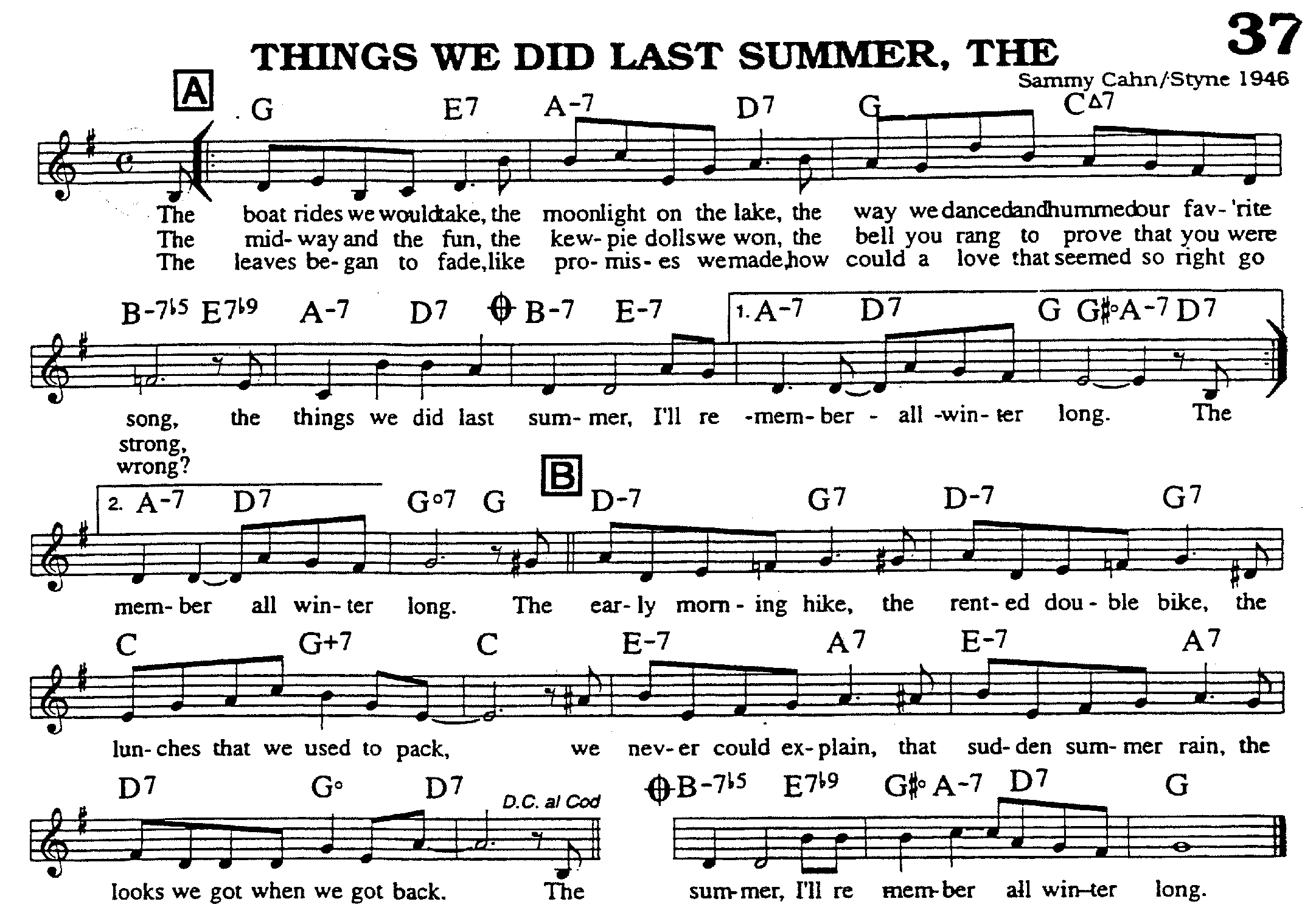
1. Song Overview
| Field | Details |
|---|---|
| Song | The Things We Did Last Summer |
| Composer | Jule Styne |
| Lyricist | Sammy Cahn |
| Year | 1946 |
| Original context | American popular song, published independently by Edwin H. Morris & Co. in 1946. Early recordings include Frank Sinatra, Jo Stafford and Vaughn Monroe. |
| Lead-sheet key | G major |
| Form | 32-bar AABA chorus, with first and second endings, D.C. al Coda, and a written final coda |
| Principal tonal centres | G major; temporary tonicisation of A minor; C major in the bridge; the dominant region of D |
| Common jazz classification | Great American Songbook standard; popular ballad adaptable to swing, instrumental jazz and vocal jazz |
The Things We Did Last Summer is a study in the unreliability of happiness when viewed retrospectively. Its subject is not simply a vanished romance but the transformation of ordinary experiences into emotionally charged memories. Boat rides, carnival prizes, bicycle excursions and packed lunches acquire significance because they belong to a period that cannot be recovered. Sammy Cahn constructs the lyric around an accumulating inventory of apparently inconsequential details. Their emotional meaning is withheld until the final return of the A section, when the recollection of summer becomes inseparable from the failure of romantic promises.
The song’s emotional trajectory is unusually deceptive. Its opening scenes have the uncomplicated quality of affectionate reminiscence, and Jule Styne provides a predominantly diatonic melody whose repeated rhythmic figures make the recollections sound spontaneous. Nevertheless, the harmonic language is less secure than the surface suggests. Secondary dominants, minor-key applied cadences, half-diminished chords and chromatic diminished sonorities continually interrupt G major. These devices belong to conventional popular-song harmony, but their placement permits a compelling expressive reading: even the happiest memories contain traces of the instability that retrospectively defines them.
What distinguishes the song from many other nostalgic standards is its delayed revelation. The opening two A sections establish a catalogue of shared experiences without explicitly announcing that the relationship has failed. The bridge extends the catalogue, apparently postponing any deeper explanation. Only the third A section introduces fading leaves, broken promises and an explicit question about love going wrong. Consequently, the earlier material is transformed after the listener has already heard it twice. The harmony has not suddenly become tragic; rather, its previously understated tensions now seem more revealing.
The governing emotional tension is between the permanence of memory and the impermanence of the experience remembered. The singer cannot preserve summer, repair the relationship or explain its failure. Remembering is the one action that remains available. That makes the recurring promise to remember throughout winter simultaneously an expression of devotion, an acknowledgement of absence and a possible defence against accepting the loss.
2. Form and Dramatic Architecture
The attached lead sheet presents a 32-bar AABA song in common time, with each principal section occupying eight bars. Its notation is compressed through repeat signs, alternative endings and a D.C. al Coda instruction.
The complete performed structure is:
| Section | Bars | Tonal centre | Lyrical or dramatic function | Musical function |
|---|---|---|---|---|
| A1 | 1–8 | G major, with A minor tonicisation | Establishes the remembered summer through boating, moonlight, dancing and music | Introduces the principal melody, tonic harmony, applied dominants and the recurring ii-V-I framework |
| A2 | 9–16 | G major | Adds carnival imagery, prizes and playful demonstrations of strength | Repeats the A material, but uses the written second ending to prepare the bridge |
| B | 17–24 | C major, then the dominant region of D | Extends the memories into more intimate and less idealised experiences | Moves towards IV through Dm7-G7, establishes C temporarily, then approaches the home-key dominant through Em7-A7 |
| A3, opening | 25–29 | G major, with A minor tonicisation | Introduces fading leaves, promises and the possibility that love has ended | Reprises the opening five bars; previously familiar harmonic tensions receive a different dramatic meaning |
| A3, coda | 30–32 | A minor tonicisation resolving to G major | Restates the enduring commitment to remember | Replaces the ordinary sixth-bar continuation with Bm7♭5-E7♭9, then approaches the final G through G#°-Am7-D7 |
The repeated A sections
The first two A sections are musically almost identical, but the words create different social and emotional settings.
The first is predominantly romantic. The lake, moonlight and dancing belong to a familiar vocabulary of courtship. These memories are aesthetically idealised: they concern places, atmosphere and shared music.
The second introduces more individualised details. The carnival midway, prizes and bell-ringing contest suggest a particular relationship rather than an abstract romantic scene. The person remembered becomes more distinct through an action intended to impress the singer.
This progression matters because specific memories can become more painful than general ones. The first A section establishes an atmosphere; the second makes the absent person more recognisable.
The lead sheet supplies a different ending for the second A. The first ending contains a G-G#°-Am7-D7 turnaround, leading back into the repeated strain. The second uses Am7-D7 followed by G°7-G, supplying a chromatically coloured tonic arrival before the bridge.
The bridge
The eight-bar B section is marked explicitly with rehearsal letter B.
Its first four bars move into the subdominant region, C major, through repeated Dm7-G7 progressions. The following four bars move from Em7-A7 towards D7, returning the harmony to the dominant of G.
Dramatically, the bridge initially appears to continue the same recollective activity. There is no explicit confession of loss. Instead, the memories become increasingly domestic and particular: shared exercise, packed lunches, unexpected weather and the reactions of other people.
The bridge thereby increases intimacy without yet supplying an explanation. It is important that the unexpected rain is remembered alongside pleasure rather than simply replacing pleasure with sadness. The relationship is recalled as a shared life that included minor inconveniences, not as an uninterrupted fantasy.
The final A section and coda
At the end of the bridge, the lead sheet instructs D.C. al Coda. The performer returns to the opening, now singing the third set of A-section lyrics. At the coda sign preceding the original Bm7-Em7 bar, the performer jumps to the separately written ending.
This produces a complete final eight-bar A section without adding an extra formal strain.
The third A is the song’s dramatic reversal. Images that previously suggested leisure and affection become evidence of impermanence. The melody has already been established, so the listener recognises it before fully registering the changed meaning of the words.
Styne’s decision to preserve the melodic framework is crucial. The music does not announce a new emotional world through a contrasting lament. Instead, it requires the same tune to carry increasingly painful information.
The final coda modifies the familiar continuation harmonically. The written Bm7♭5-E7♭9 restores the minor-key applied cadence before G#°-Am7-D7 leads to G. The final tonic is therefore reached through chromatic and minor-coloured harmony rather than an uncomplicated diatonic affirmation.
No separate introduction, instrumental interlude or extended tag is shown. The final G chord carries a sustained melody note and a double barline.
A prefatory verse is documented in surviving 1946 commercial sheet music, but it is not included in the attached lead sheet. This analysis consequently treats the notated 32-bar chorus as the complete performed form. scholarsjunction.msstate.edu+1
3. Close Reading of the Lyrics
First A section: The romantic inventory
| Lyric or cue | Literal meaning | Literary and poetic reading | Emotional subtext | Musical and harmonic interaction |
|---|---|---|---|---|
| “boat rides” (bar 1) | The couple travelled together on the water. | The ordinary plural suggests repeated experiences rather than one exceptional occasion. The habitual construction makes the memory feel established and familiar. | The speaker recalls a pattern of companionship, not merely a single romantic encounter. | The melody begins low, moving through small intervals over G before E7 introduces the first secondary dominant. Its uncomplicated rhythm suggests ease, while the harmony is already moving away from tonic stability. |
| “moonlight on the lake” (bar 2) | The couple experienced the lake at night. | Moonlight is conventional romantic imagery, but the setting is connected to a specific shared activity. The rhyme between take and lake supplies a sense of completeness. | The scene is presented as emotionally uncomplicated, perhaps idealised by memory. | Am7-D7 forms a straightforward ii-V in G. The melody rises towards C5 before descending. The phrase gains energy without becoming harmonically unstable for long. |
| “danced” / “fav'rite song” (bars 3–4) | The couple danced together and sang a familiar melody. | Music becomes an object of memory within a song about memory. The reference is therefore subtly self-reflexive: the present performance may itself resemble the music being remembered. | The recollection combines physical closeness with a shared cultural or personal attachment. | The melodic high D5 on the dancing image gives the recollection prominence. The following descent reaches an explicitly naturalised F over Bm7♭5 at “song”, replacing the diatonic F# with F-natural. This is the first particularly striking darkening of the melodic language. |
| “things we did” (bars 5–6) | The speaker collects the memories under a general description. | The deliberately unspecific noun things is a form of understatement. After several precise images, it compresses the whole relationship into an ordinary phrase. | The activities matter because of their shared emotional ownership. | Am7-D7 followed by Bm7-Em7 establishes a circle-of-fifths progression. The melody returns to a lower register, reducing the intensity after the earlier peak. |
| “all winter long” (bars 7–8) | The speaker intends to remember throughout winter. | Summer and winter form the central temporal opposition. Summer signifies lived intimacy; winter signifies the period in which memory must substitute for experience. | The future-tense commitment suggests that the relationship, or at least the summer experience, is no longer available in the present. | Am7-D7 resolves towards G, but the first ending adds G#°-Am7-D7, turning the arrival into another departure. The music refuses to remain at the home chord. |
The opening lyric relies on an apparently artless method: naming things. There are few elaborate metaphors, no declaration of eternal love and no description of the beloved’s physical appearance. Instead, the speaker reconstructs intimacy through activities.
This gives the song its particular psychological credibility. People frequently remember relationships through incidental details whose significance was not obvious at the time. A familiar melody, a particular place or a shared habit can retain emotional force long after the relationship itself has changed.
The grammar is equally important. The habitual past describes repeated actions, while the promise of future remembrance implies that those actions have become inaccessible. The speaker’s narrative moves from what the couple regularly did to what the speaker will now do alone.
Musically, the section establishes the same oscillation. The recurring ii-V-I grammar provides familiarity, but the applied minor cadence in bar 4 introduces a colour that cannot be explained entirely by the cheerful imagery.
Second A section: Public pleasure and private attachment
| Lyric or cue | Literal meaning | Literary and poetic reading | Emotional subtext | Musical and harmonic interaction |
|---|---|---|---|---|
| “midway and the fun” (bar 9) | The couple visited a carnival or fairground. | The change from lake to midway replaces natural scenery with public entertainment. The broad noun fun is deliberately uncomplicated. | The remembered relationship included playfulness as well as romance. | The opening melodic figure returns over G-E7. Its recognisability establishes continuity between the two sets of experiences. |
| “kewpie dolls” (bar 10) | The couple won novelty prizes. | A specifically material detail gives the memory individuality. The rhyme of fun and won is simple, almost childlike, matching the fairground setting. | The value of the prizes is retrospective and emotional rather than monetary. | The Am7-D7 progression repeats the earlier lake phrase. The same melodic movement accommodates a less idealised image without alteration. |
| “bell you rang” (bar 11) | The remembered person rang a bell, presumably in a fairground strength-testing game. | The addressee becomes an active character. The shift towards you makes the relationship more particular. The bell represents a public demonstration performed for someone whose opinion matters. | The gesture is affectionate but also performative. It may imply a wish to impress or reassure the speaker. | The same high D5 previously associated with dancing now emphasises the bell-ringing action. The melodic peak makes an otherwise trivial feat momentarily important. |
| “prove ... strong” (bars 11–12) | The person wanted to demonstrate physical strength. | Prove introduces an element of self-presentation. The speaker may be remembering the gesture with affectionate irony. The rhyme of strong with song links the two A sections. | Physical confidence does not necessarily imply emotional permanence. That irony becomes clearer after the final A section. | The melody returns to F-natural over Bm7♭5 at “strong”. The alteration is structural, occurring at the corresponding position in both A sections, but it can be heard as questioning the apparent confidence of the word. |
| Refrain and winter image (bars 13–16) | The speaker repeats the commitment to remember. | Repetition changes the statement from a casual observation into a ritual. The events differ, but the psychological conclusion remains identical. | Memory becomes the organising principle through which the speaker preserves the relationship. | The ii-V cycle returns, while the second ending's G°7-G offers a more definite tonic arrival than the first-ending turnaround. The chromatic approach nevertheless prevents the cadence from sounding wholly unqualified. |
The second A section is especially revealing because it introduces the idea of performance within the relationship. The fairground strength test is itself a miniature act of self-presentation: one person demonstrates an ability in order to impress another.
The lyric does not ridicule this gesture. It remembers it affectionately, although its emotional meaning changes once the relationship’s failure becomes known. Strength, publicly demonstrated, turns out to have been irrelevant to the durability of love.
There is also a gradual movement from collective identity towards the remembered individual. The first A section largely concerns what the couple experienced together. The second gives the addressee a distinctive action. The eventual loss is therefore not merely the disappearance of a pleasant season but the absence of a particular person.
Bridge: Shared life and unexplained interruption
| Lyric or cue | Literal meaning | Literary and poetic reading | Emotional subtext | Musical and harmonic interaction |
|---|---|---|---|---|
| “early morning hike” (bar 17) | The couple went walking early in the day. | Morning introduces another point in the daily cycle. The lyric has already moved through moonlit evenings and now recalls daytime companionship. | The relationship is remembered as part of ordinary life, not exclusively romantic occasions. | Dm7-G7 moves into the harmonic territory of C major. The change of tonal centre creates freshness after the repeated G-major A sections. |
| “rented double bike” (bar 18) | The couple hired a bicycle designed for two riders. | The image suggests shared movement and practical cooperation. The rhyme hike/bike and parallel rhythmic construction give the recollection a playful regularity. | The detail implies a close, comfortable partnership. | A second Dm7-G7 bar repeats the previous musical structure. The parallelism reinforces the lyric's paired activities. |
| “lunches ... pack” (bars 19–20) | The couple prepared food for their excursions. | The memory is domestic rather than spectacular. The habitual construction again establishes recurrence. | The speaker remembers the routine of caring and planning together. | C provides relative harmonic stability, but G+7 reintroduces altered dominant colour before C returns. The arrangement of stable and unstable chords mirrors the passage's combination of ordinary routine and temporal movement. |
| “never could explain” (bar 21) | The couple could not account for something that happened. | The phrase introduces explicit uncertainty for the first time. Importantly, its immediate subject is an incident involving weather, not the relationship's failure. | The speakers once confronted an unexplained event together. In retrospect, their inability to explain it may acquire a second resonance. | Em7-A7 begins a ii-V directed towards D. The music leaves the temporarily stable C-major region at the same point that the lyric introduces uncertainty. |
| “sudden summer rain” (bar 22) | Unexpected rain interrupted an outing. | The repeated initial s gives the phrase verbal fluency. Rain contrasts with the earlier idealised summer imagery, but the episode remains part of an affectionate recollection. | Imperfection is incorporated into the memory rather than excluded from it. | Em7-A7 repeats, withholding the arrival on D7 until the following bar. The dominant movement provides a convincing sense of interruption and continuation, although the sequence is also a normal structural device. |
| “looks we got” (bars 23–24) | Other people reacted to the couple's appearance after their return. | The repeated verb got and plain conversational syntax provide humour. The precise reaction is unstated, allowing the listener to imagine embarrassment, amusement or disapproval. | The couple is remembered as a unit facing the outside world together. Even minor embarrassment becomes a shared possession. | D7-G°-D7 sustains and decorates dominant function. The bridge ends without tonic resolution, leaving the musical return to G for the resumed A section. |
The bridge contains the lyric’s most revealing instance of uncertainty before the final A section. The inability to explain the sudden rain is, literally, a minor observation about an unexpected natural event. It would be excessive to claim that the rain necessarily symbolises the collapse of the relationship.
Nevertheless, the phrase becomes suggestive after the ending. The couple once experienced something unexpected that neither could explain. Later, the speaker confronts a much more consequential event whose explanation is equally elusive.
This is an instance of retrospective association rather than explicit allegory. Cahn allows an apparently trivial incident to acquire additional significance without giving it an overt symbolic label.
The bridge also introduces outsiders. The earlier memories belong almost entirely to the couple. The final anecdote concerns how other people saw them. Yet the speaker recalls this exposure with warmth, suggesting that the relationship had once provided a secure sense of shared identity.
The dominant prolongation at the bridge’s close preserves that collective memory without completing it. The music must return to the A section, where its emotional meaning will change.
Final A section: The collapse of certainty
| Lyric or cue | Literal meaning | Literary and poetic reading | Emotional subtext | Musical and harmonic interaction |
|---|---|---|---|---|
| “leaves began to fade” (bar 25) | The foliage changed as summer ended. | The image marks the passage from summer towards autumn. Began is important: it describes the onset of decline rather than a completed disappearance. | The speaker recognises a process of loss that may not have been fully understood when it began. | The original G-E7 phrase returns. E7 again directs the harmony away from G, so the fading image appears within a progression already characterised by departure. |
| “promises we made” (bar 26) | The couple had made commitments to one another. | The simile compares fading leaves with weakening promises. The rhyme fade/made binds natural change to human responsibility. | The relationship's failure is now connected to expectations that were not fulfilled. | Am7-D7 accompanies the phrase, reproducing the earlier melodic movement associated with moonlight and carnival prizes. Its familiarity contrasts with the altered meaning of the words. |
| “seemed so right” (bar 27) | The relationship once appeared unquestionably appropriate or successful. | Seemed introduces retrospective doubt. The speaker distinguishes the appearance of certainty from knowledge of what was actually true. | The remembered happiness can no longer be accepted without qualification. | The phrase occupies the same G-Cmaj7 melodic descent previously associated with carefree recollection. Diatonic stability is briefly restored, even as the language calls that stability into question. |
| “go wrong?” (bar 28) | The speaker asks how an apparently successful love could fail. | The question is rhetorical rather than informational. It exposes an unresolved contradiction between remembered experience and subsequent outcome. The rhyme with song and strong completes the three A sections' verbal pattern. | This is the moment of greatest explicit vulnerability. The speaker admits that the outcome remains unintelligible. | The decisive word “wrong” falls at the corresponding Bm7♭5 position, where the notated melody uses F-natural. Its departure from the key-signature F# now sounds especially pointed. |
| Final remembrance (bars 29–32) | The speaker returns to the commitment to remember. | The refrain is unchanged in substance, but its meaning has altered. The same statement now follows the acknowledgement of romantic failure. | Remembering becomes an alternative to explanation or reconciliation. | The final coda replaces the ordinary Bm7-Em7 continuation with Bm7♭5-E7♭9, followed by G#°-Am7-D7-G. The intensified minor-key approach makes the final tonic sound earned rather than automatic. |
The third A section changes the interpretation of everything preceding it.
The first two sections described a sequence of happy experiences. The third introduces evidence that the relationship did not survive. More importantly, it questions the speaker’s ability to understand what happened.
The word seemed is the lyric’s most consequential qualification. Without it, the speaker would be asserting that the relationship was unquestionably right and that its failure was inexplicable. With it, Cahn allows the possibility that the earlier certainty was mistaken.
The song does not establish whether the promises were broken deliberately, whether affection gradually diminished, whether circumstances separated the couple or whether one person recognised problems that the other did not.
The speaker knows the outcome but not necessarily its cause.
The return of the refrain cannot erase this uncertainty. The singer can promise to remember, but memory is not equivalent to understanding.
The final G chord resolves the musical sentence. The lyric does not resolve the emotional question.
4. Lyrical and Emotional Arc
Opening Position
The speaker begins in a position of affectionate recollection. The immediate tone is not accusatory or despairing. The memories are selected for pleasure, familiarity and their association with companionship.
There is nevertheless an important temporal distance. The habitual past tense establishes the events as completed, while the future promise of remembering implies that recollection will occupy the speaker for an extended period.
The opening position is therefore emotionally divided. The speaker recounts happiness but speaks from a time when that happiness is no longer directly available.
The musical equivalent is G major repeatedly approached through its dominant and related harmonies. The tonic provides a recognisable point of return, but the melody and progression do not remain there.
Development
The lyric becomes progressively more specific.
The first A section recalls romantic atmosphere and shared music. The second introduces public amusements and the addressee’s individual behaviour. The bridge presents everyday intimacy, including exercise, food preparation and an unexpectedly embarrassing experience.
These increasingly particular memories suggest that the speaker is reconstructing a relationship rather than merely celebrating a season.
The bridge’s temporary move towards C major expands the musical environment. It seems to offer an alternative emotional space, but this region proves temporary. The music returns through a prolonged dominant, preparing the same A-section melody.
At the final return, the mode of recollection changes. Instead of describing activities, the speaker confronts the loss of the relationship itself.
Point of Greatest Tension
The greatest lyrical tension occurs in the final A section’s question about how love could have gone wrong.
This is the only passage that explicitly challenges the validity of the earlier happiness.
Its force lies in the combination of three elements: the admission that appearances may have been misleading, the failure to understand the outcome, and the reappearance of a melody already associated with pleasure.
The word “wrong” is especially effective because it occupies the same harmonic and melodic location as the earlier rhyming words associated with singing and strength.
In all three cases, the Bm7♭5-E7♭9 progression introduces the minor-key applied cadence. Initially it appears as conventional chromatic colour. On the final repetition, its expressive implications become much harder to overlook.
The harmony does not become more dissonant at this particular word. The words reveal the possible significance of a dissonance that was already present.
Resolution or Lack of Resolution
The song achieves a genuine musical resolution but only a limited psychological one.
Its final dominant resolves to G, and the melody settles on a stable tonic note. The formal cycle is complete.
The speaker, however, has neither explained the relationship’s failure nor indicated that reconciliation is possible.
The final commitment to remember may be understood as acceptance of the past, but it does not necessarily imply acceptance of the loss.
There is therefore a combination of resignation, emotional persistence and deliberate circularity.
The singer returns to the same promise with greater knowledge and less certainty.
Central Paradox
The central paradox is that memory preserves the emotional reality of a relationship while also exposing its failure to endure.
The recollected experiences remain genuine sources of happiness. Their subsequent loss does not make them false.
Yet the speaker’s insistence on remembering may also prevent the relationship from becoming entirely past. The act of preservation can sustain an attachment to something that no longer exists.
The song’s sophistication lies in refusing to decide whether remembrance is ultimately consoling or painful.
It is both.
5. Detailed Harmonic Analysis
Global harmonic framework
The lead sheet is written in G major, indicated by its single-sharp key signature. G is the governing tonic throughout.
There are three important qualifications.
First, A minor is repeatedly tonicised by Bm7♭5-E7♭9-Am7. This progression borrows the minor-key iiø-V-i grammar, but A minor does not replace G as the global tonic.
Second, the bridge establishes C major temporarily through Dm7-G7-C. This is a substantial local tonicisation of IV, although the eight-bar bridge ultimately functions within the larger G-major form.
Third, the latter bridge approaches D7 through Em7-A7. This tonicises the dominant region and leads to V7 in G without establishing D major as an independent key through a major-tonic cadence.
The Roman numerals below are calculated relative to G major unless an applied function or temporary tonal centre is explicitly indicated. Plain major-triad symbols such as G and C are preserved as written, rather than automatically converted into major-seventh chords.
A1: Bars 1–8
| Bars | Lyric cue | Chords | Roman numerals | Tonal centre | Harmonic function and interpretation |
|---|---|---|---|---|---|
| 1 | Boat rides | G - E7 | I - V7/ii | G | Tonic establishes the home key. E7 introduces C# and acts as an applied dominant towards Am7. |
| 2 | Moonlight | Am7 - D7 | ii7 - V7 | G | Conventional predominant-dominant motion, resolving into G in the following bar. |
| 3 | Dancing and singing | G - Cmaj7 | I - IVmaj7 | G | Tonic arrival followed by subdominant expansion. The Cmaj7 introduces a gentler harmonic colour without changing key. |
| 4 | Favourite song | Bm7♭5 - E7♭9 | iiø7/ii - V7♭9/ii | A minor, temporary | Minor ii-V directed to Am. The diminished fifth F-natural in Bm7♭5 and the F-natural flat ninth of E7 introduce a chromatic inflection. |
| 5 | Things we did | Am7 - D7 | ii7 - V7 | G | Am7 is simultaneously the goal of the preceding applied cadence and the predominant of a new ii-V in G. |
| 6 | Summer | Bm7 - Em7 | iii7 - vi7 | G | Diatonic circle-of-fifths movement. Bm7 and Em7 extend the tonic-region progression while preparing Am7. |
| 7 | Remembering | Am7 - D7 | ii7 - V7 | G | Renewed predominant-dominant motion, setting up the first-ending tonic. |
| 8, first ending | Winter long | G - G#° - Am7 - D7 | I - #i° - ii7 - V7 | G | A tonic arrival is immediately converted into a chromatic turnaround. G#° provides leading-tone movement into Am7 before D7 redirects the harmony towards the repeat. |
The opening dominant sequence
The first significant event is E7 in bar 1.
In G major, E would normally form an E minor chord. E7 introduces G# instead of G-natural, creating a dominant that points towards A minor.
The bass progression G-E-A-D-G suggests an expanded circle-of-fifths structure, while the movement from G to G# and then towards A creates an additional chromatic attraction.
The resulting harmony is not a modulation to A minor. E7 functions as V7/ii, and Am7 immediately resumes its role as ii7 in G.
This is a characteristic form of tonicisation in popular-song harmony: a diatonic chord is temporarily treated as a local tonic, then returned to its original function.
The minor-key applied cadence
Bars 4–5 contain the most distinctive recurrent harmonic event:
Bm7♭5 - E7♭9 - Am7
Locally, in A minor, this is:
iiø7 - V7♭9 - i7
Globally, in G major, it is:
iiø7/ii - V7♭9/ii - ii7
The use of Bm7♭5 rather than Bm7 is essential.
Bm7 contains F#, consistent with the key signature. Bm7♭5 contains F-natural, immediately introducing a note foreign to the prevailing G-major collection.
E7♭9 intensifies the minor-key colour through F-natural, its flat ninth, while G# supplies the leading tone to A.
The guide-tone relationships are clear:
- The third of Bm7♭5, D, moves towards D as the seventh of E7.
- The seventh of Bm7♭5, A, may move down to G#, the third of E7.
- G# then resolves upwards to A in Am7.
- F-natural, the flat ninth of E7, can resolve downwards to E, the fifth of Am7.
The lead sheet supplies chord symbols and melody rather than complete voicings, so these are available voice-leading tendencies rather than prescribed inner parts.
The crucial expressive result is that a minor cadence appears inside an otherwise major-key song.
A2: Bars 9–16
| Bars | Lyric cue | Chords | Roman numerals | Tonal centre | Harmonic function and interpretation |
|---|---|---|---|---|---|
| 9 | Midway | G - E7 | I - V7/ii | G | Repeats the opening tonic and applied dominant. |
| 10 | Carnival prizes | Am7 - D7 | ii7 - V7 | G | Returns directly to the familiar ii-V framework. |
| 11 | Bell-ringing | G - Cmaj7 | I - IVmaj7 | G | Tonic arrival followed by IV prolongation. |
| 12 | Strength | Bm7♭5 - E7♭9 | iiø7/ii - V7♭9/ii | A minor, temporary | Repeats the minor-key applied cadence. The harmonic colour is unchanged despite the altered lyric. |
| 13 | Shared memories | Am7 - D7 | ii7 - V7 | G | The tonicised Am becomes the predominant of G again. |
| 14 | Summer | Bm7 - Em7 | iii7 - vi7 | G | Diatonic continuation through thirds and fifths. |
| 15, second ending | Remembering | Am7 - D7 | ii7 - V7 | G | Standard cadential preparation. |
| 16, second ending | Winter long | G°7 - G | I°7 (CT°7) - I | G | A common-tone diminished approach to tonic, replacing the first ending's extended turnaround. |
The second ending
The distinction between the two endings is harmonically meaningful.
The first ending begins with G but then leaves it through G#°-Am7-D7. It is designed to continue.
The second instead uses G°7-G, an immediate chromatic approach to a tonic arrival.
G°7 contains G, B♭, D♭ and F♭ (enharmonically E). Relative to G major, its characteristic altered tones can move chromatically towards chord tones of G.
In a practical voicing, G may remain common, B♭ may rise to B, and D♭ may rise to D. The remaining diminished-chord tone can move to a nearby consonance.
This is more convincingly understood as a common-tone diminished embellishment than as an applied dominant or a modulation.
The chord does not require the same functional analysis as the G#° of the first ending. Its root and context are different.
B: Bars 17–24
| Bars | Lyric cue | Chords | Roman numerals | Tonal centre | Harmonic function and interpretation |
|---|---|---|---|---|---|
| 17 | Morning hike | Dm7 - G7 | ii7 - V7 in C; globally ii7/IV - V7/IV | C | Establishes an applied ii-V directed towards the subdominant. The F-natural in both chords marks the departure from G-major diatonic harmony. |
| 18 | Double bicycle | Dm7 - G7 | ii7 - V7 in C | C | Repetition confirms C as the immediate tonal destination. |
| 19 | Packed lunches | C - G+7 | I - V7#5 in C | C | C is established locally. G+7 is an altered dominant returning towards C, not a separate new key. |
| 20 | Shared routine | C | I in C; IV in G | C | A tonic arrival within the bridge, temporarily stabilising the subdominant region. |
| 21 | Unexplained event | Em7 - A7 | ii7 - V7 in D; globally ii7/V - V7/V | D dominant region | Begins an applied ii-V aimed at D. |
| 22 | Summer rain | Em7 - A7 | ii7 - V7 in D | D dominant region | Repeats the applied progression, intensifying expectation of D. |
| 23 | Reactions on returning | D7 - G° | V7 - I° (chromatic neighbour sonority) | G, dominant region | D7 is the global dominant. G° interrupts it chromatically before D7 returns; its function is primarily voice-leading and embellishing. |
| 24 | Returning home | D7 | V7 | G, dominant region | Prolonged dominant preparing the return of the opening G harmony through D.C. al Coda. |
The movement into C major
The bridge begins:
Dm7 - G7 - Dm7 - G7 - C
Relative to C, this is a repeated ii-V followed by I.
Relative to the global key of G, C is IV.
The distinction matters. The passage does more than introduce a borrowed D minor chord for colour: it establishes a local dominant relationship and confirms C as its destination.
Dm7 contains F-natural, changing the previously familiar Dm-versus-D-major distinction in the G-major environment. G7 also contains F-natural, making G function as V7 of C rather than as an unqualified tonic.
The listener is therefore encouraged to hear C as the temporary point of stability.
Nevertheless, C is not the governing tonic of the entire composition. Its role is subordinate to the larger return to G.
The augmented dominant
The chord G+7 in bar 19 is written as an augmented dominant seventh.
Its conventional pitch collection is:
G - B - D# - F
Relative to C major, this is V7#5.
The altered fifth, D#, has a natural upward resolution to E, the third of C.
The dominant seventh, F, may resolve downwards to E.
This produces strong chromatic convergence on the third of the following C chord.
The chord is not best analysed as a tritone substitution. Its root is the conventional dominant G, and its altered fifth intensifies the resolution already implied by that function.
The approach to D7
The second half of the bridge moves through:
Em7 - A7 - Em7 - A7 - D7
Locally, the Em7-A7 pairs form ii-V progressions in D.
However, the chord that follows is D7 rather than Dmaj7 or D major.
This means the apparent destination becomes a dominant requiring further resolution. The harmony thus moves through a chain of applied functions rather than settling in D major.
In relation to G:
ii7/V - V7/V - V7
The effect is cumulative. Each temporary destination becomes the means of reaching another destination.
The bridge therefore turns from the relative stability of C towards renewed motion and anticipation.
The G° chord in bar 23
The score places G° between two appearances of D7.
Unlike the G°7 chord of the second ending, this symbol does not explicitly include a seventh. Its basic notes are G, B♭ and D♭.
Against D7, these notes can function as chromatic upper neighbours to F#, A and C respectively.
This suggests an efficient voice-leading interpretation:
G° -> D7
with G moving towards F#, B♭ towards A, and D♭ towards C.
A diminished-seventh extension could support additional enharmonic functional readings, but the lead sheet does not specify that extension.
The safest analysis is therefore a chromatic diminished embellishment within the prolonged dominant region, not a new tonic or an automatically assumed tritone substitution.
A3 and coda: Bars 25–32
| Bars | Lyric cue | Chords | Roman numerals | Tonal centre | Harmonic function and interpretation |
|---|---|---|---|---|---|
| 25 | Fading leaves | G - E7 | I - V7/ii | G | Returns to the original tonic and immediately departs through the applied dominant. |
| 26 | Promises | Am7 - D7 | ii7 - V7 | G | Repeats the familiar predominant-dominant pattern. |
| 27 | Love seemed right | G - Cmaj7 | I - IVmaj7 | G | Restores the diatonic opening phrase despite the increasingly uncertain lyric. |
| 28 | Love gone wrong | Bm7♭5 - E7♭9 | iiø7/ii - V7♭9/ii | A minor, temporary | The minor-key applied cadence now coincides with the lyric's strongest expression of doubt. |
| 29 | Remembered experiences | Am7 - D7 | ii7 - V7 | G | Returns to the main cadential grammar before the coda jump. |
| 30, coda | Summer and remembering | Bm7♭5 - E7♭9 | iiø7/ii - V7♭9/ii | A minor, temporary | Replaces the original Bm7-Em7 continuation with a more chromatically charged approach to Am. |
| 31, coda | Winter | G#° - Am7 - D7 | vii°/ii - ii7 - V7 | G, via A minor | G#° acts as a leading-tone diminished chord to A minor. The following ii-V directs the final cadence towards G. |
| 32, coda | Long | G | I | G | Final tonic arrival, with the melody sustaining G. The cadence is structurally conclusive. |
The altered final continuation
The final A differs most importantly from the earlier A sections at bar 30.
The original sixth bar contains:
Bm7 - Em7
These are diatonic iii7-vi7 chords in G.
The coda replaces them with:
Bm7♭5 - E7♭9
This substitutes an applied minor-key ii-V for the comparatively gentle diatonic continuation.
The roots remain B-E, so the descending-fifths logic is preserved. What changes is the chord quality and chromatic intensity.
The contrast is economical but significant.
Bm7 becomes Bm7♭5, changing F# to F-natural.
Em7 becomes E7♭9, changing G-natural to G# and adding F-natural as the flat ninth.
Instead of passing through the relative minor as an ordinary diatonic harmony, the progression now makes A minor a strongly directed harmonic destination.
G#° as a leading-tone chord
The following bar begins with G#° before Am7.
G#° contains G#, B and D.
These notes form the diminished leading-tone triad of A minor:
vii°/ii -> ii7
The essential leading-tone resolution is G# to A. Other voices may move by semitone or common tone into Am7.
Unlike G° in the bridge, G#° has a clear applied leading-tone function here.
It should not be treated as a tritone substitution for some unrelated dominant simply because it is chromatic.
The final cadence
The last progression is:
G#° - Am7 - D7 - G
This combines chromatic leading-tone motion with the most familiar cadence in G.
The progression moves from a diminished chord through ii-V-I, compressing uncertainty and resolution into the final two bars.
The final G chord supplies harmonic closure. Styne does not need a deceptive cadence or an unresolved dominant to preserve the lyric’s uncertainty.
The ambiguity remains in the relationship between the completed musical structure and the unresolved personal narrative.
6. Tonal Journey
| Passage | Starting centre | Destination | Mechanism | Dramatic effect |
|---|---|---|---|---|
| Opening A, bars 1–3 | G major | G major | I-V7/ii-ii7-V7-I, followed by IVmaj7 | Establishes a familiar home key while keeping it in motion. |
| Middle A, bars 4–5 | G major | A minor, then G's dominant | Bm7♭5-E7♭9-Am7-D7 | Introduces minor colour into the recollection before returning to the major-key cadential framework. |
| A-section endings | G major | G major | Chromatic diminished approaches and turnarounds | Differentiates continuation from arrival. |
| Bridge opening, bars 17–20 | G major | C major | Repeated Dm7-G7 followed by C, with G+7 as an altered dominant | Opens a distinct harmonic environment for the more intimate shared memories. |
| Bridge conclusion, bars 21–24 | C major | D7, dominant of G | Em7-A7 leading to D7, with G° embellishment | Builds expectation and withholds the return to the global tonic. |
| Final A, bars 25–29 | G major | A minor and back towards G | Repeated applied minor cadence and ii-V progression | Places darker lyrical information inside previously familiar harmony. |
| Final coda, bars 30–32 | A minor region | G major | Bm7♭5-E7♭9-G#°-Am7-D7-G | Intensifies chromatic tension before delivering an unequivocal tonic cadence. |
Tonal stability and emotional security
G major is not absent for long periods, but its stability is repeatedly qualified.
The opening makes G recognisable, then immediately introduces an E7 applied dominant. The subsequent Am7-D7 restores the conventional pathway home, only for the progression to move onwards.
This recurring process creates a balance between familiarity and departure.
The listener always knows where the tonic lies, but the music is rarely content to remain there.
That harmonic design suits the lyric’s recollective character. Memory continually returns to a stable image while the act of remembering moves through associated events and feelings.
The subdominant bridge
C major offers the song’s most substantial tonal contrast.
The departure is perceptible through the repeated Dm7-G7 progressions and their F-natural. The move is not startlingly remote, since C is IV in G, but it changes the function of G itself.
In the A sections, G is home.
In the bridge, G7 becomes a dominant seeking C.
This is a useful distinction for performers. The same root can represent security in one passage and directional tension in another.
The bridge’s tonal movement consequently provides a fresh perspective without abandoning the original harmonic world.
Dominant preparation and delayed arrival
The movement from Em7-A7 to D7 in bars 21–23 delays the return of G by establishing a secondary dominant chain.
A7 suggests D as an arrival, but D appears as D7, itself requiring resolution.
This is not a deceptive cadence in the strict sense. It is a functional progression in which the apparent destination becomes the next dominant.
The bridge ends before the ultimate resolution, and the return to the opening A section supplies the missing tonic.
The musical experience is therefore one of delayed return rather than permanent displacement.
The final tonic
The final G chord is harmonically conclusive.
Nevertheless, the coda makes the route towards it more chromatic than the earlier diatonic Bm7-Em7 continuation.
The distinction is perceptually important: the harmony becomes more intensely directed towards home precisely when the lyric has made home, understood as the former relationship, irrecoverable.
The final cadence supplies an answer in tonal terms.
It does not supply an answer to the singer’s question.
7. Melody and Prosody
Range and tessitura
The notated melody extends approximately from B3 to D5, a range of a minor tenth.
Most of the line occupies the middle register, particularly between D4 and B4. The upper notes are used selectively rather than maintained as a consistently high tessitura.
The contrast between the low opening pickup and the brighter upper register is important. The melody begins conversationally and develops towards brief moments of heightened recollection.
The A section’s high D5 is especially revealing because it falls on different words in successive appearances of the same melody:
- A1: the remembered act of dancing.
- A2: the bell-ringing achievement.
- A3: the word “love”.
This is a particularly effective consequence of the repeated form.
The same melodic peak moves from shared pleasure to an individual’s behaviour and finally to the relationship itself.
The importance of the note is established before its most consequential lyrical appearance.
Opening melodic gesture
The opening pickup begins on B3, scale degree 3 of G major, below the principal middle-register material.
The melody then moves largely by step through the lower register before rising towards the next phrase.
This modest beginning has a particular expressive effect. Rather than presenting a grand melodic declaration, Styne allows the song to emerge as though the singer were already in the process of remembering.
The four-eighth-note groupings accompanying the early lists of activities provide a clear rhythmic identity.
The recurrent pattern is sufficiently distinctive to establish formal continuity, but simple enough to accommodate substantially different verbal imagery.
Melodic rise and return
The moonlight phrase rises into the upper register, reaching C5 before descending.
Relative to G, C is scale degree 4. It gives the line a temporary feeling of expansion without supplying the final tonic.
The following G-major phrase reaches D5, scale degree 5, at a more conspicuous point in the melody.
This is not a climactic tonic arrival. The melodic high point belongs to the dominant degree, while the phrase subsequently moves through the subdominant harmony.
That distinction contributes to the song’s flowing quality. The melody achieves height and emphasis without suggesting that the musical argument is finished.
The descending continuation over Cmaj7 then releases this intensity.
The result is a recurrent gesture of rising recollection followed by subsiding reflection.
The prolonged F-natural
One of the most important melodic details occurs in bar 4 of each A section.
The lead sheet explicitly naturalises F, cancelling the F# implied by the key signature.
The note is sustained as a dotted half note over Bm7♭5, giving it considerably more duration than the surrounding eighth-note figures.
In the global key of G, F-natural is the flattened seventh degree.
Against Bm7♭5, however, it is not an incidental dissonance. It is the chord’s diminished fifth and therefore belongs directly to the written harmony.
This distinction is essential. The note sounds chromatically altered in relation to the prevailing key, but its expressive force comes from the combined melody and chord quality rather than from an unresolved non-chord tone.
The sustained note also interrupts the flowing list of recollections. The melody pauses over each A section’s corresponding rhyming word.
On the final A, the word is “wrong”.
That creates a striking expressive conjunction: a question about the failure of love is concentrated on a long, chromatically inflected note that has already appeared in happier settings.
Repeated melodic motives
The principal A melody uses recurrence rather than extensive thematic transformation.
The opening phrases share small melodic cells, and the recurring ii-V progressions support recognisable patterns of ascent and descent.
This repetition has two advantages.
First, it gives the song immediate memorability. The melody can be recognised even when the lyric changes substantially.
Second, it enables Cahn to exploit dramatic reinterpretation. The same musical gesture acquires a different psychological meaning through successive verbal substitutions.
The bridge also employs repeated rhythmic and melodic patterns, especially in its first two bars.
These correspond to the parallel images of walking and cycling.
The repeated figures reinforce the sense that the two experiences belong to the same category of shared activity.
Chromaticism and anticipation
The melody’s chromatic notes are relatively restrained compared with the harmony.
The conspicuous F-natural in the A section is closely related to the half-diminished applied cadence.
The lead sheet also uses sharpened pickup notes around transitions, including the chromatic approach to the bridge.
Such notes provide forward motion without turning the melody into a continuously chromatic line.
This is characteristic of the composition’s overall balance: the tune remains readily singable while the harmony supplies more elaborate functional movement beneath it.
Phrase lengths and breath
The A section is built from short, rhythmically connected units that lead towards longer held notes.
The opening lists require precise diction, but not equally heavy articulation on every syllable.
The natural grouping is conversational:
- A remembered activity is introduced.
- A second activity answers or extends it.
- A third image brings the phrase to a stronger melodic point.
- The longer note gives the listener space to absorb the recollection.
The bar-4 sustained note is a particularly important breathing and rhetorical point.
A singer who treats it only as a long musical value may lose the sense of a remembered image coming temporarily into focus.
Conversely, an exaggerated pause after every short phrase could fragment the cumulative lyric.
The long note and following space already provide considerable expressive punctuation.
Prosodic setting
Cahn’s words fit Styne’s melody through a mixture of natural spoken accents and deliberately musical elongation.
The opening unstressed article functions as an anacrusis. The more substantial words receive greater melodic and metrical weight.
Words associated with actions and images are distributed across the recurring eighth-note groupings, preserving the fluency of speech.
The rhyme words receive more substantial duration, particularly at the ends of the longer A-section phrases.
This is an important aspect of the lyric’s construction. The rhymes are not merely verbal ornaments. They occur at corresponding musical points and help define the listener’s sense of structure.
The bridge uses similarly natural language but a somewhat more continuous narrative rhythm.
Its final anecdote allows the singer to approach the prolonged D7 with the energy of a story being completed.
Syncopation and rhythmic flexibility
The notated melody is not built around aggressive syncopation. Much of its rhythmic identity comes from eighth-note motion, dotted values, ties and pickups.
That relative simplicity creates space for interpretive displacement.
A singer may delay a remembered detail slightly behind the beat while allowing the accompaniment to maintain time.
An instrumentalist may anticipate selected chord changes without obscuring the underlying four-bar and eight-bar phrase structure.
However, excessive displacement can make the song sound more rhythmically complicated than its language warrants.
The most useful rhythmic freedom is generally local: allowing certain words or melodic arrivals greater weight while preserving the sense of continuous recollection.
The final melodic resolution
The final coda moves through a compact, predominantly stepwise concluding figure before sustaining G, the tonic.
The last note is harmonically stable and rhythmically extended.
This gives the final word a sense of duration consistent with the lyric’s promise of prolonged remembrance.
Yet the singer has arrived at exactly the same tonic around which the earlier memories were organised.
The melody has not discovered a new destination.
It has returned to the original point with a different understanding of what that point represents.
8. Word, Melody, and Harmony: Key Moments
| Moment | Lyric cue | Musical event | Interpretive significance |
|---|---|---|---|
| 1. Opening departure, bar 1 | The first remembered outing | G moves to E7, V7/ii, before the opening phrase has established a lasting tonic. | The memory begins with apparent security but immediately becomes harmonically mobile. The gesture is conventional, although it permits an interpretation of recollection as movement away from the present. |
| 2. Romantic expansion, bar 2 | “moonlight” | The melody rises into the upper register over Am7-D7. | The visual image coincides with increased melodic energy. The phrase expands without settling on a final melodic tonic. |
| 3. The repeated high point, bars 3, 11 and 27 | “danced”, “rang”, “love” | D5 appears at the same structural melodic peak in each A section. | Successive lyrics redirect attention from activity to individual behaviour and finally to the relationship. The last occurrence gives the previously familiar peak its greatest emotional significance. |
| 4. The three rhyme words, bars 4, 12 and 28 | “song”, “strong”, “wrong” | Sustained F-natural over Bm7♭5, followed by E7♭9. | The same minor-coloured harmonic event acquires progressively more pointed meaning. Its final appearance allows the listener to reinterpret the earlier repetitions. |
| 5. The understated refrain, bars 5–6 | “things we did” | Am7-D7 leads into Bm7-Em7 in the first two A sections. | The deliberately ordinary phrase is supported by predictable functional harmony. The music makes remembrance feel habitual rather than exceptional. |
| 6. Contrasting endings, bars 8 and 16 | “winter long” | The first ending turns G into a G#°-Am7-D7 turnaround; the second approaches G through G°7. | The first ending makes remembrance cyclical. The second provides a more definite arrival while still retaining chromatic colour. |
| 7. Bridge departure, bars 17–20 | “early morning hike” | Dm7-G7 tonicises C, followed by C-G+7-C. | The bridge's more particular memories unfold in a newly established tonal region. The music expands the narrative without suggesting a permanent abandonment of G major. |
| 8. The domestic memory, bar 19 | “lunches ... pack” | C gives way to G+7, whose altered fifth directs the harmony back towards C. | Even an ordinary domestic scene receives chromatic motion. The event is more plausibly structural dominant colour than literal word-painting. |
| 9. Uncertainty and rain, bars 21–24 | “never could explain” | Two Em7-A7 progressions lead into a prolonged D7, interrupted by G°. | The lyric introduces an unexplained incident while the music creates a chain of dominant expectations. This parallel is suggestive, but the harmony also performs the necessary task of preparing the A-section return. |
| 10. Final revelation and cadence, bars 28–32 | “wrong?” and the final remembrance | The long F-natural is followed by the coda's Bm7♭5-E7♭9-G#°-Am7-D7-G. | The emotional question is exposed before the harmony becomes more chromatically directed towards closure. The final cadence completes the music without resolving the question. |
The most important compositional relationship is the interaction between the repeated melodic high point and the sustained F-natural that follows.
Together, these events establish a consistent expressive pattern.
The melody rises to emphasise a memorable image, then moves through the subdominant region and settles on a more chromatically altered note over Bm7♭5.
In the first A section this can sound like a natural fluctuation within affectionate recollection.
In the second, the same pattern accommodates a mildly comic demonstration of strength.
In the third, it becomes a progression from the word “love” towards the acknowledgement that the relationship has failed.
This is more persuasive than treating each chromatic chord as an isolated instance of text-painting. Styne establishes a reusable musical structure, and Cahn’s successive lyrics exploit its capacity to acquire new meanings.
9. Historical and Cultural Context
Composition and publication
The Things We Did Last Summer was written by Jule Styne and Sammy Cahn and published in New York by Edwin H. Morris & Co. in 1946.
Mississippi State University’s Charles H. Templeton sheet-music collection preserves a contemporary four-page piano-vocal publication. The catalogue identifies Styne as composer, Cahn as lyricist, and 1946 as the publication year.
Significantly, this publication includes a prefatory verse about the rapid passage of happy weeks. That material is absent from the attached jazz lead sheet, which begins directly with the principal chorus. scholarsjunction.msstate.edu
The prefatory verse makes explicit an idea that the chorus communicates more indirectly: happiness alters the experience of time. The summer seems to have passed quickly, yet its memories persist into the following season.
The song’s surviving publication and early recording history establish it as a commercially circulated popular song. No specific Broadway production or motion picture has been reliably identified as its original dramatic source. It should therefore not be assigned to a particular show or film merely because both writers worked extensively in those fields.
The Smithsonian’s National Museum of American History holds a 1946 copy featuring Frank Sinatra on the cover. Other surviving copies feature Jo Stafford and Vaughn Monroe, demonstrating the publishers’ association of the song with prominent contemporary recording artists. National Museum of American History+1
Styne and Cahn’s partnership
Styne and Cahn began collaborating in the early 1940s. Their work extended across Hollywood film music, independent popular songs and, subsequently, Broadway.
Among their earlier successes were I’ve Heard That Song Before, I’ll Walk Alone and Saturday Night Is the Loneliest Night of the Week. They also wrote Let It Snow! Let It Snow! Let It Snow! and later Time After Time. Concord
Their collaboration was particularly effective because Styne’s melodies combined straightforward popular-song construction with enough harmonic and rhythmic movement to sustain sophisticated arrangements.
Cahn’s lyrical technique frequently depended on conversational diction, structural repetition and a clearly articulated central image rather than elaborate poetic language.
The Things We Did Last Summer demonstrates these qualities especially well. Its title names the subject with deliberate simplicity, and its recurring phrases make room for increasingly consequential changes of meaning.
There is also a documented anecdote concerning the song’s creation. Music writer Mark Steyn, who knew both songwriters, recounts that Styne and Cahn wrote the song during unusually cold winter weather, following their composition of Let It Snow! during the heat of the previous summer. This is a reported recollection rather than a precisely dated composition record. SteynOnline
The juxtaposition is appropriate to the two songs’ different approaches to seasonality. Let It Snow! celebrates the possibilities of winter in the present. The Things We Did Last Summer presents winter as the season in which summer survives only through memory.
The American popular-song environment of 1946
The song emerged in the immediate aftermath of the Second World War.
American popular music was negotiating a transition from wartime themes of separation and anticipated reunion towards the domestic and recreational experiences of peacetime.
The imagery in Cahn’s lyric belongs comfortably to that environment. Fairgrounds, excursions, boating and bicycle riding are ordinary leisure activities, not grand romantic settings.
The song’s emotional appeal can be understood partly through the contrast between such everyday pleasures and their fragility.
Nevertheless, nothing in the lyric establishes that the speaker or addressee is a returning service member, or that the relationship failed because of wartime circumstances. Such an interpretation is possible within the broader historical culture, but it is not documented by the text.
The song is better understood as a postwar popular composition whose subject was sufficiently general to accommodate many different personal experiences.
Early recordings and commercial reception
Frank Sinatra recorded the song for Columbia on 24 July 1946, with an arrangement conducted by Axel Stordahl. It was issued on Columbia 37089, paired with The Coffee Song. 1946+1
Jo Stafford recorded it with Paul Weston and his orchestra on 25 July 1946. Her recording appeared on Capitol 297, and reached number 10 on the American popular chart in November 1946. 499, 78rpm numerical listing discography+1
Vaughn Monroe also recorded the song in 1946, with his orchestra, for RCA Victor. The existence of these near-contemporary recordings demonstrates its rapid circulation among important popular-music performers. rsa.fau.edu
The evidence confirms the dates of these recordings but does not establish a definitive first public performance.
The competing and complementary recordings were characteristic of the era, when a successful popular composition could circulate simultaneously through multiple orchestras and singers.
The song’s early identity was therefore not inseparable from one definitive recorded performance.
Entry into the jazz repertoire
The composition entered instrumental jazz relatively early.
A particularly useful example is Lou Donaldson’s quartet recording of 20 June 1952, featuring Horace Silver, Gene Ramey and Arthur Taylor. It appeared on Blue Note 1599 and subsequently on New Faces-New Sounds. jazzdisco.org
The Australian Jazz Quartet recorded the song in New York on 21 February 1955 for Bethlehem Records, demonstrating its suitability for a smaller, chamber-like jazz ensemble with a distinctive instrumental palette. jazzdisco.org
These recordings show that the composition had become useful beyond its original vocal context.
Its appeal to jazz musicians is understandable. The tune has a standard 32-bar form, a clear melodic identity and several contrasting harmonic regions. The bridge offers a particularly useful change of tonal perspective, while the minor ii-V passages provide opportunities for chromatic improvisation.
The song also supports a broad range of time feels. Its original popular-ballad character can be maintained, but its harmonic rhythm and repeated melodic motives can accommodate a more explicitly swinging interpretation.
The continuing cultural life of the song
The composition was not confined to the 1940s and 1950s.
Shelley Fabares released a version in 1962 that reached number 46 on the American popular chart, introducing the song into an early-1960s youth-pop context. musicvf.com
That later popularity is significant because the lyric’s subject is not tied to the experience of a particular generation.
Summer memories, casual romantic encounters and the disappointment of relationships that do not survive remain recognisable.
Yet the song also retains unmistakable traces of its original culture. The fairground strength test and kewpie dolls belong to a specific world of mid-century American popular entertainment.
These details give the lyric historical texture without making its emotional argument inaccessible.
As the song moved into jazz, performers acquired greater freedom to vary tempo, harmony, phrasing and instrumentation. Its original narrative remained available to singers, while instrumentalists could evoke the emotional trajectory through melodic emphasis and harmonic treatment.
The result is a composition that occupies both the popular-song tradition of 1946 and the continuing interpretive culture of jazz.
10. Significant Interpretations
The following recordings are selected because they represent distinct approaches to the composition: early orchestral popular singing, instrumental modern jazz, small-ensemble treatment, jazz vocal interpretation and later popular reinvention.
| Performer | Recording or period | Interpretive character | What it reveals about the song |
|---|---|---|---|
| Frank Sinatra | Columbia, 24 July 1946; Axel Stordahl arrangement 1946 | Orchestral popular-ballad treatment, centred on vocal legato and the relationship between singer and arranged accompaniment | The lyric can function as an extended act of personal recollection. Orchestral continuity allows the changing words to carry the principal dramatic development. |
| Jo Stafford | Capitol 297, 1946, with Paul Weston and his orchestra 45cat | Restrained, clearly articulated popular singing within a polished orchestral setting | The song does not require overt theatrical distress. Its apparently uncomplicated surface can preserve the delayed revelation of loss. |
| Lou Donaldson Quartet | Blue Note, 20 June 1952, with Horace Silver, Gene Ramey and Arthur Taylor jazzdisco.org | Small-group instrumental jazz, presenting the composition as material for melodic interpretation and improvisation | The melody and harmonic progression retain an identity independent of the words. The minor applied cadences and bridge become improvisational resources. |
| The Australian Jazz Quartet | Bethlehem, recorded 21 February 1955 jazzdisco.org | Instrumental chamber-jazz approach, using the ensemble's contrasting reed, keyboard and percussion colours | The song accommodates lighter textures and close interaction without relying on orchestral sentimentality. |
| Nancy Wilson with the George Shearing Quintet | Recorded 29 June 1960; The Swingin's Mutual! (1961) Radio Swiss Jazz+1 | Light, rhythmically assured jazz vocal interpretation within Shearing's compact ensemble sound | The song's charm need not disappear beneath the recognition of loss. A more buoyant treatment can intensify the contrast between surface pleasure and retrospective sadness. |
| Shelley Fabares | Colpix, 1962 musicvf.com | Early-1960s youth-pop treatment, recasting the composition for a different popular-music audience | The summer-romance narrative is adaptable beyond its original era. Changes in musical style alter the implied age and perspective of the remembering voice. |
Sinatra and Stafford: Two early vocal perspectives
Sinatra’s recording belongs to his Columbia period, when Axel Stordahl’s orchestral arrangements provided a particularly sympathetic setting for sustained, lyrical singing.
The composition suits such treatment because its emotional meaning emerges through accumulating detail rather than through a single abrupt declaration.
A broadly legato approach allows the singer to treat the opening memories as connected thoughts. The accompaniment can sustain continuity beneath phrases that otherwise have the shape of conversational speech.
Stafford’s recording offers a complementary model of vocal restraint.
The important interpretive possibility is that the singer need not reveal the full emotional significance of the song immediately. Clear diction and an apparently composed manner can make the final A section more consequential.
The distinction is less a matter of one singer being more emotional than the other than of how vocal presentation controls the listener’s access to the narrative.
Lou Donaldson: The composition as instrumental material
Donaldson’s 1952 recording is important evidence of the song’s adoption by modern jazz musicians.
The quartet setting removes the explicit narrative of summer, winter and lost love.
Without the words, the listener must encounter the melody as a sequence of musical gestures.
The repeated upper-register notes, the descending phrase endings and the sustained F-natural become structural markers. The progression’s minor-key ii-V passages supply harmonic contrast independent of their verbal associations.
For improvisers, this changes the interpretive problem.
The question is no longer how to communicate the speaker’s story directly, but how to preserve the tune’s distinctive musical relationships while developing new melodic material.
The Australian Jazz Quartet: A different instrumental scale
The Australian Jazz Quartet’s recording offers another early example of instrumental adaptation.
Its recorded personnel included Dick Healey, Erroll Buddle, Bryce Rohde and Jack Brokensha, whose instrumental resources encompassed reeds, piano, vibraphone and drums.
Such a combination differs substantially from the string-oriented popular orchestras associated with the earliest vocal recordings.
It makes the tune available to an ensemble language of contrasting timbres, short phrases and instrumental conversation.
The song’s formal regularity supports this approach. Because the melody and harmonic movement establish a recognisable framework, the arrangement can vary texture without obscuring the composition.
Nancy Wilson and George Shearing: Lightness without triviality
The Wilson-Shearing recording is a particularly useful counterweight to heavily sentimental readings.
In a review of The Swingin’s Mutual!, Nick DeRiso described the song’s treatment as having a breezy quality and emphasised the clarity of Wilson’s delivery within Shearing’s ensemble. The Swingin’s Mutual (1961)
This approach recognises an important feature of the composition: the remembered experiences were pleasurable.
A performance that sounds uniformly devastated risks denying the reality of that pleasure.
A lighter, rhythmically assured delivery can allow the listener to experience the earlier memories as the speaker originally experienced them. The final revelation then changes their meaning.
The Shearing ensemble also illustrates how compact jazz accompaniment can provide harmonic sophistication without competing with the vocal narrative.
Shelley Fabares: A later generational reading
Fabares’s 1962 recording is not primarily significant as a jazz interpretation.
Its relevance is cultural.
By placing the composition within early-1960s popular music, it demonstrates that the lyric’s basic narrative could be reinterpreted through a younger musical identity.
The same fairground and summer imagery can suggest a relatively brief youthful romance rather than a long-established adult relationship.
That shift changes the emotional stakes without requiring a different underlying story.
The song’s durability therefore depends partly on its ability to accommodate different implied speakers.
Comparison of the approaches
These recordings suggest three broad interpretive possibilities.
The orchestral popular-ballad tradition foregrounds the song as a sustained recollection.
The small-group instrumental tradition foregrounds its melodic and harmonic construction.
The jazz vocal tradition can combine the two, allowing the words to remain central while introducing rhythmic freedom, improvised accompaniment and alternative harmonic colours.
None of these approaches requires treating the song as an uncomplicated lament.
Its central tension survives precisely because the remembered happiness remains audible.
11. Place in the Jazz Canon
A standard with a distinctive harmonic identity
The Things We Did Last Summer occupies an established, though not universally dominant, place in the jazz repertoire.
It has been recorded by important popular singers, modern jazz instrumentalists and vocal jazz performers across several decades.
Its recording history supports its classification as a jazz standard, although it is less obviously a universal jam-session vehicle than compositions such as Autumn Leaves or All the Things You Are.
Its appeal lies in the combination of accessibility and harmonic specificity.
The melody is memorable without demanding unusual technical virtuosity. The overall 32-bar AABA form is familiar, and the song’s phrases generally align with regular harmonic units.
At the same time, the applied minor cadences and subdominant bridge distinguish it from a purely diatonic popular ballad.
Suitability for improvisation
The A sections offer a progression through several related functional regions:
G - E7 - Am7 - D7
followed by:
G - Cmaj7 - Bm7♭5 - E7♭9
and subsequent circle-of-fifths movement.
This provides opportunities for both inside and outside harmonic approaches.
An improviser can maintain G-major vocabulary over the tonic material, then acknowledge C# on E7, F-natural over Bm7♭5 and G# over E7♭9.
The recurring Am7-D7 cadences provide conventional points of resolution.
The bridge offers a particularly clear change of perspective.
Over Dm7-G7-C, the improviser can develop material belonging to C major before returning through Em7-A7 and D7.
The important principle is not to treat every chord as a separate isolated scale.
The progression is best understood through connected voice-leading lines and the larger movement of tonal centres.
Improvisational challenges
The song’s principal challenges are interpretive rather than technical.
An improviser must recognise the difference between the major-key Bm7-Em7 continuation and the minor-key Bm7♭5-E7♭9 approach.
These two progressions share the same roots, but their harmonic implications are different.
Similarly, G°7 in the second ending, G° in the bridge and G#° in the coda should not be treated as interchangeable diminished chords.
Their individual functions depend on their surrounding harmonies.
The bridge also requires awareness of the difference between tonicising C and moving towards D7.
A soloist who simply plays in G major throughout may satisfy some chord tones but miss the song’s distinctive tonal journey.
Pedagogical value
The tune provides useful material for studying several interconnected jazz-harmony concepts.
It demonstrates how a secondary dominant can tonicise ii without producing a full modulation.
It shows how a minor iiø-V cadence can be embedded within a major-key standard.
It provides an accessible example of tonicisation of IV, followed by a secondary dominant chain returning towards V.
It also illustrates how diminished chords can have different functions depending on their position.
These features make the song useful for teaching harmonic analysis through voice leading rather than through isolated chord-scale assignments.
Relationship to the wider Songbook
The composition shares several characteristics with other Styne and Cahn songs.
Its lyric is conversational, its principal melody is strongly organised by repetition, and its emotional argument develops through subtle changes in verbal emphasis.
It differs from the more expansive romantic declarations found elsewhere in the Songbook because it does not centre on a present-tense request or confession.
The relationship is already being considered retrospectively.
The improviser therefore has an unusual opportunity: the same A-section melody can be treated differently on successive choruses, suggesting changes in emotional perspective even without words.
That is one of the strongest reasons for the composition’s continued usefulness.
12. Interpretive Considerations for Performers
Establishing the emotional position
The central performance decision concerns how much the singer or instrumentalist reveals before the final A section.
A performance can begin with uncomplicated pleasure, gradually introducing a more reflective tone.
Alternatively, it can establish sadness from the outset, making each happy memory sound like an attempt to recover something lost.
Both approaches are legitimate, but they produce different dramatic trajectories.
The first relies on delayed revelation.
The second makes the audience aware of an underlying loss before the lyric explicitly identifies it.
The danger of the second approach is excessive emotional uniformity. If every recollection is already sorrowful, the third A section has less capacity to change the listener’s understanding.
Vocal diction and conversational character
The opening lists should retain the character of remembered speech.
The nouns are important because they make the memories specific. Heavy emphasis on every descriptive word, however, can make the language sound studied.
The singer should distinguish between details that establish atmosphere and those that advance the emotional argument.
The lake and carnival images need clarity, but they do not necessarily require dramatic weight.
The decisive changes occur around the references to promises, apparent certainty and failure.
The word seemed is especially significant. Its placement should allow the listener to understand that the speaker is reconsidering a former belief.
Similarly, the final question should remain recognisably a question.
Excessive vocal intensity can turn it into an accusation, although the text does not identify a clear person or event to blame.
Managing the recurring melodic peak
The high D5 in the A section offers an important opportunity for cumulative interpretation.
On the first occurrence, it can simply mark the energy of a happy recollection.
On the second, it can carry affection or gentle amusement.
On the third, the same note can acquire greater emotional weight through phrasing, tone or duration.
It is not necessary to make the final occurrence dramatically louder.
A change in vocal colour or a slight rhythmic delay may communicate more than increased volume.
For instrumentalists, the same principle applies. The high note can be varied through articulation, vibrato, dynamic shape or the treatment of the surrounding phrase.
Preserving the sustained F-natural
The dotted-half-note F-natural over Bm7♭5 is one of the melody’s most important details.
It should remain audible as a structural arrival.
Its effectiveness depends partly on the contrast with the preceding eighth-note movement.
A performer who fills the sustained duration with excessive embellishment may weaken the rhetorical pause.
That does not preclude ornamentation, but any embellishment should preserve the sense that the melody has reached an important point.
The accompanying Bm7♭5 should also remain harmonically recognisable.
Replacing it with Bm7 removes the F-natural from the chord and changes the character of the melodic note.
Such a substitution can be used deliberately, but it should not be treated as an inconsequential simplification.
Harmonic landmarks
Several progressions deserve particular attention in accompaniment and improvisation.
Bars 4–5, 12–13 and 28–29: The Bm7♭5-E7♭9-Am7 cadence should retain its minor-key colour. These passages distinguish the tune from a conventional major-key turnaround.
Bars 17–20: The Dm7-G7-C movement should establish C as a credible temporary tonic. Treating Dm7 merely as an arbitrary altered D chord can obscure the bridge’s tonal identity.
Bar 19: G+7 can be voiced to emphasise D# moving towards E in the following C harmony. This chromatic resolution offers expressive colour without requiring a more elaborate substitution.
Bars 21–24: The Em7-A7-D7 progression should preserve its chain of dominant relationships. The D7 must remain capable of returning convincingly to G.
Final coda: G#°-Am7-D7-G provides the final approach to tonic. Its chromatic voice leading should be audible, particularly if the arrangement has otherwise been harmonically restrained.
Reharmonisation
The composition offers considerable room for reharmonisation, especially during instrumental solos.
A performer may introduce additional ii-V progressions, chromatic approaches or altered dominant tensions without obscuring the basic form.
However, indiscriminate reharmonisation can weaken the relationship between the words and their original setting.
The Bm7♭5-E7♭9 passages are particularly important.
Their minor-key grammar is already expressive. Replacing them with more elaborate chromatic substitutions may increase harmonic complexity while reducing the clarity of the original dramatic design.
The bridge’s temporary C-major centre is another region worth preserving.
If too many unrelated substitutions are introduced, the tonal distinction between the A sections and bridge can disappear.
A useful approach is to preserve the song’s primary cadential landmarks while varying passing harmony and inner-voice movement.
Tempo and time feel
At a slow ballad tempo, the spaces between phrases become more prominent.
This can intensify the retrospective quality of the lyric. The singer appears to be examining memories individually, allowing the emotional implications of each to accumulate.
The danger is that the recurring lists become excessively solemn.
At a moderate swing tempo, the song’s conversational rhythms and playful images can emerge more naturally.
The contrast with the final A section may consequently become stronger, since the emotional reversal occurs within a musical environment that remains rhythmically buoyant.
At a brisker tempo, the tune can function effectively as an instrumental standard, with its harmonic sequences providing forward motion.
The principal risk is losing the significance of the longer melodic notes and the distinctive placement of the minor cadences.
Rubato and rhythmic freedom
Useful opportunities for rhythmic flexibility include the opening pickup, the transition into the bridge, the sustained A-section rhyme words and the final return to the refrain.
These moments can support subtle delays or anticipations without compromising the form.
The bridge benefits from maintaining some rhythmic continuity, since its anecdotes are connected by parallel constructions.
An extended rubato treatment throughout the bridge may make each incident sound independent rather than part of a shared history.
The final question can support a modest relaxation of tempo, provided the accompaniment continues to imply the underlying harmonic direction.
Endings
The written coda is already an effective conclusion.
It intensifies the minor-key approach before resolving clearly to G.
A singer may choose to sustain the final note without a substantial ritardando, suggesting composed acceptance.
A slower final cadence can suggest reluctance to release the memory.
An instrumental group may add a short tag, but doing so changes the narrative effect. A repeated ii-V-I can make the conclusion feel ceremonial, while an open-ended ending can intensify unresolved longing.
Neither is inherently preferable.
The distinction is between preserving Styne’s clearly resolved musical ending and introducing a new emotional implication through arrangement.
Ensemble interaction
The most effective accompaniment is likely to recognise the difference between the song’s surface lightness and its underlying harmonic tension.
The rhythm section need not signal every reference to loss through a conspicuous change of dynamics.
Subtle alterations in voicing, register and harmonic density can provide sufficient contrast.
For example, the first two A sections might use relatively open voicings around G and Cmaj7, allowing the Bm7♭5-E7♭9 passages to stand out naturally.
The final A could retain the same harmonic structure but introduce closer voicings or greater chromatic inner movement.
An instrumental solo can similarly develop from simple melodic paraphrase towards more elaborate harmonic treatment before returning to a restrained final statement.
The essential consideration is proportion. The composition’s emotional development is already present in its lyric, form and harmonic architecture. The performance need not continually underline it.
13. Final Reading
The Things We Did Last Summer is fundamentally concerned with the difference between experiencing happiness and understanding it afterwards. The speaker remembers a relationship through activities that seemed unremarkable when they occurred. Their significance has increased because they belong to a completed period of life. Cahn’s lyric therefore reverses the usual hierarchy between important events and incidental details. The fairground prizes, bicycle rides and packed lunches become more emotionally substantial than any abstract declaration of love. Their importance comes not from what they meant publicly, but from the private history they preserve.
The speaker’s recollection is affectionate but incomplete. What is remembered most readily is the texture of the relationship: where the couple went, what they did and how they responded to minor events. What remains inaccessible is an adequate explanation for its failure. The final A section exposes this gap between remembered experience and retrospective understanding. The speaker knows that the relationship once appeared right, yet cannot reconcile that conviction with its outcome. The lyric’s emotional credibility depends on this limitation. It does not transform the singer into an authority on love simply because the relationship has ended.
Styne’s music gives the recollection a similarly divided character. The recurring G-major framework supplies recognisable stability, while the applied minor cadences repeatedly disturb its diatonic surface. The Bm7♭5-E7♭9 progression is especially consequential because it appears before the lyric acknowledges any romantic failure. On the first two hearings, its minor colour may seem no more than an elegant harmonic variation. When it returns beneath the final question, the same progression becomes retrospectively expressive. The listener hears the earlier music differently, not because its notes have changed, but because the narrative has supplied information that was previously missing.
The melody deepens this process through repetition. The high D5 first gives prominence to dancing, then to the remembered person’s display of strength, and finally to love itself. The sustained F-natural that follows is similarly transformed by its successive verbal associations. These relationships are unusually economical. Styne does not require a new melodic climax for the final revelation. The existing climax acquires greater force because the listener already knows it. Recognition becomes part of the emotional experience, and the repeated tune begins to resemble the way memory revisits familiar events while continually revising their significance.
The song also avoids complete sentimentality through its attention to ordinary life. The remembered summer was not an uninterrupted sequence of ideal romantic tableaux. It included tiring excursions, practical preparations, unexpected rain and public embarrassment. These incidents make the relationship more credible, and consequently make its disappearance more affecting. The singer is not simply mourning an idealised season of moonlight and dancing. The loss includes a shared daily existence, with all its minor accidents and pleasures. This is why the bridge matters so much: it gives substance to the intimacy whose failure the final A section will question.
The final cadence returns unmistakably to G major. In musical terms, the progression has reached its destination and the melodic line has settled. Yet the singer’s commitment to remembrance remains open-ended. Winter is not a solution to summer’s disappearance; it is the period in which the disappearance must be lived with. The final G chord therefore carries two different kinds of closure. It completes the composition while leaving the relationship beyond recovery or explanation. A restrained performance can allow both meanings to coexist, whereas a more expansive interpretation may emphasise either consolation or unresolved attachment.
The song’s central achievement is to make a repeated melody behave like memory itself: the events remain recognisable, but their meaning changes with what the remembering person has come to know.