1. Song Overview
| Field | Details |
|---|---|
| Song | That's All |
| Composer | Bob Haymes |
| Lyricist | Alan Brandt |
| Year | 1952 |
| Original context | Standalone popular song, not written for a documented Broadway show or film; first recorded commercially by Nat King Cole in 1953 |
| Lead-sheet key | B-flat major |
| Form | A-A-B-A, with 12-bar A sections and an 8-bar bridge; 44 bars when fully realised |
| Principal tonal centres | B-flat major; strong tonicisations of E-flat major and F major in the bridge |
| Common jazz classification | Great American Songbook vocal standard; jazz ballad and medium-swing standard |
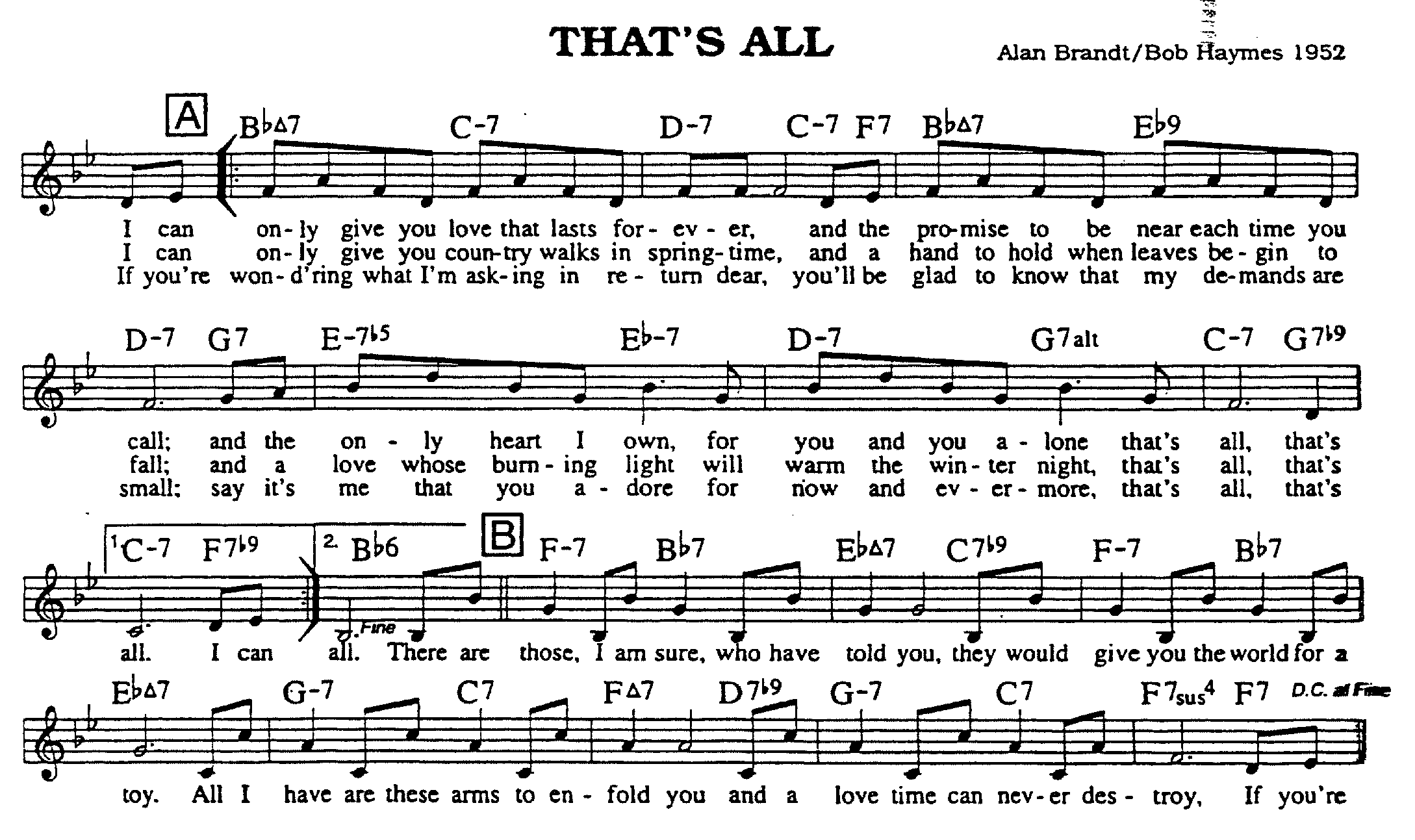
The attached lead sheet identifies Alan Brandt and Bob Haymes and dates the composition to 1952. BMI’s historical repertory material likewise places “That’s All” in 1952, while some later catalogues give 1954 as a publication date. The distinction is best understood as composition or copyright chronology versus later publication rather than evidence for a different song. Bob Haymes wrote the music and Alan Brandt the lyric.
The song’s central rhetorical device is contained in its title. The speaker repeatedly claims to be offering very little: love, presence, physical affection, seasonal companionship. Yet every apparently modest offer expands into permanence. The love lasts indefinitely; the speaker will answer every call; the only heart available is given exclusively; the warmth promised survives winter; the final request is lifelong devotion. “That’s all” is therefore not merely a refrain but a repeated act of understatement. The speaker minimises an offer that is emotionally total, then eventually minimises a demand that is equally total.
That tension separates the song from many straightforward declarations of devotion. It does not simply announce undying love. It stages an argument about value. Material extravagance, represented in the bridge by other suitors who can offer the “world”, is set against things that cannot easily be priced: constancy, touch, time and exclusivity. The harmony repeatedly complicates the speaker’s calm language. Important assertions of simplicity occur over altered dominants, borrowed minor harmony and chromatically descending chords. Even the title phrase is often harmonically less settled than the words imply. The result is affectionate without being entirely innocent: beneath the modest diction lies a formidable request for reciprocal permanence.
2. Form and Dramatic Architecture
The lead sheet realises an unusual 44-bar A-A-B-A design. Each A section is 12 bars rather than the eight bars expected in a conventional 32-bar Songbook AABA form. The bridge is eight bars. The notation economises space by printing the three A-section lyrics under the same music, using a first ending to return for the second A, a second ending leading into section B, and D.C. al Fine at the end of B for the final A. The Fine lies in the B-flat6 second ending.
| Section | Bars | Tonal centre | Lyrical or dramatic function | Musical function |
|---|---|---|---|---|
| A1 | 1-12 | B-flat major | Defines what the speaker can offer: permanent love, availability and an exclusive heart | Establishes tonic but progressively chromaticises it; first ending becomes a turnaround |
| A2 | 13-24 | B-flat major | Recasts the offer in physical and seasonal imagery | Repeats the A architecture; second ending resolves to B-flat6 before the bridge |
| B | 25-32 | E-flat major -> F major -> dominant of B-flat | Introduces rival suitors and compares material extravagance with the speaker's emotional offer | Two sequential tonicising regions move first to IV, then V; culminates on F7 |
| A3 | 33-44 | B-flat major | Reveals the reciprocal price of the offer and converts apparent generosity into a proposal for lifelong exclusivity | Returns the A material after dominant preparation; final second ending settles on B-flat6 |
The form is dramatically more consequential than a simple repeated chorus. A1 and A2 establish a catalogue of gifts. A1 deals mainly in abstract constancy, while A2 converts that constancy into sensory images: walking, holding hands, changing seasons, light and warmth. The bridge then introduces an external social world. Other people have apparently made grander offers, and the speaker now has competitors. The final A therefore cannot mean exactly what the first two did. Its melody and much of its harmony are familiar, but the rhetorical direction reverses: instead of stating what the speaker gives, it asks what the beloved must give back.
The 12-bar length of each A also permits a less symmetrical conversational flow than the standard eight-bar song phrase. The opening declaration is compressed, the middle expands, and the repeated title is given disproportionately large formal weight. This matters in performance. A musician who unconsciously hears the tune as a conventional 32-bar AABA standard can easily lose the form. More importantly, the extended A allows the apparently casual refrain to function almost as a small cadential drama in itself.
Alec Wilder described the composition as an A-A1-B-A song and specifically remarked on the unusual naturalness of Haymes’s melodic writing, including the repeated octave leaps in the release. His willingness to discuss a 1952 song in a book nominally covering popular song only to 1950 is evidence of how quickly he considered it part of the established Songbook tradition.
3. Close Reading of the Lyrics
The lyric cues below are deliberately brief. They identify each passage without reproducing the complete lyric.
| Lyric or cue | Literal meaning | Literary and poetic reading | Emotional subtext | Musical and harmonic interaction |
|---|---|---|---|---|
| "only give you love" | The speaker claims that love is the principal thing available to offer. | "Only" immediately diminishes what follows, even though the object being offered is immense. The sentence begins a sustained pattern of litotes, presenting abundance as limitation. | The modesty can be sincere, self-protective or persuasive. The speaker refuses to compete in conventional displays of wealth. | The pickup moves into B-flatmaj7 and then Cm7. The tonic initially supports confidence, but the immediate move to ii prevents the declaration from becoming a static anthem. |
| "lasts forever" | The love is said to be permanent. | The phrase quietly contradicts "only". What appeared modest has already become absolute. "Forever" introduces the temporal vocabulary that later expands through seasons and "evermore". | There is no hedging in the promise itself. Vulnerability appears instead through the attempt to describe such permanence as a small thing. | The phrase does not conclude the entire section. Its local settling is followed by renewed motion, so verbal infinity is embedded inside a still-developing harmonic sentence. |
| "promise to be near" | The speaker promises continuing physical or emotional availability. | The diction is notably practical. Love is translated into presence rather than spectacle. "Promise" makes the statement contractual without sounding legalistic. | The speaker wants to be dependable, not merely passionate. | The middle of the A section moves through Dm7, Cm7-F7 and back to B-flatmaj7 before the E-flat9 colour. The harmonic departure and recovery enact distance and return more persuasively than a static tonic would. |
| "each time you call" | The beloved can expect the speaker to respond whenever needed. | "Each time" converts romantic devotion into repeated future action. The promise is behavioural rather than ornamental. | The speaker offers reliability, but also places the self permanently at the beloved's disposal. | The phrase reaches Dm7-G7 rather than a conclusive tonic. The syntax closes while the harmony continues forward, keeping the promise active rather than complete. |
| "only heart I own" | The speaker possesses one heart and offers it. | The phrasing borrows the vocabulary of property. Against later promises of material wealth, the only thing literally "owned" is the self. | It combines humility with exclusivity. There is no reserve supply and therefore no emotional escape route. | The passage reaches the conspicuous Em7b5 sonority. A statement of singularity is placed over one of the A section's least diatonic chords, introducing vulnerability beneath apparent certainty. |
| "you and you alone" | The beloved is the sole recipient of the speaker's affection. | Repetition of "you" intensifies exclusivity. "Alone" is simultaneously romantic and isolating: devotion has narrowed the speaker's emotional world to one person. | The offer is generous, but its totality hints at the reciprocal exclusivity eventually requested. | Em7b5 gives way to Ebm7 and then Dm7. The roots and several inner voices descend chromatically. The line becomes more harmonically exposed precisely as the speaker insists on singleness and certainty. |
| "that's all" in A1 | The speaker concludes that these promises are the entirety of the offer. | The refrain is comic understatement without becoming a joke. The listener has just been promised permanence and exclusivity, yet the speaker calls the package minimal. | Restraint masks the scale of commitment. | The first occurrence is intensified by G7alt. The calm verbal summary sits over maximum dominant alteration. Subsequent Cm7-G7b9 and the first-ending Cm7-F7b9 refuse finality and send the song around again. |
| "country walks" | The speaker offers simple shared experiences rather than luxury. | The lyric deliberately turns from abstraction to pastoral detail. The image is ordinary, intimate and accessible. | Love is imagined as companionship in time rather than as a spectacular event. | The A material returns, so the humble image occupies the same harmonic space previously used for "love that lasts". The repetition equates mundane companionship with the earlier abstract promise. |
| "springtime" | The first seasonal image represents renewal and pleasant companionship. | Spring begins a compressed seasonal cycle that will move through autumn into winter. Time is no longer abstract; it becomes visible in nature. | The relationship is imagined as enduring through change rather than remaining in an eternal romantic present. | The phrase inhabits the relatively diatonic opening of A, preserving freshness before later chromatic darkening. |
| "hand to hold" | The speaker offers physical companionship. | The image is deliberately small in scale. A hand contrasts sharply with the bridge's extravagant "world". | Touch becomes evidence of reliability. It is intimate without being eroticised. | The melody and harmony continue through the same expanding middle phrase used for the promise of nearness in A1. The repeated musical frame links emotional presence with physical touch. |
| "leaves begin to fall" | The speaker remains present as autumn arrives. | Falling leaves introduce decline, ageing and impermanence into what began as spring imagery. The lyric avoids saying "old age", but the seasonal sequence makes the implication available. | Devotion is tested not in spring but in change and loss. | The movement through B-flatmaj7 to the dominant-quality E-flat9 introduces darker colour without yet abandoning the home key. The chromaticised subdominant is particularly apt as the imagery moves away from spring's uncomplicated brightness. |
| "burning light" | Love is imagined as a source of heat and illumination. | The metaphor transforms an immaterial emotion into something physically sustaining. Fire and light oppose the coming winter. | Passion is no longer merely decorative. It becomes what enables endurance. | The phrase falls into the Em7b5 region. The ostensibly bright image is therefore not harmonised brightly. This is not necessarily literal text-painting, but the contrast prevents the metaphor from becoming saccharine. |
| "winter night" | Love will provide warmth during the coldest season. | Spring, autumn and winter compress a lifetime into a few images. Winter may signify age, hardship, loneliness or mortality without requiring any one interpretation. | The speaker imagines love as durable under adverse conditions. | Ebm7 moving to Dm7 gives this passage the strongest minor-inflected colour of the A section. The borrowed minor subdominant makes winter perceptible as harmonic shadow. |
| "that's all" in A2 | The second catalogue is again dismissed as modest. | Repetition changes the phrase. After the seasonal cycle, "that's all" now carries an implicit promise across years, not merely isolated romantic gestures. | The understatement has become increasingly implausible, which is precisely its charm. | This A uses the second ending, B-flat6. Unlike the first pass, the refrain receives actual tonic repose before the song introduces the bridge and the rival offers. |
| "those, I am sure" | The speaker acknowledges other suitors or admirers. | The parenthetical "I am sure" is diplomatically indirect. The speaker claims knowledge without accusing the beloved of encouraging competitors. | Jealousy is present but controlled. The speaker maintains composure and politeness. | The bridge immediately moves to Fm7-Bb7 and tonicises E-flat. The first explicit mention of outsiders coincides with the first strong departure from the home tonic. |
| "world for a toy" | Rivals have supposedly promised extravagant material gifts. | The image is hyperbolic. The whole world is reduced to an object of amusement. Material extravagance becomes almost childish through the word "toy". | The speaker may feel materially outmatched, but attempts to devalue the competition by presenting it as ostentation. | The first half of the bridge establishes E-flat through ii-V-I motion. Repeated registral leaps give the rhetoric a more public, declaratory profile than the conversational A melody. |
| "arms to enfold" | The speaker contrasts material gifts with physical embrace. | "All I have" echoes the earlier "only". The body itself becomes the gift. "Enfold" suggests protection as well as affection. | The line is both humble and intensely personal. The speaker cannot offer the world but can offer the self. | The bridge's second four-bar sequence moves up to an F-major area through Gm7-C7. The increased tonal level and continued octave displacement make the counterclaim more assertive. |
| "time can never destroy" | The speaker claims that the love offered is immune to time. | This is the lyric's strongest claim. The seasonal imagery had acknowledged time; here the speaker attempts to defeat it. | The absolute wording reveals how much is emotionally at stake. | The phrase does not end on the tonic. Fmaj7-D7b9, Gm7-C7 and finally F7sus4-F7 leave the statement suspended over the dominant of B-flat. Certainty in language is therefore answered by incompletion in harmony. |
| "asking in return" | The speaker finally names the reciprocal side of the bargain. | Commercial vocabulary enters explicitly. "Give", "own", "world", "have", "asking", "return" and "demands" create a concealed economic lexicon running through the lyric. | What seemed an unconditional gift is revealed as a proposal requiring reciprocity. | The return of the A music restores B-flat, but the listener now hears familiar harmony under a fundamentally changed rhetorical function. |
| "demands are small" | The speaker claims that very little is required in exchange. | This is the lyric's sharpest understatement. The next request makes the word "small" demonstrably questionable. | The speaker is charmingly disingenuous, whether consciously or not. | The familiar A progression again becomes increasingly chromatic after the tonic opening. The harmony undermines the casualness of "small" by moving towards the Em7b5-Ebm7-Dm7 sequence. |
| "me that you'll adore" | The beloved is asked to choose the speaker. | The request transforms generosity into exclusivity. "Adore" is stronger than a request for ordinary affection. | The speaker's real vulnerability finally appears: all previous promises depend upon being chosen. | The chromatic half-diminished and borrowed-minor region gives the demand greater instability than the light diction admits. |
| "now and evermore" | The requested devotion is both immediate and permanent. | Present time and endless future are compressed into one phrase. The request mirrors the opening promise of love lasting forever. | Reciprocity is now exact: permanent love is offered in exchange for permanent love. | The progression approaches G7alt and the final refrain. An applied dominant builds expectation at the precise point where the requested commitment becomes absolute. |
| Final "that's all" | The speaker ends by again calling the request minimal. | The final refrain retrospectively exposes the whole song's central joke and paradox. "All" means both "nothing more" and, in practice, nearly everything. | The tone can be heard as affectionate wit, vulnerability or deliberate persuasion depending on performance. | The last pass abandons the first-ending turnaround and moves to B-flat6. The altered dominant environment finally gives way to tonic warmth, but the 6th chord avoids a hard, triumphal close. |
The lyric’s poetic technique is therefore less dependent on elaborate figurative language than on controlled rhetorical contradiction. Brandt repeatedly chooses plain diction, concrete nouns and familiar seasonal images. The sophistication lies in how those ordinary words are arranged: “only”, “all”, “small” and “forever” continually collide. The song says less than it means.
4. Lyrical and Emotional Arc
Opening Position
The speaker begins from apparent humility. There is no complaint, memory of betrayal or explicit uncertainty. Instead, the opening sounds like a calm statement of resources: this is what can be given. Yet the modest posture is unstable from the outset because the first object offered is not modest at all. Permanent love is introduced under the limiting adverb “only”.
The emotional stance is therefore composed rather than naive. The speaker seems determined not to sell love through grandeur. The first A establishes a value system in which constancy outranks display.
Development
A2 converts that abstract value system into lived experience. Love becomes walking, holding hands, surviving autumn and warming winter. The important development is temporal. “Forever” in A1 is an abstraction; the seasonal sequence lets the listener imagine what permanence would feel like.
The bridge then changes the argument. The speaker’s values exist in competition with another kind of romantic rhetoric, one promising the “world”. For the first time, insecurity becomes visible. The song briefly leaves the home tonic at exactly the point where the speaker turns attention away from the couple and towards outsiders.
The final A changes the direction of exchange. What began as an offer becomes a request. The beloved is expected to answer permanence with permanence.
Point of Greatest Tension
The greatest lyrical tension lies in the juxtaposition of the claim that the speaker’s “demands are small” with the subsequent demand for exclusive, enduring adoration. That is the instant at which understatement becomes transparent.
Musically, this revelation enters the same chromatic region that darkened the previous A sections: Em7b5, Ebm7 and Dm7, followed by G7alt. The harmony does not prove that Brandt and Haymes deliberately “painted” the word “demands”, but structurally the most vulnerable part of every A happens to coincide, on the final pass, with the speaker’s most revealing request. The result is dramatically effective whether or not conceived as literal text-painting.
Resolution or Lack of Resolution
There is genuine tonal resolution but only qualified psychological resolution. The final B-flat6 establishes home clearly. The speaker has completed the proposal and stated the requested terms. No answer from the beloved is ever heard.
The song is therefore not a narrative in which love is obtained. It ends at the point of presentation. The emotional action belongs entirely to the speaker: offer, comparison, request. Whether the bargain is accepted remains outside the composition.
Central Paradox
The central paradox is precise: the speaker insists on asking for almost nothing while both offering and requesting almost everything.
“That’s all” means “nothing beyond this”, but the content of “this” is permanent love, perpetual availability, exclusive devotion and resistance to time. The song’s depth comes from refusing to resolve whether the understatement is innocent, witty, strategically persuasive or self-deceiving. A convincing interpretation can contain traces of all four.
5. Detailed Harmonic Analysis
The global tonic of the attached lead sheet is B-flat major. The two-flat key signature, opening B-flatmaj7 and final B-flat6 make this unambiguous. No written key-signature changes occur. The bridge nevertheless establishes strong temporary centres in E-flat major and F major.
The harmonic analysis below follows the attached symbols exactly. In particular, the E-flat9, Em7b5, Ebm7 and altered G7 sonorities are not replaced with changes from other editions.
| Bars | Lyric cue | Chords | Roman numerals | Tonal centre | Harmonic function and interpretation |
|---|---|---|---|---|---|
| 1, 13, 33 | A opening | B-flatmaj7 | Imaj7 | B-flat | Direct tonic statement. The major 7th gives repose without the finality of a triad. |
| 2, 14, 34 | Opening continuation | Cm7 | ii7 | B-flat | Diatonic predominant colour; the song leaves tonic immediately but gently. |
| 3, 15, 35 | Clause transition | Dm7; Cm7 F7 | iii7; ii7 V7 | B-flat | Compressed iii-ii-V motion. The harmonic rhythm accelerates towards tonic. |
| 4, 16, 36 | "promise", "hand", "glad" region | B-flatmaj7 | Imaj7 | B-flat | First clear recovery of tonic inside the A phrase. |
| 5, 17, 37 | "near", autumn, "demands" region | E-flat9 | IV9, dominant-quality | B-flat | Chromaticised subdominant. The flattened seventh of E-flat turns IV into a dominant-quality colour without requiring a modulation to A-flat. |
| 6, 18, 38 | "call"; transition onward | Dm7 G7 | iii7; V7/ii | B-flat | Dm7 is diatonic iii; G7 is an applied dominant pointing towards Cm. The expected resolution is delayed by the following chromatic sequence. |
| 7, 19, 39 | "heart", "burning light", final request | Em7b5 | #ivm7b5 | B-flat, chromatic field | Best understood primarily as a voice-leading sonority rather than a completed secondary ii-V. It begins a striking semitone descent towards Ebm7 and Dm7. |
| 8, 20, 40 | "for you", winter, "adore" | Ebm7 | ivm7 | B-flat minor borrowing | Borrowed minor subdominant. It supplies one of the song's darkest colours and continues the descending root motion E -> E-flat -> D. |
| 9, 21, 41 | "you alone", "winter night", "evermore" | Dm7 | iii7 | B-flat | Return to a diatonic sonority after chromatic planing. Its function is transitional rather than cadential. |
| 10, 22, 42 | First title phrase | G7alt | V7alt/ii | B-flat | Strong applied dominant to Cm. Alterations heighten tension immediately under the song's rhetoric of simplicity. |
| 11, 23, 43 | Refrain continuation | Cm7 G7b9 | ii7; V7b9/ii | B-flat | Cm initially fulfils the preceding applied dominant. G7b9 then renews the pull towards Cm rather than directly preparing B-flat. |
| 12 | A1 first ending | Cm7 F7b9 | ii7 V7b9 | B-flat | Conventional turnaround. It converts the refrain into a loop and returns to bar 1 for A2. |
| 24 | A2 second ending | B-flat6 | I6 | B-flat | Stable tonic. The sixth gives a warmer, less emphatically final colour before the bridge. |
| 25 | "those ... sure" | Fm7 Bb7 | ii7 V7 in E-flat | E-flat | Clear applied ii-V into the global IV. The bridge immediately establishes a new local gravitational field. |
| 26 | "told you" | E-flatmaj7 C7b9 | Imaj7; V7b9/ii | E-flat | Arrival on E-flat followed by C7b9, which drives back to Fm. |
| 27 | "world" | Fm7 Bb7 | ii7 V7 in E-flat | E-flat | Repetition confirms the E-flat centre rather than treating bar 25 as a passing tonicisation. |
| 28 | "toy" | E-flatmaj7 | Imaj7 in IV | E-flat | Second local tonic arrival. Relative to global B-flat it is IVmaj7. |
| 29 | "arms to enfold" | Gm7 C7 | ii7 V7 in F | F | The bridge's harmonic pattern is transposed up a whole tone, redirecting the local centre from E-flat to F. |
| 30 | "love ... time" | Fmaj7 D7b9 | Imaj7; V7b9/ii | F | F-major arrival followed by D7b9, an applied dominant towards Gm. |
| 31 | "never destroy" | Gm7 C7 | ii7 V7 in F | F | Repeats the local ii-V. Relative to B-flat these are vi7 and V7/V. |
| 32 | Bridge ending | F7sus4 F7 | V7sus4 V7 | B-flat dominant | Local F major is converted into F dominant. Suspension resolution clarifies the return function and prepares the D.C. |
| 44 | Final title phrase | B-flat6 | I6 | B-flat | The second ending replaces the turnaround. The song closes on tonic without a heavily accented dominant-tonic formula in the final bar itself. |
Several features deserve emphasis.
First, the A section is not simply a diatonic progression decorated by occasional dominants. Bars 5-9 form a carefully controlled chromatic region. E-flat9 introduces a dominant-quality IV. Dm7-G7 then suggests applied dominant motion. Em7b5, Ebm7 and Dm7 create a striking descending chain. The motion from Em7b5 to Ebm7 is especially smooth: several chord tones can move downward by semitone while B-flat can act as a common or near-common colour. Ebm7 to Dm7 continues parallel semitone descent. The ear therefore accepts harmonies whose Roman-numeral labels look remote because the voice leading is exceptionally economical.
Second, G7 serves repeatedly as V7/ii, but the tune plays with its resolution. G7alt at bar 10 does reach Cm7 at bar 11. G7b9 then immediately recreates the same applied-dominant pressure. On the first ending, the expected Cm appears and then F7b9 completes a ii-V turnaround. On the final route, the second ending removes that machinery and supplies B-flat6. This is an elegant practical lead-sheet device: the same refrain can be made circular or terminal merely by changing the final bar.
Third, the bridge is unusually lucid compared with the A section’s chromaticism. Its first four bars establish E-flat major through repeated Fm7-Bb7 motion; its second four transpose the basic mechanism to F major through Gm7-C7. The final F chord changes from major-tonic function to dominant function by becoming F7sus4-F7. Thus the bridge travels IV -> V -> V7 of the global tonic. It does not wander aimlessly; it climbs one structural step at a time towards the dominant that sends the song home.
The Em7b5 admits an alternative reading as part of a rootless or incomplete dominant sonority, but the written root E and the following Ebm7 make its linear function more compelling than an attempt to force it into a conventional secondary ii-V. The lead sheet’s spelling should therefore be respected.
6. Tonal Journey
| Passage | Starting centre | Destination | Mechanism | Dramatic effect |
|---|---|---|---|---|
| A opening | B-flat | B-flat | Imaj7 -> ii7 -> iii7 -> ii7-V7 -> Imaj7 | Establishes composure while allowing immediate mobility |
| A middle | B-flat | Chromatic subdominant field | E-flat9 followed by applied dominant and descending chromatic sonorities | Darkens the apparently modest declaration |
| A refrain | Chromatic field | B-flat or turnaround | G7alt -> Cm7; first ending ii-V, second ending I6 | Makes "that's all" either provisional or genuinely terminal |
| Bridge, first half | B-flat | E-flat | Fm7-Bb7 -> E-flatmaj7 | Moves into the realm of comparison and rival offers |
| Bridge, second half | E-flat | F | Whole-tone transposition of the ii-V-I principle | Raises the tonal level as the speaker asserts the value of personal love |
| Bridge ending | F major | F7, dominant of B-flat | F7sus4 -> F7 | Converts a local tonic into the mechanism of return |
| Final A | B-flat | B-flat | Reprise of A chromatic sequence with second ending | Familiar music now supports a more exposed reciprocal demand |
The A section repeatedly leaves and recovers B-flat without truly abandoning it. E-flat9, Em7b5 and Ebm7 are conspicuous colours, but the global tonic remains perceptually available. The song therefore creates emotional instability without needing large-scale modulation.
The bridge is different. Fm7-Bb7-E-flatmaj7 constitutes a sufficiently explicit ii-V-I to make E-flat audible as a genuine temporary centre. The corresponding Gm7-C7-Fmaj7 sequence then establishes F. These two centres are structurally related to the home key as IV and V. The bridge effectively ascends the tonal architecture of B-flat major.
This movement matters dramatically. The song is furthest from tonic when attention is furthest from the private relationship. Rival suitors enter, the scale of romantic promises expands, and the speaker compares values. When the speaker finishes the argument, F7 becomes a literal dominant and returns the music to B-flat for the personal question.
The last tonic does resolve the musical journey, but it does not provide an answer to the proposal. Harmonic closure therefore exceeds narrative closure.
7. Melody and Prosody
Haymes’s melody is notable for how naturally it accommodates Brandt’s conversational syntax despite the unusual 12-bar A section. The A melody is relatively compact in register, while the bridge introduces the conspicuous octave displacements that Alec Wilder singled out when discussing the song. Across the written line the effective range is only a little more than an octave, but the release makes that range feel larger by repeatedly opposing low and high registers rather than reaching a single climactic summit.
The A sections begin with pickups. “I can” and, on the final return, “If you’re” begin before the principal downbeat. This matters prosodically. The statements sound as though they have already begun in speech and happen to flow into metre rather than being announced ceremonially on beat one. The technique suits the lyric’s tone of private conversation.
Much of the A melody is syllabic. Short note values carry strings of ordinary words, while grammatical endings receive longer durations. The effect resembles heightened speech rather than operatic declamation. Important thoughts are not necessarily assigned spectacular high notes; they are often made significant by duration, harmonic context or what follows them.
The repeated title is an important example. “That’s all” is melodically economical, but the surrounding harmony makes each iteration different. Over G7alt it becomes a statement made under pressure. Over the turnaround it becomes an invitation to repeat the argument. At the Fine, over B-flat6, it finally becomes quiet closure. The melodic economy is therefore an asset. An elaborate title motive would weaken the lyric’s principle of understatement.
The bridge sharply changes the method. Repeated octave-leap figures create a more declamatory profile. Instead of the A section’s predominantly conjunct, conversational movement, the release places successive words or short groups in contrasting registers. The gesture can suggest the speaker quoting or caricaturing other people’s extravagant claims, but it should not be reduced to literal character acting. More fundamentally, it provides the registral expansion required of a bridge after two 12-bar A statements.
The bridge’s registral design also cooperates with its harmony. As the harmonic sequence moves from the E-flat region to the F region, the melodic material is correspondingly raised and renewed. The second four-bar unit therefore feels like an intensification rather than mere repetition.
Longer notes frequently occur at grammatical boundaries. This gives singers opportunities for microtiming without destroying the composition’s syntax. A sustained word can be entered slightly late, tapered or allowed to float over the harmony, while the quicker internal syllables should generally retain their verbal direction.
The melody avoids excessive chromaticism of its own. Much of the sophisticated colour comes from placing essentially singable diatonic material over changing chord functions. This is one reason the tune tolerates reharmonisation yet remains recognisable. The melodic identity does not depend on spelling every altered chord extension.
The final cadence is similarly restrained. The lead sheet chooses B-flat6 rather than a brilliant B-flatmaj9 or heavily decorated tonic. That sonority preserves the song’s domestic scale. The ending should sound inhabited rather than monumental.
8. Word, Melody, and Harmony: Key Moments
| Moment | Lyric cue | Musical event | Interpretive significance |
|---|---|---|---|
| Opening | "only give" | Pickup into B-flatmaj7 | The sentence enters conversationally, while tonic establishes sincerity without theatricality. |
| First large promise | "forever" | Tonic area immediately continues into further harmonic motion | Verbal permanence does not stop musical time; the promise remains part of an unfolding argument. |
| Exclusive heart | "heart I own" | Em7b5 enters the A section's chromatic sequence | The language of possession and certainty is accompanied by one of the least stable sonorities. |
| Exclusivity | "you alone" | Ebm7 -> Dm7 chromatic descent | Emotional narrowing coincides with harmonic contraction by semitone. |
| First refrain | "that's all" | G7alt | The lyric's strongest understatement occurs over its most conspicuously altered dominant. |
| Winter image | "winter night" | Borrowed Ebm7 region | The seasonal imagery acquires harmonic shadow without requiring literal text-painting. |
| Rival suitors | "those ... sure" | Fm7-Bb7 establishes E-flat | The moment outsiders enter the lyric, the music leaves the home tonic decisively. |
| Material hyperbole | "world for a toy" | Repeated octave figures over the E-flat-centred bridge | Registral enlargement suits the inflated scale of the rival promises. |
| Speaker's counterclaim | "arms to enfold" | Bridge sequence rises to Gm7-C7-Fmaj7 | The speaker's supposedly humbler offer receives increased musical assertion. |
| Absolute permanence | "never destroy" | F area becomes F7sus4-F7 rather than resolving home | The strongest verbal certainty is left harmonically incomplete. |
| Claimed modesty | "demands are small" | Return of the chromatic A sequence approaches | The song quietly exposes the discrepancy between what is said and what is being requested. |
| Final refrain | Final "that's all" | Second ending to B-flat6 | The title finally receives genuine home-key closure, but with warmth rather than triumph. |
One of the composition’s most effective procedures is therefore musical irony without sarcasm. Harmony repeatedly knows more than the speaker says. The words insist on simplicity; the harmonic design quietly reveals complication.
9. Historical and Cultural Context
“That’s All” belongs to a relatively late phase of the classic American popular-song tradition. The attached lead sheet dates it 1952, as does BMI’s historical repertory chronology. Bob Haymes supplied the music and Alan Brandt the words. Haymes was a singer, actor and broadcaster as well as a songwriter and was the younger brother of vocalist Dick Haymes. Brandt worked as a lyricist and later became a playwright.
Unlike many standards from the 1920s through the 1940s, the song did not depend on a Broadway musical or Hollywood film for its identity. It emerged as a freestanding popular song at a moment when the old theatre-to-standard pipeline was becoming less dominant. That makes its subsequent assimilation into the Great American Songbook especially revealing. Its craft is structurally continuous with earlier Songbook writing even though its commercial environment belongs to the early 1950s.
Nat King Cole made the crucial early commercial recording on 20 January 1953 at Capitol in Hollywood. The session was arranged and conducted by Nelson Riddle and used an orchestra including strings, winds, harp and rhythm section. The recording was issued on Capitol 2610 with “Lover, Come Back to Me!” on the other side.
The song moved into jazz almost immediately. Ben Webster recorded an instrumental version on 8 December 1953 in Los Angeles with a group including Benny Carter, Harry “Sweets” Edison, Oscar Peterson, Herb Ellis, Ray Brown and Alvin Stoller. That is significant evidence that the composition was not merely a singer’s vehicle that jazz musicians adopted decades later. Within its first year of recorded circulation it was already serving as material for improvising instrumentalists.
Alec Wilder’s response is equally revealing. Although his major study was nominally devoted to American popular song through 1950, he made an exception for “That’s All”. He regarded it as unusually natural in melodic construction and observed that it bypassed the normal pattern of a spectacular initial hit followed by gradual standardisation. JazzStandards’ account likewise characterises it as becoming established without a conventional first-stage hit trajectory.
Bobby Darin played an important role in the song’s broader popular visibility. He recorded it with Richard Wess’s orchestra in New York on 19 December 1958, during the same session that produced “Mack the Knife”. The resulting 1959 Atco album took the title That’s All. The album marked Darin’s deliberate movement from the teenage pop market towards standards, big-band and adult popular singing.
The song subsequently became a natural meeting place between traditional pop and jazz. Its lyric rewards close vocal interpretation, while its harmonic structure is substantial enough to support instrumental treatment. That dual identity explains why the performance history ranges from Cole, Sinatra, Vaughan and Tormé to Webster, Ray Brown and later jazz singers.
10. Significant Interpretations
| Performer | Recording or period | Interpretive character | What it reveals about the song |
|---|---|---|---|
| Nat King Cole | Capitol, 20 January 1953; Nelson Riddle arrangement | Poised early popular-ballad reading with orchestral refinement | Establishes how naturally the lyric works when understatement is preserved. Cole's restraint makes the extravagant permanence of the words more persuasive than overt melodrama would. |
| Ben Webster | Los Angeles, 8 December 1953; later associated with King of the Tenors | Instrumental ballad treatment centred on vocalised tenor phrasing | Demonstrates that the melody can carry the lyric's emotional argument even without words. Webster's spacious phrasing exposes the tune's long melodic breath and chromatic harmony. |
| Sarah Vaughan | Vaughan and Violins, 1958; Quincy Jones arrangement | Flexible vocal phrasing within an orchestral setting | Vaughan makes the melody harmonically responsive rather than fixed. Her version demonstrates how much rhythmic elasticity the tune permits while retaining the lyric's syntax. |
| Bobby Darin | Recorded 19 December 1958; That's All, 1959; Richard Wess arrangement | More compact, extroverted traditional-pop treatment | Shows that the song need not be treated exclusively as a slow torch ballad. A firmer pulse brings out the lyric's wit and rhetorical confidence. |
| Frank Sinatra | Sinatra & Strings, 1962; Don Costa arrangement | Expansive string-supported reading, with long-breathed verbal phrasing | Emphasises adult romantic seriousness. The lyric's apparently casual offer becomes a mature declaration of commitment rather than youthful idealism. |
| Mel Tormé | That's All, 1965 | Highly controlled vocal-jazz treatment with clear rhythmic articulation | Reveals how naturally the song responds to a singer who treats melody, diction and harmonic placement with instrumental precision. |
| Ray Brown Trio | Soular Energy, 1985 | Extended instrumental trio interpretation | Demonstrates the progression's usefulness beyond the lyric. The bridge centres and chromatic A sequence provide substantial material for improvisational development. |
| Dianne Reeves | Dianne Reeves, 1987 | Modern jazz-vocal treatment with Billy Childs, Tony Dumas and Ralph Penland | Shows the composition surviving outside the mid-century orchestral aesthetic. Its harmonic form accommodates contemporary rhythmic and vocal freedom without losing identity. |
Cole’s and Webster’s recordings are particularly important as complementary early evidence. One preserves the song as intimate popular vocal repertoire; the other almost immediately proves its viability as an instrumental jazz vehicle. The distance between those two uses is remarkably small.
Darin and Sinatra then expose opposing tempo and presentation possibilities. Darin can make the lyric urbane and lightly self-assured; Sinatra can make the same words sound weightier and more vulnerable. Neither interpretation requires changing the fundamental argument. Tempo changes which side of its rhetoric becomes dominant.
Later instrumental versions further detach the composition from its original verbal premise without making the lyric irrelevant. An improviser who knows what “that’s all” signifies can still shape the repeated harmonic returns as acts of understatement, escalation and release.
11. Place in the Jazz Canon
“That’s All” has endured because its materials are strong in more than one dimension. The melody is sufficiently independent to survive without the lyric, the lyric rewards sophisticated singers, and the harmony is functional enough to be navigable while containing enough chromatic detail to resist routine treatment.
The unusual form is one of its principal jazz challenges. A player who assumes an eight-bar A or a 32-bar AABA scheme will be wrong. The 12-bar A creates a 44-bar chorus, excluding pickups. Experienced rhythm sections therefore need to hear the phrase architecture rather than merely count isolated measures.
The A section also rewards understanding of voice leading. Em7b5-Ebm7-Dm7 should not be approached as three unrelated chord-scale problems. The progression becomes much easier to improvise over when heard as contracting semitone motion. Similarly, G7alt should be understood as applied dominant pressure towards Cm, not simply as a place to insert an altered scale because the symbol says alt.
The bridge poses a different challenge. A soloist should hear two local centres: E-flat and then F. Treating every chord solely relative to B-flat obscures the logic. Fm7-Bb7-E-flatmaj7 is a complete local ii-V-I process; Gm7-C7-Fmaj7 repeats the same idea a tone higher. The final F7 then changes role from local tonic territory into the dominant of the global key.
This harmonic clarity also makes the song receptive to substitution. Tritone substitutes, altered dominant voicings, diminished approaches and additional ii-V preparation can all be introduced. Yet reharmonisation can easily damage the tune if it erases the original chromatic descent or flattens the contrast between the A section and the bridge. The composition already contains a sophisticated tonal argument; adding more chords is not automatically an improvement.
For vocalists, the song occupies a valuable position between ballad and medium-swing repertoire. It can tolerate considerable changes of tempo because the lyric is syntactically strong and the melody does not depend on one particular rhythmic groove. Its survival across Cole, Darin, Sinatra, Vaughan, Webster, Brown and Reeves illustrates that flexibility rather than a single canonical performance practice.
12. Interpretive Considerations for Performers
The principal interpretive danger is overstatement. The lyric itself does almost none. It speaks in ordinary vocabulary and repeatedly minimises its own emotional scale. A performance that announces every declaration as a climax removes the friction between diction and meaning.
The opening benefits from conversational directness. The pickup should sound like the beginning of a sentence, not a formal entrance. At slower tempos there is room to delay selected syllables, but excessive rubato can fragment Brandt’s syntax. The thought should remain larger than the individual note.
“That’s all” requires particular judgement. It can be affectionate, witty, resigned, persuasive or vulnerable. Heavy emphasis risks turning its irony into a punchline. Understatement is generally more productive because the harmony is already doing much of the expressive work. Over G7alt, the words need not manufacture tension; the chord supplies it.
The seasonal A2 should resist pictorial exaggeration. “Springtime”, falling leaves and winter are not three miniature scenes. They form one temporal metaphor. A singer can subtly alter colour as the harmony reaches E-flat9, Em7b5 and Ebm7, but theatrical imitation of changing weather would narrow the lyric.
The bridge permits a different level of projection. Its repeated octave figures and clearer sequential harmony justify greater registral and dynamic contrast. Even so, the passage about rival suitors works best when it remains part of the speaker’s argument rather than becoming caricature. The tonal move E-flat -> F already provides an increase in intensity.
For an instrumentalist, the bridge should similarly be heard in two four-bar spans. Voice leading that acknowledges the E-flat and F tonicisations will generally sound more coherent than running B-flat-derived material continuously through the bridge. The final F7sus4-F7 should remain recognisable as a structural landmark.
The Em7b5-Ebm7-Dm7 sequence is another harmonic landmark worth preserving. Arrangers can enrich it with extensions, but replacing it with a generic circle progression sacrifices one of the song’s most distinctive colours. The same applies to E-flat9. Converting it automatically to E-flatmaj7 may sound smoother, but it removes the dominant-quality subdominant colour printed in this lead sheet.
The final A contains the song’s dramatic revelation. “Demands are small” should not necessarily be sung ironically. The line is stronger when the listener is allowed to discover the contradiction. A completely sincere reading makes the speaker endearingly unaware of the scale of the request; a slightly knowing reading makes the speaker witty and persuasive. Both are defensible.
Tempo changes the speaker’s personality. A slow ballad emphasises vulnerability and permanence but can become sentimental if every phrase is inflated. Medium swing reveals the lyric’s elegance and dry wit. A faster traditional-pop treatment can make the speaker sound socially confident, but if taken too lightly the bridge’s comparison and final request lose consequence.
The ending should also be considered carefully. B-flat6 is warm rather than monumental. A performer can lengthen or soften it without needing an elaborate tag. If a tag is added, repeating “that’s all” too many times risks defeating the lyric’s central economy. The composition’s own final understatement is already complete.
13. Final Reading
“That’s All” is fundamentally a song about the difficulty of measuring love. Its speaker enters an implicit marketplace of romantic promises and refuses the accepted units of value. Other people can offer the world; the speaker offers presence, touch, warmth and time. Yet the argument works only because the supposedly modest alternatives gradually reveal themselves as more ambitious than any material gift. A world can be promised extravagantly. Permanent fidelity cannot be given casually.
The lyric’s governing word is therefore not “love” but “only”. Again and again Brandt places limitation beside absoluteness. Only love, but forever. Only one heart, but exclusively. Only arms, but protection against time. Only a small demand, but lifelong adoration. The title gathers all of these contradictions into two words. “That’s all” simultaneously closes the inventory and exposes its enormous scale.
Haymes’s harmony refuses to let this rhetoric remain uncomplicated. The home key is secure enough for the speaker to sound sincere, but the A section repeatedly acquires shadows: dominant-quality IV, applied dominants, Em7b5, borrowed Ebm7 and altered G7. The chromaticism does not depict individual words mechanically. Its deeper function is structural. Every A begins simply and then discovers complication, exactly as each stage of the speaker’s argument begins with modesty and ends in total commitment.
The bridge makes the design still clearer. When the lyric leaves the private world of speaker and beloved to discuss rival promises, the music leaves B-flat and establishes E-flat. When the speaker answers those promises with a defence of personal love, the sequence rises into F. At the strongest declaration of permanence, the harmony does not resolve but becomes the dominant that forces a return home. Certainty is spoken before certainty is musically granted.
The final A is therefore not merely another verse. Its familiar melody has acquired new meaning. The listener now knows that the gifts enumerated in the first two A sections form one side of an exchange. What the speaker wants in return is the same permanence that has been promised. The song never supplies the beloved’s answer, so the final B-flat6 closes the musical argument without closing the human situation. The proposal has been made; acceptance remains imagined.
“That’s All” endures because understatement is built into every level of the composition. The words call permanence small, the melody remains conversational while making carefully judged registral expansions, and the harmony places complexity beneath apparent ease. The speaker says that very little is being offered and very little is being asked. By the final cadence, the listener understands that both claims mean the opposite.