1. Song Overview
| Field | Details |
|---|---|
| Song | My Romance |
| Composer | Richard Rodgers |
| Lyricist | Lorenz Hart |
| Year | 1935 |
| Original context | Billy Rose's Broadway musical Jumbo, introduced by Donald Novis and Gloria Grafton |
| Lead-sheet key | C major |
| Form | 32-bar ABAC |
| Principal tonal centres | C major, with prominent F-major, A-minor and E-minor tonicisations |
| Common jazz classification | Great American Songbook and jazz standard; commonly treated as either a ballad or medium swing |
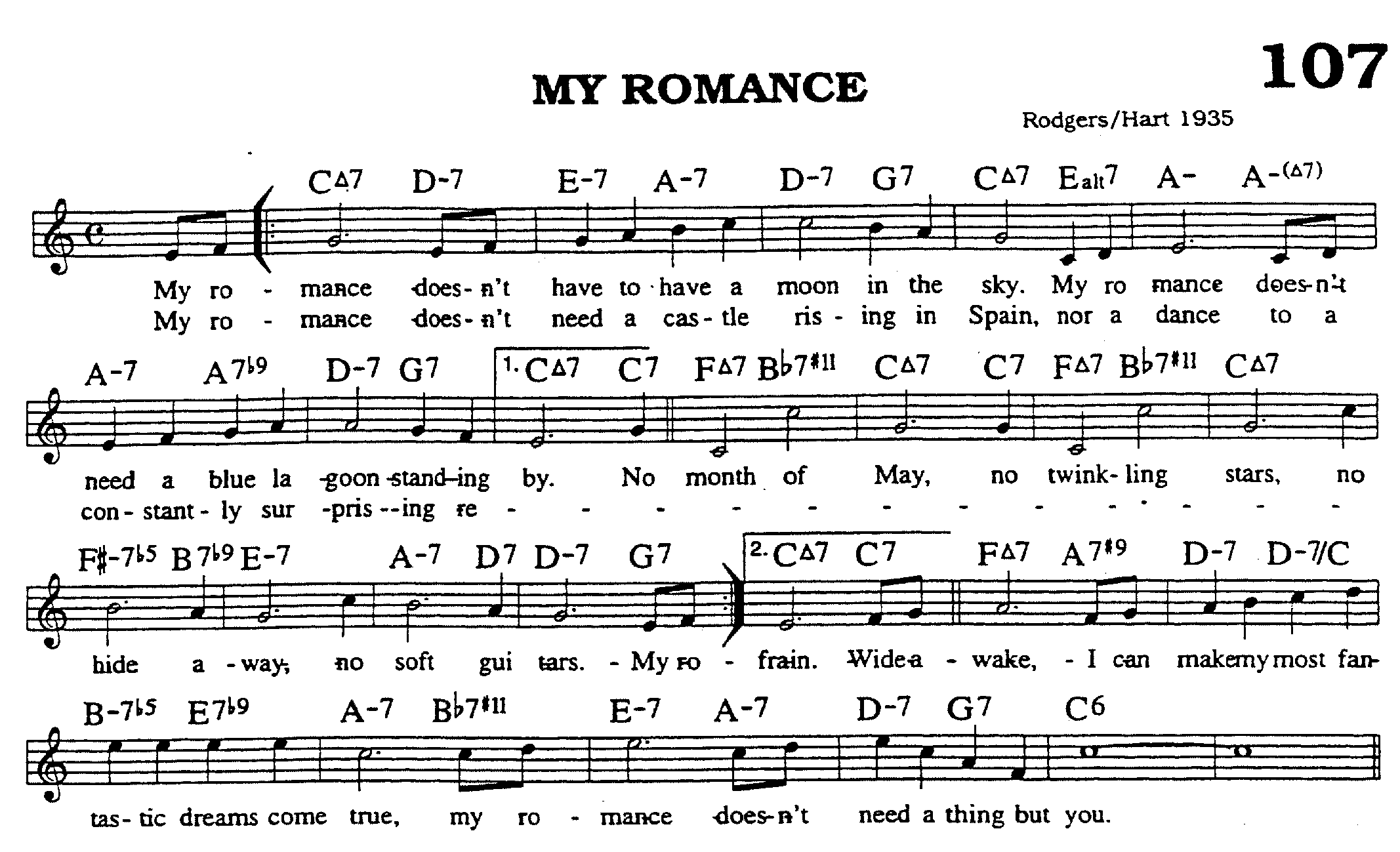
The attached lead sheet is unequivocally centred on C major. This also corresponds to the original published key, although B-flat major has become a common jazz-performance key. The song is a 32-bar ABAC refrain rather than the more ubiquitous AABA design. Its opening and third sections share melodic and harmonic material, while B and C perform different dramatic functions. Jazz sources consequently describe the tune as unusually adaptable to ballad and medium-swing treatments.
Hart’s central device is negation. The speaker does not begin by describing what romance is, but by inventorying what it does not require: celestial scenery, exotic locations, seasonal atmosphere, music, fantasy architecture and theatrical spectacle. The rhetoric initially resembles an attack on romantic cliche. Yet the lyric is not anti-romantic. It gradually reveals itself as a more radical romantic proposition: once the beloved is present, all the conventional machinery of romance becomes redundant. This distinction gives the song its particular wit. The speaker rejects sentimental scenery while making an exceptionally absolute declaration of devotion.
Rodgers complicates that apparent simplicity. The melody is predominantly stepwise and conversational, but the harmony is considerably less innocent. Secondary dominants, minor-major colour, borrowed dominant sonorities, a iiø-V tonicisation of E minor and chromatic approach harmony repeatedly disturb the diatonic surface. The result is not cynicism, but a subtle tension between what the speaker says and what the music does. The words insist that nothing elaborate is necessary, while the harmony continually supplies precisely the sort of sophistication, colour and surprise that the lyric claims to dispense with.
There is also an important theatrical irony. Jumbo was among the most spectacular Broadway productions of its period, built around a circus environment, enormous physical production and speciality acts. Against that setting, Hart wrote a song whose speaker systematically rejects romantic spectacle. Rodgers and Hart had been brought back to New York by Billy Rose for the project, and Jumbo opened at the Hippodrome on 16 November 1935, running 233 performances. The song therefore achieves part of its meaning through understatement: intimacy is declared sufficient in the middle of extravagance.
2. Form and Dramatic Architecture
| Section | Bars | Tonal centre | Lyrical or dramatic function | Musical function |
|---|---|---|---|---|
| A1 | 1-8 | C major, moving through A-minor colour | Rejects conventional romantic scenery and establishes the governing idea | Introduces the mainly stepwise principal melody; tonic expansion, applied dominant to vi, minor chromatic line, ii-V return |
| B | 9-16 | F-major colour, C major, brief E-minor tonicisation | Compresses the catalogue of romantic cliches into terse images | Provides melodic intervallic contrast and increased harmonic mobility; IV and borrowed bVII colour, then iiø-V of iii |
| A2 | 17-24 | C major with A-minor colour | Repeats the argument but escalates from ordinary scenery to fantasy and musical spectacle | Restates the A material, making psychological development depend on new words rather than new melody |
| C | 25-32 | F major, D minor, A minor, then C major | Abandons negation for the song's first sustained positive assertion and final declaration | Reuses aspects of the A-section melodic language but follows a new harmonic route through applied dominants, chromatic approach harmony and a final iii-vi-ii-V-I return |
The notation compresses the ABAC structure economically. The common A material is written once with two sets of lyrics. A one-bar first ending, Cmaj7-C7, leads into B. At the repeat sign after B, the performer returns to A for the second lyric. On the second traversal, the first ending and B are bypassed; the second ending, also Cmaj7-C7, leads directly into the C section. The logical bar numbers used below refer to the complete 32-bar ABAC form rather than to the physical economy of the printed page.
A1 is not a complete dramatic statement. Its syntax is deliberately open-ended: the repeated title phrase keeps beginning new assertions, and the harmony repeatedly leaves tonic almost as soon as it finds it. B intensifies the process by reducing the lyric to short nominal images: May, stars, seclusion, guitars. The lack of verbs in much of this passage makes the list sound dismissive, almost as though the speaker were ticking items off a catalogue.
A2 is structurally more interesting than a literal repeat. The music is familiar, but the imagery grows larger. The first A concerns moonlight and landscape; the second invokes castles and musical performance. What sounded initially like preference becomes principle. Because Rodgers withholds new melodic material, the listener hears psychological development through Hart’s new language.
C finally changes the grammar. The speaker stops saying what romance does not need and announces what love can accomplish. The harmony also stops merely circling through the opening pattern. It travels through IV, ii and vi-related regions before returning through iii-vi-ii-V. Thus the only section that speaks positively is also the only section given a genuinely new route home.
3. Close Reading of the Lyrics
| Lyric or cue | Literal meaning | Literary and poetic reading | Emotional subtext | Musical and harmonic interaction |
|---|---|---|---|---|
| "My romance" | The speaker identifies the relationship as a personal conception of romance. | The possessive "my" is important. Hart does not define romance universally; he establishes a private category against public convention. | The speaker sounds confident, but the repeated need to define this romance indirectly suggests an underlying urge to justify or distinguish it. | The phrase begins anacrustically and settles into the bar, allowing the stressed second syllable of "romance" to receive structural weight. Rodgers makes the title feel like an assertion that repeatedly has to be completed. |
| "doesn't have to have" | Certain circumstances are unnecessary. | The deliberate verbal redundancy is conversational rather than polished. "Have to have" imitates ordinary speech and prevents the lyric from sounding precious. | The informality protects the speaker from grandiosity. This is devotion expressed through understatement. | The opening moves rapidly away from simple tonic stasis through Cmaj7-Dm7 and Em7-Am7. The harmony is already mobile while the language claims simplicity. |
| "moon in the sky" | Moonlight is not required. | The moon is perhaps the most conventional visual emblem of romantic song. Hart names the cliche only to discard it. | The dismissal implies that the beloved creates an atmosphere stronger than scenery could provide. | Dm7-G7 draws towards tonic as the image is completed. The arrival on C-major stability makes the rejected image sound momentarily attractive before the lyric moves on. |
| Second "My romance" | The speaker restates the proposition. | Repetition creates anaphora. Each return to the title functions almost like a thesis statement followed by another piece of evidence. | The repeated formulation becomes increasingly insistent. | Cmaj7 is immediately destabilised by E7alt, an applied dominant to A minor. The musical certainty of tonic lasts only briefly. |
| "blue lagoon" | An exotic waterside setting is unnecessary. | The phrase belongs to the vocabulary of escapist romance. Its colour adjective and exotic location are deliberately more picturesque than the plain language surrounding them. | The speaker claims indifference to fantasy while demonstrating a vivid imagination capable of inventing it. | The move through Am, Am(maj7), Am7 and A7b9 surrounds the rejection with one of the song's most sensuous chromatic passages. The contradiction is productive: the lyric renounces atmosphere while the harmony creates it. |
| "standing by" | The lagoon need not be conveniently present. | "Standing by" humorously treats landscape almost as a servant waiting to assist romance. | Hart lightly mocks the idea that love needs stage properties. | A7b9 resolves to Dm7 and G7, pulling the music back towards C. The harmonic logic is stronger than the fantasy image. |
| "No month of May" | Springtime is unnecessary. | May functions metonymically for spring, courtship and seasonal renewal. The abrupt "No" sharpens the rhetoric. | The speaker is stripping romance of environmental dependence. | The C7 at the end of A has already turned tonic into V7/IV, and Fmaj7 supplies a fresh, spring-like harmonic brightness just as spring itself is rejected. |
| "twinkling stars" | Starlight is unnecessary. | Hart deliberately uses an almost childlike romantic image. Its familiarity makes it especially suitable for dismissal. | The repeated negatives are increasingly playful rather than defensive. | Fmaj7-Bb7#11-Cmaj7 gives the phrase a shimmering, chromatic backdoor colour. The music again aestheticises the very cliche being verbally discarded. |
| "hideaway" | Lovers do not need a secluded place. | The word implies privacy, secrecy and retreat from society. By rejecting it, the speaker claims that intimacy is not dependent on isolation. | The relationship is imagined as internally sufficient rather than protected by circumstance. | The B section moves towards F#m7b5-B7b9 and E minor. The harmony becomes more inward and minor-coloured precisely as the lyric rejects physical retreat. |
| "soft guitars" | Romantic musical accompaniment is unnecessary. | This is the song's most obvious metamusical joke. The speaker is singing a highly crafted popular song while claiming not to need music as a romantic accessory. | The line introduces self-awareness without destroying sincerity. | Em7, Am7-D7 and Dm7-G7 form an increasingly active chain. The musical setting becomes more harmonically articulate while the lyric dismisses musical ornament. |
| "castle rising in Spain" | Fantasy grandeur is unnecessary. | The image expands the scale from natural scenery to imagined architecture. "Spain" contributes conventional exoticism and the suggestion of an extravagant dream-world. | The speaker's denial now sounds less like modest taste and more like a claim that reality with the beloved exceeds fantasy. | A2 restates the familiar A progression. The return of the same melody tells us that the argument has not changed structurally, even though its imagery has become more extravagant. |
| "Nor a dance" | A romantic dance is also unnecessary. | Hart begins to reject not only scenery but the very conventions of musical theatre and popular song. | The speaker is approaching the claim that the beloved substitutes for the whole apparatus of romance. | The A-minor chromatic progression again gives the phrase sophisticated internal movement. The music refuses the simplicity that the lyric professes. |
| "surprising refrain" | No perpetually inventive song is required. | This is another self-referential joke. Hart describes a musical refrain while writing one, and calls for surprise at the moment Rodgers is supplying harmonic variety. | The speaker's confidence now contains a trace of theatrical wit. | The second-ending Cmaj7-C7 refuses to let tonic remain settled. It immediately turns C into V7/IV, launching the final section. The refrain proves harmonically "surprising" while claiming it is unnecessary. |
| "Wide awake" | The speaker is fully conscious rather than dreaming. | This phrase overturns the preceding imagery of fantasy. The coming "dreams" are not nocturnal illusions but possibilities made real in consciousness. | The speaker moves from rejection to affirmation. This is the emotional hinge of the song. | The C section begins after the tonic has been converted to C7. The positive declaration therefore begins not on complete rest but on harmonic motion towards Fmaj7. |
| "fantastic dreams" | The speaker claims that extraordinary hopes can become real. | The language deliberately joins incompatible states: being awake while realising dreams. Hart makes fantasy possible without surrendering to fantasy. | The confidence is emotionally exposed because it is finally stated directly rather than through negation. | Bm7b5-E7b9 tonicises A minor, after which Am7-Bb7#11 introduces striking chromatic colour. The most openly idealistic thought receives some of the song's least diatonic harmony. |
| "come true" | The beloved enables imagined happiness to become reality. | The phrase converts the earlier rejected cliches from external props into internal possibility. | This is the speaker's strongest assertion of faith in the relationship. | The chromatic Bb7#11 gives way to Em7, and the progression begins its circle towards home. Instability starts to organise itself into resolution. |
| Final "My romance" | The central proposition returns for the last time. | The repeated title is now reinterpreted. Earlier repetitions introduced exclusions; this one introduces the answer. | Confidence finally becomes disclosure. | Em7-Am7-Dm7-G7 provides the clearest diatonic circle of the entire song. The harmonic grammar simplifies as the emotional grammar becomes direct. |
| "but you" | Only the beloved is necessary. | "But" is restrictive: everything previously named is excluded in favour of one person. The whole lyric contracts from cosmos, landscape, season, music and fantasy to the addressee. | The conclusion is absolute but not florid. Its force comes from economy. | The prolonged C6 ending provides the stability previously withheld. After thirty bars of qualification, tonic can finally remain tonic. |
Hart’s technique is particularly economical because most of the song is grammatically negative but emotionally affirmative. The more objects he removes, the larger the importance of the addressee becomes. Absence functions as accumulation.
The imagery also progresses from relatively plausible to increasingly artificial forms of romance. Moonlight and spring belong to nature. A lagoon is picturesque geography. A hideaway and guitars imply arranged atmosphere. A Spanish castle is outright fantasy. A “surprising refrain” turns inward towards the song itself. Only after exhausting these external substitutes does the lyric state what it actually values.
4. Lyrical and Emotional Arc
Opening Position
The speaker begins from apparent certainty. There is no question, conditional phrase or appeal for reassurance. The relationship is already called “my romance”, and the repeated negatives sound like declarations rather than doubts.
Yet the certainty is indirect. Instead of describing the beloved, the speaker discusses scenery. This creates emotional distance. The opening can therefore be performed either as lightly sophisticated banter or as a defensive strategy in which the speaker avoids saying directly how much the beloved matters.
Development
The song progresses through subtraction. Each new image is removed from the definition of romance. Because the images become increasingly extravagant, the argument simultaneously grows more ambitious. By the second A section, the speaker is not merely rejecting moonlight but fantasy castles and even the machinery of song and dance.
The repeated A music contributes to this development precisely by refusing to change. Rodgers lets Hart alter the psychological meaning of identical musical material. The listener recognises the setting, so attention shifts to the escalation in language.
Point of Greatest Tension
The most revealing point occurs around “Wide awake” and “fantastic dreams”, bars 25-28. Here the speaker finally abandons negative definition and risks a positive assertion: reality with the beloved can fulfil what fantasy merely promises.
Musically this statement is not placed over uncomplicated tonic harmony. C7 first launches the music towards F, A7b9 points to D minor, Bm7b5-E7b9 tonicises A minor, and Bb7#11 interrupts straightforward diatonic continuity. The claim of waking certainty therefore passes through some of the refrain’s most unstable harmony. That does not necessarily mean Rodgers is contradicting Hart, but it prevents the statement from sounding facile.
Resolution or Lack of Resolution
The ending provides genuine tonal resolution. Em7-Am7-Dm7-G7-C6 is a clear circle back to tonic, and the sustained C6 lets the music cease wandering.
Psychologically, however, what has been resolved is not a conflict between two people. There has been no quarrel, absence or uncertainty about reciprocation. What changes is the speaker’s mode of expression. Negation becomes declaration. The song begins by telling us what love can do without and ends by telling us what it cannot do without.
Central Paradox
The central paradox is that one of the most romantic songs in the Rodgers and Hart repertoire is constructed as a rejection of romanticism.
Hart denies moonlight, spring, stars, secrecy, guitars, castles and musical spectacle. Yet merely naming those things fills the song with them. Rodgers does the same musically. The lyric argues for simplicity while the harmony supplies secondary dominants, chromatic alterations and borrowed colour. The song therefore escapes sentimentality not by avoiding romance, but by becoming conscious of its conventions.
5. Detailed Harmonic Analysis
The global tonic in the attached lead sheet is C major. Temporary tonicisations of A minor, F major, E minor and D minor colour the progression, but none displaces C as the structural tonic.
Bar numbers below refer to the complete 32-bar ABAC form reconstructed from the lead sheet’s repeated A notation and alternative endings.
One important feature of this particular chart is that it should not be silently replaced by a more familiar modern set of jazz changes. Other circulating charts commonly insert diminished passing harmony in the A section and use different substitute dominants in the final eight bars. The attached sheet instead contains, among other details, Em7-Am7 early in A and Bb7#11 in the C section. Those details materially alter the voice-leading and are retained here. JazzStandards.com likewise notes that modern performance changes often diverge substantially from Rodgers’s earlier harmonic settings.
| Bars | Lyric cue | Chords | Roman numerals | Tonal centre | Harmonic function and interpretation |
|---|---|---|---|---|---|
| 1 | Opening title | Cmaj7 - Dm7 | Imaj7 - ii7 | C major | Tonic is established but immediately placed in motion. The step from I to ii begins a broad diatonic expansion rather than a cadence. |
| 2 | "have to have" | Em7 - Am7 | iii7 - vi7 | C major | Diatonic third and sixth continue a roots-by-fourths tendency. The harmony remains functional without asserting dominant pressure. |
| 3 | "moon" | Dm7 - G7 | ii7 - V7 | C major | Conventional ii-V. The first strong dominant preparation coincides with completion of the opening image. |
| 4 | "sky" / title pickup | Cmaj7 - E7alt | Imaj7 - V7/vi | C major to A minor | Tonic arrives, then is quickly destabilised. E7alt strongly tonicises A minor and supplies chromatic tension beneath the renewed title phrase. |
| 5 | Second title phrase | Am - Am(maj7) | vi - vi(maj7) | A minor colour | A minor is prolonged while the major seventh G-sharp introduces harmonic-minor colour. This is less a modulation than a local tonicisation embedded within C major. |
| 6 | "blue lagoon" | Am7 - A7b9 | vi7 - V7/ii | A minor to D minor | The minor seventh relaxes the chromatic minor-major sonority; A7b9 then converts A into the applied dominant of Dm7. |
| 7 | "standing by" | Dm7 - G7 | ii7 - V7 | C major | Functional ii-V re-establishes the route to the tonic. |
| 8 | First ending | Cmaj7 - C7 | Imaj7 - V7/IV | C major to F | C first resolves the cadence, then acquires B-flat and becomes the applied dominant of F, directly preparing B. |
| 9 | "month of May" | Fmaj7 - Bb7#11 | IVmaj7 - bVII7#11 | F-major colour / C major | Fmaj7 confirms the preceding C7's local resolution. Bb7#11 is a borrowed bVII dominant with a backdoor-like resolution towards C. The E-natural #11 helps retain connection to C-major pitch content. |
| 10 | "twinkling" | Cmaj7 - C7 | Imaj7 - V7/IV | C major to F | The borrowed colour resolves to tonic, which is once again converted into V/IV. |
| 11 | "stars" | Fmaj7 - Bb7#11 | IVmaj7 - bVII7#11 | F-major colour / C major | Repetition makes the IV-bVII-I cycle structural rather than incidental. |
| 12 | "No..." | Cmaj7 | Imaj7 | C major | Brief tonic plateau before the harmony turns towards E minor. |
| 13 | "hideaway" | F#m7b5 - B7b9 | iiø7/iii - V7/iii | E minor | A textbook minor ii-V tonicises iii, E minor. F-sharp and D-sharp temporarily move outside C major. |
| 14 | "soft..." | Em7 | iii7, locally i7 | E minor | The applied dominant resolves. E minor functions momentarily as a local tonic without becoming a full structural key. |
| 15 | "guitars" | Am7 - D7 | vi7 - V7/V | C major, with G implication | Am7-D7 can be heard as ii-V directed towards G. The expected G resolution is withheld. |
| 16 | A pickup | Dm7 - G7 | ii7 - V7 | C major | D7's F-sharp falls chromatically to F-natural as D7 becomes Dm7. This same-root dominant-to-minor change elegantly redirects the failed V/V into the home ii-V. |
| 17 | Second A opening | Cmaj7 - Dm7 | Imaj7 - ii7 | C major | Restatement of bar 1. The unchanged harmony now supports new, more extravagant imagery. |
| 18 | "castle..." | Em7 - Am7 | iii7 - vi7 | C major | Diatonic continuation. |
| 19 | "rising..." | Dm7 - G7 | ii7 - V7 | C major | Familiar ii-V strengthens the sense that the speaker's argument is repeating itself deliberately. |
| 20 | "Spain" / pickup | Cmaj7 - E7alt | Imaj7 - V7/vi | C major to A minor | The applied dominant again shifts the emotional colour away from the secure tonic. |
| 21 | "Nor a dance" | Am - Am(maj7) | vi - vi(maj7) | A minor colour | Minor-major colour returns, now beneath imagery of performance rather than landscape. |
| 22 | "surprising..." | Am7 - A7b9 | vi7 - V7/ii | A minor to D minor | Applied dominant sets up the familiar ii chord. |
| 23 | "refrain" | Dm7 - G7 | ii7 - V7 | C major | Strong dominant preparation. |
| 24 | Second ending | Cmaj7 - C7 | Imaj7 - V7/IV | C major to F | Apparent tonic resolution immediately becomes a launch into the new C section. The lyric's positive turn is therefore harmonically propelled rather than settled. |
| 25 | "Wide awake" | Fmaj7 - A7b9 | IVmaj7 - V7/ii | F-major colour to D minor | IV provides brightness, while A7b9 immediately redirects towards D minor. |
| 26 | "I can make" | Dm7 - Dm7/C | ii7 - ii7 with tonic bass | D minor colour / C pedal | The bass descends D-C beneath an otherwise retained ii7 sonority. This creates smooth linear motion and weakens root-function clarity before the next applied ii-V. |
| 27 | "fantastic..." | Bm7b5 - E7b9 | iiø7/vi - V7/vi | A minor | Minor ii-V strongly tonicises vi. The lyric's most idealistic language is accompanied by unmistakable dominant tension. |
| 28 | "dreams come true" | Am7 - Bb7#11 | vi7 - bVII7#11 | A minor to chromatic approach | Am7 confirms the local tonicisation. Bb7#11 is best heard here as chromatic approach harmony rather than as a conventional dominant resolution. Its E-natural #11 can remain common into the following Em7, while Bb rises to B, F falls to E and Ab can fall to G. |
| 29 | Final title return | Em7 - Am7 | iii7 - vi7 | C major | The harmony returns to a fully diatonic circle. Roots move by fourth and prepare the final ii-V. |
| 30 | "doesn't need" | Dm7 - G7 | ii7 - V7 | C major | Unambiguous cadential preparation. |
| 31 | "but you" | C6 | I6 | C major | Final tonic. The sixth softens the closure relative to a bare triad without weakening its function. |
| 32 | Sustained ending | C6 | I6 | C major | Tonic is prolonged. Unlike many earlier arrivals on C, it is no longer converted into an applied dominant. |
Several voice-leading processes deserve particular attention. Bars 4-7 contain a carefully controlled move into and out of A minor: E7alt drives to Am, the minor-major seventh introduces G-sharp, Am7 restores G-natural, and A7b9 converts that same A root into a dominant directing the ear towards D minor. The harmonic identity changes substantially while the root A remains fixed for several chords.
The B section’s Bb7#11 chords are similarly effective because they do not behave like crude chromatic intrusions. The E-natural #11 is especially important. In C major it preserves a diatonic common tone inside an otherwise borrowed dominant seventh sonority. The chord therefore sounds chromatic without becoming disconnected from the tonic environment.
Bar 15 into bar 16 is one of the most elegant functional pivots in the chart. D7 appears to promise G, but instead the root remains D while the third F-sharp falls to F-natural, producing Dm7. What had been V/V is transformed into ii7, after which G7 completes the home ii-V. The expected dominant resolution is evaded by modal alteration rather than by a root leap.
The C section contains a comparable piece of economy in Dm7-Dm7/C. The harmony remains recognisably supertonic while the bass descends. This prepares B in the following Bm7b5 and contributes to the larger downward bass tendency of the final section even while the roots continue to participate in functional cycles.
6. Tonal Journey
| Passage | Starting centre | Destination | Mechanism | Dramatic effect |
|---|---|---|---|---|
| Bars 1-3 | C major | C major | Diatonic I-ii-iii-vi-ii-V motion | Establishes confidence without harmonic stasis; the speaker's certainty is active rather than static |
| Bars 4-6 | C major | A-minor colour | E7alt as V7/vi, followed by Am-Am(maj7)-Am7 | Darkens the first romantic catalogue and introduces chromatic intimacy |
| Bars 6-8 | A-minor colour | C major, then F | A7b9 to Dm7-G7-Cmaj7, followed by C7 | Restores home briefly, then immediately turns tonic into a departure point |
| Bars 9-12 | F-major colour | C major | Fmaj7-Bb7#11-Cmaj7 cycles | Produces luminous borrowed colour under the most conventional romantic images |
| Bars 13-14 | C major | E minor | F#m7b5-B7b9-Em7 | Creates the clearest non-tonic tonicisation in B |
| Bars 15-16 | E-minor region | C major | Am7-D7, then chromatic D7-Dm7 conversion and ii-V | Expected G resolution is sidestepped; home is recovered by voice-leading |
| Bars 17-24 | C major | F preparation | Restatement of A and C7 as V/IV | Familiarity makes the second lyric sound like a deepening argument rather than a new subject |
| Bars 25-26 | F-major colour | D-minor colour | Fmaj7-A7b9-Dm7 | The positive lyric begins by moving outward from tonic |
| Bars 27-28 | D-minor region | A minor, then chromatic instability | Bm7b5-E7b9-Am7-Bb7#11 | Greatest harmonic uncertainty accompanies the dream/reality paradox |
| Bars 29-32 | C-major diatonic field | C major | iii-vi-ii-V-I | Progressive simplification produces the song's first genuinely final tonic |
The song repeatedly arrives at C without allowing C to remain inert. Bars 4, 8, 10 and 24 demonstrate different degrees of tonic instability. Particularly important are the C7 chords: each converts a just-established tonic into V/IV. Home therefore has a double identity, both destination and point of departure.
This makes the final C6 unusually satisfying. Its power does not come from unusual cadential harmony. On the contrary, it comes from the fact that the preceding thirty bars have trained the listener to expect tonic to become something else. At the end, it does not.
The tonal movement also parallels Hart’s rhetoric. The song’s many negations occupy harmonically mobile territory. When the speaker finally says what the relationship positively means, the harmony initially becomes even more adventurous, then gradually sheds that complexity. Emotional directness and harmonic directness coincide only in the last four bars.
7. Melody and Prosody
Rodgers’s principal melodic strategy is stepwise motion. Alec Wilder singled out “My Romance” as an especially clear example of Rodgers’s skill with scalar melodic writing, noting the contrast when the second section begins using wider intervals. The attached lead sheet confirms that basic design. The A material is built largely from adjacent scale degrees and short, singable cells rather than dramatic leaps.
The melody occupies a relatively compact, approximately octave-plus range and spends most of its time in a comfortable middle tessitura. Its effect therefore comes less from extreme register than from placement. A few changes of intervallic behaviour become conspicuous precisely because the surrounding writing is so conjunct.
The pickup to the title is essential. “My ro-” precedes the structurally accented arrival of “-mance”. Rodgers therefore aligns musical metre with spoken English: the stressed syllable of “romance” receives stronger metric weight. This small detail makes the opening sound spoken rather than declaimed.
The early A phrases gradually climb. The contour suits Hart’s cumulative syntax: each additional rejected romantic object seems to extend the same thought rather than begin a separate melody. The scalar construction also gives the harmony freedom to change beneath relatively stable melodic logic. Chords may become chromatic while the tune continues to sound natural.
The B section changes the listener’s perception by introducing fourth- and fifth-like gestures and more pronounced registral alternation. JazzStandards’ analysis likewise identifies wider leaps in this passage before the tune returns to stepwise writing. This is more than formal contrast. Hart’s B lyric is a list of short images rather than flowing sentences, and the melodic discontinuity matches that rhetorical compression.
Longer values are strategically important. Words completing images tend to receive sufficient duration to register before the next proposition begins. Rodgers rarely overloads Hart’s language with melisma. The setting is predominantly syllabic, which preserves the impression of sophisticated conversation.
The C section returns to the opening song’s linear logic but changes its expressive significance. Stepwise motion no longer supports a list of absences. It now supports a positive argument. This is a classic example of a composer obtaining dramatic change without abandoning melodic identity.
The final phrase is especially effective because rhythmic activity progressively diminishes. After the iii-vi-ii-V motion has clarified the harmonic destination, the concluding word is sustained over C6. The lyric has reached its shortest and most direct statement at exactly the point when the music permits the greatest temporal spaciousness.
Prosodically, performers should notice that several phrases begin before the bar rather than on it. Straightening those pickups into square downbeats can make Hart’s text sound formal and stiff. The song works best when the lyric seems to lead the barline rather than obey it.
8. Word, Melody, and Harmony: Key Moments
| Moment | Lyric cue | Musical event | Interpretive significance |
|---|---|---|---|
| Opening | "My romance" | Anacrustic title phrase settles onto structural accent | Establishes conversational prosody and gives the title the character of an assertion rather than a slogan |
| Bars 4-5 | "sky" to renewed title | Cmaj7 immediately becomes E7alt and resolves to Am | The first apparent arrival at home is fleeting; emotional certainty already contains harmonic restlessness |
| Bars 5-6 | "blue lagoon" | Am-Am(maj7)-Am7-A7b9 | One of the most chromatic passages accompanies a claim that picturesque atmosphere is unnecessary |
| Bars 8-9 | "No month..." | Cmaj7 becomes C7 and resolves to Fmaj7 | The lyric rejects spring while the harmony opens into the bright IV region |
| Bars 9-12 | Seasonal and stellar imagery | Repeated Fmaj7-Bb7#11-Cmaj7 movement | Borrowed backdoor colour gives unusual lustre to images the singer claims not to need |
| Bars 13-14 | "hideaway" | F#m7b5-B7b9-Em7 | The most inward image coincides with a brief move into the minor iii region |
| Bars 15-16 | "soft guitars" | D7 fails to resolve to G; F-sharp falls to F in Dm7 | A dominant expectation is quietly redirected, an elegant harmonic surprise under the rejection of musical ornament |
| Bar 24-25 | "Wide awake" | Cmaj7 immediately changes to C7-Fmaj7 | The first positive declaration begins by leaving tonic rather than resting on it |
| Bars 27-28 | "fantastic dreams" | Bm7b5-E7b9-Am7-Bb7#11 | The dream/reality paradox receives the most concentrated chromatic instability of the C section |
| Bars 29-32 | Final title and "you" | Em7-Am7-Dm7-G7-C6 | Emotional directness is answered by the clearest functional cadence in the song |
The repeated Cmaj7-C7 transformation is especially revealing. In several places the speaker sounds verbally certain at precisely the moment tonic is being converted into an applied dominant. The effect should not necessarily be interpreted as psychological doubt, but it does ensure that certainty remains dynamic.
By contrast, the ending needs no harmonic cleverness. Once the beloved is finally named as the essential element, Rodgers removes the need for further diversion. The iii-vi-ii-V-I cadence almost sounds deliberately ordinary after the chromatic detail of the preceding bars. That simplicity is earned.
9. Historical and Cultural Context
Richard Rodgers and Lorenz Hart wrote “My Romance” for Billy Rose’s Jumbo. Rodgers and Hart had spent several years working in Hollywood before Rose brought them back to New York in 1935 for the circus spectacular. The official Rodgers and Hammerstein organisation identifies My Romance, “Little Girl Blue” and “The Most Beautiful Girl in the World” among the score’s important songs.
Jumbo opened at the Hippodrome Theatre on 16 November 1935 and closed on 18 April 1936 after 233 performances. Billy Rose produced it; Richard Rodgers supplied the music, Lorenz Hart the lyrics, and Ben Hecht and Charles MacArthur the book. The production combined musical comedy with large-scale circus presentation, including extensive speciality acts.
The original dramatic pairing was Gloria Grafton’s Mickey Considine and Donald Novis’s Matt Mulligan Jr. A contemporary 1936 account describes Grafton and Novis singing “My Romance” together with Paul Whiteman directing the orchestra, specifically noting their blended voices and the audience response. A contemporary TIME notice also singled out Novis singing the number in Jumbo.
That setting gives Hart’s lyric an additional layer. Jumbo was deliberately oversized entertainment. The song at its centre says romance needs no elaborate environment at all. The contrast between production spectacle and lyrical anti-spectacle is therefore not merely something imposed retrospectively by jazz singers. It was available to the original Broadway audience.
A Paul Whiteman recording featuring Novis and Grafton was made in 1936 and reached number 18 on the American popular charts for a single week. The song’s later jazz life was more significant than its initial chart performance.
An introductory verse exists but is absent from the attached lead sheet, which begins directly with the 32-bar refrain. The verse is seldom used in jazz performance. JazzStandards.com notes both its rarity and Alec Wilder’s view that it is less successfully integrated with the refrain than most Rodgers verses. The practical jazz tradition has therefore concentrated overwhelmingly on the refrain analysed here.
The song’s jazz standing grew particularly strongly in the 1950s. Jazz historian Chris Tyle has noted the importance of Ruby Braff’s early-1950s treatments, including his accompaniment of Lee Wiley and his 1955 duet with Ellis Larkins. Thereafter the tune became attractive to pianists, singers and horn players precisely because the melody could withstand substantial rhythmic and harmonic reinterpretation.
Its later flexibility is striking. It works as a slow ballad, medium swing, intimate duo, interactive piano trio and orchestrated vocal feature. Modern jazz charts also developed substitutions that differ from earlier published harmony. That divergence is itself evidence of the tune’s assimilation into jazz practice: musicians came to treat the harmonic skeleton as a framework for voice-leading and reharmonisation rather than a fixed theatre arrangement.
The 1962 film Billy Rose’s Jumbo returned the song to its theatrical origins, with Doris Day performing it. By that time, however, “My Romance” already had an independent jazz identity.
10. Significant Interpretations
| Performer | Recording or period | Interpretive character | What it reveals about the song |
|---|---|---|---|
| Paul Whiteman Orchestra with Donald Novis and Gloria Grafton | 1936 | Theatre-derived popular-orchestral presentation | Provides the closest recorded connection to the original Broadway conception and reminds later performers that the lyric began as character-driven musical theatre rather than as an abstract jazz standard. The recording entered the charts briefly in 1936. |
| Ruby Braff and Ellis Larkins | 1955 | Intimate cornet-piano duet, melody-centred | Removes theatrical scale and exposes the tune's melodic architecture. JazzStandards identifies the Braff/Larkins version as an important point in the tune's emergence into the 1950s jazz repertoire. |
| Ella Fitzgerald with Buddy Bregman | 1956, Ella Fitzgerald Sings the Rodgers and Hart Song Book | Controlled, text-centred vocal interpretation with orchestral framing | Fitzgerald demonstrates how clearly Hart's sequence of negations can work when diction and phrase shape remain central. The session was recorded in Los Angeles on 30 August 1956 with Buddy Bregman arranging and conducting. |
| Red Garland Trio | 1956, A Garland of Red | Spacious piano-trio ballad treatment | Garland shows that the harmony can be elaborated pianistically without obscuring the melody. The recording, with Paul Chambers and Art Taylor, was made on 17 August 1956. |
| Carmen McRae | 1958 | Lyric-conscious jazz-ballad treatment | McRae's phrasing reveals how much interpretive room lies between Hart's written accents. JazzStandards specifically recommends her version for listeners studying the lyric. |
| Bill Evans Trio with Scott LaFaro and Paul Motian | Village Vanguard, 25 June 1961; Waltz for Debby | Medium-tempo, highly interactive trio conception | Perhaps the most important instrumental jazz model. Melody, bass and drums operate as conversational voices rather than accompanimental hierarchy. Two takes were recorded at the Vanguard; Take 1 appeared on Waltz for Debby. The official reissue material emphasises the trio's unusually interactive conception. |
| Ben Webster and Harry "Sweets" Edison | 1962, later issued as Wanted to Do One Together / Ben and "Sweets" | Slow, spacious horn-ballad reading | Webster demonstrates how the tune's relatively plain melody supports deep timbral and rhythmic inflection. The session included Hank Jones, George Duvivier and Clarence Johnson. |
| Doris Day | 1962 film Billy Rose's Jumbo | Cinematic traditional-pop treatment | Returns the song to dramatic romance and large-scale production, thereby making Hart's rejection of romantic scenery newly ironic. |
The Bill Evans treatment is particularly important for instrumentalists because it demonstrates that the composition need not remain a sentimental ballad. At a medium swing the scalar melody becomes an improvisational launching point and the underlying chain relationships become far more audible.
Conversely, Webster’s ballad conception reveals how little melodic alteration is necessary when tone and timing carry the interpretation. These two poles, interactive medium swing and expansive ballad, account for much of the song’s continued usefulness in jazz.
The vocal recordings reveal another distinction. Fitzgerald tends to clarify the architecture; McRae can make the same text sound more psychologically knowing. Because Hart’s lyric contains both sincerity and wit, neither approach exhausts it.
11. Place in the Jazz Canon
“My Romance” has several qualities that make it unusually hospitable to jazz improvisation. Its melody is memorable without being harmonically restrictive. Much of it is scalar, so improvisers can preserve melodic identity while reharmonising beneath it. The B section supplies contrasting leaps and harmonic movement, preventing the 32-bar form from becoming monotonous.
The harmony contains familiar materials but arranges them in ways that reward close listening. There are ordinary ii-V relationships, but also E7alt to A minor, the Am-Am(maj7)-Am7 sequence, Cmaj7-C7 transformations, Fmaj7-Bb7#11 backdoor colour, a minor ii-V into E minor, the D7-Dm7 voice-leading pivot, and the chromatic Bb7#11 in the final section.
This means the tune is pedagogically valuable beyond chord-scale matching. An improviser who merely assigns scales to each symbol may miss the larger voice-leading. The important lines include G-sharp to G in the A-minor region, F-sharp to F in D7-Dm7, and the semitone/common-tone possibilities around Bb7#11.
The ABAC form also requires attention. A player accustomed to AABA standards can easily assume that the final eight bars will behave like the bridge or return to A. They do neither. C borrows the opening section’s melodic character but takes a different harmonic path. Form therefore needs to be heard rather than counted mechanically.
The tune also invites tempo transformation. At ballad tempo, individual altered dominants and chromatic inner voices become expressive events. At medium swing, the large-scale circle-of-fifths logic becomes more prominent. The fact that Bill Evans’s medium-tempo treatment and Ben Webster’s ballad readings can both sound idiomatic demonstrates the durability of the underlying composition. JazzStandards specifically cites those two contrasting traditions when introducing the tune.
Reharmonisation is common, but the lead sheet demonstrates why indiscriminate substitution can be counterproductive. Much of Rodgers’s effectiveness lies in the alternation between simple diatonic motion and isolated chromatic events. If every bar is given substitute dominants, diminished approaches and upper-structure alterations, the distinction between structural harmony and colour disappears.
An improviser should therefore know not only the symbols but the hierarchy: C is home; C7 repeatedly points to F; A minor is an important secondary field; F#m7b5-B7 tonicises E minor; D7 is deliberately redirected into Dm7; and the final iii-vi-ii-V is the point at which the harmony deliberately becomes least ambiguous.
12. Interpretive Considerations for Performers
The most productive emotional stance is usually one of conviction with intelligence rather than overt sentimentality. Hart has already supplied romantic imagery. A singer who additionally loads every phrase with pathos risks destroying the lyric’s humour and proportion.
The repeated negatives should not all receive identical emphasis. The first A can sound almost casual: moonlight and landscape are simply unnecessary. B can become more pointed and witty as the list shortens. A2 can broaden the scale of the rejection. Only at “Wide awake” does the speaker need to reveal the full emotional premise.
The opening title phrase benefits from preserving its pickup character. Pulling “My” and the first syllable of “romance” onto a heavy downbeat removes the speech-like quality of Rodgers’s setting. Similar freedom is useful at the starts of longer sentences, provided the arrival syllables remain clear.
At slow tempo, the Am-Am(maj7)-Am7-A7b9 sequence can become a major expressive landmark. The chromatic inner voices are audible, and a singer or horn player can allow the phrase to float above the harmony rather than attempting to dramatise every chord.
At medium tempo, the danger is the opposite. The tune can become breezily elegant but lose the importance of the final declaration. Keeping the A phrases conversational and reserving greater rhythmic breadth for C can preserve the dramatic hierarchy.
The B section should contrast melodically with A. Its wider intervals and shorter lyric fragments should not be smoothed into the same legato contour. A modest change in articulation is often more effective than a dramatic dynamic increase.
The harmonic landmarks worth preserving in accompaniment are E7alt to A minor, the A-minor chromatic sequence, C7 to Fmaj7, F#m7b5-B7b9-Em7, D7-Dm7, and the final Bm7b5-E7b9-Am7 region. These are the points that give the form direction.
The Bb7#11 sonorities require particular judgement. In bars 9 and 11 they participate in a borrowed backdoor-like return to C. In bar 28 the same chord symbol functions more like chromatic approach harmony into Em7. Treating all three occurrences identically can obscure their different contexts.
Reharmonisation can strengthen the tune when it clarifies these voice-leading processes. It can weaken the tune when chromatic substitutes are added simply because the melody tolerates them. Rodgers’s alternation between uncomplicated diatonic space and concentrated colour is part of the design.
For instrumentalists, knowing Hart’s words remains valuable. The B section is not merely “the contrasting eight”; it is the catalogue of discarded cliches. The C section is not merely “the last eight”; it is the first direct emotional disclosure. An instrumental solo that preserves those changes of rhetorical character will often communicate the form more strongly than one based solely on chord density.
The final cadence deserves restraint. The iii-vi-ii-V-I progression is intentionally conventional after the preceding chromatic detail. Elaborating it excessively can lessen the force of the lyric’s final simplification.
13. Final Reading
“My Romance” is fundamentally about sufficiency. The speaker’s argument is not that the familiar signs of romance are false, nor that beauty, music or fantasy are undesirable. It is that they are unnecessary. Hart constructs the beloved’s value by removing everything that could compete with it. Moon, landscape, spring, stars, secrecy, music and fantasy are all dismissed until the relationship stands alone.
The lyric’s sophistication comes from the fact that the rejected objects never really disappear. Once Hart names moonlight, a lagoon, stars and guitars, the listener imagines them. The song therefore fills the mind with romantic imagery while denying its importance. It achieves luxuriance through negation. That is why the text can remain deeply romantic without becoming naive.
Rodgers performs an analogous operation harmonically. The surface melody is direct, scalar and largely conversational, but underneath it the harmony moves through applied dominants, minor colour, borrowed bVII sonorities and secondary tonicisations. The words claim that nothing elaborate is required; the music replies with elaborate craft. Yet the complexity rarely sounds decorative. Nearly every chromatic event has a voice-leading purpose.
The repeated A section is central to the composition’s dramatic intelligence. Nothing musically revolutionary occurs when the speaker moves from moonlight to castles and dances. The same melodic material carries the new images. This makes the escalation feel psychological rather than theatrical. The speaker has not discovered a new emotion. The speaker has discovered the extent of an emotion already present.
The C section finally exposes what the earlier wit has concealed. “Wide awake” rejects the safety of fantasy, yet the following idea insists that dreams can become real. Rodgers does not support this with immediate harmonic reassurance. The music moves through IV, D-minor preparation, A-minor tonicisation and chromatic Bb7#11 before it begins to simplify. The claim is therefore tested harmonically before it is granted resolution.
The final iii-vi-ii-V-I matters because it is almost plain. After the earlier minor-major sonority, altered dominants, backdoor colours and tonicisations, Rodgers lets functional harmony speak without disguise. The music reaches C6 and, for once, does not turn C into another dominant. The lyric has stopped listing substitutes, and the harmony has stopped seeking destinations.
What remains after the cadence is not ecstasy but clarity. Hart’s speaker has reduced romance to one irreducible requirement, and Rodgers has reduced harmonic motion to tonic. The song’s deepest gesture is therefore one of subtraction: the more it removes, the more completely it reveals what matters.