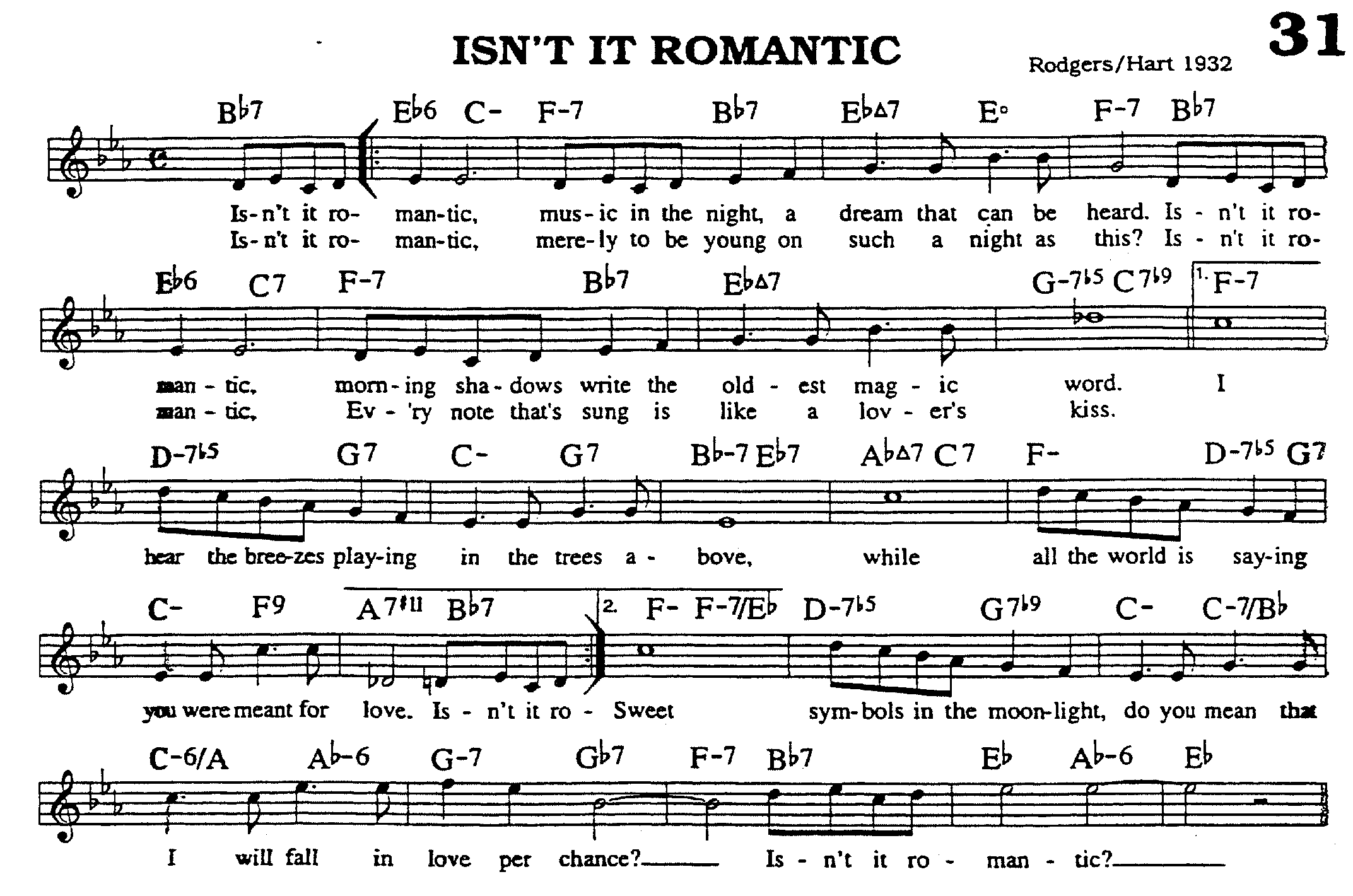
1. Song Overview
| Field | Details |
|---|---|
| Song | Isn't It Romantic? |
| Composer | Richard Rodgers |
| Lyricist | Lorenz Hart |
| Year | 1932. A possible first edition of the sheet music is catalogued by the Morgan Library as published by Famous Music Corp. in 1932. ([The Morgan Library & Museum][1]) |
| Original context | Paramount film Love Me Tonight, directed by Rouben Mamoulian and starring Maurice Chevalier and Jeanette MacDonald. ([Library of Congress][2]) |
| Lead-sheet key | E-flat major |
| Form | 32-bar ABAC, 8 + 8 + 8 + 8, notated with a repeat and first/second endings |
| Principal tonal centres | E-flat major; temporary tonicisations of F minor, C minor and A-flat major |
| Common jazz classification | Great American Songbook standard; 32-bar ABAC song commonly treated as a ballad or medium swing |
The central premise is unusual in its simplicity: the speaker is not describing an existing romance so much as interpreting the world as evidence that romance ought to occur. Night, sound, shadows, breeze, moonlight and music are all recruited as signs. The repeated title is therefore not simply an exclamation. Grammatically it remains a question, and Hart never supplies the lover who would make the question unnecessary. The song is about susceptibility to romance, about the moment when atmosphere has become so persuasive that the speaker begins to expect experience to conform to it.
That distinction gives the lyric more tension than its surface sweetness suggests. The first A section remains almost wholly external: night music, audible dreams and the mysterious inscription of a “magic word”. The B section allows nature to speak directly, insisting that somebody is “meant for love”. The returning A becomes more personal through youth and the imagined sensation of a kiss. Only in C does the first-person speaker openly ask whether love will actually happen. The dramatic movement is therefore from scenery, through interpretation, to vulnerable self-reference.
Rodgers’s harmony reinforces that movement without turning every chord into literal text-painting. The repeated A sections inhabit recognisable E-flat-major song form, but both finish not on E-flat but on Gm7♭5-C7♭9, an applied minor ii-V that points into F minor. The B section moves restlessly through C minor and A-flat before recovering the dominant. The C section is still more revealing: its bass and inner voices descend chromatically through Cm, Cm7/B♭, Cm6/A, A♭m6, Gm7 and G♭7 before the final ii-V-I. The lyric asks whether love will arrive just as the music becomes most voice-leading-driven and least content simply to sit on the tonic.
One textual detail in this particular source deserves notice. The scan appears to print “morn-ing shadows”, whereas widely circulated published and recorded versions give “moving shadows”. (Shazam) Because the attached lead sheet is the primary source, the reading below acknowledges the printed wording; given the established alternative, it is best regarded as a probable edition or engraving anomaly rather than silently normalised. The ending also matters: this sheet returns to “Isn’t it romantic?”, whereas many other versions end with “Isn’t it romance?” (Shazam) The attached version is consequently more circular, ending exactly where its central question began.
2. Form and Dramatic Architecture
The lead sheet compresses the ABAC form through repeat notation. The first eight bars constitute A1. The first ending then continues through B. The repeat returns to A with the second set of lyrics, creating A2; the second ending substitutes C for B. There are no rehearsal letters, introduction, tag or coda. An anacrustic fragment of the title appears over B♭7 before the first full bar, and the piece ultimately settles on E-flat.
| Section | Bars | Tonal centre | Lyrical or dramatic function | Musical function |
|---|---|---|---|---|
| A1 | 1-8 | E-flat major, ending towards F minor | Establishes an enchanted nocturnal world and asks the title question without identifying an actual lover | Tonic-centred eight-bar phrase; repeated ii-V activity; applied diminished harmony; closes with Gm7♭5-C7♭9 pointing to Fm |
| B | 9-16 | F minor → C minor → A-flat major → dominant of E-flat | Nature appears to speak on behalf of romance, converting atmosphere into apparent destiny | Chain of local tonicisations; B♭m7-E♭7 reaches IV; F9 and chromatic A7♯11-B♭7 reconstruct the route home |
| A2 | 17-24 | E-flat major, again ending towards F minor | Repeats the original question but replaces abstract atmosphere with youth, immediacy and imagined physical intimacy | Substantially the same melodic and harmonic A material; altered lyric changes its psychological meaning |
| C | 25-32 | F minor/C minor coloration → E-flat major | Speaker finally asks whether the signs mean that love will happen to "I" | Descending-bass and chromatic voice-leading sequence; G♭7 acts as substitute dominant into Fm7; ii-V-I followed by borrowed A♭m6 and final tonic |
The formal elegance depends on the distinction between repetition and development. A2 is not psychologically equivalent to A1 even though the music is substantially repeated. On first hearing, the title question is almost impersonal: the world itself seems romantic. On its return, the same phrase has absorbed the B section’s claim that one is “meant for love”. The second A therefore sounds less like description and more like self-persuasion.
The two contrasting sections also perform different dramatic tasks. B broadens the scale, making the whole world participate in the speaker’s fantasy. C does the opposite. It contracts the perspective until the decisive pronoun is “I”. ABAC is therefore more appropriate to this lyric than a conventional AABA structure would have been: the final section does not simply revisit earlier contrast but supplies a new psychological destination.
3. Close Reading of the Lyrics
| Lyric or cue | Literal meaning | Literary and poetic reading | Emotional subtext | Musical and harmonic interaction |
|---|---|---|---|---|
| "Isn't it romantic?" | The speaker asks whether the situation should be considered romantic. | The negative-interrogative construction expects agreement while formally retaining uncertainty. It is simultaneously question, invitation and self-suggestion. | The speaker wants confirmation. The insistence created by repetition hints that certainty has not yet been achieved. | The title is anacrustic: its unstressed opening syllables lead towards the lexical stress of "man-". The phrase settles into E-flat harmony rather than announcing itself with a dramatic melodic summit, keeping the tone conversational. |
| "music in the night" | Music is heard at night. | Night and music are conventional romantic emblems, but Hart's compression makes them sensory rather than narrative. No source of the music is identified. | The environment is being interpreted through desire. | Fm7-B♭7 places the image over ordinary predominant-dominant motion. The harmony is functional rather than exotic, allowing the lyric to supply most of the colour. |
| "a dream that can be heard" | A dream is paradoxically audible. | This is synaesthetic metaphor: the immaterial world of dreaming becomes sound. It collapses private imagination and external perception. | The speaker is already uncertain about the boundary between reality and fantasy. | E♭maj7 is immediately followed by E° before the return to Fm7. The chromatic diminished sonority subtly destabilises the apparently serene image. |
| "morn-ing/moving shadows" | In the attached sheet, shadows are described as "morn-ing"; common editions read "moving". | If taken literally as "morning", the nocturnal imagery briefly fractures and time becomes ambiguous. "Moving", the established alternative, instead gives the shadows agency and animation. | Either reading makes the visual world seem alive with significance. The printed "morning" is probably not a deliberate temporal turn, given the surrounding night imagery. | The phrase occurs after E♭6-C7 and over Fm7-B♭7: C7 pushes towards ii, adding harmonic impetus as the imagery becomes active. |
| "the oldest magic word" | The shadows supposedly write an ancient word associated with love. | Hart withholds the actual word. "Love" is implied rather than spoken, making absence itself part of the device. "Magic" treats romance as both enchantment and language. | The speaker can perceive signs of love more easily than state personal desire. | The phrase culminates near the end of A, where Gm7♭5-C7♭9 replaces tonic closure. The "word" is therefore delivered over unresolved applied dominant harmony rather than repose. |
| "I hear the breezes playing" | Wind in the trees sounds like musical performance. | Nature is personified as an instrumentalist. The song folds its own musical medium into the poem: music describes nature making music. | The speaker increasingly hears the external world as confirmation of an inner state. | The B-section melodic line becomes more continuously mobile, including a conspicuous descending figure over Dm7♭5-G7. The musical motion makes "playing" feel kinetic without requiring literal text-painting. |
| "in the trees above" | The breeze is heard in trees overhead. | Vertical imagery briefly opens the spatial field. "Above" suggests a surrounding or elevated authority. | The speaker is placing romance outside and above the self, almost as something ordained. | B♭m7-E♭7 tonicises A-flat. A comparatively sustained melodic gesture spans harmonic motion, making the word feel suspended while the harmony continues underneath. |
| "all the world is saying" | Everything seems to communicate the same message. | Hyperbole turns private expectation into universal consensus. The world is personified as a chorus. | The speaker avoids saying "I want love" and instead claims that reality itself is speaking. This is emotional indirection. | A♭maj7-C7 pivots from local IV stability back towards F minor. The apparent lyrical certainty is already being redirected harmonically. |
| "you were meant for love" | The addressee is supposedly destined to love. | "Meant" introduces fate. The statement sounds absolute, but its authority comes from the imagined world rather than from evidence. | The song reaches its strongest declaration of certainty immediately before undermining it. | Cm-F9 and the ensuing A7♯11-B♭7 do not provide tonic resolution. The claim of destiny occurs while the music is constructing a dominant return. Verbal certainty and harmonic incompletion are deliberately out of alignment. |
| "merely to be young" | Youth alone is presented as sufficient to make the moment romantic. | "Merely" is elegant understatement. The lyric proposes that romance can precede any specific relationship. | A2 shifts from scenery to temporality: youth is temporary, so the pleasure contains an implicit awareness of passing time. | The original A melody returns unchanged enough to make the new words sound like a reinterpretation of an already familiar thought. |
| "such a night as this" | The present night itself seems exceptional. | The demonstrative "this" makes the lyric immediate. Fantasy is anchored to the present moment rather than an abstract future. | The speaker's susceptibility has increased; the surroundings are now treated as evidence that something ought to happen. | The phrase occupies the same harmonic territory previously used for "dream" imagery. Repetition allows the listener to hear changed emotional content against familiar music. |
| "Ev'ry note that's sung" | Each musical note is charged with romantic meaning. | Music becomes self-referential. The song describes singing while itself being sung. | The speaker can no longer encounter neutral sensation; everything is filtered through expectation of intimacy. | C7 again intensifies the approach to Fm7, so the act of singing itself acquires forward harmonic pressure. |
| "like a lover's kiss" | A sung note is compared with a kiss. | Simile turns sound into touch. Unlike the earlier "dream that can be heard", this cross-sensory figure is explicitly erotic. | The absent lover is imaginatively supplied through sensation. The song approaches intimacy without actually presenting a partner. | The final word of A2 is prolonged near Gm7♭5-C7♭9. A sensuous image is therefore suspended on a dominant complex pointing elsewhere rather than granted tonic fulfilment. |
| "Sweet symbols in the moonlight" | Moonlit signs appear to carry meaning. | "Symbols" reveals what the entire lyric has been doing: interpreting natural phenomena semiotically. The speaker knows these things are signs rather than facts. | There is a subtle increase in self-awareness. The speaker now asks what the signs mean rather than simply accepting them. | C begins on Fm-Fm7/E♭. The melody initially broadens while the bass starts to descend, producing a gentle disparity between lyrical wonder and structural instability. |
| "do you mean that" | The speaker directly questions the signs. | The addressee is deliberately vague: "you" may be the symbols, the moonlight, the world or romance itself. | The speaker relinquishes the B section's apparent certainty. | Dm7♭5-G7♭9 leads into C minor. The question is literally placed over music seeking another temporary centre. |
| "I will fall in love" | The speaker asks whether love will happen personally. | The first-person future is the lyric's decisive disclosure. "Fall" also preserves the conventional metaphor of love as loss of control. | What had been projected onto night, world and music is finally admitted as personal desire. | The line traverses Cm-Cm7/B♭-Cm6/A-A♭m6-Gm7. The bass and inner voices descend beneath the declaration. The melodic high F in this passage, scale degree 2 of E-flat and the seventh of Gm7, gives "love" exceptional height without giving it harmonic finality. |
| "perchance?" | The speaker adds "perhaps". | The archaic diction is coy and distancing. After the directness of "I will fall in love", the speaker retreats behind a deliberately literary qualifier. | Vulnerability is immediately covered by elegance. | The question coincides with the chromatic Gm7-G♭7 motion. The harmony is still moving towards, rather than inhabiting, home. |
| Final "Isn't it romantic?" | The opening question returns. | In this lead-sheet version, the final title wording creates exact rhetorical circularity rather than substituting the noun "romance". | The speaker has become more explicit but not more certain. | Fm7-B♭7 reaches E♭, but A♭m6 colours the penultimate tonic area before the final E♭. Resolution is real harmonically but qualified chromatically. |
The lyric’s technique is therefore one of progressive disclosure. Hart repeatedly allows environment to speak where the speaker cannot. Music, shadows, breeze, the world and moonlit symbols all become intermediaries. Only at the end does the grammar contract to the emotionally dangerous phrase “I will fall in love”.
That strategy also explains why the lyric avoids the cloying effect that its imagery might otherwise produce. Moonlight, kisses and magical signs are conventional materials, but they belong to a speaker who is consciously interpreting them. The final “perchance?” reveals that the speaker has not mistaken poetic atmosphere for certainty. The sophistication lies in the distance between wanting to believe and knowing that belief is not proof.
4. Lyrical and Emotional Arc
Opening Position
The speaker begins in a state of pleasurable receptivity rather than established love. The opening question presupposes an atmosphere that seems self-evidently romantic, but no beloved is named and no relationship is described. Sensation precedes attachment. Music, night and dream imagery permit the speaker to enjoy the emotional condition of romance without yet risking a personal claim.
The repeated question is important because it is grammatically indirect. “Isn’t it…?” seeks assent from an implied listener. The speaker does not merely announce “it is romantic”. The question creates a small but persistent need for corroboration.
Development
The song gradually makes the world more animate. Shadows write; breezes play; the world speaks. This is not merely decorative personification. Each device transfers responsibility for the romantic interpretation away from the speaker. By the B section, the environment has become a supposed authority capable of declaring that someone is “meant for love”.
A2 changes the emotional emphasis while retaining familiar music. The subject becomes youth, this particular night, singing and the imagined sensation of a kiss. The lyric is now much closer to the body and the present tense. What began as aesthetic appreciation is turning into desire.
Point of Greatest Tension
The greatest exposure occurs in C with the question of whether “I will fall in love”. The pronoun matters more than the conventional phrase. It is the first point at which the speaker stops talking principally about romance as a property of the environment and asks whether it will become an event in personal life.
Musically, this admission coincides with one of the score’s strongest voice-leading passages: Cm-Cm7/B♭-Cm6/A-A♭m6-Gm7-G♭7. The bass falls while the harmony slips chromatically from one sonority to the next. The melodic line reaches its upper register around “love”, but the pitch is not a tonic arrival. The lyric becomes most direct at precisely the point where the harmony is most reluctant to settle.
Resolution or Lack of Resolution
There is genuine tonal resolution but no corresponding narrative resolution. Fm7-B♭7-E♭ restores the home key, and the final E♭ is unambiguous. Yet the penultimate A♭m6 borrows from E-flat minor and stains the cadence with a minor-subdominant colour. The tonic returns after, rather than before, that moment of shadow.
The speaker has learned something about desire but not about the future. At the beginning, romance is everywhere except in an actual relationship. At the end, the speaker can acknowledge personal hope, but the hoped-for lover has still not appeared. The return of the title question therefore functions as circularity rather than solution.
Central Paradox
The song’s central paradox is that the world seems overwhelmingly full of evidence for love while the speaker possesses no evidence that love will actually occur. The more certain nature appears to become, the more revealing the speaker’s final uncertainty becomes.
That contradiction explains the particular tone of Rodgers and Hart’s romanticism. The song is neither cynical nor naïve. It permits enchantment while retaining the distinction between an atmosphere of romance and the fact of being loved.
5. Detailed Harmonic Analysis
The global tonic is E-flat major. Three flats, repeated E-flat-major cadences and the final E-flat establish this clearly. The song does not undergo a sustained large-scale modulation. Instead, Rodgers repeatedly tonicises F minor, C minor and A-flat major, often by local ii-V motion. These temporary centres are structurally important because they prevent E-flat from becoming static.
The symbols below follow the attached lead sheet exactly. In particular, the engraved E° does not specify a seventh; performers often realise such a fake-book diminished symbol as a diminished-seventh sonority, but that extension should not be assumed to be literally notated. Likewise, Cm6/A is retained as written even though its pitch content is enharmonically equivalent to Am7♭5.
| Bars | Lyric cue | Chords | Roman numerals | Tonal centre | Harmonic function and interpretation |
|---|---|---|---|---|---|
| 1 | Title arrival | E♭6 – Cm | I6 – vi | E-flat major | Tonic prolongation by relative-minor substitution. The move to Cm keeps tonic-family stability without remaining literally on I. |
| 2 | "music in the night" | Fm7 – B♭7 | ii7 – V7 | E-flat major | Conventional predominant-dominant motion. |
| 3 | "a dream..." | E♭maj7 – E° | Imaj7 – vii°/ii | E-flat major | E° functions principally as an applied leading-tone diminished chord to Fm. It may also be heard as chromatic passing diminished harmony between I and ii. |
| 4 | "...heard / Isn't it ro-" | Fm7 – B♭7 | ii7 – V7 | E-flat major | Restates ii-V and sets up the second half of A. |
| 5 | Second title phrase | E♭6 – C7 | I6 – V7/ii | E-flat major | C7 is the applied dominant of F minor, introducing more directed chromatic energy than bar 1. |
| 6 | "shadows write..." | Fm7 – B♭7 | ii7 – V7 | E-flat major | Resolution of C7 to ii followed immediately by the global dominant. |
| 7 | "oldest magic..." | E♭maj7 | Imaj7 | E-flat major | Brief tonic repose. |
| 8 | "...word" | Gm7♭5 – C7♭9 | iiø7/ii – V7♭9/ii | Towards F minor | Minor-key ii-V directed at Fm. This is tonicisation, not a modulation requiring a new global key. |
| 9 | "I" | Fm7 | ii7; locally i7 | F minor within E-flat | Resolves the preceding applied ii-V. The opening of B therefore sounds temporarily grounded in the supertonic minor. |
| 10 | "hear the breezes..." | Dm7♭5 – G7 | iiø7/vi – V7/vi | Towards C minor | Applied minor ii-V into Cm. |
| 11 | "in the trees..." | Cm – G7 | vi – V7/vi | C minor | Cm is locally tonic; G7 immediately reasserts its dominant and prolongs the C-minor field. |
| 12 | "...above" | B♭m7 – E♭7 | ii7/IV – V7/IV | Towards A-flat major | Clean ii-V into the subdominant key. |
| 13 | "while" | A♭maj7 – C7 | IVmaj7 – V7/ii | A-flat → F minor | A-flat is a temporary point of repose. C7 then turns directly back towards Fm. |
| 14 | "all the world is saying" | Fm – Dm7♭5 – G7 | ii; iiø7/vi – V7/vi | E-flat / C minor | Fm receives C7's resolution, then the bar pivots rapidly back towards C minor. The acceleration of harmonic rhythm increases propulsion. |
| 15 | "you were meant for love" | Cm – F9 | vi – V7/V | E-flat major | F9 is V of B♭, preparing the global dominant. |
| 16 | "Isn't it ro-" | A7♯11 – B♭7 | ♯IV7(#11) – V7 | E-flat major | A7♯11 is best heard as a chromatic lower-neighbour dominant sonority approaching B♭7 by semitone voice-leading, not automatically as a tritone substitution. C♯→D and G→A♭ help animate the dominant arrival. |
| 17 | Second title arrival | E♭6 – Cm | I6 – vi | E-flat major | Return of A material restores the tonic family after B's excursions. |
| 18 | "merely to be young..." | Fm7 – B♭7 | ii7 – V7 | E-flat major | Same structural ii-V as bar 2. |
| 19 | "such a night..." | E♭maj7 – E° | Imaj7 – vii°/ii | E-flat major | Repetition gains dramatic meaning from the new lyric. |
| 20 | "...as this?" | Fm7 – B♭7 | ii7 – V7 | E-flat major | Continued tonic-dominant circulation. |
| 21 | Second title phrase | E♭6 – C7 | I6 – V7/ii | E-flat major | Applied dominant again redirects tonic towards Fm. |
| 22 | "Ev'ry note..." | Fm7 – B♭7 | ii7 – V7 | E-flat major | Resolution to ii followed by V. |
| 23 | "like a lover's..." | E♭maj7 | Imaj7 | E-flat major | Momentary repose before the phrase-ending destabilisation. |
| 24 | "...kiss" | Gm7♭5 – C7♭9 | iiø7/ii – V7♭9/ii | Towards F minor | Identical structural device to bar 8, now leading not to B but to C. |
| 25 | "Sweet..." | Fm – Fm7/E♭ | ii – ii7 with ♭7 in bass | F minor coloration | Resolves C7♭9. The bass descends F→E♭ while the upper F-minor identity persists. |
| 26 | "symbols in the moonlight" | Dm7♭5 – G7♭9 | iiø7/vi – V7♭9/vi | Towards C minor | Strong minor ii-V into Cm. The ♭9 intensifies the cadence. |
| 27 | "do you mean that" | Cm – Cm7/B♭ | vi / local i – same harmony over ♭7 bass | C minor | Tonic-minor prolongation with descending bass C→B♭. |
| 28 | "I will fall in..." | Cm6/A – A♭m6 | ♯ivø7 – ivm6 | E-flat major with chromatic voice-leading | Cm6/A contains A-C-E♭-G and is therefore equivalent to Am7♭5. Here its strongest role is voice-leading: the bass continues B♭→A→A♭. Because no D7 follows, treating it simply as iiø of G minor would overstate a functional tonicisation. A♭m6 is borrowed minor-subdominant colour from E-flat minor. |
| 29 | "...love perchance?" | Gm7 – G♭7 | iii7 – subV7/ii | E-flat major | Gm7 continues the descending bass to G. G♭7 is the tritone substitute for C7 and resolves by semitone to Fm7. This is a genuine substitute-dominant use. |
| 30 | "Isn't it ro-" | Fm7 – B♭7 | ii7 – V7 | E-flat major | Conventional home-key ii-V after the chromatic descent. |
| 31 | "...man-tic" | E♭ – A♭m6 | I – ivm6 | E-flat major | Tonic is reached, then immediately coloured by borrowed minor subdominant. This delays uncomplicated closure. |
| 32 | Final sustain | E♭ | I | E-flat major | Definitive final tonic. |
Several larger harmonic designs emerge from the table. The A sections are not static tonic phrases: each uses repeated ii-V motion, an applied diminished chord and C7 before ending on a minor ii-V into Fm. Rodgers therefore continually lets E-flat recover and then relinquish its stability.
The most individual progression is in C. From Cm through Cm7/B♭ and Cm6/A, the upper structure changes less rapidly than the bass, creating a controlled line C-B♭-A-A♭-G-G♭-F. The progression is not best understood as a sequence of unrelated chord-scale opportunities. It is a voice-leading composition. Treating each symbol independently in improvisation can obscure the coherence that makes the passage persuasive.
The final A♭m6 is equally important. It is not required for functional cadence: Fm7-B♭7-E♭ has already accomplished ii-V-I. The borrowed ivm6 reintroduces minor colour after tonic arrival and then yields once more to E-flat. That small harmonic afterthought is one reason the ending feels reflective rather than merely conclusive.
6. Tonal Journey
| Passage | Starting centre | Destination | Mechanism | Dramatic effect |
|---|---|---|---|---|
| Pickup → A1 | B♭ dominant | E-flat major | V7 → I | The title arrives as a release into home tonality. |
| Bars 1-8 | E-flat major | F minor | Gm7♭5-C7♭9 applied minor ii-V | The apparently settled opening ends by leaning away from home. |
| Bars 9-11 | F minor | C minor | Dm7♭5-G7 | B begins with a rapid transfer of local gravity, mirroring the lyric's expanding imaginative world. |
| Bars 12-13 | C minor | A-flat major | B♭m7-E♭7 → A♭maj7 | The subdominant region briefly opens and warms the harmony. |
| Bars 14-17 | F/C minor regions | E-flat major | Dm7♭5-G7 → Cm-F9 → A7♯11-B♭7 → E♭ | A chain of dominants reconstructs the route home rather than returning directly. |
| Bars 17-24 | E-flat major | F minor | Repetition of A and Gm7♭5-C7♭9 | The same departure now supports more intimate words, making the familiar instability psychologically more exposed. |
| Bars 25-27 | F minor | C minor | Fm bass descent then Dm7♭5-G7♭9 | C begins away from the tonic and immediately moves deeper into minor coloration. |
| Bars 27-30 | C minor coloration | F minor / E-flat dominant field | Cm-Cm/B♭-Cm6/A-A♭m6-Gm7-G♭7-Fm7 | Chromatic bass descent and substitute dominant transform functional progression into continuous voice-leading. |
| Bars 30-32 | F minor predominant | E-flat major | ii-V-I, then I-ivm6-I | Home is recovered, briefly shadowed by borrowed minor subdominant, then confirmed. |
The tonal design repeatedly leaves E-flat without ever truly losing it. This matters perceptually. The song is not a modulation study in the manner of a tune that establishes several equally weighted keys. E-flat remains the gravitational reference; the local centres function more like changes in emotional lighting.
F minor is particularly important. Both A sections finish by pointing to it, so the supertonic becomes the threshold between familiarity and development. The title question lives in E-flat, but each statement of it eventually produces the need to move elsewhere.
C minor performs a different role. It is the relative minor, close enough to the tonic to sound psychologically connected but dark enough to change the emotional temperature. In C, its prolongation under the question “do you mean that…” gives the speaker’s uncertainty a structural analogue without requiring a literal claim that Rodgers was text-painting each word.
The final recovery of E-flat is genuine but not simplistic. The A♭m6 after the first tonic arrival means that the music remembers the minor colours it has traversed. Home is recovered with altered knowledge.
7. Melody and Prosody
In the attached E-flat lead sheet, the melody spans approximately C4-F5, a perfect eleventh, with most of the tune occupying a substantially narrower middle tessitura. That economy is crucial. Rodgers does not make every romantic image a climax. Much of the melody is stepwise and speech-like, reserving the upper range for later disclosure.
The title motive is defined as much by rhythm as pitch. “Isn’t it ro-” functions as an anacrusis, allowing the stressed syllable of “romantic” to arrive with greater metrical weight. This accords closely with normal spoken stress: ro-MAN-tic. The word is therefore musically natural rather than contorted to fit a tune. Its recurring placement also makes the title a formal hinge, often beginning before the bar or section whose harmony will complete the thought.
The A melody alternates held notes with compact streams of shorter values. The title itself has room to breathe; the descriptive continuation becomes more mobile. This reproduces the distinction between question and observation. “Isn’t it romantic?” sounds like a phrase addressed to someone, while the following images flow as elaboration.
B begins with stronger linear motion. The setting of the breeze imagery contains a conspicuous descending figure from the upper-middle register. Rodgers does not mimic wind mechanically, but the line’s continuity complements “playing” and the movement through the trees. Longer tones later in the section allow the harmony to change beneath a relatively stable melody, particularly around the A-flat tonicisation.
The return of A is a lesson in prosodic recontextualisation. The same melodic design that previously carried dream and shadow imagery now bears words about youth, the present night and a lover’s kiss. The music has not changed substantially, but its semantic weight has. An experienced singer can exploit that by changing inflection rather than inventing a wholly new melodic treatment.
C is the most important melodic departure. “Sweet” is given breadth at the start while the bass begins to fall. The succeeding line becomes increasingly directed. In the passage containing “I will fall in love”, the melody reaches its upper limit around F5. In E-flat major that is scale degree 2 rather than the tonic, and over Gm7 it functions naturally as the chordal seventh. The peak therefore gives “love” prominence while withholding the simple stability that an E-flat or B-flat arrival might have supplied.
That choice is expressive without being melodramatic. The climax is not a huge leap onto the home-key tonic; it is an upper chord tone embedded in continuing harmonic motion. The speaker can finally say the crucial word, but the music still refuses to make that word a final answer.
Rhythmically the tune remains close to Great American Songbook speech syntax. Pickups, pairs of eighth notes and lightly displaced phrase entries produce flexibility without making syncopation the principal expressive device. The metre can therefore accommodate either a lightly swinging interpretation or a more rubato ballad treatment without destroying the natural accents of Hart’s text.
Long notes are especially significant because they often permit harmony to change beneath a single melodic perception. This occurs at several sectional boundaries and is central to the song’s expressive economy: Rodgers frequently keeps the melodic surface calm while the harmonic foundation moves.
8. Word, Melody, and Harmony: Key Moments
| Moment | Lyric cue | Musical event | Interpretive significance |
|---|---|---|---|
| 1 | Opening title | Anacrustic title fragment over B♭7 resolves into E♭ | The question begins before tonal arrival; the tonic feels like an answer that the lyric itself does not yet possess. |
| 2 | "dream" imagery | E♭maj7 gives way to E° before Fm7 | A serene image is immediately touched by chromatic diminished harmony. |
| 3 | "magic word" | Gm7♭5-C7♭9 replaces expected tonic closure | The lyric invokes a supposedly decisive word while the harmony points away from home. |
| 4 | "breezes playing" | Flowing descending melodic motion over Dm7♭5-G7 | Motion in the melody complements, rather than crudely imitates, the natural imagery. |
| 5 | "meant for love" | Cm-F9 continues into A7♯11-B♭7 rather than tonic | The strongest verbal assertion of destiny occurs over unresolved dominant preparation. |
| 6 | "lover's kiss" | End of A2 again reaches Gm7♭5-C7♭9 | Sensual fulfilment in the text is paired with harmonic non-fulfilment. |
| 7 | "do you mean that" | Dm7♭5-G7♭9 leads to Cm | The lyric becomes interrogative just as the music seeks a temporary minor centre. |
| 8 | "I will fall in love" | Cm-Cm/B♭-Cm6/A-A♭m6-Gm7 forms a descending-bass chain; melody reaches F5 near "love" | The most personally exposed words receive the strongest linear harmonic design and the melodic apex, yet not tonic stability. |
| 9 | "perchance?" | G♭7 slips chromatically into Fm7 | The coy qualifier coincides with substitute-dominant instability. |
| 10 | Final title | Fm7-B♭7-E♭, then A♭m6-E♭ | The cadence resolves, but minor-subdominant colour prevents the ending from sounding emotionally uncomplicated. |
The most revealing irony is the repeated mismatch between declarative language and unresolved harmony. “You were meant for love” sounds like certainty but lies inside a dominant chain. “I will fall in love” reaches the melodic high point but not the home-key tonic. Rodgers repeatedly lets the lyric make claims one degree stronger than the music is prepared to certify.
9. Historical and Cultural Context
“Isn’t It Romantic?” was written by Richard Rodgers and Lorenz Hart for Paramount’s 1932 musical film Love Me Tonight. The Morgan Library catalogues a possible first edition of the vocal score, published in New York by Famous Music Corp. in 1932, while the Library of Congress’s Richard Rodgers Collection preserves a holograph piano-vocal score, partial lyric and typed lyric material for the song in the Love Me Tonight files. (The Morgan Library & Museum)
The film was directed by Rouben Mamoulian and starred Maurice Chevalier and Jeanette MacDonald. AFI dates its American release to 26 August 1932. (AFI Catalog) The Library of Congress describes Mamoulian’s practice of pre-recording the score and integrating music and image with unusual fluidity for an early sound musical; Love Me Tonight was selected for the National Film Registry in 1990. (Library of Congress)
The original cinematic use of the song is particularly important. It does not begin as a conventional isolated star number. The melody is passed from character to character and location to location: from Chevalier’s tailor-shop world through travellers, soldiers and gypsies, eventually reaching Princess Jeanette. Contemporary and later accounts have repeatedly singled out this relay structure as one of the film’s major innovations. (MIFF 2026) In dramatic terms, the technique makes the tune itself a travelling object. Two future lovers can be linked musically before ordinary narrative circumstances unite them.
The film lyrics differ from the genericised text preserved in later sheet music and jazz practice. That difference matters. The film sequence could tailor successive lyric fragments to characters and situations; the standalone popular song had to work without cinematic relay. The published lyric therefore internalises what the film externalises. Instead of a melody literally moving across a social world, one speaker imagines the world speaking back.
Jeanette MacDonald recorded the song for Victor on 5 July 1932, according to discographical listings, and multiple orchestral and vocal recordings followed during the same year. (The Shedd Institute) The speed with which the piece circulated beyond the film is consistent with the broader Tin Pan Alley and Hollywood practice of publishing film songs as autonomous popular numbers.
Its transition into jazz required no radical structural surgery. The 32-bar ABAC chorus already supplied recurrent tonic-dominant logic, local ii-Vs, secondary dominants and an unusually strong final chromatic sequence. What jazz performance changed was the hierarchy: theatrical text became optional, the melody became thematic material, and the harmony could be expanded through substitution without destroying the song’s identity.
The attached lead sheet belongs to that later practical tradition. Its chord vocabulary is more explicitly jazz-oriented than a basic 1932 popular-song reduction: maj7 sonorities, half-diminished applied ii chords, C7♭9, F9, A7♯11, slash-bass chords and G♭7 all foreground functions that improvisers can act upon. The resulting page is therefore not merely a historical transcription. It is a performance map shaped by decades of jazz practice.
10. Significant Interpretations
| Performer | Recording or period | Interpretive character | What it reveals about the song |
|---|---|---|---|
| Maurice Chevalier, Jeanette MacDonald and ensemble | Love Me Tonight film sequence, 1932 ([MIFF 2026][5]) | The melody travels between characters, social settings and eventually the future romantic pair | Reveals that the tune was conceived not only as an intimate ballad but as connective dramatic material capable of changing identity with each singer |
| Chet Baker Quartet with Russ Freeman | Early Pacific Jazz recording, 1953. Contemporary discographical sources place "Isn't It Romantic" among Baker's earliest quartet repertoire. ([Jazz Discography][7]) | Cool, understated and strongly melodic; Russ Freeman's piano participates actively in stating and reframing the tune, while Baker treats the melody as material for closely related variations | Demonstrates how little ornament is required for the song to function instrumentally. Its lyricism survives removal of the words because the melodic syntax is already speech-like |
| Art Tatum | Solo piano, 22 April 1954 ([BnF Catalogue][8]) | Highly elaborated solo-piano treatment in which passing harmony, inner motion and virtuoso decoration enlarge the harmonic field around the tune | Exposes how readily the composition tolerates dense reharmonisation without losing its melodic outline |
| Ella Fitzgerald with Buddy Bregman's orchestra | Recorded August 1956; issued in Ella Fitzgerald Sings the Rodgers and Hart Song Book, 1957 ([Jazz Discography][9]) | Clear, poised vocal presentation within a polished orchestral setting; Bregman's arrangement places the song closer to concert ballad and traditional-pop sonority than small-group improvisation | Provides a useful reference for Hart's diction and Rodgers's long melodic line. Fitzgerald's restraint emphasises songcraft over dramatic reinterpretation |
| Bill Evans Trio with Chuck Israels and Larry Bunker | Shelly's Manne-Hole, Los Angeles, May 1963 ([Jazz Discography][10]) | Gently swinging trio reading with a highly melodic presentation and restrained interaction; contemporary review commentary specifically notes the sensitivity of the theme and Israels's solo | Reveals the tune's usefulness as a vehicle for conversational trio playing. The chromatic voice-leading and local tonicisations suit Evans's emphasis on inner harmonic motion |
The Baker and Evans versions are especially useful comparisons. Baker’s melodic identity tends to remain close to a sung line even in improvisation, whereas the Evans trio makes the song’s harmony and internal voice-leading more central to the performance’s personality. Both approaches validate the tune as jazz material for different reasons.
The Fitzgerald performance supplies a complementary lesson. A singer does not need to exaggerate Hart’s romantic imagery for it to register. The architecture itself progressively exposes the speaker. A relatively unforced delivery can therefore allow the song’s increasing personal specificity to do the dramatic work.
11. Place in the Jazz Canon
The tune has endured because its melody is singable without being harmonically inert. The A sections are immediately memorable, but they contain enough functional motion to reward substitution: tonic-family alternation, ii-Vs, an applied diminished chord, V7/ii and an applied minor ii-V. The B section offers temporary minor and subdominant centres, while C contains a chromatic bass-line progression that can support anything from near-original harmony to sophisticated modern voicings.
Its ABAC form also creates a useful improvisational challenge. A player who hears only eight-bar chunks can easily mistake the two contrasting sections for interchangeable endings. They are not. B is a travelling harmonic narrative that eventually constructs the dominant of E-flat. C is a descending voice-leading design whose culmination is the final tonic. An improviser should therefore hear the form as four differentiated dramatic units rather than simply “A, something, A, something”.
The applied Gm7♭5-C7♭9 cadences at bars 8 and 24 are structural landmarks. They make the next Fm sound earned. Replacing them casually with a generic E♭ turnaround can flatten one of the tune’s characteristic gestures. The same applies to the final Cm-Cm/B♭-Cm6/A-A♭m6-Gm7-G♭7-Fm7 chain. Its identity lies at least as much in bass and guide-tone movement as in chord roots.
For improvisers, the tune rewards horizontal thinking. Bar 28 is a prime example. Reading Cm6/A merely as a stack of notes encourages a chord-by-chord response. Hearing C-B♭-A-A♭-G-G♭-F in the larger bass trajectory suggests lines that connect the entire final section.
The song also accommodates a broad tempo range. At ballad tempo, its chromatic inner motion and unresolved lyric become prominent. At medium swing, the repeated title motive becomes lighter and more conversational, and the ABAC harmonic logic gives soloists a clear but non-trivial framework. The tune’s history from MacDonald’s vocal recording through Baker, Tatum and Evans demonstrates that neither vocal delivery nor one specific groove is necessary for its identity. (The Shedd Institute)
It is therefore pedagogically useful beyond memorising chord-scale relationships. It teaches applied minor ii-Vs, tonicisation of IV, chromatic approach dominants, substitute dominants, minor-subdominant borrowing and, above all, the distinction between functional analysis and voice-leading analysis.
12. Interpretive Considerations for Performers
The most productive emotional premise is anticipation rather than consummated romance. A singer who performs the opening as though a great love affair is already under way risks removing the central tension. The speaker is enchanted by possibility. The title should therefore retain some interrogative character, whether playful, wondering, self-mocking or genuinely uncertain.
Restraint is especially useful in A1. The imagery already contains night, dreams, magic and romance; additional vocal sentiment can make the material overly saturated. A plain or lightly inflected first title gives the later first-person disclosure somewhere to go.
B can expand without becoming triumphal. “You were meant for love” is the lyric’s strongest assertion, but the harmonic context remains unresolved. A singer may choose to project confidence there, yet the accompaniment can preserve the dominant trajectory so that the music quietly questions the claim.
A2 should not simply duplicate A1. The same melody now carries “young”, the immediacy of the night and the imagined “lover’s kiss”. Subtle changes of timing, timbre or consonant weight can reveal that the speaker has become more personally involved while retaining the compositional symmetry.
C benefits from particular attention to the bass line. Fm-Fm/E♭ and Cm-Cm/B♭-Cm6/A-A♭m6-Gm7-G♭7-Fm7 should remain perceptible even in a substantially reharmonised arrangement. Replacing the sequence with dense unrelated upper-structure chords may increase harmonic complexity while reducing the passage’s compositional logic.
The melodic high F around “love” is worth protecting. In the written key it is scale degree 2 and fits Gm7 as its seventh. Its importance comes from both height and instability. Altering it to a more consonant tonic pitch can make the line sound more resolved than Rodgers’s melody actually is.
The final A♭m6 is similarly valuable. A straight ii-V-I ending can work, particularly at a bright swing tempo, but it removes the brief minor shadow that distinguishes this cadence from generic closure. Retaining the borrowed ivm6 is especially effective in slower interpretations where its C-flat can be allowed to resolve audibly into B-flat or its surrounding voices into E-flat-major tones.
Tempo changes the psychology. A very slow reading magnifies the absence of an actual lover and can make the title question sound introspective or lonely. A medium swing emphasises Hart’s wit, the mobility of the melody and the pleasure of being susceptible to romance. A rubato opening moving into time can combine both: uncertainty first, social buoyancy later.
Instrumentalists should still think in terms of lyric prosody. The title’s anacrusis, the long-short relationships within “romantic”, the descending breeze figure, the broad opening of C and the final chromatic descent all carry rhetorical functions even when no words are sung. Playing only the pitches without those functions can make an elegant melody sound strangely generic.
13. Final Reading
Isn’t It Romantic? is fundamentally about the period before love becomes fact. Its world is saturated with preparatory signs: music sounds dreamlike, shadows form language, breeze becomes performance, moonlight becomes symbolism. Yet the central event remains absent. There is no declaration from a lover, no meeting, no kiss that actually occurs. The lyric instead dramatises the mind’s ability to make an environment feel prophetic.
Hart’s repeated question is the key to that ambiguity. The speaker is neither a detached observer nor a secure lover. “Isn’t it…?” continually asks for agreement. By allowing the world to “say” that one is meant for love, the speaker briefly converts private longing into apparent external truth. But C dismantles that certainty. Once the pronoun becomes “I”, certainty shrinks back to “perchance”.
Rodgers gives that progression a harmonic analogue without making the song schematic. E-flat is present enough to establish confidence, but the ends of both A sections turn towards F minor. B moves through C minor and A-flat before rebuilding the dominant. C then abandons easy functional blocks for one of the tune’s most memorable linear designs: Cm, Cm/B♭, Cm6/A, A♭m6, Gm7, G♭7, Fm7. The movement feels less like a succession of destinations than like ground slipping gently beneath the speaker.
The melody is correspondingly disciplined. Rodgers does not use range merely to decorate romantic images. The most exposed upper note is reserved for the passage in which the speaker finally imagines personally falling in love. Even there, the pitch is not the tonic. The melodic climax therefore intensifies the admission while leaving its outcome unsettled.
The final cadence solves the musical problem but not the human one. Fm7-B♭7-E♭ restores E-flat, yet A♭m6 briefly darkens the tonic before the final chord. In the attached lead sheet, the lyric returns to the title question itself. The result is neither resignation nor fulfilment. The speaker ends more conscious of desire than at the beginning, but no better informed about whether desire will be answered.
That is the composition’s central achievement. It makes romantic expectation itself the subject. The tune repeatedly approaches certainty, harmonically and verbally, then preserves a small remainder of doubt. Romance exists first as an interpretation of the world, and only perhaps as a future event.